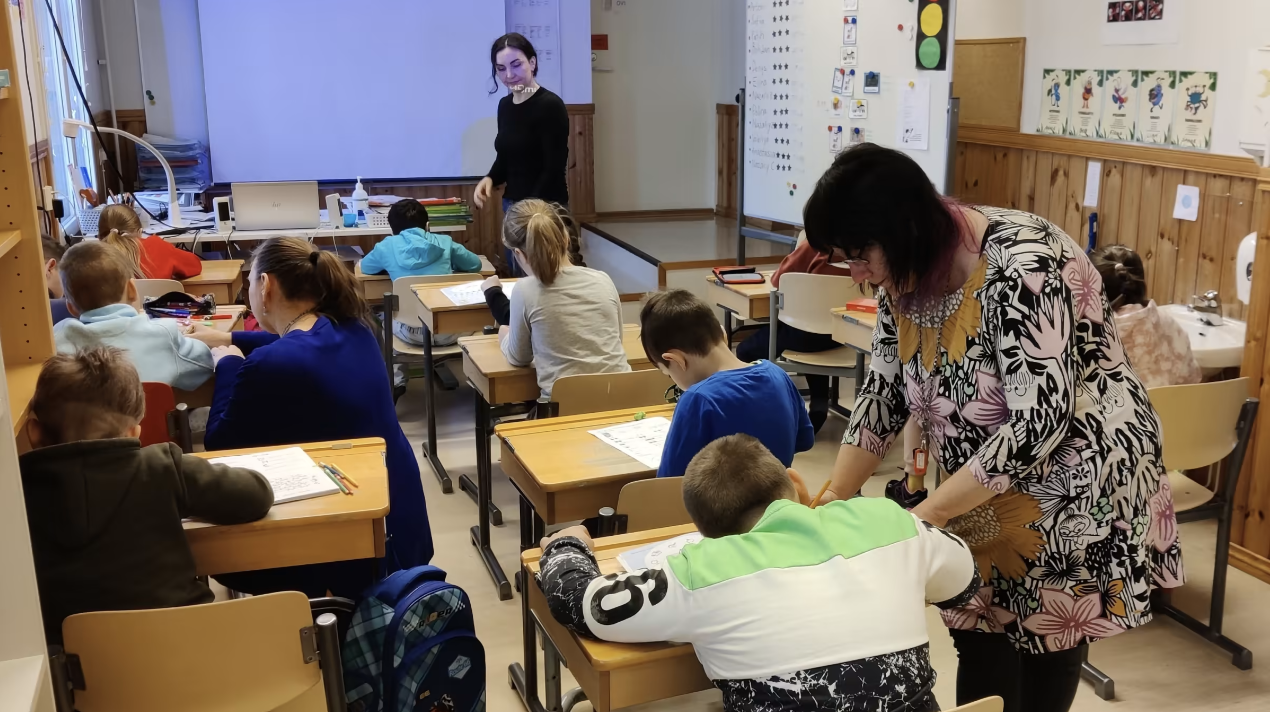
A return to school after the COVID closures and hopes for a “bounce back” characterize some of the back-to-school headlines; but in Ukraine and some parts of the developing world, many of the headlines focus on critical challenges including violence, war, floods and famine that are continuing to keep some students, particularly girls, out of school.
“[F]or many students here and around the world, especially girls, there is no excitement around supply shopping or reuniting with their friends again — because none of that will happen at all. Between schools staying closed over fears of a new COVID-19 wave and other barriers to getting an education, back-to-school doesn’t look quite as bright.” – Back to school? Think again, Plan International
“Every August a new cohort of students begin their apprenticeships across Switzerland. The appetite for vocational training remains strong despite the impact of Covid-19, with experts pointing to a return to pre-pandemic levels.”
“The new school year is a day of celebration in Ukraine, where children dress up and give bouquets of flowers to their teachers. But Russia’s invasion has cast a shadow on the happy day. Now educational facilities across the country are racing to build bunkers and bomb shelters for returning students,” CNN
““Right now, I don’t even have a pencil for my children to start classes in September,” said Florena Delgado, who teaches first and fifth grades at two schools in one of the lowest-income neighborhoods of the capital, Caracas”- NBC News
“Over it” but also unable to escape it seems to capture the sentiment of many of the back-to-school stories that address the continuing impact of the COVID-19 pandemic on schools. A series of articles from the74 in particular highlight that although many schools and educators are making decisions to end closures, remote options, and masking, there also appears to be a recognition that those decisions could lead to more surges requiring schools to respond again. Education Week also highlighted how, in the US, those decisions have been supported with new guidelines from the Centers for Disease Control and the White House to help schools deal with the “new abnormal.”
“According to a new review by the Center on Reinventing Public Education, the “approaches of America’s 100 largest districts suggest that most are jettisoning remote learning entirely, or reverting back to programs that existed before the pandemic forced them to swiftly provide all families with some sort of online option.”
“As students return from summer vacation, school systems nationwide are scaling back COVID masking and quarantine requirements — in some cases, eliminating them altogether. Many are simply telling students to stay home if they have symptoms, much as they did before the pandemic.”
“The White House followed the CDC’s lead, de-emphasizing the importance of masking and quarantining and instead focusing on vaccinations, testing, and air quality as major prevention strategies.” – Education Week
“My biggest concern is that we’ve seen a ton of viral infections just over the summer,” says Magna Dias, MD, a Yale Medicine pediatrician. “So, when we get back to indoor settings with kids being together again, it could mean that we will see more infections happening—both with COVID-19 and with other viral infections.” – Yale Medicine
“It’s not going to be pretty, but it’s going to be better,” Lydia McNeiley, a college and career coordinator from Hammond Indiana, summed up the sentiments reflected in many US back-to-school stories this year. Quoted in an Education Week story on “Student Wellness Issues for Schools to Watch This Year”, McNeiley captured the mixed feelings expressed in many of the headlines.
“It’s not going to be pretty, but it’s going to be better,” Lydia McNeiley quoted in Education Week
Despite occasional optimism, for the most part, the talk of “re-imagining” schools has been replaced with stories about the realities of dealing with concerns about missing students, money, socio-emotional development, health, safety, and, particularly with the recent release of the latest results from the National Assessment of Educational Progress, learning.
Reports of some positive changes and offerings of hopeful advice are also pprinkled among the headlines For his part, US Education Secretary Cardona noted the importance of addressing issues like how to provide more support for teachers, but he also looks forward to a “return to normal:” “I’m really thrilled that students are feeling that back-to-school excitement the way it was before. It’s not back to school with a caveat.” (U.S. Secretary Cardona: how to fix teachers shortages, create safer schools, EdWeek).
“49.5 million students were enrolled in public schools in fall 2021…well below the 50.8 million students who were in public pre-K-12 before the pandemic began. Where are the other 1.3 million kids?” – Education Week
“Eighty-three percent of school district technology leaders report that they will expand their cybersecurity initiatives, with a majority (62 percent) also increasing their cybersecurity budgets…By contrast: in 2020, only 31 percent said they were increasing their cybersecurity budgets.” –Education Week
“Another year, another reason to cancel classes: soaring school heat worsened by faulty or non-existent air-conditioning. School closures due to heat are not new but they have been increasing significantly, with numbers doubling in cities such as Baltimore, Cleveland, Denver and Philadelphia”, – District Administration and Daily Kos.
“Sixty-one percent of principals and 37 percent of teachers surveyed by the RAND Corporation reported experiencing harassment about these politicized topics, which contributed to burnout, frequent job-related stress, and symptoms of depression…. And there are signs this contention has led to a chilling effect: 1 in 4 teachers have been told to stay away from conversations about political and social issues in class. Seventeen states have imposed bans and restrictions on how teachers can discuss racism and sexism, either through legislation or other avenues” –Education Week
IEN will be taking a break until the end of August, but in the meantime, please revisit some of our posts highlighting specific improvements that organizations like Fount for Nations, Van Ness Elementary School and Transcend, and the Central Square Foundation are making in schools and learning opportunities around the world. IEN returns in September with our annual scan of “back to school” headlines in the US and other parts of the world.
In this month’s Lead the Change Interview, Elizabeth Leisy Stosich talks about her work focusing on understanding how district, school, and teacher leaders can work together to strengthen the quality and equity of students’ learning opportunities and outcomes. Stosich is Assistant Professor and Associate Chair of the Division of Educational Leadership, Administration, and Policy at Fordham University. The LtC series is produced by Alex Lamb and colleagues from the Educational Change Special Interest Group of the American Educational Research Association. A pdf of the fully formatted interview is available on the LtC website
Lead the change (Ltc): The 2023 AERA theme is InterrogatingConsequential Education Research in Pursuit of Truth and charges researchers and practitioners with creating and using education research to disrupt institutionalized forms of discrimination. The call urges scholars to challenge traditional methods of inquiry in order to create increasingly useful, responsive, and equity-oriented research that can be used by schools to develop informed policies and practices to better support students. What specific responsibility do educational change scholars have in this space? What steps are you taking to heed this call?
Elizabeth Leisy Stosich (ELS): I appreciate how AERA’s theme this year urges us as scholars to take responsibility for critically considering not simply what we research but how we approach our research and the consequences of these decisions. As educational scholars, we are (hopefully) deeply invested in understanding and supporting meaningful improvements in schools and systems. Yet, as educators and scholars, one challenge we face is that we each bring our own biases to understanding problems in education and, correspondingly, the change that is needed. These biases can lead us to define problems and identify solutions in particular ways, ways that may not reflect the actual problem as experienced by those closest it. For example, as a scholar focused primarily on instructional improvement, I can be quick to identify problems as student learning challenges that require new professional learning for teachers and school leaders. When you’re a hammer, every problem requires a nail. For me and many of the educational leaders I work with, we can be quick to see each problem as simply requiring new or different teacher PD. We can also be slow to give up on ideas that we’ve deeply invested in even when they either are a poor fit for the problem or we see little evidence of authentic improvement.
As educational change scholars, I think a central aspect of centering equity and pursuing truth is to engage as partners with the stakeholders closest to the “change.” In improvement science this is often described as being “user” centered. When we partner with practitioners, we need to take time to carefully understand and define the problems we seek to address with our change efforts. These initial decisions have important implications for the change work we take up. I think we are much more likely to be successful in supporting meaningful change when we engage in shared problem diagnosis and solution identification as partners with educators and the students and communities they serve. Through this collaborative process, we can bring more diverse perspectives to defining the problems we center in our change efforts.
Ltc: In your work, you examine relationships between school leaders on decision-making teams and during policy implementation. What are some of the major lessons the field of Educational Change can learn from your work and experience?
ELS: In my own research (Stosich, 2020, 2021) as well as a number of large survey studies one thing stands out: principals think they are involving teachers in decision-making and teachers do not agree. Looking closely at decision-making in instructional leadership teams (ILTs), I found one explanation for this gap; principals typically involve teachers in decision-making only superficially. For example, principals may ask teachers to decide whether or not to move forward with a proposed initiative (e.g., Should we do lesson study?) rather than engaging them more fully as partners in problem diagnosis and solution identification (e.g., How could we work together to strengthen our instruction?).
This is a big problem for two reasons. First, truly engaging teachers as partners in decision-making is a powerful leadership practice because it allows for teachers to draw on their instructional expertise and knowledge of students and colleagues to inform the decision. Second, when principals and teachers make decisions together, principals gain teachers’ commitment for implementation as part of the decision-making process. When principals only engage teachers superficially in decision-making, they don’t benefit from teachers’ knowledge in shaping the decision and are unlikely to gain their commitment for implementing the proposed solution.
“Through this collaborative process, we can bring more diverse perspectives to defining the problems we center in our change efforts.”
Ltc: In your recent work investigating how educators experience policy shifts in high-accountability contexts, you find that policy alignment, thoughtful sequencing, slower pace, and extensive support can be helpful in creating successful change. How might your findings help scholars and practitioners imagine and implement policy changes more effectively?
ELS: I think we would benefit from paying greater attention to the larger environmental conditions we are creating for policy change. What are the conditions we are creating and what do they feel like for the educators responsible for policy implementation?
In a strategy activity in my book with Michelle Forman and Candice Bocala, The Internal Coherence Framework: Creating the Conditions for Continuous Improvement for Schools, we ask educators to reflect on the question: What does it feel like to be a teacher in this school? I think this question is essential in policy change. Do teachers feel like they are focused and engaged in sustained learning in an effort to implement a change that will result in meaningful benefits for students? Or are they overwhelmed by multiple initiatives with little time to really understand and apply new learning about these ideas in their classroom? We typically pair ambitious policy goals with pretty limited support for learning what changes are necessary to meet these goals. Changing practice is difficult and time-consuming work!
My research looking specifically at principals suggests that when principals acknowledge the challenge presented by new instructional policies and frame this challenge as one that requires learning to work with students and content in new ways, they are more likely to close the gap between current practice and policy goals than when they frame the challenge as one of simply executing new approaches (Stosich, 2017). As research from Amy Edmondson and others suggests, when we frame policy change as a “learning” rather than an “execution” challenge, we acknowledge that we don’t know everything we need to know to meet our goals for policy change and, thus, open ourselves to new learning and change. An execution challenge is more appropriate for routine changes, which are rarely the focus of policy change.
In my research with Emily Hodge on the Common Core (Hodge & Stosich, 2022), we found that when policies are introduced in rapid succession even those that are connected and reinforcing can be experienced by teachers and leaders as overwhelming and incoherent. This is particularly true when you introduce high-stakes accountability. We need a supportive environment for learning and change during policy implementation, one that provides the time and support necessary for learning and change before introducing accountability. This should include sustained, job-embedded opportunities for professional learning about the policy change and systems that reinforce and support this learning, such as aligned curriculum and assessment materials and ongoing, developmental feedback for teachers and school leaders.
“Learning is challenging but also rewarding—something we need to acknowledge and celebrate.”
Ltc: Educational Change expects those engaged in and with schools, schooling, and school systems to spearhead deep and often difficult transformation. How might those in the field of Educational Change best support these individuals and groups through these processes?
ELS: Be part of the change yourself! As scholars, we learn and change our thinking all the time (hopefully!) based on new understanding we gain from those with whom we study and work.
We need to share openly with our partners about how we are shifting our beliefs and practice and why. I think this modeling is important for reinforcing the idea that learning and change is an opportunity for growth and not simply an admission of weakness. Just this past fall I really shifted how I think about how people connect and develop relationships through improvement work after a comment from a member of our doctoral program led me to question some of my assumptions. I always assumed that we build the relationships that support our collaborative learning and improvement through working together towards shared goals. A student remarked with some surprise that we seemed to just “get right down to business” working on identifying and addressing problems of practice before really getting to know each other on a more personal level. This comment really struck a chord with me and led me to think more deeply about the very personal nature of change and what relationships could best support our collective change efforts. I tried to reflect openly about this change and how her thinking had changed my own during the course in hopes that this would encourage others to be open to change. I also thanked her—learning is challenging but also rewarding—something we need to acknowledge and celebrate.
Still, change can be personally challenging. Something I read in James Spillane’s (2004) book about standards implementation has stuck with me for a long time: when we ask people to learn new ways of doing familiar things, we risk damaging their self-concept. Essentially, when we ask people to change what they are already doing, we ask them to admit that what they have been doing wasn’t good enough and needs to change. This can feel a lot like telling me that I’m not good enough. I think the change process becomes less daunting when we share openly and model how we are changing our own beliefs and practices. This is important for people in all roles but particularly for leaders—are you asking others to be open to change without being open to change yourself? This creates an inhospitable environment for authentic learning and change, which requires acknowledging the limitations of our current knowledge and being open to new ideas and approaches.
Ltc: Where do you perceive the field of Educational Change is going? What excites you about Educational Change now and in the future?
ELS: I am excited about the more critical lenses educational leaders and scholars are bringing to their work in educational change. In doing so, there has been greater attention to not only issues of achievement and access but also issues of identity and power as part the focus of change. For instance, I’ve had the opportunity to learn from some very exciting work happening in a Bronx Community School District that involves networks of principals working together to address three equity-focused issues: reducing racial disproportionality in chronic absenteeism, strengthening culturally responsive-sustaining education (CRSE), and creating more affirming and inclusive school environments. In my view, chronic absenteeism is an access issue, while the district’s work on strengthening CRSE addresses issues of identity—including ensuring students’ identity is reflected in the curriculum—and power, as they teach students to understand and address systems of oppression. I am energized by the focus on more holistic, student-centered, and culturally responsive discussions of learning and change taking place in so many districts and schools.
My favorite recent book is Decoteau Irby’s Stuck improving: Racial equity and school leadership. One important lesson I took from his research on racial equity improvement is that centering Black and Brown people’s perspectives, what he describes as “Black and Brown people’s influential presence,” is essential for understanding problems and monitoring progress (and setbacks) with attention to the influence of race and racism. This involves much more than simply seeking out the perspectives of Black and Brown youth, educators, and community members on the change work at one point in time. Instead, it involves building the organization—the school or district—in ways that will ensure Black and Brown people are not only present but actively influencing our change work at every step—including the problems we identify, the decisions we make about how to work on them, and all our learning along the way.
References
Forman, M. L., Stosich, E. L., & Bocala, C. (2017). The internal coherence framework: Creating the conditions for continuous improvement in schools. Harvard Education Press.
Hodge, E. & Stosich, E. L. (2022). Accountability, alignment, and coherence: How educators made sense of complex policy environments in the Common Core era. Educational Evaluation and Policy Analysis. https://doi.org/10.3102/01623737221079650
Irby, D. J. (2021). Stuck improving: Racial equity and school leadership. Harvard Education Press.
Spillane, J. P. (2004). Standards deviation: How schools misunderstand educational policy. Harvard University Press.
Stosich, E. L. (2017). Leading in a time of ambitious reform: Principals in high-poverty urban elementary schools frame the challenge of the Common Core State Standards. Elementary School Journal, 117(4), 539-565. https://doi.org/10.1086/691585
Stosich, E. L. (2020). Central office leadership for instructional improvement: Developing collaborative leadership among principals and instructional leadership team members. Teachers College Record, 122(9). https://www.tcrecord.org/Content.asp?ContentId=23383 Stosich, E. L. (2021). “Are we an advisory board or a decision making entity?”: Teachers’ involvement in decision making in instructional leadership teams. Leadership and Policy in Schools, 1-19. https://doi.org/10.1080/15700763.2021.1995879
Do schools around the world show the same basic patterns of organization and instruction found in US schools and classrooms over the past 100 years? Larry Cuban explored this question in a series of speculative blog posts over the past few months. Cuban acknowledged the limitations of his unsystematic review of classroom photos he found on the internet, but Cuban’s reflections also serve as another opportunity to continue conversations about what has and hasn’t changed in schooling over time and across contexts. To that end, in this week’s post, Thomas Hatch pulls together some of Cuban’s observations and photos.
To what extent does the prevailing organization of the age-graded school and dominant teacher-centered way of instruction found in many U.S. public schools characterize schools and classrooms in other countries? Larry Cuban asked this question in a series of seven blog posts that began with Schooling in the U.S. and around the World (Part 1). He posed this question as one means of challenging his own observation of these patterns in the US, wondering, “perhaps I am incorrect because there are other ways to organize classrooms and teach elsewhere in the world of which I am ignorant. This latter possibility of my being unaware of other patterns in organizing schools and teaching approaches in other nations is one I want to explore. I may be incorrect in claiming these historic patterns of schooling and teaching in the U.S. are present in other nations.”
Cuban’s posts show photos with common images of students sitting in rows facing the front of a classroom:
Clockwise from top left: Sweden; Uttar Pradesh, India; Preschool in Japan (AP Photo/Yuri Kageyama); 1st grade in Russia; secondary school classroom in Germany; Second grade classroom in France
Some of those posts also show photos that feature both the same classroom organization that dominated US classrooms throughout the 20th Century and the display or use of new technologies invented at the beginning of the 21st Century:
Schoolchildren listen to a teacher showing how to use “GraphoLearn”, an application on a digital tablet, to learn to read, in a primary school in Marseille, France & classroom use of technology used in a pilot project in India
Along with the pictures of students in sitting in rows around the world, an occasional picture shows students and teachers seated in a circle:
Sweden; India; Japan; Germany (Gordon Welters for The New York Times)
While acknowledging the short-comings of his approach and inviting readers to challenge his generalizations, Cuban concluded “…similarities are obvious:
Every nation compels parents to send their sons and daughters to school up to a decade or more.
Every one pays the costs for schooling either directly or indirectly.
Every one is age-graded.
Every one publishes national (or state) curriculum standards for each elementary and secondary school subject.
Every one tests student performance in elementary and secondary school subjects.
Every one has at least one teacher for each classroom.
Some are national (or federal) systems and some are state-operated with the federal government and states splitting funding and supervisory responsibilities. All of these nations and their states set curriculum standards for each subject and administer tests to determine if schools and students are meeting those standards.
Some nations have centralized systems (e.g., France, Russia, Italy, Japan) where ministry officials make decisions for schools and some are decentralized (e.g., Canada, U.S. Norway) with states and local districts having a moderate degree of discretion to alter what national authorities require. Whether centralized or decentralized, individual schools in every nation have some autonomy in adapting national or state curriculum when organizing for instruction. Need I add that once they close their classroom doors, teachers also exercise discretion in teaching the lesson they planned for the students in front of them that day.
What needs to be stressed that these commonalities among nations in establishing and operating systems of schooling over the past century exist side-by-side with inevitable within-nation variations between rural and urban and wealthy and poor schools that exist. Both commonalities and variations influence the schooling and teaching that occurs daily.”
“High dosage” tutoring has emerged as a common response, to help support student learning in the wake of pandemic school closures. In Part 1 of a scan of some of the headlines on the related news and research since the start of the pandemic, Naila Shahid reported on the discussions of the emergence of tutoring initiatives, related research, and support programs, particularly in the US. This week Part 2 of the scan focuses on some of the tutoring initiatives launched in different states and questions about implementation so far.
The emergence of high-dosage tutoring initiatives across the US
As students pile back into in-person learning settings, many school districts across the US are using COVID relief funding from the American Rescue Plan for high-dosage tutoring programs. A report from The Education Trust, FutureEd and Education Reform Nowreveals that by the beginning of 2022, “at least 17 states have committed to investing in targeted intensive tutoring, at least five have committed to building statewide tutoring programs, and at least six have committed to providing state-level guidance and support targeted intensive tutoring programs.” According to the report, states that have committed to utilizing a significant portion of their funding on high dosage tutoring include: Louisiana, New Mexico, Tennessee, and Texas. Louisiana expects to spend $90 million of its $4.1 billion, New Mexico $176 million out of $1.5 billion, Tennessee $200 million out of $3.9 billion; and Texas $1.4 billion out of $19.2 billion.
“At least 17 states have committed to investing in targeted intensive tutoring, at least five have committed to building statewide tutoring programs, and at least six have committed to providing state-level guidance and support targeted intensive tutoring programs.”
Two years ago, the College of New Jersey’s School of Education, in partnership with the Overdeck Family Foundation, launched the New Jersey Summer Tutoring Corps. The program hired in-service and preservice teachers to tutor students for a minimum of 10 hours a week. The tutoring locations were YMCA and Boys & Girls Club. Tutors earned $20 to $25 per hour. The NJ Summer Tutoring Corps provided tutoring to 2,000 students in the summer of 2021 and expanded to 42 sites in the fall of 2022.
The Arkansas Department of Education has also launched an Arkansas Tutoring Corps. That initiative aims to build a system to recruit and train tutors to meet the academic needs of students in their geographic area. Total compensation for tutors is expected to be up to $3,000 in their first year and $2,500 in subsequent years. Arkansas Tutoring Corps tutors can be students enrolled in the educator prep programs in institutions of higher education, retired educators, current teachers, and community members.
Indiana
The City of Indianapolis in Indiana also planned to expand a virtual tutoring initiative as part of their effort to help students catch up on reading and math skills. According to a Chalkbeat report, the results of two pilot programs showed improvement in participating students’ math scores of 12% to 26% and English/language arts scores by 4% to 9%.
In place of this month’s Lead the Change (LtC) Interview, Alex Lamb, LtC Editor posed this key question to leaders of several professional organizations in education. Below, we share Lamb’s introduction, her question, and the responses she received. Lamb is a postdoctoral researcher in the Learning, Leadership, and Education Policy program at the Neag School at the University of Connecticut.
Note from Alex Lamb, LtC Editor: This month, we decided to pause our regular format to better respond to the wave of recent Supreme Court rulings deeply impacting the daily lives of millions of educators and school children specifically. These rulings have shaken many of those in our community and ushered in sweeping changes to the systems we rely on for care and learning.
As I read the news, I felt scared, rageful, demoralized, and dehumanized. I thought about how we might use this platform and this community to build coalitions that move us to a better future. In these desperate times, how can we lean on our communities to find solace and energy for the path ahead?
In this issue, we hear from the leaders of professional organizations, AERA (American Educational Research Association), AEFP (Association for Education Finance and Policy), UCEA (University Council for Educational Administration), and our Educational Change SIG chair. In hearing from these leaders, we hope to provide guidance, solidarity, hope, and community. I asked them to respond to the following question:
Recently, there have been a rash of Supreme Court decisions that have fundamentally reshaped American society and schools including women’s rights to bodily autonomy, the use of public funds for religious schooling, and shifting rules regarding prayer in schools. What role do you see professional organizations of education scholarship playing in helping scholars and practitioners navigate these tumultuous and dangerous times?
These leaders all generously offered ideas about how to best move forward in these trying times. I hope you find something in this issue to support and sustain you. These responses helped me to feel less alone, and I hope they can do the same for you. Take care of yourselves.
-Alex
The Work of Consequential Education Research in Pursuit of Truth
H. Richard Milner IV, President, AERA,
Felice J. Levine, Executive Director, AERA
The questions posed to us by the editor of the Lead to Change Series are very timely and complex. There is no single function or role that defines what we do. The American Research Association (AERA) as a scientific member association has multiple tools and approaches at our command consonant with our mission.
On matters of public policy and position taking, AERA has been enabled by a statement on Position Taking and Policy Processes Guidelines adopted by AERA Council in January 2005.1 That document overviews the range of ways that AERA as a professional research association can address significant social policy issues through research. The value of featured symposia, teach-ins, and professional workshops at the AERA Annual Meeting; research briefings to governmental agencies and holding public fora that bring together researchers, policy makers, and practitioners; special issues of journals elevating research and research directions; and professional development workshops to build capacity in the research community are just some of those ways.
When the issues are societally significant and the research is compelling, AERA with Council’s approval has prepared and led research amicus briefs or joined sign-on letters to communicate the scientific studies and scholarly bodies of work that need to be considered by courts or policy bodies. AERA has done so over two decades in a series of “affirmative action” education cases before the Supreme Court. The decision to do so is consonant with AERA’s mission to serve the public good and make accessible research when the education research is compelling, when the issues are of high social significance, and when distortion of research for advocacy ends may also be evident.2
As we at AERA see it, professional research organizations have an essential role in supporting and facilitating the advancement of knowledge, in building the capacity to do so and in fostering wide awareness of that knowledge to peoples around the globe. Especially in these deeply polarizing and political moments in the United States, our attention to salient issues of public significance needs to be more rather than less elevated, and we need to press for evidence-based decisions. Where there is germane education research, we also have an organizational responsibility to be sure that work is visible and accessible in policy and practice settings and that researchers in our field are encouraged to do so.
“Education research must be designed intentionally to bring to light when policy or practice formulations harm certain groups or the collective good.”
The work of professional organizations in response to Supreme Court decisions such as Dobbs v. Jackson Women’s Health Organization and the decisions on religion and schooling bring to the fore all these issues. To be sure, members of AERA embody an enormous range of diversities and have various belief systems. Members also reflect a spectrum of political views ranging from ultra-liberal to highly conservative. They also approach their research and the problem spaces they probe from different epistemological orientations. They draw from divergent conceptual and theoretical tools. They construct different conjectures and support or are active in different forms of advocacy or mission organizations that reflect those interests and views. What binds us together, however, is our members’ commitment to our research mission—to advance knowledge in ways that embrace discussion and debate, that allow for and consider divergent questions and issues, and that arrive at research implications or applications based on the best of our knowledge at any point in time.
“The lives of many women will never be the same under this ruling, and our organizations must be responsive to these shifting times.”
In our view, this means that AERA must be steadfast in our emphasis on research—in naming, speaking out against, and building systems to dismantle injustice and inequity based on robust and sustained study.3 To be consequential – it should lead to evidence about education in relation to the potential deleterious effects of rulings and policies that have a real bearing on physical, psychological, and emotional health and wellbeing of our members as well as the communities in which we study. In this way, education research must be designed intentionally to bring to light when policy or practice formulations harm certain groups or the collective good. Moreover, education research must be consequential in making recommendations based on science— for what these moments of societal shifts might mean for the lives that education helps to shape.
As an organization, we hope we will as a community work to do the following:
Listen to, be sensitive and empathetic toward, and work in collaboration with the people most influenced by oppressive policy and practice shifts. This means that expectations for research, knowledge production, teaching, and service in institutions such as higher education, think tanks, and other organizations must shift expectations based on needs of women.4
Learn about and make recommendations on ways to co-construct communities of health and wellness and not operate from a business-as-usual framework. The lives of many women will never be the same under this ruling, and our organizations must be responsive to these shifting times.
Focus our research, teaching, and service on matters that address intersections of the Supreme Court rulings and education. In short, educational organizations have a responsibility to work with communities to design research agendas of education consequences in theory, practice, praxis, and policy.
Share what we know widely and often. What we learn and come to know from education research must be shared as widely as possible with communities inside and outside of the academy. As politicians make decisions about education, they should be able to rely on the world’s largest education research association to find answers to problems. Because those outside of our communities may not read traditional outlets with education research such as full-length books or journal articles, our work can be informative and shared through blog posts, poetry, data-rich opinion essays, social media commentaries, music, short films, YouTube clips, and newspaper articles.
Consonant with steps 1-4 above, AERA’s 2005 guidelines also provide for AERA’s speaking out in opposition to or in support of public policies that centrally affect our field (see 2005 guidelines on “mission-oriented policy and position taking”), including related to the education research workforce. The Dobbs decision is likely to have an adverse impact on women graduate students and professionals in education research. The implications of this situation for further actions by AERA, including with other scientific associations, is under active consideration.
AERA has not heretofore been silent in unparalleled times. But we reaffirm that our responses must be guided by the best of what we know from sound empirical research in pursuit of truth and the Association’s commitment to diversity and equity for all.
Jason A. Grissom, President, AEFP
The Association for Education Finance and Policy (AEFP) is a professional organization for researchers, policymakers, and practitioners tackling the most important education finance and policy issues of the day across the spectrum from early childhood to postsecondary education. Our primary goal, stated in the AEFP mission statement, is to promote research and connections between researchers and policymakers/practitioners that can inform education policy and finance and, ultimately, improve educational outcomes.
The question of how professional organizations like ours can help scholars and practitioners navigate the current environment is one for which we have very incomplete answers right now. That’s why I start with our mission: when organizations face new questions, mission statements can provide direction. And ours highlights that two ideas sit at the center of AEFP’s work: research and connections. So, in thinking about how AEFP can help our members respond to the current moment, I start with those ideas.
Let’s start with research. An important way we can meet the current moment is by creating space and visibility for timely, high-quality research to inform the policies and practices that must respond to these big changes in our social environment, especially as they intersect with education. Our members care deeply about current issues and no doubt will be generating new evidence about these shifts and their impacts on students and educators. We can promote that evidence and help push it into public debate.
To this end, the last annual conference featured a special track for research on racial and other forms of educational equity and another for research on COVID-19. We organized “policy talks” (featuring researchers and practitioners in public conversation) that directly addressed these topics. We invited a keynote who spoke to the connection between research and advocacy around this “dual pandemic.” We plan for our next conference to similarly highlight research, policy, and practice around social and educational issues exemplified in Texas, given that Fort Worth is slated to host the event. This means directing attention toward research at the intersection between education and, for example, reproductive care or LGBTQI+ rights that are so salient in Texas and beyond.
The point is that AEFP members often shape their research in response to issues of the day, and we want the conference and our other events to be ready vehicles for sharing, discussing, and spreading that research. Professional organizations like ours are uniquely positioned to play this kind of elevating role.
“A more inclusive community is going to supply better answers to more complex problems of policy and practice.”
Finding new ways to build connections are just as important. A defining characteristic of AEFP has always been the sense of community among its members, and community feels more valuable now than ever. One of our major initiatives of the last year has been the creation of new “community groups” organized around different aspects of identity (e.g., scholars of color, LGBTQI+ members) to promote networking, reflection, and professional learning opportunities. In tumultuous times, a role of professional organizations is to build this kind of connective tissue, and indeed this year we are doubling down, investing new resources and starting new groups. Tighter connections to fellow travelers can be key sources of support and reinforcement.
They can also present new opportunities for collaboration around the research the field needs to address the challenges a rapidly shifting policy environment poses. That’s why it’s so important now that we strengthen connections not just among the kinds of researchers and policymakers who traditionally have made up AEFP’s membership but among a more diverse set of voices. A more inclusive community is going to supply better answers to more complex problems of policy and practice. The current moment should be (and in our case, at least, is) intensifying efforts of professional associations to become more welcoming and deliberately inclusive of a diverse membership.
David DeMatthews, President, UCEA
Education research societies, such as the American Educational Research Association (AERA) and the University Council for Educational Administration (UCEA), play a critical role in encouraging and supporting education research and preparing the next generation of researchers and practitioners. Education research societies provide important opportunities for training future researchers and practitioners, disseminating research findings, and incubating and testing innovations and new ideas. Over the past few years, the importance of these research societies has become even more critical.
“Over the past few years, the importance of these research societies has become even more critical.”
Perhaps more than ever before, education researchers and practitioners are working in a highly politically-divisive environment. Climate change continues to disrupt life on our planet and the work of education systems while many elected officials deny its existence. The COVID-19 pandemic has significantly impacted communities, families, students, and educators. The murder of George Floyd and ongoing calls for racial and social justice led many state legislatures to make it illegal to teach about racism or a true accounting of U.S. history. The Trump administration’s separation of children from families at the U.S.-Mexico border, the January 6 th attack on the U.S. Capitol, and a wave of recent Supreme Court decisions undermine American values, civil rights victories, and the separation of church and state (e.g. Dobbs v. Jackson Women’s Health Organization; Carson v. Makin).
The current divisive political context is a serious challenge for education research societies and its members, but also serves as an important opportunity to reflect, build and strengthen relationships, and further advance knowledge for the public good. At this moment, education research societies are extremely important because they serve as powerful, formalized social networks able to speak to broad social challenges and offer the public evidence-based insights into complex issues. However, education research societies must be even more intentional about how they mentor aspiring and current researchers and practitioners, how they sponsor and disseminate research, and their approaches and opportunities for incubating new ideas.
Moving forward, education research societies can be more responsive and further their missions by:
Investing in preparation pipelines that attract more diverse researchers and practitioners capable of drawing from different disciplines and experiences;
Partnering and participating within other research societies and practitioner organizations to champion research, practitioner knowledge, and justice;
Safeguarding academic freedom so researchers and practitioners can raise questions and new ideas without fear of retribution;
Strategically investing into areas of research that can serve the public good and address pressing problems of practice;
Mentoring researchers and practitioners to be more effective at communicating research findings and relevant information in nation, state, and local policy arenas.
These actions are not comprehensive but can bolster the impact of education research societies and their members as they seek to advance the public good. Many education research societies are already engaged in these efforts, so it is also important that researcher and practitioner members remain engaged, volunteer, participate in governance and oversight activities, and offer ongoing support within their respective societies.
Jennie Weiner, Chair, Educational Change SIG
As someone who considers herself an intersectional feminist and spends quite a bit of my professional life thinking about how to make educational systems more equitable and better places for adults and students to grow and learn, it is perhaps not a surprise I have recently been in conversation with a number of people, including some of my students, colleagues, friends, and family members trying to make sense of these court decisions and seeking advice of how to respond. Never have I felt so unable to provide comfort or really answers of any kind to myself or others. I feel gutted, I am despairing, and honestly, I don’t know what to do.
My paralysis is not due to a lack of affiliation or a failure of those in positions of power or leadership in our field to try to give comfort or purpose to our work. Rather, I am at a point where I think, just as our foremothers argued, that using the very systems that enabled these things to happen will not work to change them. I don’t think these are problems that can be solved with better research or doing more of the work we have always done (or even some of what we haven’t). The tools that I have as an educational researcher are insufficient to make the laws of this country treat me and other women, girls, and any other pregnant person as human beings with bodily autonomy and the right to live. No matter how good I am making my work accessible via social media or through op-eds, I do not believe I can make those in power reinstitute the separation of church and state or to stop the use of public funds for religious education and prayer in school.
So what to do? Well, I might suggest that there are lots of people who have been fighting for our rights and the rights of educators, communities, and children without it being officially sanctioned by those in power and that we should be looking to them and not to the academy for answers. I note here that some of these are folks are in our SIG and AERA more broadly and have worked hard to tell us that we would never get real transformation through the existing system. There are also community organizers, educators, parents, young people, and lots of others who have long been doing this work and know what to do and how to do it. We should ask them what to do and listen when they tell us. I’m trying to follow this advice and do all I can to listen deeply to them, learn from them, use my resources to uplift, bankroll, and promote their work.
“There are community organizers, educators, parents, young people, and lots of others who have long been doing this work and know what to do and how to do it. We should ask them what to do and listen when they tell us.”
This does not mean I am giving up on my work or educational research more broadly and what I believe it can do – move people to ask different and hopefully more thoughtful questions about change and school systems and equity. In this best cases, such efforts will then lead to new and better solutions. As such, I still plan to engage in my research, serve the larger education community, and teach and learn from my students. In my professional life, I will continue to make a stink that can push the academy, the professional organizations with which I affiliate, and my institution to be fairer and more humane.
As the Educational Change SIG, I would suggest too that we can do the same in our organization and respective institutions. We can push for policies and structures that challenge the status quo and evoke research ideas and methods that promote equity and justice. But I am also going to be honest with myself that while this work is important, it is not, in and of itself, my solution to how to navigate these times, nor do I expect it to be – and that makes me feel just a little bit better.
See, e.g., Levine, F. J., & Ancheta, A. N. (2013). The AERA et al. amicus brief in Fisher v. University of Texas at Austin: Scientific organizations serving society. Educational Researcher, 42(3), 166–171. https://doi.org/10.3102/0013189X13486765
Note that AERA adopted a social justice mission statement in 2004 reaffirmed in 2006. See American Educational Research Association. (2007, January/February). AERA social justice mission statement. Educational Researcher, 36(1), 49. https://journals.sagepub.com/doi/pdf/10.3102/0013189X06299093

The adverse impact of COVID-19 for graduate student and early career women and women of color was pointed out in Levine, F. J., Nasir, N. S., Rios- Aguilar, C., Gildersleeve, R. E., Rosich, K. J., Bang, M., Bell, N. E., & Holsapple, M. A. (2021). Voices from the field: The impact of COVID-19 on early career scholars and doctoral students [Focus group study report]. American Educational Research Association; Spencer Foundation. https://doi.org/10.3102/aera20211v
“High dosage” tutoring has emerged as a common response, to help support student learning in the wake of pandemic school closures. Naila Shahid has been scanning the tutoring-related headlines throughout the pandemic, and this week she reports on some of the discussions of the emergence of tutoring initiatives, related research, and support programs. Later this month, Part 2 of this post will describe some of the tutoring initiatives launched in different states and related questions of implementation so far.
What is high dosage tutoring and why is there a need for it?
Over the past year, a number of news reports have highlighted the expansion of tutoring initiatives across the US and in some cases other countries. Many of these initiatives have emerged specifically to combat fears about pandemic-driven “learning loss.” Illustrating the interest in tutoring, an EdWeek Research Center survey reported that, on average, about 40% of educators and 45% of parents say their students could benefit from tutoring to address “learning loss,” and 97% of district leaders said that they expected to offer tutoring for this purpose in the 21-22 school year. Those leaders also anticipated that about 1 in 3 students would receive tutoring (equivalent to about 17 million of the 51 million public school students in the US). If that’s the case, the total national expenditure on tutoring this year could reach over 12 billion dollars.
But what makes these initiatives – often referred to as involving “high dosage” or “high impact” tutoring – different from regular tutoring? According to Kevin Huffman and Janice K. Jackson, high dosage tutoring reflects some basic principles: student groups of four or fewer meeting multiple times a week, with a trained and consistent tutor, with a focus on helping students gain ground academically, improve attendance, and connect with trusted adults for support. Drawing on recent research, the Annenberg Institute at Brown University outlined a set of design principles (related to frequency, personnel, group size, focus, etc.) they argue will help make “high-dosage” tutoring effective. SmartBrief also highlights in a FAQ that what they refer to as high-impact tutoring should not be remedial. Instead, it should focus on scaffolding content so students can learn new skills built on their previous knowledge. A related overview of the research from the Hechinger Report explains that the emphasis on “high-dosage/high impact” tutoring has been influenced by studies suggesting that tutoring is most effective when “the tutors are specially trained and coached and adhere to a detailed curriculum with clear steps on how to work with one or two students at a time. As Jonathan Guryan, an economist at Northwestern University who has studied tutoring programs put it, “it is not once-a-week homework help.”
What programs have emerged to support tutoring?
Along with the growing interest in tutoring, after the start of the pandemic, a number of organizations and funders have proposed or launched initiatives designed to provide resources, financing, and other supports for new tutoring initiatives. In March 2020, for example, Brown University’s Annenberg Institute for School Reform started the National Student Support Accelerator to help give K-12 students access to tutoring. The late Robert Slavin and researchers at John Hopkins University also proposed an Educational Marshal Plan to scale-up tutoring initiatives. Based on the AmeriCorps model, the proposal envisioned using billions of dollars in Title 1 funding to recruit and train 300,000 tutors. Relatedly, the Center for American Progress also proposed an Opportunity and Counseling Corps to consist of high school graduates, college students, and community members to tutor students in high-poverty schools. The model suggests employing up to 17,000 tutors and resident teachers and up to 12,000 social workers, counselors, and school psychologists.
“A Tutoring Marshall Plan would provide intensive funding to enable Title I schools nationwide to substantially advance the achievement of their students who suffered mightily from COVID-19 closures and related trauma”
More recently, in April 2022, funders like the Bill & Melinda Gates Foundation, Arnold Ventures, and the Overdeck Family Foundation helped to raise over $65 million dollars to establish Accelerate, which aims to provide district and state education leaders with technical assistance for high dosage tutoring. As part of their plans to help students recover from the pandemic learning loss, the Biden Administration also announced a plan to provide schools with 250,000 tutors, mentors, and coaches. This National Partnership for Student Success aims to bring together school districts, nonprofit organizations and higher education institutions to recruit, train, and support tutors. A search for virtual and technology-based solutions is also underway, including efforts by non-profits and private companies to utilize artificial intelligence to address the challenges of finding enough tutors.
“The majority of students could never afford a private tutor, so we wanted to build a private tutor that mimics all the qualities of a tutor. We can help personalize the attention and assess a student’s knowledge continually.” — Miral Shah, CK-12 quoted in The74
The interest in tutoring as a response to “learning loss” extends beyond the US as well. The UK, for example, announced a £350-million National Tutoring Program even before many plans got underway in the US. In China, in conjunction with plans to crack down on private tutoring, the Beijing Municipal Commission of Education has announced a plan to build an online tutoring platform where primary and middle school teachers can provide tutoring services in various forms, including one-on-one teaching, live-streaming classrooms, and pre-recorded videos. Each semester’s compensation for tutors can be up to 50,000 yuan ($7,880), and the platform is entirely free to use for students.
This week, Sam Abrams lays out some of the key implications of recent Supreme Court decisions related to education, highlighting that by failing to acknowledge related foreign precedents, the US Supreme Court has made clear that religious schools can get public funds without adhering to the same standards and regulations as public schools. Abrams is an Adjunct Assistant Professor of Education at Teachers College Columbia University; Director, National Center for the Study of Privatization in Education; and a Fulbright Visiting Professor, University of Turku, Finland, 2022-23. He is also the author of Education and the Commercial Mindset (Harvard University Press, 2016). This post was published originally as The Telling Gap in Carson v. Makin by the National Center for the Study of Privatization in Education.
In tandem with its reversal of Roe v. Wade, the Supreme Court stands to substantially alter everyday life in America with its recent decisions of Carson v. Makin, amplifying its support for public funding of religious schools, and Kennedy v. Bremerton School District, allowing prayer in public schools. The significance of Kennedy is blunt. With the Court ruling 6-3 along party lines that the dismissal of a football coach at a public high school in the state of Washington for holding post-game prayer meetings violated his First Amendment right to free exercise of religion, we can expect similar meetings as well as Bible study sessions, nativity pageants, and the like in public schools across the country. Such events will surely lead some students to feel coerced into participating for fear of disappointing peers and authority figures. In her dissent, Justice Sonia Sotomayor indeed noted that a lower court had determined that some players said they joined the coach’s prayer meetings “because they felt social pressure to follow their coach and teammates.”
The significance of Carson is more subtle but equally profound. In Carson, the same justices ruled 6-3—as forecasted on this site following oral arguments in December—that Maine’s exclusion of religious schools from partaking in its Town Tuitioning Program likewise violated the right to free exercise of religion. This program covers all or part of the cost for students in rural districts without high schools to attend either public or nonsectarian private high schools in nearby districts or beyond (if the school is public, the total cost is covered; if it is private, coverage is pegged to per-pupil statewide average spending). With this decision, we can expect religious groups in considerably rural states across the country to lobby legislators to create programs similar to Maine’s.
But there’s another dimension to Carson, which derives as much from what it did not say as from what it did. To grasp the wider implications of Carson requires understanding what is missing from the decision. While many countries—such as Belgium, France, and the Netherlands—have for many years allowed a considerable portion of their students to attend religious schools with public funding, the Court did not cite such foreign practice. In the Netherlands, in fact, 55 percent of students attend religious schools with public funding. Why then didn’t the Court cite foreign practice? This indifference to foreign practice holds, as well, for the majority opinions in Zelman v. Simmons-Harris in 2002, validating the provision of government-funded vouchers to cover tuition at religious schools in Cleveland, and Espinoza et al. v. Montana Department of Revenue in 2020, mandating that if a state permits students to attend private schools with scholarships funded by a tuition tax-credit program, it cannot bar religious schools from participation.
American jurisprudence does tend to stick to domestic precedent, but that custom cannot explain this disregard for education policy abroad.
American jurisprudence does tend to stick to domestic precedent, but that custom cannot explain this disregard for education policy abroad. After all, former Justice Anthony Kennedy, who voted with the majority in Zelman, was a prominent champion of deference to foreign practice and inspired others to follow in his path. In authoring the majority opinion in Lawrence v. Texas in 2003, Kennedy famously drew on British legislation and the European Convention on Human Rights to overturn state laws criminalizing homosexual relations. Two years later, Kennedy made use of the United Nations’ Convention on the Rights of the Child in writing the majority opinion in Roper v. Simmons to nullify the constitutionality of the death penalty for juvenile offenders.
The answer to this question is crucial. To have invoked foreign practice would have been to invite trouble. Publicly funded religious schools in such countries as Belgium, France, and the Netherlands are regulated to a degree that American proponents of religious schools would find unacceptable. In Carson, Chief Justice John Roberts conceded in this light that while Maine public schools must adhere to specific standards for instruction in a range of subjects, that is not so for nonsectarian and religious private schools. Though accredited by the New England Association of Schools and Colleges (NEASC), such schools, wrote Chief Justice Roberts, “are exempt from these requirements, and instead subject only to general ‘standards and indicators’ governing the implementation of their own chosen curriculum.”
In Carson, Chief Justice John Roberts conceded in this light that while Maine public schools must adhere to specific standards for instruction in a range of subjects, that is not so for nonsectarian and religious private schools.
As Justice Stephen Breyer pointed out in his dissent, one of the two schools at the heart of Carson, both of which are accredited by NEASC, considers academic and religious education “completely intertwined,” so much so that “in science class, students learn that atmospheric layers ‘are evidence of God’s good design.’ ”At religious as well as nonsectarian private schools funded with public money in such countries as Belgium, France, and the Netherlands, curricula must comport with national standards (meaning, for example, no attribution to divine design for atmospheric composition). In addition, teachers must be certified and guaranteed access to union membership while members of the LGBTQ community cannot be barred from either enrollment or employment.
The parameters of NEASC and other independent school organizations across the United States do not come close to such expectations, as Justice Breyer’s point about science education indicates. Indeed, many religious schools, such as the two defining Carson, refuse to hire gay or lesbian teachers. While Maine passed an amendment to its human rights act to bar schools from receiving public money if they discriminate based on sexual orientation or gender identity, that does not mean other states motivated by Carson to create similar programs will enact such protections; nor does it mean that Maine’s amendment will go unchallenged on the grounds that it interferes with an institution’s right to free exercise of religion.
In a guest essay in The New York Times, Aaron Tang, a professor of law at the University of California, Davis, cited this amendment as a model for deflecting the impact of decisions like Carson, but he neither acknowledged that other states implementing town tuitioning programs might not take such action nor recognized that Maine’s amendment might not last. Setting aside whether public funding of any form of religious schooling poses a threat to democratic values by fostering societal division and conflict, as Justice Breyer claimed in his dissent, there can be no doubt that public funding of lightly regulated religious schooling poses precisely such a threat.
Setting aside whether public funding of any form of religious schooling poses a threat to democratic values by fostering societal division and conflict, as Justice Breyer claimed in his dissent, there can be no doubt that public funding of lightly regulated religious schooling poses precisely such a threat.
Policymakers abroad have understood this. And it is basic to our own tradition. The Supreme Court made this clear in 1925 in Pierce v. Society of Sisters, ruling unanimously that Oregon could not, as decided by a statewide referendum in 1922, bar private schools from operating but that it was empowered to carefully regulate them. “No question is raised concerning the power of the State reasonably to regulate all schools,” the Court declared in Pierce, “to inspect, supervise and examine them, their teachers and pupils; to require that all children of proper age attend some school, that teachers shall be of good moral character and patriotic disposition, that certain studies plainly essential to good citizenship must be taught, and that nothing be taught which is manifestly inimical to the public welfare.”
With Carson building on Zelman and Espinoza, public funding of religious schooling appears irreversible. But that does not mean the message of Pierce and the lessons from abroad cannot be heeded. With Kennedy, the public school as neutral common ground is over.” With Carson building on Zelman and Espinoza, public funding of religious schooling appears irreversible. But that does not mean the message of Pierce and the lessons from abroad cannot be heeded. With Kennedy, the public school as neutral common ground is over.