What’s next for US education? Scanning the post-election headlines

A flurry of articles in the US press since the presidential election in November explored the effect that a new Trump administration might have on schools, on students, and on a number of education issues. In this week’s post, IEN shares some of the headlines as well as those discussing the results of governor’s races and local propositions with particular relevance for education. 

Results: Education Week’s Guide to the 2024 Election, Education Week

Education policy: How it will shift under new administration , District Administration

Trump has won a second term. Here’s what that means for schools., Chalkbeat

Experts expect civil rights enforcement to change and transgender students to lose new protections.

What’s at Stake for Schools as Trump Returns to the White House, Education Week

How Trump’s Second Term Will Affect Education: 4 Things to Know, Education Week

What education could look like under Trump and Vance, Hechinger Report

What a Second Trump Presidency Could Mean for Education in the U.S.The 74

Can Trump Force Schools to Change Their Curricula?, Education Week

Trump pledged to cut federal funding to schools “pushing critical race theory” and “transgender insanity.”

Trump has vowed to push schools to the right on gender and race. Now he can, Washington Post

What will Donald Trump’s 2nd term mean for Title IX?, K-12 Dive

Education Department’s future uncertain under Trump, Education Week

Can Trump Really Dismantle the Department of Education?, Education Week

Will Trump eliminate the federal role in education or weaponize it?, Flypaper

Is the federal role in education slated for elimination or expansion?…There’s no way to be sure today. But there’s ample reason to be unsure, and that’s because the Trump world has long sent exceedingly mixed messages when it comes to K-12 education and the federal role therein.

Trump’s Push to Expand Choice, Nix the Ed. Dept. Takes on New Momentum, Education Week

Would axing the Education Department hurt kids with disabilities? Experts say: It depends, Chalkbeat

Trump has called for abolishing the U.S. Department of Education. How that affects students with disabilities would depend a lot on what happens next.

What will a second Trump term mean for education and libraries?, School Library Journal

How Trump Could Roll Back Access to Free School Lunches, Education Week

A policy that allows schools to serve free meals to all students may be under fire.

Colleges wonder if they will be ‘the enemy’ under trump, New York Times

New Appointees Impact on Education?

Trump picks Linda McMahon to lead, and possibly dismantle, Education Department, Chalkbeat

Trump Taps Linda McMahon, Donor and Former Wrestling Exec, to be Education Chief, The74

Despite championing apprenticeships and workforce development, her main charge may be dismantling the department she’s set to lead.

5 things to know about Linda McMahon, Trump’s pick for Education secretary, The Hill

Betsy DeVos’ Advice for Trump’s Next Education Secretary, Education Week

What Elon Musk’s New Role in the Trump Administration Means for Schools, Education Week

Musk’s new role may have big implications for schools. 

Trump’s Defense Pick Pete Hegseth has an opening to reshape American Classrooms, Politico

Pete Hegseth has pushed for years to steep American education in patriotic principles and Christian theology — and he could implement that vision for thousands of military families if he’s confirmed to lead the Defense Department.

What Could RFK Jr. as HHS Secretary Mean for School Vaccine Requirements?, Education Week

The vaccine skeptic in line to lead Health and Human Services could influence schools’ vaccine rules

How RFK Jr. could shake up school lunches, K-12 Dive

Trump picks Rollins to lead USDA — and thus school nutrition programs, K-12 Dive

What Trump’s pick for FCC chair could mean for E-rate expansion, K-12 Dive

Effects on States, Cities, and Students

What the new Trump presidency could mean for California students and schools, EdSource

California education leaders try to reassure students of protections against Trump policies, EdSource

Many California children and their families, including immigrants, transgender students and Black and Latino students, are feeling fear and uncertainty.

California schools chief pledges to resist cuts in funding if Trump axes U.S. Dept. of Education, EdSource

Here are how Donald Trump’s promised policy changes could be felt in NYC, Gothamist

Eliminating the Department of Education: What it could mean for NYC, PIX11

In wake of Trump win, Chicago Board of Education moves to reaffirm protections for immigrants, Chalkbeat

Philly students walked out of their classes in protest of Trump’s election win, Chalkbeat

High schoolers said they are concerned about the president-elect’s policies about education, climate change, and reproductive rights.

Young Voters Favored Abortion Rights and President-Elect Trump, New Data Shows, The74

“More than a dozen states had ballot measures related to protecting or codifying access to abortion rights, the majority of which passed. But for Gen Z, being pro-reproductive rights did not equate to voting Democratic. In Florida, over half (52%) of young voters favored ending the state’s six-week abortion ban while supporting Trump by a 10-point margin.”

Trump pledged to roll back protections for transgender students. They’re flooding crisis hotlines, AP

School Leaders Confront Racist Texts, Harmful Rhetoric After Divisive Election, Education Week

Educators say inflammatory rhetoric from the campaign trail is in schools.

FBI investigating post-election text threats sent to Latino, LGBTQ people, many of them young, Washington Post

Protecting undocumented students: How schools and colleges are responding to Trump’s second term, El País

Governors, States, and Local Issues & Propositions

Where Newly Elected Governors Stand on Education Policies – 2024, ExcelinEd

Eleven newly elected governors have big plans for education in their states, with a focus on key issues including school funding, teacher retention, early literacy, math proficiency, career readiness, and school choice.

Texas will approve school vouchers, boost public education spending, governor says, Hechinger Report

Republican Victories in Texas House Give Governor Abbott a Path to Universal Education Savings Accounts, The74

Clashing with Dems’ Education Plan, Republicans Expand Reach in Arizona’s Legislature, The74

In a huge upset for Democrats hoping to curb growth of private school vouchers, GOP lawmakers to lead both houses.

Democratic frontrunner and former teacher Matt Meyer elected Delaware’s next governor, The74

Mike Braun Wins Governor’s Race in Indiana Against Career Educator, The74

Josh Stein Wins Governor’s Race in North Carolina. What’s Next for the Schools, The74

Former North Carolina Superintendent Defeats MAGA Homeschooler for Schools Chief, The74

How did K-12 fare on state ballots in the 2024 election?, K-12 Drive

Voters largely rejected school choice initiatives but embraced a variety of school funding measures

How Child-Focused Ballot Measures Fared This Election, The74

Child care won at the ballot box, Hechinger Report

A bigger child tax credit could ease child poverty and help students in school. But will it happen?, Chalkbeat

Candidates promised a larger child tax credit. Now a Republican-controlled Congress will decide its fate.

School choice may get its biggest moment yet, Hechinger Report

Advocates ready their plans for a new administration they believe will be friendly to vouchers, charters and other schooling options

Ballot Propositions: Voters in 2 States Reject Private School Choice, The74

Voters in Kentucky and Nebraska said no to private school choice Tuesday, dashing the hopes of advocates who wanted to further advance the movement for vouchers and education savings accounts. 

The Future of School Choice in the States That Rejected It, Governing

Voters in three states rejected ballot measures promoting school choice. But they didn’t reject the legislators who favor it.

In Deep-Red Florida, Voters Reject Partisan School Board Races, Education Week

Did School Battles Hurt Democrats in Liberal Strongholds?, New York Times

Voters in the Virginia suburbs shifted toward Trump. Some said they were still frustrated by pandemic closures and fights over gender, race and testing in schools.

Massachusetts Will Do Away With High School Standardized Testing Graduation Requirement, The74

Around the World in Math and Science: Scanning the headlines on the results of TIMSS 2023

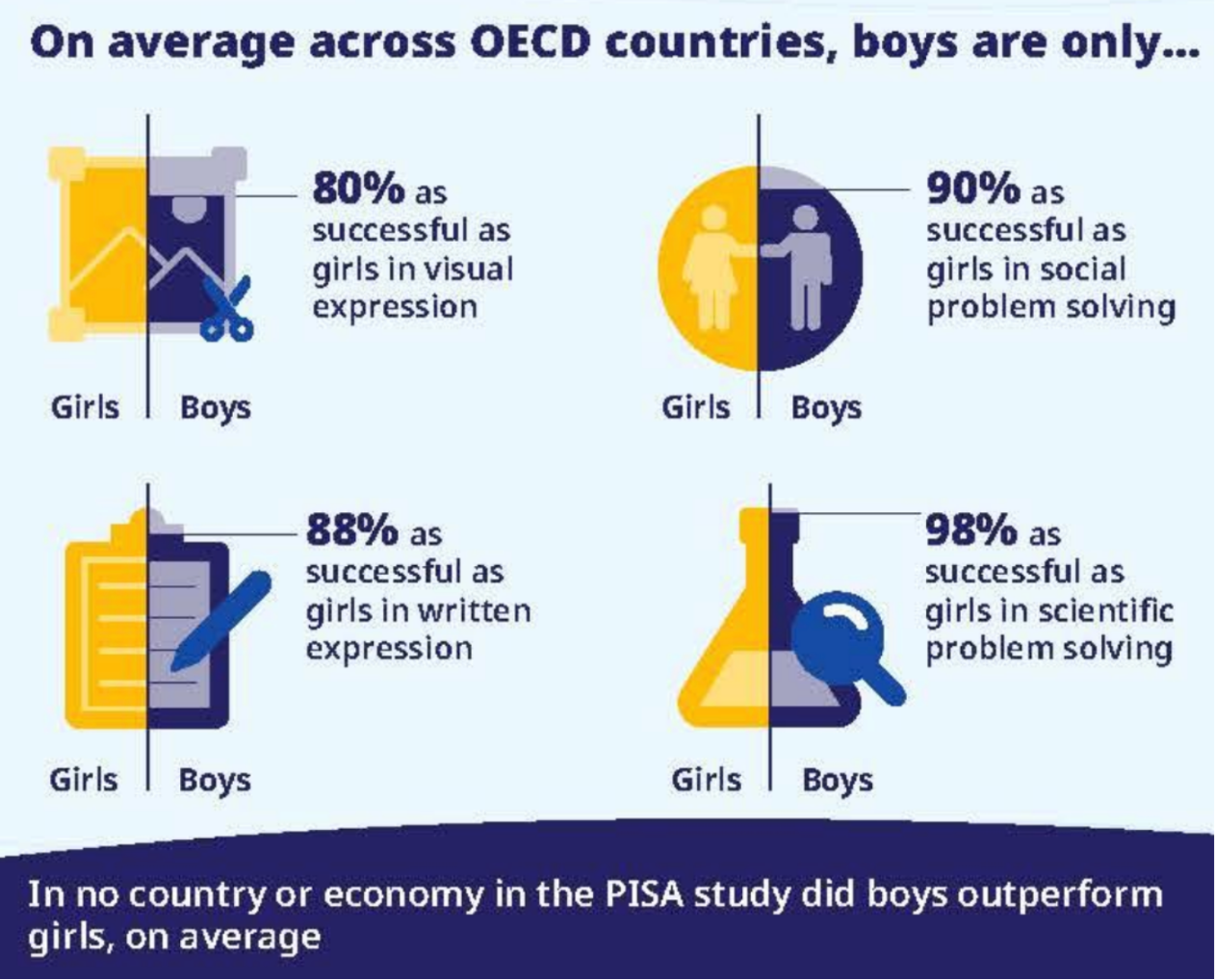
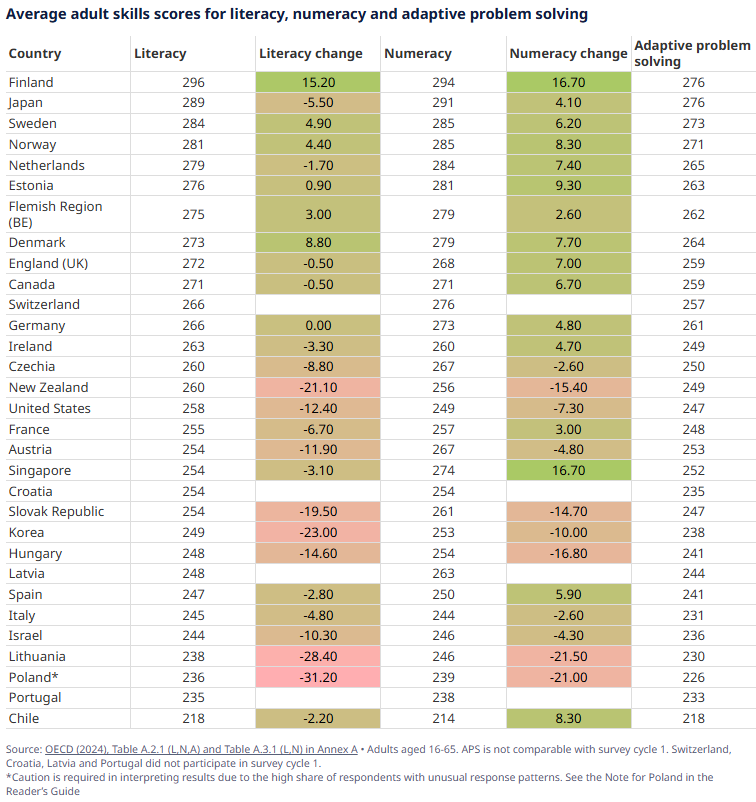
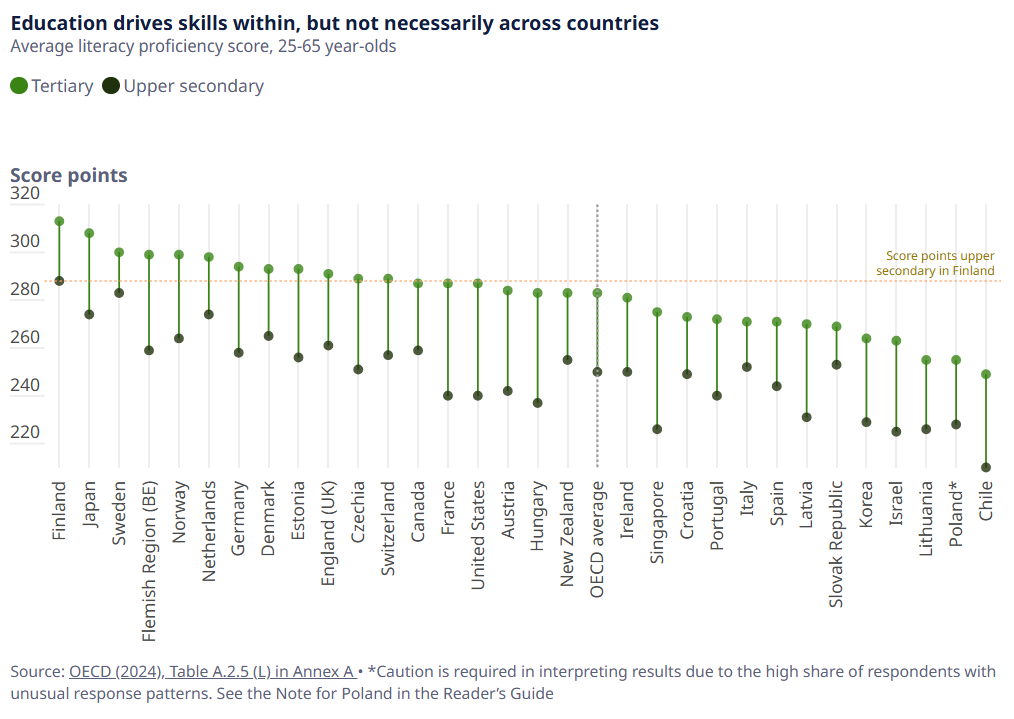
Holding steady in fourth grade but dropping at 8th grade sums up some of the key results from the eighth administration of the Trends in Mathematics and Science Study. The results, released on December 4, 2024, show that 8th graders in only three countries showed an increase in average math scores (Romania, Sweden, UAE) or in average science scores (England, Hong Kong, UAE), but that roughly equal numbers of countries saw increases or decreases in their math or science scores at the 4th grade level. Top performers in both subjects, as usual, included Asian countries like Singapore, South Korea, and Japan. 650,000 fourth and eighth graders in 64 countries participated in the tests in 2023, which also showed a widening gender gap as boys outperformed girls by significant margins in many education systems. Headlines touted gains in some countries like the United Arab Emirates, Turkey and Australia, but highlighted concerns about substantial declines in performance in countries like Israel and the US. In the US, the drop in scores was particularly pronounced for the lowest performing students, with one in five 8th graders able to demonstrate even a basic level of proficiency. Adding to the concerns, yesterday, December 10, OECD released the latest results of the 2023 administration of the Program for the International Assessment of Adult Competencies (PIAAC) which showed US adults are getting worse at reading and math as well, while adults in Finland, Japan, the Netherlands, Norway and Sweden excelled in literacy, numeracy and adaptive problem-solving. To put the latest international assessment figures in a historical context, see the scan of headlines related to the PISA 2022 results, the PISA 208 results and the results of TIMSS 2015.

Australia

Australian primary students score best ever result in global maths and science test, despite pandemic disruption,The Guardian

‘Interesting and disappointing’: Gap between girls and boys in STEM subjects growing, report shows, ABC

Bulgaria

Bulgaria’s Fourth Graders Score 530 in Mathematics and Science, Outperforming Global Averages in 2023 TIMSS Study, Bulgarian News Agency

Bulgaria’s results place its students roughly 14th or 15th globally… Bulgaria’s 530-point score in mathematics matches Czechia and Sweden, surpasses Finland by one point, and exceeds Australia and Germany by 5 and 6 points, respectively.

England

England moves into top five in global rankings for science, Time & Star

Timss 2023: Year 5 maths declines for first time but science scores surge, TES

France

France ranks last in Europe for math skills as education system ‘plagued by inequality’, Anadolu Agency

Hong Kong

Hong Kong students excel in TIMSS 2023 results, Dimsum Daily

“Hong Kong students have consistently demonstrated high levels of performance in mathematics. Our Primary Four students ranked fourth globally with a score of 594, markedly surpassing the international average of 503. Meanwhile, our Secondary Two students secured fifth place with a score of 575, well above the international average of 478. Notably, 38% of Primary Four and 32% of Secondary Two students achieved advanced levels in mathematics, compared to the international median of just 7%.”

Ireland

Pupils in Ireland among top maths performers in Europe, global study finds, The Irish Times

Performance by girls in maths and science falls, RTÉ

Israel

2+2=5? Israeli student math, science scores plummet, study finds, Ynet News

Japan

Japanese Science, Math Scores Remain High in 2023, Nippon.com

Mystery lies behind gender gap in academic performance, The Asahi Shimbun

Latvia

Latvian pupils’ exam results in maths and natural sciences become worse, Baltic News Network

Macau

Macau’s P4 students excel in math and science in TIMSS 2023, Macau Daily Times

Malaysia

MOE Identifies Challenges In Maths, Science Learning Among Students, BERNAMA.com

Malaysia’s Participation Reflects Effectiveness, Quality Of Mathematics And Science Education, BERNAMA.com

Malta

Maltese students obtain positive results in Mathematics and Science, TVMnews.mt

Morocco

Moroccan Students’ Performance Declines in Mathematics, Science, Morocco World News

New Zealand

NZ school science results improve – but international testing highlights a stubborn socioeconomic gap, The Conversation

Taiwan

Taiwan ranks second in global math study for 2023, TVBS News

Singapore

Singapore students top maths and science in 2023 international study, Straits Times

South Africa

Massive maths and science embarassment for South Africa, BusinessTech

South Africa’s grade 5 learners—who were largely assessed against grade 4 learners from other countries—placed stone last among the 58 nations assessed for both mathematics and science. The grade 9 learners—who were largely assessed against grade 8 learners from other countries—placed slightly better, ranking fifth-last, above Morocco, Brazil, Palestine and Jordan in mathematics, and second-last for science, placing above Morocco.

International maths, science study reveals SA Grade 9’s global maths success amid literacy challenges, News24

South Africa’s Grade 5 pupils have been ranked last out of 59 countries in maths and science in an international standardised test conducted last year. However, the country’s Grade 9 performance in maths in the Trends in International Mathematics and Science Study (TIMSS) has shown “a remarkable upward trend” after pupils’ scores improved by eight points from 389 in 2019 to 397 last year.

Spain

Los alumnos españoles bajan en matemáticas y ciencias y se agranda la brecha entre niños y niñas (Spanish students are falling behind in maths and science and the gap between boys and girls is widening), El Pais

España, a la cola en matemáticas y ciencias, según el TIMSS 2023 (Spain ranks last in math and science, according to TIMSS 2023), RTVE

“Balearic Islands, Canary Islands, Catalonia and Andalusia, the worst in Mathematics, according to the TIMSS 2023”

Turkey

Türkiye sees big gains in TIMSS 2023 science, math results, Daily Sabah

Türkiye emerges among top 5 in education improvement: TIMSS 2023 report, Hurriyet Daily News

Türkiye tops Europe in elementary science education: TIMSS 2023, Türkiye Today

United Arab Emirates

UAE tops Arab world in TIMSS 2023, The Print

United States

Some countries show improvements in math post-pandemic. Not the United States, Chalkbeat

U.S. students posted dire math declines on international test, New York Times

Math scores plummet, progress ‘erased,’ NCES reports, K-12 Dive

Average U.S. math scores on the latest Trends in International Mathematics and Science Study reverted to 1995 levels.”

Uzbekistan

Quarter of 4th and 8th graders lack basic understanding of subjects, TIMSS-2023 study reveals, Gazeta.uz

The HundrED Global Collection for 2025

This week’s post highlights the 2025 HundrED Global Collection of education innovations and shares links to some of the panels from the HundrED Innovation Summit.  This year’s Global Collection featured one hundred solutions from six continents selected from more than 700 submissions. Major themes in this year’s collection were access to education, equity, wellbeing, and creativity as well as a 100 percent increase in the number of innovations using some form of educational technology. To see how this year’s collection of innovation compares to previous years, see the IEN posts on the HundrED Global Collection for 2024, 2023, 2022, 2021, & 2019.

Images & excerpts from the the HundrED Global Collection 2025 report

This year’s selections for the global collection include: Alpha Tiles (Mexico); 50/100 Period Education (Taiwan); Bright Eyed (Trinidad and Tobago); Board Games for Improved Learning Outcomes (Nigeria); Barabar (Bulgaria); 7 Gen Blocks (United States).

Giving Thanks for Education Around the World 2024

This week, in celebration of Thanksgiving in the US, IEN continues its annual tradition of giving thanks for the many groups and individuals who have dedicated their lives to support learning and education around the globe. In recognition of these contributions, we highlight the below interviews that we’ve done this year. These remarkable educators represent various ways to support, sustain, and improve student learning and development in places like rural and urban China, Vietnam, Bangladesh, Iceland, Scotland, and Finland. We encourage everyone to reach out, give thanks, and support the educators and organizations who are making a difference for students in their communities. 

Supporting healthy development of rural children in China: The Sunshine Kindergartens of the Beijing Western Sunshine Rural Development Foundation | An interview wtih Guangmin Li and colleagues from the Beijing Western Sunshine Rural Development Foundation

The Evolution of an Alternative Educational Approach in Vietnam: The Olympia School Story (Part 1) | (Part 2) | The Olympia Schools

License to innovate: A conversation with Shefatul Islam about the development of Bangladesh’s online education platforms (Part 1) | (Part 2)

On the Inertia of Education Systems and Hope for the Future: A Conversation with Jón Torfi Jónasson on Educational Change in Iceland (Part 1) | (Part 2)

Achieving Education for All for 100 Million People: A Conversation about the Evolution of the Vietnamese School System with Phương Minh Lương and Lân Đỗ Đức (Part 1) | (Part 2) | Vietnam National Institute of Educational Sciences (VNIES)

Listening Beyond the System: A Conversation with Alma Harris & Carol Campbell about the National Discussion on Scottish Education One Year Later (Part 1) | (Part 2) | Report on All Learners in Scotland Matter – National Discussion on Education

The Desire for Innovation is Always There: A Conversation with Yong Zhao on the Evolution of the Chinese Education System (Part 1) | (Part 2)

Leading when following is not required: Tapio Lahtero on the work of the principal in Finland during and after COVID (Part 1) | (Part 2) | (Part 3) 

Reimagining Schooling for Equity and Justice: Lead the Change Interview with Carlos Sandoval

In this month’s Lead the Change (LtC) interview, Carlos Sandoval shares his insights on how systems of schooling can be improved to create more affirming environments for minoritized students. Sandoval is an Assistant Professor at Clemson University, where his research focuses on building the capacity of school systems to drive equity-driven transformation. The LtC series is produced by Elizabeth Zumpe and colleagues from the Educational Change Special Interest Group of the American Educational Research Association. A pdf of the fully formatted interview is available on the LtC website.

Lead the Change (LtC): The 2025 AERA theme is “Research, Remedy, and Repair: Toward Just Education Renewal.” This theme urges scholars to consider the role that research can play in remedying educational inequality, repairing harm to communities and institutions, and contributing to a more just future in education. What steps are you taking, or do you plan to take, to heed this call?

Carlos Sandoval (CS): As an improvement researcher and practitioner, my work is and has always been about working closely with educators at any and every level of the system to advance equity and justice. Most recently, I have been working with others to get improvement research to take a more critical turn in its work. Improvement research in this context refers to research aimed at solving problems of practice alongside practitioners, typically through iterative cycles of inquiry, design, and testing. That currently entails articulating the harm that can result when taking up improvement methodologies from industries like manufacturing without interrogating their analogy to education. I recently wrote a paper with Dr.
Rebecca Colina Neri (Sandoval & Neri, 2024), where we discuss how we can reorient improvement methodologies away from dominant outcomes (i.e., standardized test scores, attendance, preparing students for labor markets) and towards justice-focused outcomes (comfort, agency, and dignity). I
identify myself as being part of a growing community of improvement scholars who are seeking to
steer improvement into taking a critical turn, such as folks like Drs. Brandi Hinnant-Crawford (e.g.,
Hinnant-Crawford et al., 2023), Sola Takahashi (e.g., Takahashi et al., forthcoming), and Dr. Neri.

The current reality is that the structures that shape schools and schooling are organized to sort students. In particular, this sorting is often in service of achieving outcomes that educators, families, and
communities may not prioritize when thinking about their hopes and dreams for their children and students (Domina et al., 2017). While educators, families, and communities may espouse desires for
students to become skilled and get good jobs, when scholars interrogate that line of thinking more deeply, they find that what many families and communities really care about is ensuring that their students are affirmed, cared for, and afforded dignity and agency (e.g., Ishimaru & Bang, 2022; Ishimaru et al., 2023). Historically, minoritized students and people—Black, Brown, LGBTQ+, disabled students—are least likely to experience comfort, agency, and dignity in schools, in workplaces, and in their own communities.

What does that all mean, concretely, for my work? I imagine that question will consume me for a while! Right now, I am driven to use improvement research methods to prioritize outcomes that serve to improve students’ comfort, agency, and dignity in schools. For example, in a previous project, I led an
improvement network on preparing teachers to build on multilingual students’ strengths to participate in affirming learning environments (e.g., Sandoval & van Es, 2021). Our network deliberately chose that focus to prioritize the goal of recognizing students’ linguistic and cultural assets, rather than focusing on
something like improving the English language proficiency of so-called “English language learners,” where the goal is to assimilate students into a dominant linguistic culture while minoritizing those students’ linguistic strengths. I see that work as an example of what improvement for justice can look like. For example, teacher educators who had strong commitments to justice tended to problematize the framing of problems—e.g., by asking why low “English language proficiency” rate is considered a problem, whose problem it is, and what are the alternatives? Questions like this allowed us to engage with expansive notions of equity of the kinds that dreaming scholars like Megan Bang, Shirin Vossoughi, and Ann Ishimaru articulate when seeking educational justice (Bang & Vossoughi, 2016; Ishimaru et al., 2023). In the coming years, I aim to expand the lessons from that teacher preparation network as I collaborate with colleagues at Clemson who are experts in this problem space, such as folks like Heather Dunham and Lindsey Rowe (e.g., Dunham et al., 2022; Rowe, 2018).

LtC: Much of your work has involved direct collaboration and learning alongside practitioners to develop capacity for continuous improvement. What are some of the major lessons that practitioners and scholars of Educational Change can learn from your work?

CS: I have convictions to do just, right, and good work in the first position, and generate scholarly insight in the second position. This means that when I work with practitioners, I think about what they need from me to support them before I think about research questions I want to answer.

My research interests center around improving schools for Black, Brown, LGBTQ+, disabled, linguistically diverse, and other minoritized students. If practitioners have a problem they need or want to solve related to making schools better for minoritized students, and if they think my expertise with improvement methodologies can help them solve those problems, then I help them.

A common practice in research-practice partnership work is a negotiation of joint work between and among researchers and practitioners. In many of these arrangements, researchers and practitioners negotiate the focal problems of practice of their work, such that the joint work most closely meets the needs of practitioners while also aligning with the research interest of researchers (Penuel et al., 2013). While this is a crucial process through which researchers can get closer to the everyday work of schools and schooling, I personally do not engage in these kinds of negotiations. This is because my research agenda is driven more by felt need. When there is a colleague or practitioner who seeks my skillset and commitments to redress an injustice, I work with them to find a way to study it. The questions that drive my research agenda, then, are around understanding the kinds of activities that help practitioners solve the problems they want to solve, and then how practitioners actually go about solving those problems.

When I work with leaders, teachers, practitioners—people who are doing the work—my goal is to be of service to them and to help them solve their problems and redress injustices in their settings. Doing work that’s important to folks on the ground is always researchable and intellectually interesting to me, no matter how far away the problem spaces seem to be from my experiences or current expertise, and no matter how much the field already purports to know. Maybe it’s the naïveté of an early-career scholar, just three years post-Ph.D. and new to a faculty role, but I imagine that there can always be needed insights to share with the field through this approach to knowledge production.

To illustrate why I think the field has much to learn through collaboration with practitioners as a form of knowledge production, I’ll relay a story from when I was at a conference several years ago. I was talking to a district leader who worked in another state. This district leader oversaw math curriculum and instruction and was itching to work with faculty at their local university to help them address problems they were having with providing professional learning for teachers in mathematics. However, when they tried approaching the faculty, the faculty rebuffed the district leader and told them, “The field already knows what to do about this problem.”

I was floored. If the field already knew what to do about this problem, why was this district leader still experiencing it? Sure, we may have decades of rich insight to draw on from research on mathematics teaching, math teacher learning, and professional development activities for math teachers. But what the field doesn’t know is how all parts of our systems—every state department of education, every county office of education, every district, every school, and every teacher—can put into practice what we know from research.

So that’s my bent and that’s my (possibly naïve) conviction: I foreground the work that’s most important to the people on the frontlines and generate insight from what happens as we try to make change happen. This is not a completely novel insight, but it is an approach to scholarship that I’m committed to. I’ll let you know if this was a bad decision for my academic career in a few years. (If anyone out there reading this has some advice for me about all this, I’d love to chat!)

LtC: In your research, you have explored power dynamics entailed in the practice of continuous improvement in education. What might practitioners and scholars take from this work to foster better school systems for all students?

CS: In currently available improvement scholarship, relational dynamics and moment-to-moment improvement practices tend to be far less documented and studied than the technical work of improvement. Because of that, existing research offers too little insight into the power dynamics at play in improvement efforts in education.

My advice for practitioners who are leading (or aspire to lead) improvement work is that attending to and managing interpersonal tensions and power dynamics is more important than the use of technical improvement tools.

I wrote a piece a couple of years ago on synthesizing as an improvement practice (Sandoval, 2023). Folks are welcome to email me for a copy if they’re interested in reading. The highlight is this: Improvement work goes through periods of divergence and convergence, or what Dr. Alicia Grunow and
colleagues (2024) call flaring and focusing. During the flaring parts of this work, people generate a bunch of ideas—about the problem, about what we should do about it. During the focusing parts, people coalesce around a much smaller set of ideas—usually a focal problem or a focal aim.

How that happens is something seasoned improvement practitioners know intuitively but haven’t often written down or systematically analyzed. I tried to address that gap by identifying a practice to get from divergence to convergence that I called “synthesizing.” During the practice of synthesizing, improvement practitioners move from a period of divergence (where educators share dozens to hundreds of ideas) to a period of convergence (where educators focus on one common problem or one common aim).

I also show how synthesizing is a power-laden practice. By “power,” I refer to actions that constrain and enable actions at another time and place (Watson, 2017). In this view, power is not a currency that is held; it is not distributed, shared, consolidated, granted, wielded, but is instead produced through action. I am producing power by writing a spotlight for this newsletter, constraining and enabling what SIG members read, and constraining and enabling what newsletter organizers can publish; the newsletter organizers produce power by giving me prompts and comments that constrain and enable what is within the bounds of this spotlight, and by choosing (or choosing not) to publish my words.

What happens when improvement facilitators take ideas and organize them—sometimes behind closed doors— produces a tremendous amount of power because it has an outsized influence on which improvement efforts the group focuses on. In my paper, I highlighted how I (the improvement facilitator) produced power by foregrounding the justice-focused ideas that people generated. I had an outrageously outsized influence on how that work unfolded, and at the time, I was not quite aware that that’s what I was doing. Although I produced power by foregrounding justice-focused ideas, my new awareness of the hidden operation of power raised questions for me about the possibility that improvement facilitators might produce power by peripheralizing justice. Indeed, during my experience as an improvement practitioner for over a decade, I have regularly heard stories of how improvement practices can peripheralize justice. Their stories are not mine to share here, but I hope those who experience this will share their stories because the field needs to hear them.

So if an improvement practitioner—or an aspiring one—is reading this, my advice is to attend to how they produce power, including in seemingly mundane moments and activities. Whose voices do you privilege when you take everyone’s ideas and try to synthesize them? Whose voices do you push to the margins? No improvement practitioner can avoid doing these things, but you can be aware of them and critically reflect on how they are shaping the work.

LtC: Educational Change expects those engaged in and with schools, schooling, and school systems to spearhead deep and often difficult transformation. How might those in the field of Educational Change best support these individuals and groups through these processes?

CS: I’ll speak from what I have done in my work helping districts and educational leaders think about transformation. I don’t know if this is the best way, and I would love to hear alternatives. The most impactful way I’ve gotten folks to think hard about systems transformation is to ask questions about what they care about and then create opportunities for them to interrogate what they say they care about.

In my experience as an improvement coach, I find that leaders often have assumptions about what students are capable of, what teachers and building-level staff are doing, and about what’s preventing schools from creating learning environments that enable students to experience comfort, agency, and dignity. Often, I find that these assumptions are built more heavily on intuition than they are on witnessing what is happening in schools. Because of this, a big part of the work I do has centered around helping those who lead schools and school systems get closer to work that’s happening on the ground. Learning to see and hear what’s actually happening is a core activity that, I believe, challenges false assumptions and generates new ideas about what’s possible. Drs. Parker Andreoli and Hans Klar (2020) illustrated this in their study of a rural research-practice partnership. They studied an improvement effort that began as a focus on reducing misalignment between formative assessments and standardized tests; after they guided educators through an investigation into that problem, leaders found that the real problem was not misalignment, but that there was variation in teachers’ understanding of curricular standards. Similar examples of leaders seeing, listening, and learning their way into “the real problems” abound in a recently published and rich volume edited by Dr. Edwin Bonney and colleagues (2024).

That work of learning to see and hear, by the way, is worth documenting and sharing with the field. The insights we generate from improving schools go far beyond (and can be far more interesting than) merely getting results in improving outcomes.

LtC: Where do you perceive the field of Educational Change is going? What excites you about Educational Change now and in the future?

I feel woefully under-qualified to speak on where I think this field is going, partly due to where I am in my career trajectory, but mostly due to the fact that I’m an improvement researcher trained as a learning scientist who has a keen interest in practice as defined by. organizational theorists; only in the past few years have I begun to identify as being in this particular field.

But from what I’ve seen and experienced, what excites me is how much energy there has been and continues to be around doing collaborative education research approaches and seeking to center issues of equity and justice. Ten years ago, I was just a scholarly baby with a limited scope on what this field was, but even I could feel how hard my mentors fought to get others to care about research that’s done
collaboratively with educators and fought even harder to get people to care about inequities
and injustices.

Now, it seems like collaborative research and centering justice have been embraced and become normal. I’m sure there are still fights to be had, but it does not feel like things folks have to defend nearly as hard as they used to. There are so many different arrangements of collaborative education research efforts— improvement science, design-based implementation research, community-based design research, and on and on (Penuel et al., 2020) —and they all have commitments to enabling research to play a role in transforming systems to better serve students that our systems of schooling have traditionally failed.

So, I’m excited to have at least a foot in this world and to learn from folks who have fought and those who have come to embrace doing just, good, and right work.

References

Bang, M., & Vossoughi, S. (2016). Participatory design research and educational justice: Studying learning and relations within social change making. Cognition and instruction, 34(3), 173-193.

Bonney, E., Capello, S., & Yurkofsky, M. (2024). Improvement Science in the Field Cases of Practitioners Leading Change in Schools. Rowman & Littlefield.

Domina, T., Penner, A., & Penner, E. (2017). Categorical inequality: Schools as sorting machines. Annual review of sociology, 43(1), 311-330.

Dunham, H., Murdter‐Atkinson, J., Nash, B., & Wetzel, M. M. (2022). Building on linguistic strengths: Tenets of a culturally sustaining teacher. The Reading Teacher, 75(6), 677-684.

Grunow, A., Park, S., & Bennett, B. (2024). Journey to Improvement: A Team Guide to Systems Change in Education, Health Care, and Social Welfare. Rowman & Littlefield.

Hinnant-Crawford, B., Lett, E. L., & Cromartie, S. (2023). Using Critical Race Theory to Guide Continuous Improvement. In E. Anderson, & S.D. Hayes (Eds.) Continuous improvement: A leadership process for
school improvement
, 105-124.

Ishimaru, A. M., & Bang, M. (2022). Designing with families for just futures. Journal of Family Diversity in Education, 4(2), 130-140.

Ishimaru, A. M., Bang, M., Nolan, C. M., Rajendran, A., & Chen, J. C. (2023). Expanding Theories of Educational Change in Family & Community-Led Designs. Journal of Family Diversity in Education, 5(2), 83-114.

Ishimaru, A. M., Bang, M., Nolan, C. M., Rajendran, A., & Chen, J. C. (2023). Expanding Theories of Educational Change in Family & Community-Led Designs. Journal of Family Diversity in Education, 5(2), 83-114.

Penuel, W. R., Coburn, C. E., & Gallagher, D. J. (2013). Negotiating problems of practice in research–practice design partnerships. Teachers College Record, 115(14), 237-255.

Penuel, W. R., Farrell, C. C., Anderson, E. R., Coburn, C. E., Allen, A. R., Bohannon, A. X., … & Brown, S. (2020). A Comparative, Descriptive Study of Three Research-Practice Partnerships: Goals, Activities, and Influence on District Policy, Practice, and Decision Making. Technical Report No. 4.
National Center for Research in Policy and Practice.

Rowe, L. W. (2018). Say it in your language: Supporting translanguaging in multilingual classes. The Reading Teacher, 72(1), 31-38.

Sandoval, C., & Neri, R. C. (2024, September). Toward a continuous improvement for justice. In Frontiers in Education (Vol. 9, p. 1442011).

Sandoval, C., & Van Es, E. A. (2021). Examining the practices of generating an aim statement in a teacher preparation networked improvement community. Teachers College Record, 123(6), 1-32.

Sandoval, C. (2023). Synthesizing as a power laden facilitation practice in a networked improvement community. Journal of Professional Capital and Community, 8(1), 47-61.

Takahashi, S., Sandoval, C., Jackson, B., Cunningham, J., & Taylor, C. (Forthcoming). Practical measurement for equity and justice. Frontiers in Education, 9.

Watson, M. (2017). Placing power in practice theory. The nexus of practices: Connections, constellations, practitioners, 169-182.

Supporting healthy development of rural children in China: The Sunshine Kindergartens of the Beijing Western Sunshine Rural Development Foundation

What does it take to support young children’s development in rural China? In this post, Thomas Hatch shares what he learned in a conversation this past May with Guangmin Li, Secretary General of the Beijing Western Sunshine Rural Development Foundation, and her colleagues. Established in 2006, the Foundation is dedicated to meeting needs of children in some of the most remote areas of China, many of whom have been left behind to live with grandparents or to attend boarding schools as their parents have moved to get jobs in larger cities. This post is the third in a series on early childhood education that includes articles from Norway and India.

What does life look like for children in rural China? Even many people living in China’s rapidly expanding urban centers at the turn of the 21st Century had relatively little direct knowledge of the daily living experiences throughout China’s rural provinces; but that began to change when a young college student, Shang Lifu, crisscrossed rural China from 1998 – 2002, biking and walking more than 90,000 miles. He took almost 10,000 photos and wrote a report that helped people in urban areas get to know parts of China that many had never seen. Lifu’s reporting inspired many initiatives to support life and education in rural China, including the establishment of the Western Sunshine Foundation. Since 2006, the Western Sunshine Foundation has been dedicated to the revitalization and development of remote areas in China with a special focus on providing teachers, students and children with opportunities for self-improvement. The foundation has pursued that mission by addressing three problems affecting youth development and education in some of the most remote areas of China: 

  • A lack of educational facilities and materials for children and adolescents aged 3 – 16
  • Little or no support for the personal, social, and emotional development of children in boarding schools
  •  Limited opportunities for the training and development of teachers. 
Photo of children in 2006 in Huining
County, Gansu Province, China leaving the cave where they had school

Supporting the “Last mile” for early childhood education in rural China
In 2006, China was still in the relatively early stages of an ongoing effort to enroll children across the country in early childhood education. In one of its first initiatives, the Western Sunshine Foundation focused on the “last mile” of this enrollment effort by trying to develop a replicable, sustainable model for early childhood education that could work in areas where there were fewif any places to gather for school and few materials other than the natural resources these environments. A key part of that approach was the design for small, “micro-kindergartens” (referred to as “Sunshine Kindergartens”) that could serve children from 3- 6 years old and that could be constructed relatively easily even in the harshest conditions. The design of the Sunshine Kindergartens feature lightweight, prefabricated materials that can be assembled quickly by local volunteers. That design evolved through three iterations, and as of December 2023, the project had built 192 Sunshine Children’s Parks in more than 25counties in 14 provinces across China, serving over 30,000 children. In addition to building the facilities, the Foundation sought to make the kindergartens sustainable by also providing training and support for teachers and offering guidance to help local governments manage these small, decentralized education centers. 

3 versions of the model for the Sunshine kindergarten

Filling a caretaker role for “left behind” children
Since those early days of the Foundation, the declining births in China and the migration to urban centers have contributed to a fresh series of challenges. Dropping school enrollments mean that schools in some of the most remote areas are closing, forcing more children to move or to travel long-distances to schools in “peri-urban” areas. As a consequence, many have been left behind by parents who have gone to work in cities, but they have also left behind their home villages, making it harder to maintain connections to family and friends and leading them to question their identities as members of farming communities. Li describes this as a new “double burden” for these rural children – separated from their parents and going to school in situations where they lack relationships with and trust in those around them. 

The consolidation of schools also contributes to the number of students, some as young as 5 or 6, who have to board at their schools. That adds a whole new set of responsibilities for their teachers, some of whom have to spend 24 hours a day with their students – teaching them in the classroom and caring for them in the dorms. In response to this situation, in addition to the major focus on scaling up the Sunshine kindergartens, the Foundation also established the Companionship and Assistance Project to prepare young volunteers with training and supervision to act as school social workers who support the learning and mental health of the rural boarding school students, and help coordinate the relationships between students, parents, and teachers. These volunteers aim to help these children participate in schools, support their learning, and address issues of internet addiction and bullying. 

Providing training and support for teachers
The lack of facilities and materials and the need to provide pedagogical and social and emotional support places a special burden on teachers in these rural areas. Many of the teachers are fresh out of college and have no experience with developmentally appropriate education or parenting. The declining population of primary school students means that the local education bureaus also asks some primary school teachers to serve in the kindergartens, but they don’t have experience with early childhood education either.  Under these conditions, lecturing – telling students what to do – is common both for teaching in the classroom and for discipline in the dorms. Compounding the challenges for the early childhood educators, the declining population and decreasing enrollments leads to kindergartens with only 20 – 30 students, requiring consolidation into one mixed age class. With little training or experience with differentiation, kindergarten teachers generally end up trying to implement one curriculum for all their students, regardless of age or needs.               

Given these challenges, the Foundation now provides early childhood teachers with materials and training to help prepare them for the unique demands of their rural context. For preschool teachers, for example, these efforts combine online teaching and research with offline training and study tours to provide sustained support. 

Key elements in the professional growth supports provided by the Beijing Western Sunshine Rural Development Foundation

Ongoing challenges
To carry out these initiatives, the Foundation constantly works to foster a wider understanding of the needs of rural children and the benefits of developmentally appropriate and student-centered education. That means confronting the pervasive belief that children’s only pathway to success is scoring high on exams – and leaving their rural homes for better schools and universities in urban areas. In turn, many donors, teachers and parents assume that success on exams depends on teacher-directed instruction further discouraging schools from trying to change their conventional practices. 

This focus on exams makes things particularly difficult for the Foundation as many of their projects and activities aim to support students’ long-term growth and do not necessarily lead to quick or clear results in their academic performance. The difficulty in directly promoting success in school has gotten harder after COVID as many schools are less interested in sharing their space or cooperating with an NGO both because of safety concerns and because of the constant pressure to keep school time and activities focused on academic achievement. As a result, the Foundation has expanded programs and activities that engage students in activities after school or on weekends or during vacations, but many donors see these outside of school activities as having more limited impact. 

To respond to these concerns, the Foundation has in some cases organized trips so that donors can visit the remote villages and engage in the same kinds of project design efforts as their young project volunteers. Li gave one example of a group of donors who spent several days identifying critical problems facing the local youth and trying to work with the students to address the problems. The donors chose to focus on school-related problems that involved developing activities within a school context, but then the school administration told the group of donors there was no time during the school day for the projects. Instead, the school told the donors they could only carry out the projects from 5 – 7 PM, when the students needed to rest.  Through this kind of engagement, donors began to get a better sense of the constraints and possibilities for improvement. As Li said, donors may still be skeptical, but some develop a curiosity about the possibilities and are willing to see what happens. 

More locally, the Foundation also tries to make the benefits of developmentally appropriate education visible by engaging local community members in their activities whenever they can. Those efforts include performances and exhibitions of the children’s work at community events and festivals and invitations for grandparents and other caretakers to join the students on hikes and other weekend activities. 

Li also described one of her own experiences as a volunteer and how she built support for children’ activities in her village. In this case, the children she worked with, ranging in age from about 7 to 11, wanted to go see some of the other villages in their area. They had never made the trip beyond their local area because they had neither bikes nor the money to buy any.  But they did have internet access. With her encouragement, the children turned to AI, asking “How can we get bikes when we have no money?” AI responded that new bikes can be created by recombining the parts of old bikes. Energized, the students searched the village for abandoned bikes and manage to build 12 bikes. “Of course,” Li explained, “the villagers opposed the whole project,” assuming that such young children couldn’t build the bikes and concerned that such a long trip and ride would be too dangerous. To change their minds and gain their support, after the bikes were built, Li and her colleagues organized a ride around the village to show the students’ accomplishments and invited the community to watch and participate. 

Into the future 
Looking ahead, the Foundation aims to continue to build the Sunshine kindergartens in underserved areas, and it is also developing a new model for community children’s centers that can support all kinds of activities after school, on the weekends and over the summer. All of this work, however, relies on those who can both recognize the challenges that rural children face and who can see the potential that they have. In terms of her own motivation, Li explained that she wants to continue to and expand this work both because of her love for the children she works with and because she herself was left behind in a small village. Despite considerable obstacles, she made her way to university, and she had the opportunity to learn how to communicate and to learn about child development and mental health. She wants to make sure that rural children today will not have to experience the same difficulties that she did and can learn how to take care of themselves at much earlier ages.

Early Childhood Education in India: Opportunities for Large-scale Reform and Green Shoots from Uttar Pradesh

This week, IEN’s reposts an article from The Central Square Foundation exploring the early childhood education landscape in India, emphasizing significant state-level initiatives. The article focuses particularly on Uttar Pradesh’s progress in aligning its programs with the central NIPUN Bharat Mission, which aims to ensure children are school-ready by age six. The authors delve into the 12-week school readiness curriculum piloted in Aligarh, showcasing its promising early results, thereby illustrating the shift from policy to practice in Indian states. The article is written by Lokeshwaran Nagaraj and Sanjay Koushik and the full article was originally published on Oct 23, 2024. This post is the second in a series on early childhood education that includes articles from Norway (Norway law decrees: Let childhood be childhood) and China (next week).

90% of brain development happens before the age of six. Neuroscience indicates that early preventive intervention is more efficient and produces favourable outcomes than remediation later in life[1]. Development research around the globe shows that investment in early childhood education (ECE) is one of the most effective investments for societal outcomes. With eight crore children in the 3-6 age group in India, strengthening the delivery of ECE becomes a critical piece for the country’s development.

Challenges and Systemic Issues

While both the National Education Policy (NEP) 2020 and National ECCE (Early Childhood Care and Education) Policy 2013 recognise the critical importance of investing in young learners, we find several challenges leading to poor learning levels of children before they enter Grade 1. These challenges include:

  • Fragmented Governance: the unclear division of responsibilities between the Ministry of Education (MoE) and the Ministry of Women and Child Development (MWCD) creates confusion and inefficiencies in ECE programme delivery.
  • Budget Constraints: insufficient funding allocation limits the ability to hire dedicated educators and develop quality infrastructure.
  • Lack of Qualified Teachers: the absence of dedicated qualified ECE educators across the country hampers the quality of early education.
  • Enrollment Patterns: parental demand for structured educational environments impacts enrolment, with only one-third of children, aged between five to six years, attending Anganwadis[2]. Many children under the age of six years are enroled in Grade 1 without adequate school readiness.

Addressing these challenges is essential to establishing dedicated pre-primary sections and ensuring qualified educators are in place, forming a foundational solution to enhance ECE in India. 

Momentum for ECE in India

India has seen a growing momentum to prioritise ECE in the recent years, despite existing challenges. Both the Ministry of Education and the Ministry of Women and Child Development are making sustained efforts to enhance early childhood education. The National Education Policy (NEP) 2020 underscores the necessity of providing universal, equitable and quality early childhood care and education, emphasising a play-based approach to ensure optimal child development. This policy shift marks a significant turning point in recognising the importance of early education.

The National Curriculum Framework for Foundational Stages (NCF-FS 2022) and the recently released Aadharshila framework establish clear standards for states to develop quality ECE programmes. Furthermore, NITI Aayog has incorporated early education into its annual plans, emphasising key areas for early childhood care and education as part of broader developmental goals under Viksit Bharat @ 2047. These plans prioritise strengthening the Anganwadi system and integrating ECCE with primary education, focusing on quality infrastructure, teacher training and curriculum development. Notably, the total budget allocation for ECE by states increased from approximately ₹900 crores in 2022-2023 to around ₹1,300 crores in 2024-2025 — a 46.75% increment,  indicating a growing commitment to improving early education in the country.

State-level Initiatives: Uttar Pradesh as an Exemplar

In 2024, Uttar Pradesh (UP) secured ₹388.97 crore to improve ECE, one of the highest across the country. What is heartening is that, unlike many other states that focus solely on infrastructure, Uttar Pradesh’s budget allocations also encompass budgets allocated for recruiting and training dedicated ECE educators, educator training and teaching and learning materials (TLM), highlighting a comprehensive commitment to enhancing ECE. UP has identified the importance of having dedicated ECE educators to maximise available learning time in pre-primary classrooms. The state has streamlined its recruitment processes, establishing clear qualifications, selection protocols and procurement processes to ensure the hiring of qualified educators.

Anganwadi workers engaged in a group activity during the training, Aligarh, Uttar Pradesh

The state is also aligning its programmes with the central NIPUN Bharat Mission, which aims to ensure that children are school-ready by the age of six . To this end, it has mandated the entry for children to Grade 1 to 6 years and established convergence between the Department of School Education and Integrated Child Development Services (ICDS). By declaring 60,137 co-located Anganwadis as Balvatikas, the state places the responsibility for education on the Department of Basic Education while the ICDS focuses on health and nutrition.

  • Programmatic Enhancements and Impact

In line with its commitment to early childhood education, Uttar Pradesh has taken significant steps to strengthen programmatic inputs. The state has seen notable success in Grades 1 to 3 by adopting a structured pedagogy approach, which is now being adapted for ECE. For instance, a 12-week school readiness curriculum has been developed for the Balvatika grade (ages 5 to 6) in co-located Anganwadis. This curriculum aligns with the NCF-FS and Uttar Pradesh – State Curriculum Framework, focusing on foundational literacy, numeracy and social-emotional development. It provides educators with a clear and structured plan to prepare children for formal schooling.

The rollout of this curriculum in Aligarh has yielded promising early results. Learning time in classrooms has doubled, with new materials enabling Anganwadi workers (AWWs) to allocate time more effectively across developmental domains — from literacy to play-based learning.

  • Positive Feedback from Anganwadi Workers (AWWs)
  1. 60% of AWWs appreciated the curriculum manual for its clear daily and weekly routines and a well-defined progression of activities.
  2. 73% of AWWs found that children could easily navigate the workbooks, leading to greater engagement in the classroom.

Qualitative feedback from AWWs highlights the creative and engaging nature of the activities, which maintain children’s interest throughout the school day. One AWW remarked,

L: Navita Nirmal, Anganwadi Worker, Pala Sahibabad, Aligarh, Uttar Pradesh
R: Navita Nirmal engaging with the students at Pala Sahibabad Anganwadi Centre in Aligarh, Uttar Pradesh

This experience has provided valuable insights for designing effective ECE programmes, emphasising the importance of practice-based training, instructional videos and reward and recognition systems to build teacher capacity. Simple, user-friendly materials featuring clear text and intuitive visuals are essential to reduce preparation time and help educators focus on delivering effective instruction within their constraints. By building on these experiences, Uttar Pradesh aspires to be a pioneer in realising the vision of the NEP 2020. Learnings from early adopters like Uttar Pradesh can help accelerate the country’s journey toward strengthening ECE, ultimately delivering quality early learning for all children in the country.

Through this landscaping of the current state of ECE in India, we have focussed on the positive momentum for moving from policy to practice with states like UP emerging as exemplars. To realise the full potential of ECE, continued investment, comprehensive programmatic enhancements and a commitment to addressing systemic barriers are essential. 

By prioritising early childhood education and realising its pivotal role as step zero of foundational literacy and numeracy, India can ensure that all children are equipped for success in their educational journeys and beyond.

Norway law decrees: Let childhood be childhood

In this Scandinavian country, early childhood education is a national priority, enshrined in law. This week, as part of a series that will includes articles from India and China on early childhood education, IEN repost’s a piece by Jackie Mader published originally by The Hechinger Report exploring the Norwegian approach to early childhood education that aims to foster social equality, emotional resilience, and lifelong well-being.

OSLO — It was a July afternoon in 2011 when a car bomb exploded just a few blocks from Robert Ullmann’s office. Because it was the summer, only two employees from Kanvas, his nonprofit that manages 64 child care programs around Norway, were at their desks on the third floor of a narrow, nondescript building in central Oslo. Although the floor-to-ceiling glass windows shattered when the bomb exploded at 3:25 in the afternoon, both members of his team were unhurt.

When I arrived at Ullmann’s office a few months ago to interview him about Kanvas, he led me to one of the windows that looks out over Møllergata street. Just past the rusty roof of the building across the road, we could see the top of Regjeringskvartalet, a cluster of government offices, the target of that car bomb. “That’s our ‘Capitol Hill,’” Ullmann explained. The complex never reopened after the blast, which killed eight and injured more than 200. A few hours later, the far-right extremist behind the bombing opened fire at a youth summer camp on an island 24 miles from central Oslo, killing 69 people, most of them teenagers and young adults affiliated with the youth wing of the country’s Labor Party. 

The violent attack, extraordinarily rare for Norway, affected Ullmann deeply.

“I started some reflection,” he said as we stood by the window. “How can a young guy come up here and become a terrorist?” In the context of his work with young children, the goal became very clear. “What’s important is that everyone feel they’re included,” he said.

Ullmann’s conclusion embodies one of Norway’s goals for its citizens: to build a nation of thriving adults by providing childhoods that are joyful, secure and inclusive. Perhaps nowhere is this belief manifested more clearly than in the nation’s approach to early child care. (In Norway, all education for children 5 and under is referred to as “barnehagen,” the local translation of “kindergarten.”) To an American, the Norwegian philosophy, both in policy and in practice, could feel alien. The government’s view isn’t that child care is a place to put children so parents can work, or even to prepare children for the rigors of elementary school. It’s about protecting childhood.

“A really important pillar of Norway’s early ed philosophy is the value of childhood in itself,” said Henrik D. Zachrisson, a professor at the Centre for Research on Equality in Education at the University of Oslo. “Early ed is supposed to be a place where children can be children and have the best childhood possible.”

On a drizzly Thursday morning this spring in south Oslo, at Preståsen Kanvas-barnehage, one of Kanvas’ child care programs, children roamed around an expansive play yard, building sandcastles under a large evergreen tree and zooming down a hill on bikes. On an adjacent playground, children shrieked as they splashed through a large puddle. As more children were drawn to the water, rather than caution them about getting wet, a teacher handed them buckets to have at it.

There was a clear focus on inclusion: Children with disabilities, who would often be segregated in American child care programs, were included in activities, at times with the help of a city-funded aide. Posters on some kindergarten walls showed pictures of common items or requests so children who were still learning to speak Norwegian could point to what they needed. Children were learning about the Muslim holiday Eid al-Fitr. A rack of free clothes and boots was parked inside the front lobby, with instructions for parents to take what they needed.

“Kindergarten is so important to level out social inequities,” said Ullmann as we drove to a second site run by Kanvas. “In Norway, we think it’s democratic that everyone can have the same opportunities and move out of being poor. Social differences are something Norway does not accept.”

I traveled to Norway in April, disillusioned after nine years of reporting on child care in the U.S., where parents often pay exorbitant sums for care that comes with no guarantee of quality and relies on underpaid workers. I was eager to see a country that prioritizes child care and generously subsidizes that system, two things that feel wholly out of reach in the United States. 

Norway’s model comes from a deep-seated belief that creating productive, contributing members of society starts at birth. The country offers robust social support for residents, making occurrences like the 2011 attacks that much more shocking. Investing in early childhood is seen “both as an investment for the society and an investment for the child,” said Kristin Aasta Morken, program leader of the city of Oslo’s initiative for upbringing and education. Unlike in America, no attempts have been made to lower age requirements for kindergarten teachers or increase student-teacher ratios and group sizes, and there have been few debates over whether child care is ruining children or families. Ironically, Norway’s policies have been inspired in part by American studies that found language gaps between higher- and lower-income children, as well as a high return on investment for early childhood programs.

“The argument I’ve heard is that if you don’t send your children to kindergarten, then you steal some possible experiences from them,” said Adrian Kristinsønn Jacobsen, a doctoral candidate at Norway’s University of Stavanger who studies nature-based early childhood science education and is a parent of two young children. “You sort of don’t give them the chance to play with other children so much, for instance, or get to know other adults.”

At a time when the U.S. has yet to meaningfully invest in widespread, high-quality child care for all, especially for infants and toddlers — and federal child care spending, provided to states through block grants, reaches only 13 percent of eligible American children — Norway provides an example of what affordable, universal, child-centric early care can look like.

To be sure, there are important contexts behind each country’s approach. Norway, a democracy with a figurehead monarchy, is home to about 5.5 million people, about 82 percent of whom are of Norwegian ancestry, across a space roughly the size of Montana. The U.S. has 62 times the number of residents and a far more diverse population. Norway is a top producer of oil which helped generate a per capita household income that was over $104,000 in 2022, according to the International Monetary Fund. In 2022, per capita household income in the U.S. was about $77,000.

The countries’ priorities are different as well. Each year, nearly 1.4 percent of Norway’s GDP is spent on early childhood programs, compared with less than 0.4 percent in America. Public funding covers 85 percent of operating costs for child care programs. The tuition parents pay has been capped at 2,000 kroner (about $190) a month for the first child, with a 30 percent discount for the second. Tuition for a third child is free. This applies to both public and private programs, including in-home centers, giving parents some choice. Programs receive funding based on the number of children served, with sites drawing double the amount of money for each child under 3 to account for lower student-teacher ratios. 

Norwegian children are guaranteed a spot in a kindergarten after they turn 1, around the time many parents’ paid leave ends. All kindergartens are governed by the same framework and requirements, designed to protect the sanctity of the early years. If parents don’t send their children to child care, they receive financial assistance to keep them at home.

Norwegians are so serious about the right to child-centric early care, they wrote it into law. The country’s Kindergarten Act, which took effect in 2006, states that child care programs must acknowledge “the intrinsic value” of childhood. Programs must be rooted in values including forgiveness, equality, solidarity and respect for human worth. Through kindergartens, children are meant to learn to take care of each other and develop friendships. Programs are ordered to respect children, “counteract all forms of discrimination” and contribute to a child’s well-being and joy. They must be designed around the interests of children and provide activities that allow children to develop their “creative zest, sense of wonder and need to investigate.”

That doesn’t mean kids run free all day, though at times it can look like that. “If you’re standing outside a Norwegian kindergarten or just passing through, I would think you are looking at chaos,” said Anne Karin Frivik, head of kindergartens in the Bjerke borough of north Oslo. “But for us on the inside, it’s organized chaos. The autonomy of the child, the child’s own ability to choose and to learn and to interact, it’s very, very highly appreciated.”

About 7 miles north of Oslo, Sylvia Lorentzen’s two child care programs straddle a narrow, winding road amid the lush forests that encircle part of the city, offering limitless opportunities for children to immerse themselves in nature. Throughout the year, those in Lorentzen’s care ski, sled, swim, canoe, climb rocks and rest in hammocks. Around age 4, they learn how to safely use a knife. Then they huddle together outside, whittling wooden figures out of sticks to practice. At 5, they are cutting logs with a saw and building fires. 

By 11 on a Tuesday morning this spring, it was barely above freezing, but toddlers at one of Lorentzen’s programs, Turi Sletners Barnehave, had yet to set foot inside. Bundled up in colorful snowsuits and boots, they crunched through several inches of snow blanketing their picturesque play yard, splashed through muddy puddles and giggled as they chased Lorentzen’s petite, playful dog around the yard.

“Children should feel more like it’s a second home,” said Lorentzen. “We take the kids into our heart and we take good care of them.”

As the morning wore on, the five toddlers made their way up a gentle slope and stepped inside a large tent, modeled after one commonly used by the Indigenous Sami people of Northern Europe. There, the children crowded around a metal firepit and peered at the remnants of their last bonfire.

“What did you find?” their teacher, Paula García Tadeo, asked in Norwegian as a child held up some charcoal remnants. García looked closely and nodded, before instructing the child to put it back.

Another child reached into the remnants and started to taste an ashy piece of wood.

“Don’t eat it,” Garcia said calmly.

“In the kindergarten in Norway, the children find their own food!” Lorentzen joked to me, laughing. “Don’t write that!”

After a bit more exploring and singing some nursery rhymes, the toddlers set off across the play yard. Some wandered over to watch a rushing stream a few feet away, and others stumbled through the snow before sitting down to rest. The more confident walkers among them marched ahead, toward the warm meal that awaited them inside.

For Lorentzen and many other early educators here, this sort of laid-back morning, marked by child-led outdoor exploration, signifies how childhood and child care should look. Nature and outdoor play are staples of Norwegian culture. There’s even a word for it: “friluftsliv,” which translates to “outdoor life.” Norwegians are so protective of this outdoor time, they have a saying, “There is no bad weather, just bad clothes.” It’s standard for Norwegian kindergartens to have rows of cubbies just inside the door to the play area to store layers of spare clothes, rain and snow gear, boots and mittens.

Some of this outdoor focus is baked into the country’s 63-page kindergarten framework, based on the national law, which dictates the content that must be covered, staff responsibilities and kindergartens’ general goals. The framework focuses heavily on play, a word that is repeated 56 times in the English version of the document. Programs are required to facilitate a good childhood, with “well-being, friendships and play.” Learning about nature and the environment is one of the framework’s seven learning goals for children, and programs are instructed to “use nature as an arena for play.” Much of the other content, like health and movement, communication and art, is taught while children are playing, either inside chaotic-looking classrooms or while traipsing through forests.

In rain, snow or wind, children at Turi Sletners, and in programs across the country, spend their days climbing trees and getting muddy. Toddlers nap outside, bundled inside puffy, miniature sleeping bags affixed to their strollers. During the summer, Norwegian children in kindergartens spend, on average, 70 percent of their time outside. In winter about a third of the time is outside. The country’s embrace of nature is likely a factor in its high international happiness ratings, given that research has found spending time in nature can decrease anxiety and improve cognition.

Researchers have found that Norway’s kindergartens have positive effects on academic success and the adult labor force. “Putting all the pieces together, it’s a pretty consistent set of evidence that there are fairly long-term effects” of Norway’s early childhood programs, said the University of Oslo’s Zachrisson. “Which is funny, because what they do the first year is walking around in the woods eating sand and hugging trees, and [it] is super interesting to try to think of what causes them to do much better on the math test in fifth grade.”

It may be because play is the main way children learn, and Norwegian kindergarten days are overflowing with just that.

At Blindern Barnestuer, a child care program run out of four wooden houses across the street from the University of Oslo, children roam for hours, playing in a magical, expansive play yard while their parents research and teach at the university. On an April afternoon, a group of children crowded around a teacher sitting at a bench outside as he painted various insects on their faces on request.

Other kids chased each other up gentle hills as a nearby pirate flag, suspended from the branches of a knobby tree, waved. A group of preschoolers traversed an obstacle course constructed of wooden pallets and boards, clutching each other’s coats for stability. Some climbed trees and dangled from branches.

As Anne Gro Stumberg, one of the kindergarten’s lead teachers, known as a “pedagogical leader” in Norway, showed me around the outdoor play space, I commented on how Norwegians seemed to have a much higher risk tolerance for children’s play. In addition to the fire and knives that I had seen at other programs, preschoolers chased each other with brooms, fell several feet from tree limbs and stood on swings, things that gave me, a cautious American, pause. Nary a Norwegian looking on, however, batted an eye.

“We allow them to experience, and if they fall down, so what?” Stumberg said. 

I asked if she’s had many injuries among the children. 

She thought for a moment. “I can’t remember having one injury, not a serious injury,” she said. 

Stumberg sees endless lessons for children through play. At Blindern, teachers purposefully avoid teaching formal academics, like letters and numbers, unless a child is expressly interested in them. “We think that’s what they’re going to learn in school,” she said. “I don’t think it’s necessary to try to learn [reading] before school. There are so many other things that are very important, like all of the social skills, and how to move and do things on your own and to be able to have your own limits.”

This can only happen, Norway believes, with trained, qualified staff. The national framework instructs staff to behave as “role models,” and Norway’s law is strict about student-teacher ratios and qualifications. Programs are required to have one pedagogical leader, someone with a multiyear college degree or comparable education, per seven children under the age of 3, and one per 14 children older than that. Each leader is supported by two other teachers, who often have less education. For children under age 3, there may be no more than three children for each staff member, and there is a maximum of six children per staff for older children. In America, by contrast, no state has a ratio that low for toddlers. In some states, as many as 12 2-year-olds are assigned to one teacher, who is subject to far fewer training requirements than a peer in Norway.

At Jarbakken Barnehage, in northwest Oslo, director Mailinn Daljord said qualified teachers are vital, as they have a challenging job. One of the most critical lessons is teaching children emotional regulation, a skill that is imperative as children grow. “I want [children] to like being in kindergarten,” she said, as we sat in her office, surrounded by rows of early childhood pedagogy books and a pile of donated, toddler-sized skis. “But I also want them to feel disappointment, sadness and disagreement with others, because here we have grownups that will help them with their emotions, so they will learn to handle those situations on their own when they get older.”

Like Ullmann, one thing Daljord does not want children to experience is bullying or exclusion. As we spoke, she went on her computer to pull up Jarbakken’s annual plan, something every kindergarten must create to explain how it will meet the requirements of the law. This year, Daljord is especially focused on interactions and inclusion. Teachers gather small groups of children during play to provide support with interactions and give them ample opportunity to form connections with peers. During the year, Daljord’s teachers meet to evaluate how much they interact with individual children, a practice Ullmann spoke of as well. Daljord uses a scale: Green means frequent interaction with a child, yellow occasional, red infrequent. Then the kindergarten zeroes in on those getting less interaction. Often, those are the most challenging children, Daljord said.

“You need to do something to make sure all the kids are getting the same, and that they are seen and acknowledged for the person they are,” she said.

Later in our visit, as Daljord walked me through the bright kindergarten, housed in a boxy, modern building surrounded by outdoor play spaces, I was struck by the freedom children had. They could move from room to room and play with other groups of children, as long as they stayed in the area designated for their age group. As we toured, Daljord pointed out what children were learning about: dinosaurs, insects and the life cycle of plants. All around us, children scurried in and out of play areas — the word “classroom” is not used in Norwegian child care settings — laughing and chasing friends. While teachers engaged small groups of children in spontaneous activity at times, for the most part, the emphasis was on child-led play.

Daljord agreed that children in Norway have “way more” freedom — and responsibility — than in America. She told me a story that, to her, demonstrated the former. Nearly a decade ago, while visiting a park in the United States with her then almost 3-year-old daughter, she was approached by an American parent who chastised her for sitting on a bench while her daughter ran free. “Child abuse,” Daljord recalled the woman telling her. She said Daljord “needed to watch her, and stay close.”

Daljord seemed amused by the whole interaction. “Different culture,” she said, as she recalled the story.

Norway’s early childhood policies are indeed part of a distinctly different culture. In 2020, UNICEF ranked Norway No. 1 among 41 Organization for Economic Cooperation and Development and European Union countries for conditions that support child well-being. Norway spends 3.3 percent of its GDP on family benefits, one of the highest rates among OECD nations, and about three times what the United States spends. In 2020, the medical journal The Lancet ranked Norway first out of 180 countries in a “child flourishing index.” That same year, UNICEF ranked Norway third among 41 wealthy countries in child well-being, as measured by mental well-being, physical health and academic and social skills. The United States, by comparison, ranked 36th. Norway also ranks highly in work-life balance, meaning even if children attend kindergarten, parents still spend hours with them each day, parents and educators told me.

Perhaps in part thanks to these circumstances, children and their families fare well in Norway. Child mortality and poverty rates in Norway are low, and most children report good family relationships. International test scores from before the pandemic showed Norwegian teenagers performing at or above international averages in science, math and reading, though scores have fluctuated over recent years, with the arrival of more immigrants, who tend to score lower on such tests. Nearly 86 percent of Norwegians graduate from high school, and 55 percent earn a college degree. College tuition is free for Norwegian and European Union residents at the country’s public universities. 

Many of the Norwegians I interviewed spoke of a strong cultural expectation that adults contribute to Norway’s economy. More than 72 percent of the country’s labor force works, 10 percentage points higher than in America. Norway’s child care policy has supported this.

Many of Norway’s values are uniquely Scandinavian and deep-rooted. But as my visit went on, I began to wonder if part of Norway’s no-nonsense, easy-breezy approach was because many of the things that keep American parents up at night, like school shootings, mass shootings — pretty much shootings of any kind — aren’t things Norwegian parents told me they regularly, if ever, think about. Norway has one of the lowest crime rates in the world. Maybe in America, the strict, highly regulated approach we continue to take when it comes to child care is an attempt to control what we can for our children in a life where so many things feel very much out of our control.

I ran this theory by Ullmann as we drove to one of his kindergartens. I told him some of the things I worry about with my own children: If I hear sirens near my child’s school, is it America’s next school shooting? If I’m at a concert or mall, where will I hide my child if someone opens fire? Do Norwegians ever worry about those things?

Ullmann was so horrified, he missed the exit on the freeway. “That’s really very sad,” he said sympathetically, glancing at me as he took the next exit, crossed over the highway and headed back in the opposite direction.

To be sure, aspects of Norway’s kindergarten system are still being developed, and the country must adapt as its population becomes more diverse. Its first step was expanding access, experts told me. Between 2003 and 2018, the percentage of children ages 1 to 5 attending kindergarten increased from 69 percent to 92 percent. Now, the country is focusing on improving quality and targeting children who are behind in language development.

When it comes to kindergartens, “we’ve known for some time that the quality varies,” said Veslemøy Rydland, a professor at the University of Oslo and one of the lead researchers for the Oslo Early Education Study, a research project into multiethnic early childhood programs that was launched in 2021. Despite standardized requirements, finding staff for lower-income kindergartens, where turnover rates are higher, can be difficult.

As kindergartens have developed a stronger footing, the country is contending with a changing demographic and growing social inequality, testing its devotion to equity and progressive social values. Kindergartens are seeing this firsthand. Over the past decade, the number of “minority-language” children, kids with two parents who speak a language that is not native to the Scandinavian countries or English, has nearly doubled. Almost 20 percent of children in kindergarten primarily speak a language other than Norwegian, and in some cities as many as 35 percent of children are minority-language speakers. During the past decade, child poverty rates rose.  

Part of my goal in visiting Norway was to see how, and if, the country’s system and approach to child care has been able to meet the growing needs of more diverse children. Not all of Norway’s early childhood researchers are convinced that the country’s informal approach to learning works as its demographics evolve.

“This pedagogy has been doing a great job in protecting childhoods … and giving children the opportunity to explore,” said Rydland, At the same time, Rydland said when children have that much freedom, they may not be exposed to activities that could be beneficial, like whole-group reading, simply because they aren’t interested in them. “That might be the same children that are not exposed to shared reading at home,” Rydland said. “That’s the challenge with this pedagogy … I think it works better in a more homogenous society than what we have now, with much more social differences.”

There have been efforts to find a middle ground between the playful freedom inherent to Norwegian kindergartens and a more structured setting.

In Oslo, Rydland leads Språksterk, an initiative run by the University of Oslo, kindergartens in five Oslo districts and officials with the city of Oslo. The project, which roughly translates to “strong language skills” in English, is funded by the city and the Research Council of Norway and is aimed at improving adult interactions with children and ultimately enhancing language development. It’s one of several special projects and interventions in Oslo targeting children and families who are the most in need.

Like many Norwegian initiatives, Språksterk aims to “try to make the social inequalities less,” said Helene Holbæk, who develops projects for children in the Bjerke borough.

Grønland Torg is one of 80 kindergartens participating in Språksterk to help a growing number of immigrant children master the Norwegian language. Fifty-nine children attend Grønland Torg, and they altogether speak 40 different languages.

On a spring afternoon, teacher Hilde Sandnes sat on the floor of her room for 1-year-olds, next to a small cardboard box shaped like a birdhouse, as 11 children lumbered around the room, some playing alone while others interacted with the room’s two other teachers. Sandnes invited a toddler near her to come look at a collection of small, felt stuffed animals shaped like birds stacked inside the cardboard birdhouse, which had been sewn by her mother for the bird unit the children were embarking on. A child reached inside and pulled out a duck, proudly naming it in Norwegian.

Sandes repeated it and pulled out another bird, waiting to see if the child could identify it.

“Stork!” he proclaimed, a word that is the same in both English and Norwegian.

The child looked back over at the duck and excitedly proclaimed something in Norwegian.

“He told me the duck is taking a bath,” Sandnes said.

While kindergartens like Grønland Torg are attempting to adapt for immigrants, educators say not all newcomers are sold on the Norwegian model. Children who have immigrated to Norway are eligible to attend kindergarten soon after arriving, and their parents pay the same low rate, or lower, based on income. Educators said families new to Norway who enroll their children often struggle to accept the Norwegian approach to child care, expecting more academics or structure.

Many families choose not to enroll their children at all, an unintended consequence of a generous but divisive social policy in Norway: cash-for-care, which pays parents who stay home with their children. The idea is to support parents who wish to keep their children home longer — toddler enrollment in Norway’s kindergartens is lower than for older age groups — or sustain families if a child can’t get a spot in a kindergarten. Norwegian educators say children new to Norway are the ones who could benefit the most from child care and exposure to Norwegian language, yet are less likely to enroll before the subsidy expires when children turn 3.

At the same time, kindergartens are reckoning with how to support a steady rise in children with disabilities. Seventy percent of the country’s programs enroll children who qualify for special education support.

As these needs have grown, Oslo has responded with sufficient funding, educators told me. For students with disabilities, the city pays for and sends in specialists for added support. While these services are required for children under Norwegian law, national experts said the quality and extent of services can vary by city.

In America, the quality of publicly funded early learning programs is often scrutinized, especially in the pre-K years. I wondered how the Norwegian government makes sure all this public money is in fact leading to high-quality kindergartens that are adequately serving children.

While there is copious federal tracking of staffing numbers as well as quality and parent satisfaction metrics, Norwegians are skeptical of monitoring and measuring children’s development and do not focus much on the cost-benefit argument around early education. Norwegians largely see early childhood programs as a good that “leads to more equal and happy childhoods,” said Zachrisson from the University of Oslo. “This is what the public discourse is about,” he added. The value of Norway’s early childhood services is not contingent on long-term effects.

Elise Kristin Hagen Steffensen, director of Barnebo Barnehage in north Oslo, described a system based on trust. Programs report issues to their municipality as small as forgetting to lock a window or as big as teacher mistreatment of children. Hagen Steffensen regularly writes reports for the city to explain how her school is meeting various parts of the law’s requirements, and officials may visit, especially if they’ve heard a kindergarten is struggling. There is also copious federal tracking of staffing numbers as well as quality and parent satisfaction metrics. Programs failing to meet regulations face no fines, however; educators were somewhat confused when I asked about penalties for failing to meet regulations, as can be the norm in America. Instead, they told me, local kindergarten officials help programs improve.

“That approach is just the Norwegian model,” said Hagen Steffensen. “I like that very much.”

This sense of trust seemed so inherent to Norwegians that they were baffled that I was asking questions about it. One afternoon, as Frivik, head of kindergartens in Bjerke borough, walked me to a bus stop, she pointed out how fences are few and far between in Norway. The country’s “right to roam” law allows individuals to freely and responsibly enjoy “uncultivated” areas, regardless of who owns them. I mentioned that fit right in with the level of trust I discovered, both by the government toward residents and residents toward the government.

“Nobody regularly checks or scans my Metro ticket to make sure I paid,” I pointed out.

“Why wouldn’t you pay?” Frivik asked me.

Looking forward, Norway’s early educators and experts aren’t quite ready to declare success in building their system, especially as demographics change. They want to see higher quality across kindergartens and more teachers in the classroom to reduce student-teacher ratios, which are already low by American standards.

Ullmann, too, thinks there is still room for improvement. “If you take the money and the structural quality that we offer in Norway, yeah, compared to every other country in the world, these are more or less the most expensive kindergartens in the world,” Ullmann said. “It’s fantastic when you compare it to every other country.” But, he added, even that may not be enough when it comes to the youngest of children, on whom the future rests.

Contact staff writer Jackie Mader at (212) 678-3562 or mader@hechingerreport.org.

This story about Norwegian children was produced by The Hechinger Report, a nonprofit, independent news organization focused on inequality and innovation in education, with support from the Spencer Fellowship at Columbia Journalism School. Sign up for the Hechinger newsletter.

Educational Practice as a Dynamic, Context-Specific Process: Lead the Change Interview with Miguel Órdenes

In this month’s Lead the Change (LtC) interview, Miguel Órdenes explores the factors influencing teacher motivation in the context of educational reform. Órdenes argues that while extrinsic incentives can play a role in motivating teachers, they must be balanced with intrinsic factors, such as a sense of purpose and service. Órdenes is an Assistant Professor and faculty member of the Educational Leadership Program at Universidad Diego Portales in Santiago Chile. He holds a Sociology degree from the Pontificia Universidad Católica de Chile and a Master’s degree and PhD in Education from the University of California, Berkeley. His research centers on the relationship between educational policy, school
improvement, and teacher motivation. The LtC series is produced by Elizabeth Zumpe and colleagues from the Educational Change Special Interest Group of the American Educational Research Association. A pdf of the fully formatted interview is available on the LtC website.

Lead the Change (LtC): The 2025 AERA theme is “Research, Remedy, and Repair: Toward Just Education Renewal.”  This theme urges scholars to consider the role that research can play in remedying educational inequality, repairing harm to communities and institutions, and contributing to a more just future in education. What steps are you taking, or do you plan to take, to heed this call? 

Miguel Órdenes (MO): I believe that education researchers have made significant progress in deepening our understanding of the large-scale oppressive forces that produce and perpetuate harm for disadvantaged communities. However, we still have a considerable gap in understanding how change can emerge under such challenging conditions. School leaders and teachers facing socioeconomic adversity are constrained by these oppressive forces, which limit their capacity to drive change. For instance, the pernicious effect of high poverty, inequality, marginalization, or institutionalized racism are forces that systematically oppress and constrain the possibilities of action of millions of educators worldwide. Yet, educators must strive to create fairer, more humanized environments where students can succeed beyond societal expectations. This raises critical questions for researchers: How can we support the concrete efforts of educators in the face of these struggles? How can we provide actionable solutions to their practical dilemmas and help them find a way forward? 

Addressing large-scale oppressive forces requires considerable energy from educators within schools and local systems. My research has precisely focused on understanding this energy, which is manifested in teacher commitment and work motivation. Teacher commitment functions as a  stabilizing force in shaping behavior, enabling educators to maintain consistent, high-quality behaviors over time (Meyer & Herscovitch, 2001). My focus is specifically on teacher commitment to students facing socioeconomic adversity. While such commitment is crucial for supporting disadvantaged students, sustaining it can be challenging when educators are systematically exposed to overwhelming students’ needs that exceed their professional and personal capacities. In my work in Chile, I have explored the social and organizational conditions, as well as the personal characteristics, that either nurture or weaken teacher commitment to students (Órdenes, 2018).

Teacher work motivation is another critical form of energy that drives educators’ effort in their work. Understanding this phenomenon is crucial for creating work environments that unleash individuals’ full potential and direct their efforts where they are more impactful. For example, some of my research has examined how governance mechanisms and organizational designs in the U.S. and Chile can enhance or undermine teacher motivation, with the aim of providing insights to policymakers and educational leaders (as I discuss further below). 

While understanding these sources of energy—commitment and motivation—is essential, it is only part of the equation. As W.E. Deming famously remarked, education often sets miracle goals without providing a method to achieve them (Bryk, 2021). To address this challenge, I have turned to continuous improvement frameworks, particularly the Design-Based School Improvement approach (Mintrop, 2016). This methodology offers a way to channel the energy within educational organizations into productive problem-solving efforts aimed at improving schools. In Chile, I have engaged in Research-Practice Partnerships (Coburn et al., 2013) to explore how these ideas help school leaders address practical challenges and pressing needs. I have also incorporated these ideas into leadership training programs for Chilean educators, developing resources to support school leaders in improving their schools. I firmly believe that deep, lasting change comes from within. By understanding the sources of energy in schools—teacher commitment and motivation—and using continuous improvement methods to direct that energy, we can contribute to building more equitable and successful learning environments. I am convinced that if we want to support remedy and repair for schools and communities, this intersection of human energy and continuous improvement is a crucial area where researchers may focus to help educators create meaningful and lasting change.

LtC: Much of your research has examined the intersection of extrinsic drivers in education and teacher motivation in high-poverty schools and districts operating in a variety of contexts, including in Chile and the United States. What are some of the major lessons that practitioners and scholars of Educational Change can learn from your work?

MO: One of the central questions that drives my passion is how, and under what conditions, we can unleash people’s potential in schools and local systems—to resist oppression or to support meaningful change in education. To address these questions, I have focused on school improvement, specifically examining teacher motivation and commitment within the broader tensions between incentive-based policies, value-normative frameworks, and the effects and experiences of poverty. This is a vast topic, but I will highlight a key insight derived from research conducted by my colleagues and I in the U.S. and Chile (e.g., Mintrop, Órdenes, et al., 2018; Mintrop & Órdenes, 2017; Órdenes et al., 2023; Órdenes & Ulloa, 2024), which I believe is crucial for policymakers, scholars, and practitioners.

Motivating teachers to invest effort in their work and direct it productively is not an easy task. Since Lortie’s (1975)foundational work, we know that teachers are primarily motivated by intrinsic factors such as joy, purpose, and service commitments. However, this is not the whole story. Like any other workers, teachers are also concerned with practical matters, including workload, working conditions, and compensation (Mintrop & Órdenes, 2017; Watt & Richardson, 2008). In other words, they are sensitive to extrinsic aspects of their job. These two sources of energy—intrinsic motivation and extrinsic incentives—combine to fuel the complex process of teaching in schools. 

The challenge of motivating teachers, therefore, lies in designing strategies that balance intrinsic motivation with external drivers in a way that reinforces, rather than undermines, teachers’ inherent desire to teach. If we idealize teachers through moralistic lenses—such as viewing them just as heroes or social justice warriors—we risk dehumanizing them, particularly those working in difficult conditions. Teachers are also professionals who need supportive working conditions, opportunities for career advancement, and environments that allow them to thrive personally and professionally. To foster effective, high-quality teaching, both intrinsic and extrinsic motivations must be recognized. Policies and organizational designs that rely on extrinsic drivers—such as summative evaluations, performance goals, and rewards—must address this dual challenge: they must both mobilize intrinsic motivations to sustain effort and use external incentives to reinforce teachers’ ethical and effective commitment to their work.

Any motivational strategy must be designed with a deep understanding of teachers as professionals driven by a range of motives, and attention must be paid to the complexity of their work. This requires policymakers, scholars, and practitioners to challenge prevailing moral assumptions about teachers and instead develop an empirical understanding of the teaching workforce. It also requires making explicit the implicit assumptions underlying teachers’ work to better understand what is necessary to improve practice.

LtC: In 2021, you co-authored the book, Resoluci Resolución de problemas para la mejora continua: Una guía práctica para líderes escolares, with Rick Mintrop and published by LOM Ediciones. This book is an adaptation and Spanish-language version of Rick Mintrop’s Design-based School Improvement: A Practical Guide for Education Leaders, published by Harvard Education Press in 2016. The book describes a design-based model for continuous improvement in schools and districts and cases of educational leaders engaging in these methods. How did your earlier research shape your interest in this model? What do you hope practitioners and scholars in Latin America and beyond can take from this work to foster better school systems for all students?

MO: I am a sociologist focused on educational change. Before becoming a sociologist, however, I was trained as a software developer, which provided me with an intuitive understanding of design principles. There is a complementary relationship between software development and design thinking (Parizi et al., 2022), as both approaches focus on solving complex problems through user-centered innovation. Design thinking offers a mindset and methodology that can enhance the software development process by introducing creativity, empathy, and rapid prototyping to the technical and logical aspects of building software. 

The parallels between my previous work as a software developer and my current focus on applying continuous improvement ideas to educational change are significant. This earlier experience shaped my attention to practice and my approach to educational change research. Obviously, the human complexity involved in school change processes far exceeds the scope of software development. Applying design principles to human systems requires consideration of cultural aspects, interpersonal relationships, subjective perspectives, and moral concerns that are intricately intertwined with practitioners’ behaviors, all of which can significantly influence school improvement processes and outcomes. So, applying these principles to support change processes with human beings within schools have been a very challenging but rewarding process.

Regarding the book, the original 2016 version was written in English with a focus on schools and leaders in a North American context. To make the book relevant for and responsive to the needs and challenges of a Latin American audience, we meticulously worked to adapt the ideas and concepts to the policy and cultural context and added real-life cases based in Chile. Additionally, the updated version includes lessons learned from the years following the 2016 edition’s publication. Our primary aim with this book is to support and inspire educational leaders in Latin America to foster bottom up and collective agency within schools and local systems (Mintrop & Órdenes, 2021). Latin America has a legacy of authoritarian regimes and top-down hierarchical decision-making that has likely influenced educators’ ways of thinking about leadership and improvement. Therefore, our book is a step forward in offering an alternative approach that humanizes improvement processes by centering leaders’ attention on people, their practical work, and their motivation to generate meaningful change. 

This book encourages leaders to carefully consider and understand the practical problems and needs that education professionals face in their daily work. We invite leaders to think in the change process in the educators’ next level of work (City et al., 2009), considering motivation and adult learning as a launching pad to change. We also encourage leaders to create organizational learning dynamics as an essential part of the continuous improvement process. To achieve these objectives, this book provides a method for structuring the improvement process through a problem-solving logic that consists of sequential learning opportunities created iteratively and refined through trial and error until a satisfactory outcome is achieved. By approaching problem-solving in this way, we hope school leaders will avoid implementation overload and the misalignment between external programs and internal school needs that often hinder school improvement efforts. We also aspire to contribute to the development of a new mindset and skillset among practitioners in Latin America, encouraging them to think about school improvement beyond a compliance mindset, which is deeply rooted among school leaders in the region.

LtC: Educational Change expects those engaged in and with schools, schooling, and school systems to spearhead deep and often difficult transformation. How might those in the field of Educational Change best support these individuals and groups through these processes?

MO: My quick answer is to promote collaboration among all actors and help channel their efforts coherently to solve urgent practical problems. However, several challenges preclude productive collaboration among stakeholders involved in educational change. One central challenge, in my view, is bridging the persistent gap between research and practice. As a field, we are acutely aware of the limited usefulness and impact of educational research in improving quality and equity in education (OECD, 2022). Unlike sectors such as engineering or medicine, education lacks established modes of production and institutional channels that facilitate the transfer and use of research evidence to inform practical decision-making (Bauer & Fischer, 2007). Moreover, the traditional model of research production does not enjoy strong credibility among education professionals (Burkhardt & Schoenfeld, 2003). As a result, research activity and its findings often fail to connect productively with the pressing practical challenges encountered by those responsible for delivering educational services.

What I find particularly inspiring is how colleagues in the U.S. are actively shifting towards more collaborative research approaches aimed at directly serving practice (The Collaborative Education Research Collective, 2023). In this context, the rise of Research Practice Partnerships (RPPs) has emerged as a promising strategy for nurturing ecosystems where key stakeholders can collaboratively develop new modes of research production that are more in tuned with practice. Supporting and encouraging such collective efforts is crucial. 

While this is an exciting direction, it is not without significant challenges. The research field remains heavily constrained by entrenched traditions: the way researchers are trained, the incentive structures that guide their work, the institutional conditions under which research is conducted, and the cultural norms about the purpose of research. These factors all present obstacles to bridging the research-practice divide.

In Chile, for example, there are no strong incentives for researchers to engage deeply with practice, nor are there research training programs that focus on practice-based research—such as EdDs. Furthermore, we lack funding mechanisms to support sustained collaborations between researchers and practitioners. Despite these barriers, I believe we must persist. As a field, we need to actively support and engage in RPPs as a new institutional pathway for reshaping research production. I am convinced that through these efforts we will improve our chances of having a meaningful chance to support transformation and improvement in educational practice.

LtC: Where do you perceive the field of Educational Change is going? What excites you about Educational Change now and in the future? 

MO: We are currently witnessing an exciting paradigm shift in the field of educational change. The disappointing results of previous approaches to change schools—such as prescriptive programs, focusing on mere ‘implementation’ of best practices, and high-stakes accountability—has led educational actors to seek new ideas for improving schools and systems. Over the last decade, there has been a clear movement away from the so-called “what works” paradigm, which focused on identifying research-based strategies as the gold standard (Yurkofsky et al., 2020). Instead, the field is embracing the continuous improvement movement, which seeks to understand what works, for whom, and under what conditions. 

I believe that this shift requires more than just methodological adjustments; it demands a deeper transformation in how we understand and engage with educational practice and practitioners. Two aspects of this shift excite me. First, while the continuous improvement movement aims to create meaningful change solving urgent practical problems in daily educational practice, I wonder, what do we mean by “practice”? Practice is not as straightforward as it seems. It refers to the emergent reality that arises from daily interactions where social structure and individual agency intersect (Bourdieu, 2007; Spillane, 2009). Practice is dynamic, uncertain, and context-specific. In their work there is no question practitioners need guidance and structured processes, but they also must rely on intuition, improvisation, and experiential learning—factors that can sometimes elude traditional research (Schön, 1987). To foster effective change, I believe, we need to more deeply understand the nature of practice itself. 

Secondly, fostering change in practice requires understanding how to create conditions that support people’s capacity for change. Here by ‘change’, I refer to changing people’s observable behaviors, beliefs, and attitudes—what they actually do on a daily basis in their work.  While the continuous improvement movement offers strong frameworks for structuring change, I believe, it can be enhanced by integrating insights from behavioral change research. Fields such as organizational change, motivation theory, behavioral economics, adult learning, and the like provide valuable ideas for understanding how people learn, adapt, and sustain new behaviors and practice. By drawing on these interdisciplinary perspectives, educational change efforts can address the human factors that drive deeper and sustained transformation. Personally, I find these two potential ways very inspiring for my own research and practice.

References

Bauer, K., & Fischer, F. (2007). The educational research-practice interface revisited: A scripting perspective. Educational Research and Evaluation13(3), 221–236. https://doi.org/10.1080/13803610701626150

Bourdieu, P. (2007). El sentido práctico. Siglo XXI Editores.

Bryk, A. S. (2021). Improvement in action: Advancing quality in America’s schools. Harvard Education Press.

Burkhardt, H., & Schoenfeld, A. H. (2003).Improving educational research: Toward a more useful, more influential, and better-funded enterprise. Educational Researcher32(9), 3–14.

City, E. A., Elmore, R. F., Fiarman, S. E., & Teitel, L. (2009). Instructional rounds in education: A network approach to improving teaching and learning (6th ed.). Harvard Education Press.

Coburn, C. E., Penuel, W. R., & Geil, K. E. (2013). Research-practice partnerships: A strategy for leveraging research for educational improvement in school districts. William T. Grant Foundation.

Lortie, D. C. (1975). Schoolteacher: A sociological study. University of Chicago Press.

Meyer, J. P., & Herscovitch, L. (2001). Commitment in the workplace: Toward a general model. Human Resource Management Review11(3), 299–326.

Mintrop, H. (2016). Design-based school improvement: A practical guide for education leaders. Harvard Education Press.

Mintrop, R., & Órdenes, M. (2017). Teacher work motivation in the era of extrinsic incentives: Performance goals and pro-social commitments in the service of equity. Education Policy Analysis Archives25, 44–44.

Mintrop, R., & Órdenes, M. (2021). Resolución de problema para la mejora continua: Una guía práctica para líderes educativos. LOM.

Mintrop, R., Órdenes, M., Coghlan, E., Pryor, L., & Madero, C. (2018). Teacher evaluation, pay for performance, and learning around instruction: Between dissonant incentives and resonant procedures. Educational Administration Quarterly54(1), 3–46.

OECD. (2022). Who cares about using education research in policy and practice?: Strengthening research engagement (Educational Research and Innovation). OECD Publishing. https://doi.org/10.1787/d7ff793d-en.

Órdenes, M. (2018). Commitment as struggle: Teachers serving students in the face of socioeconomic adversity [Doctoral thesis]. University of California, Berkeley.

Órdenes, M., Treviño, E., Escribano, R., & Carrasco, D. (2023). Teacher motivation in Chile: Motivational profiles and teaching quality in an incentive-based education system. Research in Education116(1), 3–28.

Órdenes, M., & Ulloa, D. (2024). The design of a professional career ladder for teachers: Do extrinsic incentives trigger intrinsic motivation for improving teaching – the case of Chile. Nordic Journal of Studies in Educational Policy, 1–18. https://doi.org/10.1080/20020317.2024.2400776

Parizi, R., Prestes, M., Marczak, S., & Conte, T. (2022). How has design thinking being used and integrated into software development activities? A systematic mapping. Journal of Systems and Software187, 111217. https://doi.org/10.1016/j.jss.2022.111217

Schön, D. A. (1987). Educating the reflective practitioner: Toward a new design for teaching and learning in the professions. Jossey-Bass.

Spillane, J. P. (2009). Engaging practice: School leadership and management from a distributed perspective. In A. Hargreaves & M. Fullan (Eds.), Change wars (pp. 201–219). Solution Tree Bloomington, IN.

The Collaborative Education Research Collective. (2023). Towards a field for collaborative education research: Developing a framework for the complexity of necessary learning. The William and Flora Hewlett Foundation.

Watt, H. M. G., & Richardson, P. W. (2008). Motivations, perceptions, and aspirations concerning teaching as a career for different types of beginning teachers. Learning and Instruction18(5), 408–428. https://doi.org/10.1016/j.learninstruc.2008.06.002

Yurkofsky, M. M., Peterson, A. J., Mehta, J. D., Horwitz-Willis, R., & Frumin, K. M. (2020). Research on continuous improvement: Exploring the complexities of managing educational change. Review of Research in Education44(1), 403–433. https://doi.org/10.3102/0091732X20907363

Resilience, Trust, and Change: Tapio Lahtero on the work of the principal in Finland during and after COVID (Part 3) 

In the third part of this three-part interview, Tapio Lahtero discusses the impact of the pandemic on student learning and concludes with reflections on Finland’s efforts to develop more interdisciplinary curriculum and to reform upper secondary matriculation exams. The first part of the interview focused on how the schools Lahtero leads responded initially to the school closures and how they developed their digital competence (Leading when following is not required). The second part addressed how the schools Lahtero leads continued to carry out their key role as teacher training schools and addressed concerns about students’ mental health (Sustaining teacher education and supporting students’ mental health).

Lahtero serves as the Administrative Principal of both Teacher Training Schools of the University of Helsinki – Viikki Teacher Training School and Helsinki Normal School. He also leads the principal training program of the University of Helsinki and has written extensively on issues of leadership in Finland.  This post is one part of a continuing series looking at what aspects of schooling and education are and are not changing following the school closures in different education systems. For more from the series, see “What can change in schools after the pandemic?” and “ We will now resume our regular programming.  Previous interviews and posts have also looked at developments in the Netherlands, ItalyPolandFinlandNew ZealandSouth Africa, and Vietnam.

Thomas Hatch (TH):  What about learning loss – in the US, there’s a lot of talk about learning loss and that students test scores have gone way down and that some may never recover. I know that there has not been as much of a discussion about this in Finland, but have you seen any evidence of this kind of effect on academics or on particular groups of students such as immigrant students or those from lower socioeconomic backgrounds?

Tapio Lahtero (TL): Some students dropped out during COVID, but not that many in our schools. It is not only because of us, though; it is because of the socioeconomic environment around our schools. But I know that in some schools, there were dropouts and teachers couldn’t get into contact with them. Some students didn’t participate in virtual meetings, and even some students who did, wouldn’t turn on their cameras, so we couldn’t tell what was happening with these students. Maybe learning loss is the wrong word for this. Maybe it’s more like “pupil loss.” We lost these students. We don’t know where they are. This is, of course, quite a bad thing, especially because this often happened with the students who had the most difficulties before COVID. However, when it comes to the so-called “average” student there was not as much direct effect on academics, but these mental issues contributed to learning loss indirectly.

TH: You’ve talked about a number of changes you made in response to COVID, including changing the digital environment, particularly in terms of meetings and communication; some new digital tools are being used; and you’ve hired some additional special educators or other staff. Are there any other major changes you’ve made?  For example, many in the US are trying to implement more tutoring, are there other things that you’ve had to do now that you haven’t had to do before?

TL: The school is like an athlete who needs continuous training. When the match begins, they should be in good condition, technically sound, and well-prepared. If there are significant difficulties with teachers not trusting each other or lacking trust in the principal, then we are in trouble. All these aspects need to be in good condition for the school to function effectively. Now, with uncertainty about when the “match” (normal operations) will start, we need to stay vigilant and maintain readiness. It’s crucial to have a solid foundation in various aspects for the school to function well.

TH:  I’ve used this metaphor as well. I think it’s part of the global lesson, although we already knew it in some ways. When schools or school systems were already in good condition, they took a hit, and staggered, maybe even got knocked down, but they could get up. Other schools and systems that were already struggling are more like boxers in the sixth round who have already been knocked down a few times. When they get hit, they go down, and it takes them much longer to get back up.

TL: Yes, and let’s think about my relationship with my Dean [my boss]. I don’t need to be afraid of our Dean. What would happen if I was afraid of making a mistake? Maybe because of that I wouldn’t have the courage to do anything.  But I don’t need to be afraid, and that’s why I have the courage to do these things.

TH:  That’s fascinating. I’d like to get your take on a couple of other things before we end. Have you seen what I would call “micro-innovations” that your teachers have developed during COVID to help them teach specific skills or topics?

TL: Yes, we have a good example from one our math teachers, Päivi Kivelä. It started before COVID when she was a new teacher. After just two weeks working here, she went to one of our Assistant Principals and said, “I can’t work here; this school is too old.” She said “I have a method, and I need two smartboards – one ‘passive’ and one ‘active.’” The Assistant Principal asked me what to do. I said, “We have to try these boards. I want to see what exactly happens.” We found out that the active” board was a touchscreen where she wrote and calculated mathematical examples, and then her work was transmitted to all the pupils’ computers. Afterward, students could review the examples, and they could see the result, but also the steps the teacher went through. The passive board is just a typical screen for the teacher or student to project examples or answers. And then other math teachers in the school noticed and said they wanted to use this method too. So we put more of these dual screens in our classrooms.

Key equipment for the passive board/active board approach

When COVD started, they could use this same method for remote teaching by using a touchscreen laptop computer. Microsoft was so interested in this method that they made their own video [in Finnish] about what Päivi was doing. This is a good example because it is a new pedagogical solution that saves evergy and helps students to learn. Now, this solution has been adopted more widely by our chemistry and physics teachers as well.

TH:  That’s a fabulous example! I also wanted to ask you about Finland’s efforts to develop more of what in the US we call interdisciplinary learning. Here in Finland you call it transversal or phenomena-based learning, and when I was in Finland the last time in 2016, the latest curriculum reform was being discussed, including the importance of pursuing more phenomena-based learning. Now, on this visit, I haven’t heard much talk about it.  Have you seen any innovations in your schools in terms of transversal or phenomenon-based learning?

TL: You actually can’t find the word phenomenon-based learning in the national curriculum. Our new curriculum is quite nice, but I cannot find any major differences with earlier curricula. Some of the same kind of ideas about phenomenon-based learning were found in earlier curriculums. When the new core curriculum came out in 2016 some people and the media started to talk a lot about phenomenon-based learning because, of course, they found the idea very cool. But we haven’t talked that much more about it because it already happens. We use the method every day in primary school education and quite a lot also in lower and upper secondary school education. There may be more now than before, but I think we don’t find a lot of schools where the whole thing is phenomenon-based learning.

TH:  But the latest curriculum does say every student should engage in a module with transversal learning every year?  How do you make sure that happens?

TL: Yes, and we make sure that happens, but not by measuring. I know it happens. In primary school, our teachers have co-teaching sometimes, and I know when they have co-teaching, they do projects that are organized around some phenomenon. It’s a quite normal way for them to teach, and it has been going on for some time. But we have changed our system in some ways. For example, in the Viikki school, where we have more space, all three first grade teachers are in one classroom, and they can group things flexibly, and they have a special education teacher who is the fourth teacher in the room. They have projects where they put different subjects together. And if you read their timetables, it cannot say that this lesson is math; they feel they’re teaching in a different way. In lower secondary school where we have subject teachers, we don’t have as many possibilities, but we also have some co-teaching projects. For example, history teachers, physics teachers, and mother tongue teachers have a yearly project together, and I know all our students go through this project. Every year, we also have other yearly projects. For example, we have a “Light Week” in the fall, and during this week, at the whole school level, we have different projects that link different subjects together to study light and electricity.

TH:  I also wanted to ask you about the upper secondary schools and the matriculation exams. I know that a reform has been passed, but that right now students who do well on the mathematics exams have a better chance of getting in to university. Have you seen any positive or negative effects of that?

TL:  Negative. You can say that the higher level of education always leads the orchestra. What happens in the university always leads what happens at the upper secondary level; and the upper secondary schools leads the orchestra for the lower secondary schools.  When students in lower secondary schools want to get into high-level upper secondary schools, they are very interested in their grades in mathematics, mother tongue, and so on. When we have these weeks for projects, some pupils and parents don’t like that because they are just focused on getting high grades in the subjects. Now, our upper secondary school students know that the system is that you need high grades in mathematics. Even if you want to study history, you need high grades in mathematics. If you want to pursue law or become a medical doctor, you need high grades in mathematics. So all of them want to take mathematics, but they struggle because they dislike mathematics, but they have to do it because it is so important both for the exam and for their grade point average if they want to go to university. Now, they have changed the system, and in the fall of 2024, our new students in lower secondary school they knew that the university system is going to be a bit different when they get there. I hope it’s even possible for people who love history and want to study history at the university to concentrate on history. We really hope this helps the situation. Students could choose more languages, more humanistic studies, and more.