Tag Archives: school

Supplies, Cellphones, and Fear: Scanning the Local Back-To-School Headlines in the US for 25-26 (Part 3)

The third part of IEN’s annual scan of the back-to-school headlines highlights some of the issues that states and cities in the US are facing as students have returned to school. The first part of the scan shared stories from outside the US, and the second part gathered stories about some of the many policy changes, demands, and cuts that schools in the US are having to respond to this year.

For back-to school headlines from Fall 24: Politics, Policies, and Polarization: Scanning the 2024-25 Back-To-School Headlines in the US (Part 1); Supplies, Shortages, and Other Disruptions? Scanning the Back-to-School Headlines for 2024-25 (Part 2); Banning Cell Phones Around the World? Scanning the Back-to-School Headlines for 2024-25 (Part 3); Fall 23: Crises and Concerns: Scanning the Back-to-School Headlines (Part 1), (Part 2), (Part 3). Fall 22: Hope and trepidation: Scanning the back-to-school headlines in 2022 (Part 1)(Part 2) (Part 3); Fall 21: Going back to school has never been quite like this (Part 1)(Part 2)(Part 3); Fall 20: What does it look like to go back to school? It’s different all around the world…; Fall 19: Headlines around the world: Back to school 2019 edition.

          The many funding cuts, executive orders, and other demands from Washington dominated the local school headlines in the US this year, including fears that students might be deported and ICE agents may target schools. But a few of the usual concerns were covered as well, including concerns about the economy, the costs of supplies, and growing concerns about cellphones, AI, and other technologies.


Fears & Deportations

Immigrant Families Fear Trump’s Deportations as Children Return to School, ABC News

For Mixed Status Families, Deportation Fears Cast Shadow Over New Academic YearNPR

An 8-year-old second grade student, born in the U.S. to an undocumented family, stands holding a sign in her graduation cap and gown after her school ceremony outside the Federal Building, source NPR

‘So Many Threats to Kids’: ICE Fear Grips Los Angeles at Start of New School Year, The74

What Mass. Schools are Saying About Immigration Enforcement as Students Return, NBC Boston 

Federal Surge has Taken a Toll on Children of Immigrants in Washington, PBS


Costs & Supplies

Survey: Inflation Less Impactful this Year; Still, Nearly 1 in 3 Back-to-School Shoppers are Making Changes to Save, Bankrate

Back-to-School Prices are a Mixed Bag this Year, NBC News

Parents Say Back-to-School Feels Pricier than Ever, with Many Spending $500+ on Supplies and Activities, Yahoo News

Teachers are Spending More and More on School Supplies. Here’s Why, Indiana Capitol Chronicle

3,000 Teachers Beg for Donations for Basic Classroom Supplies — Despite NYC’s Record-Breaking per-Pupil Spending, New York Post

“There’s no other profession where you’re expected to provide literally the basics that you need to do your job on your own” Source: New York Post

School Lunches Are Costing Families More Than Ever: Here’s Why, Daily Voice


Cellphones, AI & EdTech

Most Students Now Face Cellphone Limits at School. What Happens Next? Education Week

More Students Head Back to Class Without One Crucial Thing: Their Phones, NPR

Students Turn Back to Books as More School Districts Implement Phone Bans, Newsweek

6 Ways Administrators are Handling Cellphone Bans in the New School Year, K-12 Dive

From ‘Bring It On’ to ‘This Policy Is Crazy,’ NYC Parents React to Cellphone Ban, The74

‘The New Encyclopedia’: How Some Kids Will Use AI at School this Year, CNN

ChatGPT Usage Skyrockets as Kids Return to School, Newsweek

Back to School: AI in the Classroom, the Negative Side, WNEP

Major Partnerships are Expanding K-12 AI Literacy, EdTech

Back-to-School Season Brings Spike in Cyberattacks, EdTech

Driver Shortage: Dozens of School Bus Route Cancellations Hit Mat-Su Students, KTUU

Source: KTUU

Arkansas

Arkansas School District Responses to Ten Commandments Law Mixed, Arkansas Advocate

California

California Schools Brace for Fallout from U.S. Supreme Court Decision on Religious Rights, EdSource

California Bill Requires Schools to Alert Families of Immigration Agents on Campuses, The Guardian

Colorado

Denver Schools Chief: Trump Administration is Weaponizing Title IX and Pushing ‘Anti-Trans Agenda’, Chalkbeat

Illinois

Chicago Public Schools Prepare for National Guard Threat, Chicago Tribune

About 200 Students with Disabilities Still Need a Classroom in Chicago, Chalk Beat

Florida

In the Name of Parental Rights, New Law Requires Sign-Off for Corporal Punishment in Florida Schools, Florida Phoenix

Florida Schools Will Test Armed Drones this Fall to Thwart Shooters , K-12 Dive

Massachusetts

What Massachusetts Parents Should Know this Back-to-School Season, Boston Globe

Boston Mayor Wu Expects Deportation Fears to Affect Boston School Attendance, WBUR

Michigan

Michigan Schools will have New Requirements for Teaching English Learners this School Year, Chalk Beat

Minnesota

 Minnesota Schools Adjust Breakfast Menus to Abide by New Federal Sugar Restrictions, Minnesota Star Tribune

Nebraska

Nebraska Students Adapt to Cellphone Ban in Schools, KETV

New Jersey

Newark Students Head Back to School. What’s New this School Year? Chalk Beat

New York

Adirondack Educators Contend with Dwindling Resources as Enrollment Dips, Times Union

New Year, New Rules in New York City: First Day of School Starts with Joy, Jitters, and a Cellphone Ban

Thousands of New Teachers to Start as NYC Pushes Historically Large Hiring Spree to Shrink Classes, Chalk Beat

What to Know About Vaccines in NY as Students go Back to SchoolGothamist

New N.Y.C. Food Standards Could Spell Doom for Chicken Nuggets, New York Times

Free Haircuts for NYC Kids Ahead of First Day of SchoolPIX11

Ohio

Ohio Students Face New Cellphone Ban as School Year Begins, WBNS

Oregon

Families, Staff Return to School Across Oregon, Some Under Fear of ICE Arrests, OPB

“Woodburn School Board urging board members to pass the original ‘Safe and Welcoming Schools’ resolution. The resolution reaffirms protections for students, regardless of immigration status.” Source: OPB

What to Know About Cellphones and Artificial Intelligence as Oregon Students Return to School, OPB

Pennsylvania

As Classes Begin, Pennsylvania School Districts Feel Pinch of Budget Impasse, York Dispatch

Two Susquehanna Township (PA) Schools Cancel Classes Due to Lack of Bus Drivers, WGAL

South Carolina

‘Why Don’t I See my Friends Anymore?’ Parents Fear Deportations are Coming to SC Schools, The Post and Courier

Tennessee

Gun safety classes required, starting in kindergarten, in Tennessee this year, Washington Post

Texas

‘A No-Win Situation’: How Houston School Districts are Responding to the Ten Commandments Classroom Law, Houston Chronicle

Trump’s Immigration Crackdown Upends Life at Austin Elementary School, Austin American-Statesman

Washington D.C.

‘Leave Our Kids Alone’: DC School Year Starts Amid Armed National Guard Patrols, NBC 4 Washington

Parents Mobilize to Protect School Commutes Amid Trump Deployment in DC, Bloomberg

“Members of the National Guard patrol near the Washington Monument on the National Mall in Washington, DC” Source: Bloomberg

Schools Reopen in D.C. With Parents on Edge Over Trump’s Armed Patrols, Education Week

Washington

Washington State District Finally Opens School After Support Staff Strike, The 74

Wisconsin

As Costs Rise, Wisconsin Teachers and Families Pay the Price on Back-to-School Supplies, The Wisconsin Independent

Economics, AI, Cellphones and More: Scanning the International Back-To-School Headlines for 25-26 (Part 1)

AI concerns, cellphone policies, economic worries, and questions about new schedules, new curricula and other changes fill up the back-to-school headlines this year. IEN’s annual scan of the sources of education news and research around the world begins with a look at the Northern Hemisphere headlines from outside the US. Next week, we’ll review the national and local headlines in the US along with some of the biggest changes in federal policy and funding that schools are dealing with this year. 

For back-to school headlines from Fall 23; Crises and Concerns: Scanning the Back-to-School Headlines (Part 1), (Part 2), (Part 3). Fall 22: Hope and trepidation: Scanning the back-to-school headlines in 2022 (Part 1), (Part 2) , (Part 3); Fall 21: Going back to school has never been quite like this (Part 1), (Part 2), (Part 3); Fall 20: What does it look like to go back to school? It’s different all around the world…; Fall 19: Headlines around the world: Back to school 2019 edition.

Africa


Asia & the Pacific

As the new semester approaches, study supplies are experiencing strong sales. Photo: VCG

Europe

Teacher collects pupils’ mobile phones at a school in Espoo. Photo: Vesa Moilanen / Lehtikuva

Middle East


The Americas

Abri, 9, Ecuador, by Chris DeBode for The Guardian

Next steps and critical challenges in the development of the Vietnamese education system: Can Vietnam transform the conventional model of schooling (Part 4)? 

What might it take to develop a competency-based education system? The final post in this 4-part series from Thomas Hatch describes some of the key issues that will have to be addressed to sustain and deepen Vietnam’s efforts to transform the Vietnamese education system. For other posts in this series on Vietnam see Part 1: Can Vietnam transform the conventional model of schooling? Educational improvement at scale, Part 2: Building the capacity for high quality education at scale: Can Vietnam transform the conventional model of schooling, and Part 3: Challenges and opportunities for learning and development in Vietnam: Can Vietnam transform the conventional model of schooling. Earlier posts related to Vietnam include: Achieving Education for All for 100 Million People: A Conversation about the Evolution of the Vietnamese School System with Phương Minh Lương and Lân Đỗ Đức (Part 1); Looking toward the future and the implementation of a new competency-based curriculum in Vietnam: A Conversation about the Evolution of the Vietnamese School System with Phương Lương Minh and Lân Đỗ Đức (Part 2); The Evolution of an Alternative Educational Approach in Vietnam: The Olympia School Story Part 1 and Part 2; and Engagement, Wellbeing, and Innovation in the Wake of the School Closures in Vietnam:  A Conversation with Chi Hieu Nguyen (Part 1 and Part 2).

Viewed retrospectively, Vietnam’s recent effort to shift the aims of education and the process of teaching and learning can be seen as part of a long-term, multi-decade, “renovation” effort rather than a recent initiative to transform education in one fell swoop. From this perspective, Vietnam has made substantial improvements in educational access and quality over a period of 30 years while taking incremental steps towards more flexible, student-centered approaches to teaching and learning. 

Although Finland and Singapore began the journey to systemic educational improvement earlier, they followed a similar trajectory, creating comprehensive education systems with centrally developed curricula or curriculum frameworks, focused on national education goals, aligned with those on international tests like PISA. Singapore continues to top the international educational rankings, but it is also trying to contend with wide-spread concerns about the effects that the competitive, high-pressure, academically focused system has on students’ development, mental health, and wellbeing. Finland, on the other hand, has slipped somewhat in rankings like PISA (though it continues to score at relatively high levels) raising concerns that the autonomy of teachers widely cited as a key ingredient in Finland’s educational success, may also be contributing to growing inequity and an inability to move the whole system to support interdisciplinary learning. 

Reflecting on what I’ve learned about the development of all three of these systems leaves me with a number of questions: 

  • Will Vietnam follow the trajectories of Singapore and Finland or will it chart its own course? 
  • What are the chances that Vietnam will be able to expand enrollment to secondary schools, to continue to increase quality overall, and to continue to expand and deepen the use of more powerful pedagogies?
  • Will Vietnam’s education system develop in ways that are equitable, benefiting ethnic minorities as well as elites, while reducing the pressures on students and continuing to move in more student-centered directions?  

Answering these questions depends in turn on how Vietnam deals with some critical challenges: 

Can Vietnam maintain the commitment and support for K-12 education and expand support for other aspects of the education system?  

The Vietnamese government has already launched major initiatives to support the development of early childhood education. These initiatives aim particularly at creating more equitable access for early childhood education in remote, rural areas for ethnic minority groups. In February of 2025, the government also began gathering feedback on a National Assembly proposal focuses on “modernising the preschool curriculum using a competency-based approach, fostering holistic child development in physical health, emotional well-being, intelligence, language skills and aesthetics. It also aims to lay a solid foundation for personality development, ensuring children are well-prepared for first grade while instilling core Vietnamese values.” 

At the same time, Vietnam’s higher education system remains under-developed, with the enrollment rate under 30%, one of the lowest among East Asian countries. Increasing expenditures on both early childhood education and higher education could result in a shift in the attention and funding that has been so crucial to the development of K-12 education over the past 30 years. 

Can Vietnam continue to develop the education system despite long-standing constraints? 

Although there have been efforts to improve teacher education and the quality of the teaching in Vietnam, there are continuing concerns about shortages of teachers and further declines in the quality of the education force. Ironically, the development of other sectors of the economy means that teachers can now find higher paying jobs in other occupations. At the same time, as one of my colleagues described it, many of those who do become teachers have to work multiple jobs often having to hustle side jobs at nights and on weekends just to cover basic expenses for their families. The increasing urbanization and movement of more and more people from rural areas to cities like Hanoi and Ho Chi Minh City to find jobs also mean that many urban schools will continue to be overcrowded, with large class sizes. In turn, that urban overcrowding will continue to make it difficult for teachers to adopt many student-centered pedagogies; that urbanization can also make it harder and harder to find educators to staff rural schools. 

Can Vietnam promote increased autonomy and flexibility and maintain a focus on equity at the same time?

Over time, Vietnam has tried to increase autonomy and provide more flexibility for schools and education leaders as part of their improvement efforts. In particular, initiatives to increase school-level decision-making include providing some schools with the flexibility to charge higher fees to make up for reductions in public funding. For example, about 20 of the schools in major cities like Hanoi and Ho Chi Minh City have been developing investment models in which parents can pay for their child’s full tuition for all 12 grades when they start school in first grade. In return, the school makes the commitment to pay the parents back when their child graduates. In this arrangement, students can get a free public-school education (though they lose their investment if the child leaves the school), and the school gets funds it can use to make improvements in facilities and the quality of education which can help the school to raise more revenue. 

The hope seems to be that the increased autonomy will drive improvements and might encourage schools to innovate and offer more student-centered instruction. At the same time, these developments also create issues of equity as top-performing schools may be able to charge more and may be able to pay higher salaries to attract effective teachers. In addition, the increased competition for placement in top schools can also intensify the pressure on students and teachers to focus on performing well on conventional tests and exams. That pressure can already be seen in early childhood education, where, as one of my colleagues told me, there is considerable competition to get into some of the top preschools and primary schools. In order to help their children prepare for the application and admission process, which often includes tests, some parents are sending their children to both preschool and “transition programs” that cover the content and skills needed to meet the entrance requirements. 

A map of the country

AI-generated content may be incorrect.

Can Vietnam continue to develop the education system in the face of resistance to changes in conventional instruction?  

Even with the efforts to encourage a shift to competencies, the pressures to maintain the conventional instruction remain. Many teachers, students, and parents are reluctant to embrace the changes. That resistance is already showing up as parents and teachers respond to the new textbook policy. Some parents, for example, have complained that having too many textbook options is both too costly for them and too confusing for students. As one of my colleagues explained, textbooks have long been passed down among siblings but that cost-effective practice will have to stop if teachers are choosing different textbooks. That flexibility may also erode the shared experiences and shared understanding of the instructional process that families gain from a common text. 

Allowing teachers to choose their textbooks was also supposed to be part of the move to provide them with greater flexibility in how best to help students achieve the new competencies. However, choosing the textbook and designing activities is a significant amount of work, and many schools and teachers may prefer to use more conventional textbooks and even those that use new textbooks may continue to move through them in a rigid, lock-step way. Complicating matters further, the textbook industry – and the corruption in it – has to be a part of this change as well. 

Schools in Vietnam have changed and improved, but can schooling be transformed?

Political commitment and funding, shared values, hard work by students, educators and parents, with textbook-based teaching that has provided alignment between what’s taught and what’s measured are all critical contributors to the development of the Vietnamese education system. These factors work in concert with the efforts to make an improved education system a key part of the effort create and sustain a strong nation, with a modern economy, that can defend itself in the face of threats from outsiders. Now the question is whether the textbook-based teaching and shared belief in conventional education will serve as a foundation for — or a barrier to — the development of more student-centered pedagogies and a competency-based system.

A building with trees in front of it

AI-generated content may be incorrect.


On my visit, I talked with educators and visited schools, including private schools, like the Olympia School, that have found ways to prepare Vietnamese students for the Vietnamese national exams and still make room for more student-centered, interdisciplinary learning activities. Of course, the presence of some innovative practices in some places may not have a substantial impact on the rest of the system. But if some steps toward competency-based instruction continue to be taken, and the number of policymakers, educators, parents, and students who have positive experiences with new forms of teaching and learning continues to grow, the forces of generational change may begin to put pressure on the status quo.

Leading a school in a context of uncertainty: Indrek Lillemägi discussed the initial responses to the COVID-19 school closures in Tallinn, Estonia

What was it like to lead a school in Estonia through the school closures? This week, Indrek Lillemägi looks back on his experiences in the pandemic as leader of the Emili Kool (named for Jean Jacques Rouseau’s book Emile, or On Education), a private K-9 school that Lillemägi helped launch in 2016. In the first part of the interview, Lillemägi described how he applied what he learned at the Emili Kool as the founding principal of a new upper secondary school, Tallinna Pelgulinna Riigigümnaasium, that opened in Tallinn in the fall of 2023.

This interview is one in a series exploring what has and has not changed in education since COVID.  Previous interviews and posts have looked at developments in ItalyPolandFinlandNew Zealand, the Netherlands, South Africa, and Vietnam. This interview with Lillemägi was conducted by Thomas Hatch a few months before the Pelgulinna Riigigümnaasium opened. The interview has been edited for length and clarity

Thomas Hatch (TH): When you were the principal at the Emili Kool, you were responsible for guiding the school’s initial response to the spread of COVID-19 and the related restrictions. Can you first tell us about any directions you received about how to handle the emerging situation? 

Indrek Lillemägi (IL): Maybe a week before the government’s decision to close all the schools in Estonia we had a school crisis meeting and made our first decisions then. We had most e-learning systems set up already – Office 365, student accounts, online chats – so, overall, the transition went fairly well, though video lessons were messy at first. Months later, teachers described it as a really smooth transition since we had those systems in place already. We didn’t have to rush to find new solutions. 

Indrek Lillemägi, Principal at Tallinna Pelgulinna Riigigümnaasium

TH:   Was it common to have those systems in place in Estonia? I understand that in Finland it varied a lot.

IL:  It was the same in Estonia – some broad government directions but schools invented solutions. Our staff was pretty young so our teachers were very good with technology. They were already tech fans, and they were pretty innovative. But schools were in very different situations. I heard stories about some teachers who just threw up their hands and refused to do video lessons or digital assignments. 

TH: What were the broad government directions about initially – mostly health and safety?

IL: The initial regulations were about health and safety, staying home, things like that. It took time before they gave directions on curriculum and the schedule. Later, the Ministry of Education started publishing some directions about learning and studying, but they were not too directive, especially that first spring. I remember that some of the recommendations included do not leave any student behind and to find out if every student had internet access and a computer access so schools could provide devices to students if needed. As a private school, most of our students had computers, but some bigger families didn’t have enough. I think we only gave out computers to maybe every fourth or fifth student, and we had enough computers to give out ourselves. But many tech companies in Estonia also started helping schools get computers to students who needed them. I think most students who needed a computer got one that first spring.

Initially, schools didn’t have to do video lessons if they didn’t want to. Some teachers decided just to assign individual work and just have a reflection or something once a week. But people found that it didn’t work like that; schools needed to create an online learning environment. We started with video lessons, and then we added more and more lessons. But they were not lessons like in the classroom. It was more like individual work, with a teacher working as a mentor, helping out students one by one and explaining something important. 

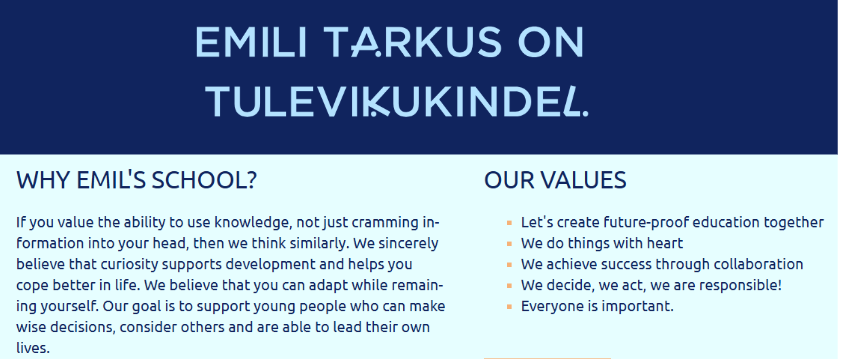
The school vision and values posted on the Emili Kool website

TH: How did you make those decisions about instruction for the school? What guidance did you give teachers?

IL: In that first or second meeting we decided that we need to make a decision together, and it’s more important to make a decision than to leave things too flexible or too messy. We had a really solid structure of staff meetings, and we also decided together which apps we would use, how many letters we would send home each week, it was all written down for the teachers. As a small school, we were able to able to make the big decisions together with most teachers. Normally, many decisions are made by the leadership team, but these decisions were more collective, with all of us discussing things together early on.

TH: What was the decision on schedule/plan? Did you tell teachers they needed students online 9am-3pm?

IL: In the beginning, all the teachers had to meet their students at least two times per week, so all the students had at least two online lessons per day. And the student from each grade had morning gatherings or morning circles at 9 O’clock every day. The teachers met with the students; they looked at the schedule and their aims; and maybe they talked about their feelings. In some cases, maybe it was important to wake students up. After the online morning meetings, the students had much more free time or autonomous learning time, and then they were brought together again by a teacher at the end of the day teachers and students would gather together again at the end of the day.

TH: That’s interesting that the teachers were talking to the students about their feelings. Was that normal before COVID?

IL: Yes, that was normal. But we wanted to make the online learning as safe, socially and emotionally safe as possible for the students, and part of that was finding things pre-COVID that we could bring to the to the online version, and morning gatherings were one of those things. 

TH: Was the morning circle just for the primary students or all students? 

IL: Both. In the primary school, the students would meet with their homeroom teacher. At the lower secondary school, the students had different subject teachers, but we still have the class teacher system in Estonia so the lower secondary students would meet with their class teacher. The head of studies made the schedule at the beginning and end of the day, but the primary teachers could decide for themselves what do in the middle of the day. 

TH: What about parents? What information did you share with parents? 

IL: I actually have the recommendations that we sent to parents and students that first month. It was a Facebook post, but we also sent it to them directly. It’s from the 17th of March, 2020 — the first month of home learning. The first recommendation is about organizing a comfortable learning space. The second is to discuss and write down the rules of home studying; make a schedule with resting and active time; make a routine; and at the end of every day write down 3 “success stories.” 

TH: As I understand it, the Estonian government made the decision early on to get students back to school as soon as possible. As you moved into the next phases and particularly as you tried to get most students back in person in the fall, what were some of the biggest issues you had to deal with. 

IL: I think the fears of people was the biggest issue. Teachers had different fears; parents had different fears. Some people were really open to coming back together, learning together, but some people were really scared to come back. Of course, people had different situations. Some had grandparents or sick people at home, and they had to be more scared. Others were thinking about all the economic problems as a lot of the parents either lost their jobs or their businesses went down, so they were much more stressed. And some parents refused to bring their children back to school. I remember there were some mathematicians who sent the calculations and said it’s going to be really bad if we come together, and they had modeled everything out.   

As a private school, there were also lot of economic questions. Lots of people were in an uncertain situation, and they didn’t know if their salaries would be cut. In general, in Estonia not too many people had deep economic problems because the government still supported small businesses and they provided some salary compensation, but still there was a lot of uncertainty. 

We tried to deal with everything through lots of communication, explaining everything, and we tried to be as flexible as we could. Some families wanted their children to stay home, and, in the first year, even after we came back in person, we accepted that, and we developed individual plans for those students to work online. But later on, during the second COVID wave, we said “These are the rules of our school, and we will all come together,” and we didn’t make these individual plans anymore. 

TH: What were some of the issues you had with online learning? As a private school, since parents were paying, maybe you didn’t have too many issues with students disappearing, but were there issues of mental health and stress? 

IL: We didn’t really have issues with students disappearing, but we had some issues with home routines not being supportive enough – so some student might just sleep in the morning and not show up online.  But no students fully disappearing; we kept parent contacts. 

There were also some students who worked individually with our psychologists or social workers during the closures, and some students came into the school and worked alone in the classroom, while a psychologist worked in the next room. We helped to create routines for those students who couldn’t work at home for some reason. 

When school opened again, we found some increased stress and anxiety among students, but it was not too bad compared to before COVID.  I still remember when we came back to school it was actually like a new positive beginning. There were really positive vibes, particularly in the primary school, where the students’ strong relationships were in their families or in their school; they don’t have friends someplace else. So they came back to school and met their friends again. 

TH:  In the US and other parts of the world there has been a lot of talk about academic “learning loss.” Has there been any talk about “learning loss” in Estonia? 

IL: Yes, of course. For some of the students, their results went down. And for some students home learning actually helped, but that’s only for the academic part. we don’t know about the social part because the social skills and relationships are rarely measured. We thought for about one third of the students, home learning helped their academics; for one third, it didn’t matter; and for one third it was more difficult. Later on, when the students came back, we had the extra support for some students and some extra lessons. We also had summer learning camps. 

TH:  Who paid for the summer learning camps? 

IL: There was government funding for the summer learning camps, but  schools had a lot of autonomy for organizing them. So the camps in some schools were more focused on social skills, but we put the two things together. These were like social learning camps where the students just spent time together, but they could also learn their ABC’s again. 

TH: Were those primarily for the students who were struggling or could anybody come? 

IL: Anybody could come, but I remember we talked a lot about that: That even if a student is doing okay in mathematics and sciences, it doesn’t mean that that he or she doesn’t need this social part, because that was a big loss. 

TH:  You also said that the school gave students more individual work during remote learning than they had in the past. Have they continued any of that or have things just gone back to the way it was? 

IL: Yes, after I left, they started doing individual e-learning days about once a month. Of course, everyday life in the school was also affected by the COVID experience because all the online systems became a normal part of learning and studying, so all the online collaboration methods for writing together, for doing video presentations they became part of normal life as well. 

Pushing the boundaries of the conventional school: Indrek Lillemägi talks about the development of a new upper secondary school in Tallinn, Estonia 

What’s involved in launching a new school? This week, Indrek Lillemägi looks back on his experiences working on the development of a new upper secondary school, Tallinna Pelgulinna Riigigümnaasium, that opened in Tallinn, Estonia in the fall of 2023. Previously Lillemägi was the founding principal of a private school in Tallinn, the Emili Kool (named for Jean Jacques Rouseau’s book Emile, or On Education) that opened in 2016. In the first part of this two part interview, Lillemägi discusses some of the key steps in the development of the upper secondary school and some of the lessons he learned from his earlier experiences in establishing the Emili Kool. In the second part of the interview, Lillemägi describes what it was like to lead the Emili Kool through the first part of the COVID pandemic in Estonia. 

This interview is one in a series exploring what has and has not changed in education since COVID. Previous interviews and posts have looked at developments in ItalyPolandFinlandNew Zealand, the Netherlands, South Africa, and Vietnam. This interview with Lillemägi was conducted by Thomas Hatch in May of 2023, a few months before the Pelgulinna Riigigümnaasium opened. The interview has been edited for length and clarity. 

Thomas Hatch (TH): Can you give us a sense of what it’s been like to develop a new upper secondary school in Estonia? What were some key milestones or challenges leading up to your opening in September of 2023? 

Indrek Lillemägi (IL):  We started with a little over 400 students in the 10th grade in the fall of 2023. We will add an 11th grade this year, and a 12th grade next year, and we will end up with a school with about 400 students in each grade at the upper secondary level. So it will be a big school, with more than a thousand students.

But this new school is part of a longer story because it’s one of a series of new State-run gymnasiums or upper secondary schools that the Ministry of Education has created in some municipal centers over the past 10 years as populations decreased. But Tallinn is another story because their population is increasing, without enough places in upper secondary schools, so three new gymnasiums were approved. The Ministry of Education then hired me along with two other new headmasters to create the schools together, so I’m not working alone. We worked in the same room every day, and we did a lot of things together. We’ve hired people together. We’ve developed communications together. We’ve done a lot of bureaucracy together. We’ve shared a lot, but we also had our own communities to serve.  Of course, we are also different as principals and as humans, and we have different things we believe in, so the schools are pretty different. But in the process, we were together.

A collage of different images of a building

Description automatically generated
The construction of the school was completed in August 2023. It is the largest wooden building in Estonia.

TH: These state-run gymnasiums will function along with the upper secondary schools run by the municipalities? 

IL:  Yes, exactly. We are the extra ones, and none of the municipal schools will close because of us. But, after 5-6 years when student numbers decrease again, the municipality may have to make some tough decisions, and they may have to close some schools.

For the new schools, the Ministry gave us full autonomy. They just said “this is the budget; this will be the new school building of yours; and these are the regulations.” We were given full leadership autonomy to build our schools. It’s enormous trust that they had in us. I don’t think that’s possible in any other country.  We also had the full support from the Ministry of Education. We had all the lawyers, all the experts, helping us. 

When I first started writing down the strategy for building a new school, I tried to understand what’s going on? What’s going in education in Tallin? Of course I had some knowledge, but I had time to really talk to people, different school heads, different teachers, and parents and also with the local community where my school would be located. I tried to understand what’s missing because I really believe that strong educational systems are heterogeneous. Students and parents should be able to choose their school according to their values or principles. So I  didn’t want to copy the “best school.” 

TH: Were the regulations specific to the new schools or are you referring to the general regulations?

IL: Just the general regulations. But I have to say, we were even pushed to try out the borders of the regulations or touch the “grey zone.” I think the Minister of Education sees us as being able to try out more new things, and then our experience can either be transferred to other places or they can be taken as a lesson. 

TH: How did they push you or encourage you to take those risks? 

IL: It wasn’t anything official, but it was through our weekly meetings with some of the those involved with the management of state schools. The schools include the new state gymnasiums but most of the schools that are managed directly by the state are schools for students with special needs or vocational schools.  

TH: So from there, what was your journey?

IL: From there, I tried to combine three things. One was what I was hearing from the local community in Northern Tallinn where the school would be. They tend to be very socially active, and the local citizens want to be involved. Second, a lot of students told me about the challenges in their lives that do not have any part in their education. Mostly, the students talked about stresses related to climate issues and their mental health. They said, “these are big things in my life, but I don’t deal with these things at school.” These stories from the students really influenced me.  

Then of course there were my own passions and things that I am interested in. When I started writing down what kind of school I would like to have, I wrote down that the focus of the new school would be about dealing with the problems that do not have easy solutions – questions of climate and the environment and questions of democracy and how to build strong democratic institutions. I set these as the focus points of the school. Of course, I didn’t write down any specific details about the curriculum; I just wrote down the principles for myself. Now, the values of our school are based partly on these principles. 

Then when I was hiring the head teacher, I showed the candidates the paper with the principles, and I asked them: “Would you like to work for that?” A lot of people applied for this position, and I hired someone who had been working last nine years in Netherlands in an International School. After she moved back to Estonia, we started working together and talking together about the curriculum about the learning methods, and about the other focus points of our school. Eventually, we hired a team of eleven people who worked on building everything from the curriculum to the bureaucracy. We then started hiring the rest of the staff when we started dealing with student applications and everything else. 

TH: What are the focus points of the other schools?

IL:  Ours is democracy and environment, solving complex problems. One school that’s located near the Technical University in Tallinn focuses on technology and science, and the third school third focuses on self-expression.

We also met with the heads of the other two new schools to talk about what could bring these three new schools together. We decided that, for all of them, the curriculum would allow students to create their own individual learning paths. We wanted our students to be able to put together their own curriculum and to have much more choice compared to the average school. Because of that, we created a network of courses that could be shared between these three schools. Now, the students of one school can take courses at the other two schools as well. These are elective or “selective” courses. Some are online, but many are in-person. Most of the selective courses are on Thursdays when students can move between schools, and when students can choose which courses to take or what internships or other activities to participate in. That means we have to coordinate our schedules with local universities, vocational schools, and NGOs as well. But now, on Thursdays, our students can move around the city between morning course time and afternoon time. If a student goes to the university, they stay there half the day.  The other days are more conventional with 70-minute lessons. Less conventional is an 80-minute midday break when students again have more responsibility for deciding how to use their time. In addition to lunch, they can use the time to rest, to do group or individual work, or go the gym or on walks. 

TH: Are there other unusual aspects to your school day?

IL: The first two weeks don’t follow the regular schedule. Students go through an onboarding program where we take them through a narrative arc that goes from the Big Bang to civilization’s end. They build relationships and learn about the school’s approach and theory of knowledge – how different fields do research and gain knowledge. It’s a completely different two-week program than most students have had before.  The other two schools have a similar onboarding approach, though it’s slightly shorter. Teachers from all three schools worked together to develop the approach. 

We also have mentoring groups in which a teacher meets with a group of about 18 students which is smaller than the average class size. The mentoring groups have weekly lessons to reflect on social-emotional and group challenges. The mentors are the regular subject teachers, but we also provide them with special training.  These kinds of mentor groups are becoming more common in the state gymnasiums.

TH: What were some of the key lessons from your work founding the Emili School that you brought to your work with this school? 

IL: This may sound like a cliches, but of course, the relationships are the most important. Everything in education starts from building relationships, first with one student. Then building a strong community and strong relationships with the local parents, grandparents, local NGO’s, local businesses, and so on. I knew these things, but I didn’t have the experience of how to involve all these people, how to make them understand everyday life in a school and the challenges in a new school.

TH: What were some of the things you learned to do to help build those relationships?

IL:  One of the key lessons was that I started being more and more honest. In the beginning, I felt responsible for “selling” the school – I talked a lot about the vision and ideas. But, later, I also started talking honestly about the challenges, the  difficulties, even the problems we faced. I began to understand that being honest built much stronger relationships, so people who joined our community were not disappointed later on – they had the transparent view before joining.

TH: What were one or two of the biggest challenges you faced when you were starting that school? 

IL: Probably that private education in Estonia is uncommon – less than 5% of students go to private schools. So parents think “private school” means a paradise school with no problems. The challenge was that in the beginning we were a normal school with the same challenges and growing pains all new organizations have. As I started telling a more honest story, with open school days where parents and community members could visit, I think they began to see and appreciate the hard work and emotions teachers go through, and they developed a better appreciation for the work the school was doing.  

TH: Was there a particular issue parents were surprised about, or was it just in general they expected perfection?

IL:  Probably the emotions throughout the school day was something they talked a lot about, especially in primary school. There’s someone crying; someone’s sad; someone’s telling a story about their weekend – it’s full of emotions.  And they saw the teachers trying to be really empathetic, trying to support all the students – the sad ones, the crying ones – and I think that was surprising to them. And I think parents often expect teachers to have free time during breaks. But especially in a starting school with new methods, we were doing a lot of preparation and a lot of reflecting and learning together. Parents expected teachers to have more free time than they actually did.

TH: Can you share a bit about how you planned to assess student outcomes and your progress in developing the school? 

IL: That’s a big topic!  We’re bringing many innovations together like much more collaborative teaching. As an example, in the 10th grade we have two “pillars” – one for natural sciences and one for cultural studies. In the natural sciences, the biology teacher, geography teacher, physics teacher, chemistry teacher, they all work together. We have also changed the national curriculum by changing the order of the learning outcomes so it’s more much more integrated than usual. Teachers often just follow the textbooks but the textbooks in different fields don’t go together very well. Some of the topics are really similar in geography, in physics and chemistry, but they are learned in different times in the different fields so students have trouble putting the big picture together. Our science teachers worked together for almost a year before the school opened, and they’ve done a lot of work reordering the national curriculum learning outcomes. That means they have to design assessments that align to those more interdisciplinary learning outcomes. It all starts from the dialogue and from feedback based on these learning outcomes. 

Besides descriptive feedback, we use percentages from 0-100 rather than letter grades. But what’s different is that the students get one percentage for all the sciences, not a separate percentage for each subject.  All of this influences the learning process because the teachers have to work together to create the final assessment or final project; they assess it together; and they plan together.  

But at the end of 12th grade, the regulations still require us to give the students marks in each of the subjects. We do use pre-tests in the subjects, some of these are provided by the State, but the pre-tests and final subject tests are just for reflection for the students and teachers, they don’t influence their school marks in each pillar. 

TH: How did other schools in Tallinn react to your planning to develop these new State gymnasiums?

IL: There been different emotions.  We heard that some Directors or Head Teachers told their teams some horror stories about us, but some of them were really supportive. Some of the Directors have asked us to come to their schools to explain everything about the school to the students, so really different approaches. 

Next Week: Leading a school in a context of uncertainty: Indrek Lillemägi discusses the COVID-19 school closures in Tallinn, Estonia

Taking learning and teaching seriously: Reflections on the life and work of Lee Shulman

IEN celebrates the life of Lee Shulman, renowned scholar and mentor, who passed away on December 30th, 2024. Shulman was a Professor of Education at Michigan State University and Stanford University, before becoming the 8th President of the Carnegie Foundation for the Advancement of Teaching in 1996. He also served terms as President of the National Academy of Education and the American Education Research Association where he helped establish the division of Teaching and Teacher Education. Shulman received numerous awards over the course of his career, including the American Psychological Association’s E.L. Thorndike Award for Career Achievement in Educational Psychology in 1995 and the Grawemeyer Award in Education in 2006. Thomas Hatch, who worked with Shulman at the Carnegie Foundation, shares some of his reflections. 

Lee Shulman was an exuberant friend and scholar. Always positive and supportive, whether in his professional advice or as a host as he and his wife Judy welcomed me, my wife (and his graduate student) Karen Hammerness and our young children into his home. Lee’s work and impact cannot be summed up in any one idea or publication, but Those who understand: Knowledge growth in teaching, his 1986 AERA Presidential Address, made clear that teaching involves substantial knowledge and expertise. In the process, he demonstrated that teaching is not just a difficult job, but a demanding profession, worthy of the same kinds of recognition and reward as any other. That work helped to launch a whole new era of research on teaching. Far more than an academic exercise, that work and Lee’s insights were central to the establishment of the National Board for Professional Teaching Standards, as well as to the advancement of the Scholarship of Teaching and Learning and to the creation of a host of centers and institutions dedicated to studying and improving the quality of teaching in K-12 as well as higher education.  

Lee worked out his ideas over time in conversations, at meals as well as in seminars, and his ideas often launched new initiatives and new lines of work. In her remembrance, Jill Perry, Executive Director of the Carnegie Project on the Doctorate – one of several projects spawned while Lee was President of the Carnegie Foundation – explained this as “classic Lee:”

“offering a casually delivered suggestion that was, in reality, a deeply considered and insightful idea. He was known for these moments, where his offhanded guidance would leave young scholars or practitioners inspired yet responsible for sorting out the details on their own.” 

I had that experience, sitting in Lee’s office in 1996, in the heart of Silicon Valley with the internet developing all around us.  He declared that he wanted to bring the power of the three great resources of the university – the laboratory, the library, and the museum – and put them online to support faculty in K-12 and higher education who were creating the scholarship of teaching and learning. And then he asked me to do it. Inspired, I returned to my office to stare for hours at the cursor blinking on my computer screen. But, eventually, we established the Carnegie Knowledge Media Lab to support the Carnegie Academy of the Scholarship of Teaching and Learning (CASTL K-12 and CASTL Higher Education) and began a long line of work that included two books, Into the Classroom and Going Public with Our Teaching, and the development of a whole series of multimedia websites and images of practice that documented the work of exceptional teachers.

Beyond his ability to tell a story and make a powerful point, Lee’s brilliance was in his humanity. Lee was as likely to draw on his experience working at the counter at his parents’ deli on the south side of Chicago as he was to quote Benjamin Bloom or Joseph Schwab, two of his mentors at the University of Chicago. That deli experience, in particular, was evident in a segment he did for NPR’s This I Believe series. What did Lee believe in? He believed in pastrami: 

“I believe that pastrami is a metaphor for a well-lived life, for a well-designed institution and even for healthy relationships. Pastrami is marbled rather than layered. Its parts, the lean and the fat, are mixed together rather than neatly separated.…  Separate layers are much easier to build, to schedule and to design. But I believe that marbling demands that we work with the messy world of people, relationships and obligations in their full, rich complexity. The diet mavens inform us that marbling can be dangerous for our health, but as an educator I’m willing — even obligated — to take the risk. I want to marble habits of mind, habits of practice and habits of the heart with my students — just like pastrami.”

His writings and his talks drew from all his experiences, and, somehow, after a well-known tendency to wait until the last minute, they would burst forth, fully-formed. On one occasion, I remember flying from San Francisco to Washington D.C. for the annual conference of the American Association of Higher Education, where Lee was scheduled to give the keynote address the following day. I happened to be seated in front of him, and as we settled into our seats, I asked him what he would be talking about. He held up a pack of index cards and told me he was going to work on it on the plane. Some six hours later, after the plane pulled into the gate, when we unbuckled our seat belts and stood up, Lee spilled all the cards onto the floor. As I stooped to help him collect his notes, I realized every single card was blank.  

The next morning, seemingly without reference to a script or a single card, Lee delivered a talk, Taking Learning Seriously, that ended in a standing ovation. In that talk, Lee addressed the first question “What does it mean to take anything seriously?” by declaring that “when we take something seriously, we often talk about professing it:” 

“The deepest, oldest meaning of the word “profess” is to take religious orders in a public and visible way. When one professes faith, it means taking on a set of obligations that will serve as the first principles for controlling one’s life, no questions asked. Professing one’s faith, behaviorally and emotionally, is an impressive example of taking something seriously.

Another sense of the word is that we profess our love–for our spouses and partners, our parents, our children, our dearest friends. We profess a kind of commitment that has within it a willingness to sacrifice on behalf of the other. Also in a public manner, we declare our devotion to another. Here is yet another example of taking something quite seriously.

A more contemporary meaning of the word, a meaning more closely associated with the work of those who read this magazine, is to profess one’s understanding, one’s expertise: to be professional, or to be a “professor.” Members of professions take on the burden of their understanding by making public commitments to serve their fellow beings in a skilled and responsible manner. “Professors” take on a special set of roles and obligations. They profess their understanding in the interests of nurturing the knowledge, understanding, and development of others. They take learning so seriously that they profess it.

Throughout the talk, and especially in the conclusion, Lee’s remarks deftly weaved together the insights of a scholar of science and a man of faith: 

“To be deeply educated, I believe, is to understand both when skepticism and evidence are appropriate, and when faith and suspension of disbelief are appropriate. There are no rules or principles for knowing this distinction. Only through studying the examples in both scientific and humanistic sources -through wrestling with that inherent contradiction between faith and reason–can we and our students come to terms with the essential uncertainties that define our roles as professionals and as human beings.

As professors, we are asked to be rational and empirical, to demand evidence. On the other hand, as teaching professionals, we expect ourselves to believe what much empirical evidence says we shouldn’t: that all our students can learn. We express our faith in our students’ potential and in our ability to teach them. As professors, we do not choose between the skepticism of reason and the hope grounded in faith. Our students demand both. And we must learn, as professional educators, to do both.”

***********

Donations can be made in Lee Shulman’s honor to the Leukemia and Lymphoma Society and the Camp Ramah Tikvah Program in Ojai, California