This second part of IEN’s annual scan of the back-to-school stories brings together some of the headlines that focused on the effects of a flurry of executive orders and policy changes from Washington. The first part of the scan shared stories from outside the US, and, next week, we’ll review some of the other back-to-school headlines in the national and local press in the US.
“As 47 million students return to school in the coming weeks, district leaders say they’re experiencing an uncertainty they haven’t felt since the pandemic. It’s “the amount of information that’s coming to you all at once,” said Jeremy Vidito of the Detroit schools. He laid out a litany of hardships, including figuring out “what’s true, what’s not. Emergency orders. Budget cuts.” But this time, the federal government is the source of the unease, as the Trump administration seeks to reduce more spending.” — The74
“Department of Education sends guidance on private school kids obtaining federally-funded benefits, including one-on-one tutoring, counseling,” Fox News
“While the Trump administration has vowed to preserve NAEP, it has overseen major cuts to staff who work on it and the elimination of more than a dozen tests” — Hechinger Report
“The Trump administration wants to roll back rules for collecting data on state career and technical education programs instituted in the final days of the Biden administration and align the largest federal CTE program with the president’s first-day executive order making it federal policy to recognize only two sexes.” — Education Week
“The Trump administration has launched investigations into school districts in Chicago and Evanston over programs aimed at supporting Black students, saying that efforts such as hiring Black teachers, expanding Black history and antiracism training may violate civil rights law. Supporters say the initiatives address systemic inequities and improve student outcomes, while critics warn they could be dismantled in court battles likely to reach the Supreme Court.” —NYT
“Posters are displayed in a Los Angeles Unified high school health education classroom in 2018. The Trump administration told 40 states to remove references to gender identity from a federally funded sex ed program and stripped California of its funding when it refused to do so.” Source: ChalkBeat
What does it take to scale a tablet-based foundational learning program to all the primary schools in Malawi? In this 3-part interview, Joe Wolf and Kira Keane describe how Imagine Worldwide has approached that challenge and share some of what they have learned in the process. The tablet-based program at the center of Imagine Worldwide’s work, developed by software partner onebillion, serves as a supplement for regular instruction, with each child in a school spending a targeted 150 minutes per week working independently on problems related to reading and mathematics. Imagine Worldwide partnered with the Government of Malawi to rollout the program in 500 primary schools in 2023-24, with the ultimate goal of expanding to all 6000 primary schools in Malawi, serving 3.8 million learners in standards [grades] 1-4 annually. Joe Wolf is the Co-CEO and Co-Founder of Imagine Worldwide and Kira Keane is the Director of Communications. (Photos/graphics are from Imagine Worldwide unless otherwise noted.)
TH: Can you describe for us some of the key steps or phases you went through as you developed your work to test and then to scale-up this tablet-based program in Malawi?
Joe Wolf: The first phase of our work was all research oriented. We wanted to see if these learner-centric tablet models could work – were they really effective for children? – before asking under-resourced systems to spend time, energy, and capital on them. That meant we had a prolonged research phase that included nine randomized controlled trials. That was across different contexts, different languages, different implementation models, different countries – really exhaustively trying to prove that these solutions can, in fact, add significant value.
The second phase was what we call “learning to scale:” What are the processes that need to be done repeatedly well to scale within these contexts? We purposely spread our work out across seven countries, with different implementation models, different implementation partners, different types of structures to really test what needs to be done repeatedly well so that these systems can adopt the work at scale. Then, only in the last three years, we’ve put the pedal down and said, “Okay, I think we’re ready to really think about scaling.” And we were only able to act on scaling thanks to the leadership of the government of Malawi, who saw the learning gains of our pilot programs and saw how this edtech intervention could support their national goals of improving foundational skills. At that point in 2022, we served around 6000 children, but we increased it to about 700,000 children by the beginning of 2025. That’s a 100x increase in the last two years, which I think is a testament to the scalability of the model, the execution of the team, and the leadership of our government partners.
TH: What’s the third phase? Implementation?
JW: I would say it’s scale plus continuous improvement. Now, our research is less efficacy oriented and more implementation oriented. How do we make it better and better and better? To address that, we have four levers we focus on:
Access: How do we serve more and more children and make the solutions easier and easier to implement?
Cost-effectiveness: How do we bring down the recurring costs to be as low as possible? We’ve brought costs down around 75% in the last five years, and we think there’s still room to go. Our key inputs are all highly deflationary, so we’re getting better economies of scale as we grow. Right now, we’re at about seven dollars (USD) per child per year. We think we can get that under five dollars (USD) as we get better economies of scale.
Advocacy: How do we use data to improve the implementation model in the software so that the efficacy of the program continues to go up and up and up? It’s one of the beauties of technology that it can iterate and improve. You’re not building a building and putting in books and then five years later it’s deteriorated. We actually have the ability to use data to continuously improve through this flywheel of innovation.
“It’s one of the beauties of technology that it can iterate and improve. You’re not building a building and putting in books and then five years later it’s deteriorated. We actually have the ability to use data to continuously improve through this flywheel of innovation.“
Sustainability. How do we work with our government partners to build operational and financial sustainability? And how do we do it starting day one, where we’re building the “muscles” within the existing education system, as opposed to the classic approach of starting off outside the system and then trying to hand it off to the system. Too often, if you haven’t done a good job of building that internal muscle, and then things fall apart. So we’ve really taken the system strengthening approach, acknowledging that there are capacity and infrastructure gaps within the countries where we work and that there are key functions that need to be built that don’t currently exist within some of these systems. We’ve tried to give it time so that, by the end of the implementation phase, the system has already been doing the work for an extended period of time. That way, you don’t have this fall off as you try to hand-off everything to the system itself.
Kira Keane: I just want to underscore a couple of points that Joe made. For Imagine, this notion of the continuous improvement loop, it’s not like we did things, something went wrong and we’re like, “Oh, we have to fix this.” This was an intentional design element from the very beginning: How do we get continuous feedback to improve both the software itself and the implementation model? And the other point is that our key question is “How do we serve as many children as possible?” The need is so immense and the population growth will be so intense over the next 10-15 years so we really need to be focused on scale. That means working with our government partners to aim for generational impact, really looking at country-wide scale, and focusing on how we design for that.
“The need is so immense and the population growth will be so intense over the next 10-15, years so we really need to be focused on scale. That means working with our government partners to aim for generational impact, really looking at country-wide scale, and focusing on how we design for that.”
JW: I’ll add two more things to what Kira said. The ecosystem is exhausted by pilots – by small things that don’t scale, that don’t have evidence, that take a lot of time and resources. Scale from day one very much aligns with where the governments are. They have a big problem with the lack of foundational learning among their students, and they need big solutions. Little, tiny things are just distracting and take too much time and energy. The second thing is that we have positioned our organization to be temporary in nature, so our job is to put ourselves out of business as quickly as we possibly can. We don’t see these as “Imagine Worldwide” programs in Malawi or “Imagine Worldwide” in Sierra Leone. These are programs of the government in Malawi and of the government in Sierra Leone that we are helping to support. We’re helping to build capacity and infrastructure to build muscle within the systems. But as soon as the government is ready to maintain this on its own, we are more than pleased to step out of the way and to move on to the next challenge. I think that positioning is really important for the governments. It’s really important for the funders. It’s really important for us and our team. Too many times, an NGO establishes itself and 50 years later, the NGO is still there, doing the work. We need this work to be sustainable within existing systems. Part of that is a commitment for us to get out of the way. We have to believe in sovereignty and the power of governments to run themselves, while also acknowledging that the use of technology in a place like Malawi is new, and so there is going to be a period of time where we have to build some functions that do not currently exist.
TH: That certainly resonates with my experiences in the US where we’ve seen multiple improvement efforts collide in schools in ways that can actually undermine their capacity for improvement. What made Malawi a good context for you to work on scale-up?
JW: The work in Malawi actually predates the partnership with Imagine. There was a program called “Unlocking Talent,” with the software developer onebillion that became our partner. The onebillion CEO went to Malawi, I think, 15 years ago, fell in love with the country, and developed the product. The first product they developed was in Chichewa, in Malawi. In other words, this was not developed in the West and then adapted to the context. This actually was developed within the Malawian context. We became a research partner to look at impact and to help do the RCT work. That has now evolved into a much more scalable model that we call the BeFIT Program. It’s serving standards [grades] one through four, whereas the first program was only standard two.
There have been a whole bunch of iterations along the way to develop our general approach, but it basically evolved by thinking about what it would take to actually scale the program much more cost effectively to many more students in more systems. If you look at the other places that we worked, you’ll see that we started with finding local partners, mostly local NGOs, some local social-oriented businesses, and then turned over a lot of the functions to those local partners to see what worked in different contexts. From that, we have built a series of centralized functions that we’re now drawing on in our country partnerships, as opposed to having it be completely decentralized. We learned a lot from the initial more decentralized exploration, but we’re now in the process of creating more standardization. Part of scaling depends on acknowledging that you can’t have fifty different bespoke operations. You need to have systems and standards and data systems. When you have 6000 children in Malawi, using a total of 1000 devices, you can do some things by hand; but now we’re trying to serve millions of children in Malawi, with hundreds of thousands of tablets. We now need data driven systems in order to be able to manage that equipment in the field.
TH: Let’s follow the arc of that evolution in Malawi. What are some of the steps that were crucial to your learning and to the development of the model?
JW: In Malawi, we took seven or eight years to do the research and to get the right level of government buy-in to understand what was working. That included learning things like what’s the infrastructure for the typical school in Malawi? Just to give you the context, that means more than 100 children per teacher and inadequate levels of teacher training. There’s very rarely basic infrastructure in place, so no electricity and certainly no internet connectivity. That’s the reality of the average class in Malawi. So as you think about the components of our model that have emerged the first was what you would call the infrastructure component. We put solar power into all of our schools, addressing questions like:
Where do solar panels go?
How does the solar electricity feed a bank of lithium batteries?
How do the tablets get stored and secured overnight so that they’re charged and they’re safe?
How does all that equipment get distributed to children in a really efficient manner, so that you’re getting as much asset utilization as possible and as much learning time as possible?
In the end, our research consistently shows that the number of minutes each student uses the content is directly correlated to the level of learning. So we’re addressing these 101 things that need to be done in terms of the infrastructure and operations to maximize that time on task. And that has to take into account that the school day and the school periods are very short in Malawi and you have a lot of children in the classroom. So even just getting kids in and out of a classroom is a lot harder than in many other contexts.
A classroom in Malawi
TH: You just described those complexities really effectively, but for those of us who aren’t familiar with the context, can you go into it even more deeply? What does it really take to get a program like this up and running at scale?
JW: I think that in addition to a foundational learning organization, we are, in a lot of ways, also a supply chain logistics company. Learning gains are still our north star, but the reality is you’re talking about a phase one of BeFIT that involved launching the program in five hundred schools in five months across half of the country of Malawi, including very rural districts. So we have to deal with the logistics of getting five hundred secure storage cabinets into those schools. We have to deal with the logistics of getting 100,000 tablets distributed across those 500 schools and of getting the solar equipment put into 500 schools. That’s a significant operational lift, and you have to approach that with a level of rigor in terms of those key functions, if you’re going to be able to scale, and you’re going to be able to do that on time. And we had to do that on budget in the middle of a huge macro-economic meltdown in terms of currency and raw materials. In the grand scheme of things, once the equipment is in place, kids can get learning very, very quickly. There’s not a huge lift in terms of adult training. There’s not a huge lift in terms of the role of the adult in the model itself; the content has been built to be autonomous, meaning the child can be self-directed. The tablets themselves have been built to be very robust. A lot of enhancements have been made to make the tablet durable. There’s a long battery life so it can be used throughout the day. Every part of the tablet has been built with screws so that a component can be swapped out if something breaks. So every part of the context has been taken into account in order to get that equipment into the field and utilized. This is one of the big learnings: you have to start with the context in mind, and you have to start with the learning objectives in mind. You then make a series of software decisions, and then you make a series of hardware decisions. Too often in education, it goes the other direction, where people buy stuff, but then they haven’t really thought about what’s going to go on the stuff? What’s the training required? What are the charging and security components of it? What is our learning objective at the end of the day? You have to start with learning, move into the context, and think about all the infrastructure decisions that need to be made in order to make that learning possible in that context.
“You have to start with learning, move into the context, and think about all the infrastructure decisions that need to be made in order to make that learning possible in that context.”
KK: I think it’s also important to flag that in working on the logistics we included the government from day one. That means things like using the delivery trucks the government already had. Trying to manage that coordination may have been a little slower or less efficient in some ways, but too often people design an implementation model, put a bow on it, and then hand it to the government without including them from inception.
In part 3 of this 3-part interview, Hirokazu Yokota shares his personal reflections on his experiences helping to establish the new Children and Families Agency (CFA) and, previously, the new Digital Agency. In Part 1, Yokota described the development of the CFA and the efforts to promote digital transformation in childcare, and in Part 2, he discusses some of CFA’s current initiative. Yokota has followed a rare career path as a bureaucrat who belongs to the Japanese Ministry of Education, Culture, Sports, Science and Technology (MEXT), but who has repeatedly stepped out of the “education circle” to work in other agencies, including the Children and Families Agency, which was established in April 2023. In September 2021, Yokota was one of the charter members who helped launch Japan’s Digital Agency , and he went on to work as a Deputy Superintendent in Today City. Yokota has previously written about his experiences as a parent and educator during the pandemic as well as his work in the Digital Agency and in Toda City: A view from Japan: Hirokazu Yokota on school closures and the pandemic; Hiro Yokota on parenting, education and the new Digital Agency in Japan; and Hirokazu Yokota on aggressive education reforms to change the “grammar of schooling” in Toda City (part 1) and (part 2). Please note that Yokota is sharing his personal view on CFA and its policies, and his views do not represent the official views of the government. For further information contact him via Linkedin.
IEN: Can you share your personal take on the initiatives by CFA – how is it working? What have you found most exciting, most challenging? What’s next for the agency/society?
HY: It is precisely because these are newly established organizations that they are able to advance policies that would be difficult under the framework of existing institutions. For example, the number of staff at the Digital Agency increased from 571 at the time of its establishment in September 2021 to 1,013 as of July 2023. The government has set a goal of further expanding this to approximately 1,500 personnel. Similarly, the Children and Families Agency’s budget has grown significantly: from approximately JPY 4.8 trillion in FY2023, to approximately JPY 5.3 trillion in FY2024, and to approximately JPY 7.3 trillion in FY2025 with the launch of the “Children’s Future Strategy” (Kodomo Mirai Senryaku) and its “Acceleration Plan” (Kasokuka Plan). Thus, it now far exceeds the Ministry of Education, Culture, Sports, Science and Technology (MEXT) budget (approximately JPY 5.3 trillion in FY2024 and JPY 5.5 trillion in FY2025). Such dramatic increases in staffing and budgets were made possible precisely because these were newly created agencies.
Also, last December we published “New Direction of Childcare Policy,” which details specific policy measures that should be taken in the next five years. There are so many workloads ahead, but I am very excited to take on these new tasks to fully realize the “child-centered society.”
Personally, during my time at the Digital Agency, I worked alongside many private-sector professionals, from developing priority plans for the realization of a digital society to promoting digital transformation in the fields of education and child-rearing. From them, I learned a great deal about flat information sharing and interactive meeting styles, which are common in the private sector. Later, when I was seconded to the Toda City Board of Education as Deputy Superintendent and Director of the Education Policy Office, I was able to take on many “zero-to-one” challenges — such as implementing the use of educational data in schools and piloting one-on-one meetings and reflection workshops to foster a flat organizational culture — things I might not have been able to do if I had remained in MEXT.
Now, as I lead digital transformation (DX) initiatives in the field of childcare at the Children and Families Agency, I feel that the “practical knowledge” I gained from my experiences at the Digital Agency and in Toda City is proving immensely valuable. As with the Digital Agency, we are advancing childcare DX projects with a mixed team of public- and private-sector personnel using a project-based approach. In this work, I constantly strive to serve as a bridge connecting “policy (systems)” and “technology (systems).” These two are two sides of the same coin: without a deep understanding of both, it is impossible to build effective structures. Given my background traversing the traditional bureaucratic divides between policy and systems, I believe that my ability to connect civil servants knowledgeable about policy and politics with private-sector experts skilled in technology is a unique value I bring. While minimizing risks, I find great purpose in leading the highly challenging task of building two entirely new national information systems in the childcare sector.
However, there is something I personally feel about the challenges faced by new organizations like the Digital Agency and the Children and Families Agency. In these organizations, the individuals who often receive public attention are those recruited from the private sector (e.g., the Digital Agency note and an article of CFA staff). Of course, I fully understand that highlighting these individuals is a necessary strategy to attract talented people from the private sector to public service. Still, it must not be forgotten that there are also many government officials—those who may not be in the spotlight—working diligently and persistently to realize a digital society and a child-centered society. During the foundational periods of these agencies, I witnessed firsthand many civil servants who unfortunately had to take leave due to overwork or mental stress. There were times when I blamed myself, wondering if I could have done more to support them. It is easy to criticize bureaucrats. That is precisely why I strongly hope that the media will shine more light on those government employees who, despite struggling to adapt to cultures different from their home ministries, are working earnestly for the public good in these new organizations. In the United States, there have been mass layoffs of federal employees. Precisely because of that, I believe that Japan should reaffirm its respect for civil servants who serve behind the scenes as the “unsung heroes” supporting public service.
“I believe that Japan should reaffirm its respect for civil servants who serve behind the scenes as the “unsung heroes” supporting public service.“
Looking toward the future, at the Children and Families Agency, we are now challenging ourselves to directly listen to the voices of children and young people through various channels and reflect their opinions in policy. In doing so, I believe it is necessary to proactively reach out to “those whose voices are not being heard” — the children and young people who have not yet had the chance to sit at the policymaking table. Constantly being aware of who is not at the table and delivering support in a proactive (“push”) manner, combined with respect for civil servants working behind the scenes, will surely help make this country better.
Furthermore, it is extremely important to make the policy methods developed by the Digital Agency and the Children and Families Agency the new norm across all of Kasumigaseki (the Japanese government). When I shared new policy challenges that I was working on, I occasionally heard comments, even from those inside the government, such as, “You could only do that because you’re in a new agency like the Digital Agency or the Children and Families Agency.” I believe that kind of thinking is truly unfortunate. One day, when I return to MEXT, I want to prove that it is not because of the agency’s novelty, but because each and every civil servant, with a sense of purpose and a little courage, can make change happen.
“[I]t is not because of the agency’s novelty, but because each and every civil servant, with a sense of purpose and a little courage, can make change happen.”
Next Week: From foundational learning to colleges and careers: Critical educational issues in India post-pandemic (Part 1)
To get a glimpse of Japan’s effort to create a “child-centered society,” Hirokazu Yokota shares what he’s learned from his experiences working at the Children and Families Agency (CFA). In the first part of this 3-part interview, Yokota describes the establishment of the CFA and the efforts to promote digital transformation in childcare.Parts 2 and 3 discuss the current initiatives of the CFA and Yokota’s personal reflections on his involvement in the development of new governmental institutions in Japan. Yokota has followed a rare career path as a bureaucrat who belongs to the Japanese Ministry of Education, Culture, Sports, Science and Technology (MEXT), but who has repeatedly stepped out of the “education circle” to work in other agencies, including the Children and Families Agency, which was established in April 2023. In 2021, Yokota was also one of the charter members helping to establish Japan’s Digital Agency , and he went on to work as a Deputy Superintendent in Toda City. Yokota has previously written about his experiences as a parent and educator during the pandemic as well as his work as a government official and administrator in: A view from Japan: Hirokazu Yokota on school closures and the pandemic; Hiro Yokota on parenting, education and the new Digital Agency in Japan; and Hirokazu Yokota on aggressive education reforms to change the “grammar of schooling” in Toda City (part 1) and (part 2). Please note that Yokota is sharing his personal view on CFA and its policies, and his views do not represent the official views of the government. For further information contact him via Linkedin.
IEN: Can you tell us a bit about the Children and Families Agency and why it was established?
Hiro Yokota: The Basic Policy on the New Framework for Promoting Child Policy – Establishment of the Children and Families Agency Aimed at Realizing a Child-Centered Society (Cabinet decision, December 21, 2021) stated a clear rationale for establishing this new agency:
“Now more than ever, we are at a critical crossroads: we must strongly advance child-related policies not only to curb the declining birthrate, but also to enhance the well-being of every child and ensure the sustainable development of society. With the best interests of the child always as the top priority, we aim to place children and child-related policies at the very heart of our society—an approach referred to as a “child-centered society” (kodomo mannaka shakai). From the perspective of children, we will take into account all environments surrounding them, guarantee their rights, and ensure that no child is left behind. As a society, we will support their healthy growth collectively. To realize this vision of a child-centered society, we are establishing a new central governing body: the Children and Families Agency (Kodomo Katei-chō).”
IEN: How did you come to work at the Children and Families Agency?
HY: From April 2022 to March 2024, I served as a deputy superintendent and director for education policy at Toda City Board of Education Office in Saitama prefecture. More than three years had passed since I left my home ministry – the Ministry of Education, Culture, Sports, Science and Technology (MEXT) – so most everyone anticipated I would return to MEXT, as I mentioned in my previous article. However, that did not happen, and I was seconded again, this time to CFA, which was actually what I wished for. In order to change and make education better, I take a stance of getting intentionally out of the “education village” and trying to change the status quo from outside.
IEN: Could you provide some examples of your primary work at the Children and Families Agency?
HY: My division (Childcare Policy Division, Child Development Bureau) is mainly in charge of three policies related to early childhood education and care; connecting children to the childcare system; increasing support for childcare workers; and promoting the digital transformation in childcare.
Free Early Childhood Education and Care
In light of the need to address Japan’s declining birthrate and recognizing the vital role early childhood education plays in personality development and forming the foundation for compulsory education, the government introduced free early childhood education and care in October 2019. Under this initiative — as explained in the English-language pamphlet “What about my child?”— all children aged 3 to 5 can attend nursery schools, certified child centers (nintei kodomoen), or kindergartens free of charge. For children aged 0 to 2, households exempt from resident tax are eligible for free care. Others have to pay a fee for their first child, but the second child in the household receives a 50% reduction in fees, and care is fully subsidized for third and subsequent children.
Connecting All Children to the Early Childhood Education System (Kodomo Dare Demo Tsuuen Seido)
According to the “Children’s Future Strategy” (Kodomo Mirai Senryaku), approved by the Cabinet on December 22nd 2023, many families — especially those with children aged 0 to 2, of whom about 60% are not enrolled in formal childcare — face anxiety and isolation in childrearing. In response, the government aims to support all children and families regardless of work status or lifestyle by enhancing access to high-quality early childhood environments. To achieve this, a new benefit called the Connecting All Children to ECEC System was established, allowing flexible, hourly use of childcare services within a monthly usage limit, without employment-related requirements.
“a new benefit called the Connecting All Children to ECEC System was established, allowing flexible, hourly use of childcare services within a monthly usage limit“
Improving Compensation and Staffing for Childcare Workers
To attract and retain dedicated childcare professionals, enhancing their working conditions is essential. As part of this effort, the FY2024 and FY2025 supplementary budget includes a significant 10.7% increase in personnel costs and, since 2012, total improvements have amounted to approximately 34%. While the average salary still lags behind that of all industries, the government’s recently published “New Directions in Childcare Policy” outlines a clear goal of achieving parity with national averages. Staffing standards are also being revised to improve safety and quality of childcare. For the first time in 76 years, the staff-to-child ratio for 4- and 5-year-olds is being improved from 1:30 to 1:25 through a new Enhanced Staffing Subsidy. Additionally, for the first time in over 50 years, for 1-year-olds a new subsidy has been introduced for facilities improving staffing from 1:6 to 1:5. To ensure that these improvements actually reach childcare sites, the revised Act on Child and Childcare Support also mandates greater transparency in financial operations. Childcare providers must annually report their staffing levels, salary data, and income/expenditure details to prefectural governors, who will then disclose key figures — such as model salaries and labor cost ratios — at both individual and aggregate levels. This transparency will help guide future improvements in standardized pricing.
Promoting Digital Transformation (DX) in Childcare Currently, both childcare facilities and local governments face substantial administrative burdens. Facilities must prepare numerous documents for subsidy applications and audits, with formats varying across municipalities. Local government staff spend considerable time manually entering and checking information submitted by facilities, often needing follow-up in cases of errors or omissions. Parents also face burdens, including time-consuming information gathering, the need to call during operating hours to schedule visits, and handwritten application forms submitted in person — even during pregnancy or while caring for young children.
To resolve these issues, the Agency aims to reduce reliance on analog documentation through digital data-sharing and thereby free up time for childcare professionals to focus on children. For local governments, the goal is to reduce the workload associated with data entry and review, allowing staff to focus on improving the quality of care. For parents, we are working toward a seamless, one-stop digital experience for all steps of the childcare application process.
“To resolve these issues, we aim to reduce reliance on analog documentation through digital data-sharing and thereby free up time for childcare professionals to focus on children.“
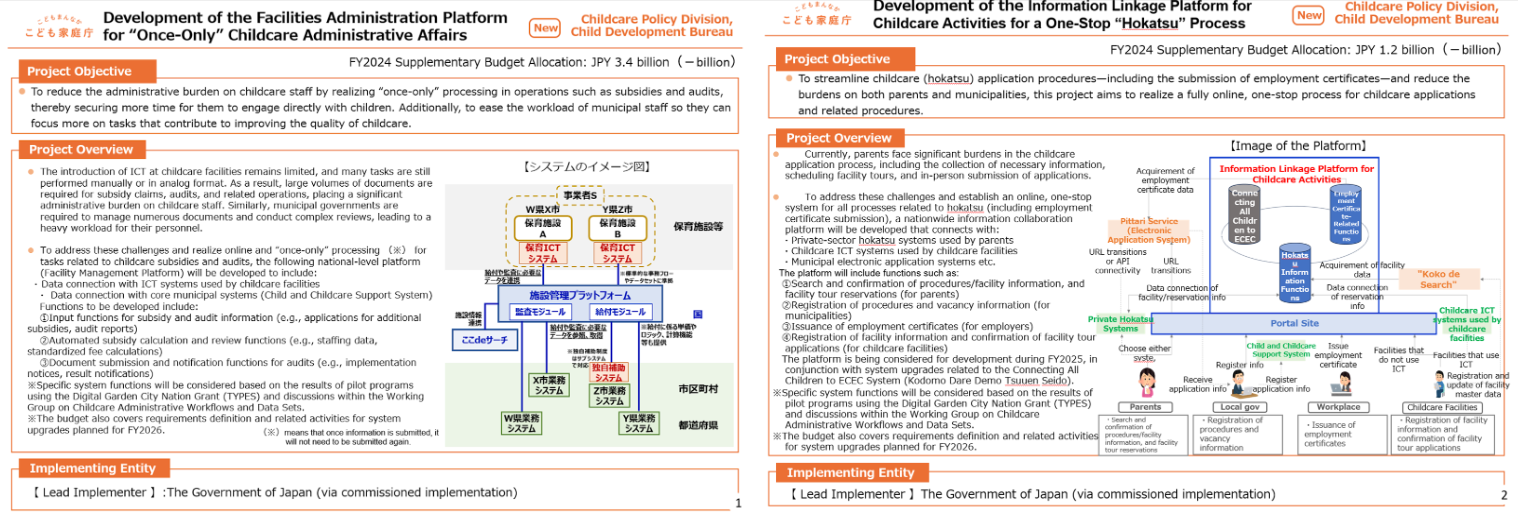
To that end, we are developing two key national platforms:
The Facilities Administration Platform on Childcare Administrative Affairs, which supports “Once Only” data entry for subsidy and audit-related procedures through integration with facility ICT systems and government backend systems. This will reduce duplicate submissions and streamline communication between facilities and municipalities.
The Information Linkage Platform for Childcare Activities, which connects parents, facilities, and local governments to enable end-to-end digital childcare procedures—such as information searches, visit reservations, and applications—via smartphone.
Plans for the Facilities Administration Platform on Childcare Administrative Affairs & Information Linkage Platform for Childcare Activities
By the end of FY2025, we aim to begin pilot operations for both platforms with nationwide rollout planned from FY2026 onward. Through all of these efforts, we aim to create an environment where the benefits of digital transformation are clearly understood by those on the ground; that enhance the attractiveness of the childcare profession for future generations; and that ultimately make the system easier and more convenient for all stakeholders.
To accelerate the digital transformation in childcare, we also launched a new initiative in FY2024: the Childcare ICT Lab Program. This program supports model projects at multiple sites across Japan, implemented in partnership with private-sector entities.
Next Week: Centering Children and Youth in Policymaking: Hiro Yokota on the Development of a “Child-Centered Society” in Japan (Part 2)




 International Education News