Category Archives: Interviews

Justice-Oriented Educational Change Through Community-Led Solutions: A Conversation with Edwin Nii Bonney

In November’s Lead the Change (LtC) interview Edwin Nii Bonney emphasizes that educational research and practice must “look back” by acknowledging colonial legacies and marginalized histories while “looking forward” by centering Indigenous, vulnerable, and community voices. His work highlights deep listening, intergenerational collaboration, and community-designed solutions as essential to dismantling deficit narratives and creating equitable educational systems. The LtC series is produced by Elizabeth Zumpe and colleagues from the Educational Change Special Interest Group of the American Educational Research Association. A PDF of the fully formatted interview will be available on the LtC website.

Lead the Change (LtC): The 2026 AERA Annual Meeting theme is “Unforgetting Histories and Imagining Futures: Constructing a New Vision for Educational Research.” This theme calls us to consider how to leverage our diverse knowledge and experiences to engage in futuring for education and education research, involving looking back to remember our histories so that we can look forward to imagine better futures. What steps are you taking, or do you plan to take, to heed this call? 

Dr. Edwin Nii Bonney

Edwin Nii Bonney (ENB): As someone who grew up in Ghana and went through K–12 and college there, I have come to appreciate the wisdom of my elders. That wisdom, often carried in proverbs and the principle of Sankofa, reminds us to look back and learn from the past so that we do not repeat its mistakes. In my scholarship, I wrestle with the reality that educational systems remain deeply embedded in coloniality. We are still grappling with the legacies of colonialism especially in the global South, and those legacies have not disappeared (Bonney, 2022). They persist in the languages we speak and use to instruct students, the books we read, our perceptions of ourselves, our standards of beauty, and even our justice systems (Bonney, 2023; Bonney et al., 2025a). Colonialism continues to shape much of who we are and how our societies function. It is essential that we acknowledge that the legacies of colonialism are still with us. It was not that long ago, and its effects continue to reverberate in our educational systems and beyond. 

Having lived and schooled in four different countries, I have come to realize that in every society there are marginalized and vulnerable groups. The dominant discourses in any context, whether social, cultural, or educational, are often so pervasive that marginalized voices, ideas, and ways of knowing are easily erased or silenced. Indigenous wisdom, local knowledge, and community customs are frequently pushed aside. This understanding shapes how I approach my scholarship. We must continually examine how educational leadership, policies, and practices have historically and presently marginalize the ways of being, speaking, and doing of those who are not part of dominant groups. Whether in the United States, Ghana, or elsewhere, there are always minoritized voices whose perspectives are excluded from how education is designed and enacted. Because of that, I believe it is vital to ask how we center the ways of speaking, knowing, and being of Indigenous, marginalized, and vulnerable communities in education. How do we ensure that their experiences and insights shape what we study, how we study it, and how we interpret what we learn?

In my own scholarship and service, I see my role as coming alongside communities and families, not as an expert above them but as a partner who recognizes them as experts of their own experiences. They understand the root causes of the challenges they face and often hold the wisdom to identify meaningful solutions. In Bonney et al. (2025a) in listening to students who had not been able to obtain passing grades in Math, many of them, after retaking the exam multiple times, I learned that they struggled to understand and make sense math concepts taught in English. They felt like failures until they went against the norm as experts of their own experiences to learn in their native languages. Learning in their own native language according to these students brought them success on the first try even though the system told them it was impossible. As we think about the future of education and research, we must keep asking: whose voices are missing from the table? Whose perspectives are absent from the design process? Which families are not engaged in our schools, and how do we empower them to participate fully? We must always ask who we are not serving well and how we can do better. When we look back at history, we see that we have not always served everyone equitably. Therefore, it must remain at the forefront of our work in education to ask, whose voices are we still not hearing?

LtC: What are some key lessons that practitioners and scholars might take from your work to foster better educational systems for all students?

ENB: Much of the work I do alongside educational leaders, students, and families begin with listening. It starts with listening deeply to the experiences of different groups and how they encounter systems of oppression. This kind of listening is to not to defend or to critique but to learn from their perspectives, their realities, and their ways of knowing and being. The next principle is building relationships across generations and forming coalitions among groups who are affected by similar problems of practice or systems of oppression. When these coalitions come together around community-informed problems and community-designed solutions, we are better able to address the issues that matter most to them. In Bonney et al. (2025b), I share about a community-based organization that brings together everyone in their village from as young as seven years to as old as 80 years. The organization gathers the elders to recount stories about the history of their community in their native language. The young people record and document the oral history and then create plays in their native language, where they dramatize the stories on digital media and on stage to be a resource for local schools because there were no resources to teach their native language other than English. This community led movement was in decreasing use of their native language. Communities understand their own challenges, and when they help design the solutions, those solutions are more authentic, effective, and sustainable (Costanza-Chock, 2020). Through these relationships and through genuine listening, we can begin to challenge deficit discourses and narratives that blame individuals instead of systems for the inequities we see in education. Deficit thinking overlooks structural causes and often misplaces responsibility. But lasting change requires us to shift our attention to the systems, policies, and practices that create and sustain inequity. 

Change in education will come only through broad coalitions that include not only researchers and educational leaders but also students, teachers, families, community members, elders and even naysayers. Their knowledge, lived experiences, and cultural wisdom are essential for reimagining a more just and equitable educational future. As we engage in this work, it is important to keep asking which solutions are working, for whom, and under what conditions (Hinnant-Crawford, 2025). Sometimes a solution may appear successful in one area but create unintended problems in another. When that happens, we must be ready to respond quickly to stop any harm. Change is not static; it is a continuous and reflective process. At the heart of this work is a simple but powerful truth: we must be intentional about involving those most affected by the problems we aim to address. We must center community expertise, engage families and students as co-creators of change, and together expose even small variations in outcomes for students as opportunities to learn. Finally, we must continue to seek out and listen to the voices and stories of those still impacted by systems of oppression or persistent inequities. Because meaningful change in education begins with listening, building relationships and broad coalitions that endure when we work together to challenge inequitable systems and co-create a more just future. These are the foundational blocks to a justice-oriented improvement approach to undo oppressive systems in education.

LtC: What do you see the field of Educational Change heading, and where do you find hope for this field for the future?

ENB: The nature of change is that it always comes with uncertainty. Sometimes that uncertainty can bring frustration on one hand or excitement on the other. We can never fully know what the future holds or what the field might look like. We cannot predict what new policies, reforms, or interventions will emerge, or what discourses will shape the field. What I do know is that we can always look back to learn. We can recognize that, as a society and as a field, there are things we’ve done well and others we have not. One of our core goals must be to serve all children well. That means preparing researchers, educational practitioners, students, and teachers so that we can meet the diverse needs of all types of learners. It also means continuing to prepare teachers for a field that is increasingly complex with diverse students who have diverse needs. It also means preparing educational leaders to create inclusive and collaborative environments that enable teachers and staff to do their best work to serve students equitably. 

So, although there is uncertainty about the future, one thing we can hold on to is that we know what we value and how to prepare for that future, whatever it looks like. More than what gives me hope is what energizes me. In Bonney et al., (2024) we created an edited volume, to center and hear from educational practitioners on the front lines and how they work with students, teachers, parents, and community to tackle problems of practice in their local schools and districts. In times of uncertainty, the best people to hear from are those on the front lines. Working alongside with these scholars, educational leaders, and practitioners, in the trenches trying to figure out how to serve all students well makes me expectant that things will change continuously for the better. They’re asking critical questions: How do we better support our teachers? How do we solve problems of practice? How do we address discipline issues or chronic absenteeism? How do we engage families more effectively? How do we reduce the overrepresentation of Black and Brown students in special education? How do we increase their representation in gifted and Advanced Placement courses? These are the kinds of questions that inspire hope for the future. Even though the future may be uncertain, we can still prepare for said future. Personally, I am not as concerned about where the field of educational change is heading but rather about preparing my students and practitioners for today’s challenges. I believe that the same justice-oriented and community-centered approach to solving today’s problems will help us address the problems of tomorrow.

Teaching in the Age of Generative AI: Lead the Change Interview with Bernardo Feliciano

In October’s Lead the Change (LtC) interview Bernardo Feliciano’s discusses his work through the AITeach Co-design Lab at UMass Lowell; this work brings educators, researchers, and technologists together to co-create strategies and tools for teaching in this age of AI. The LtC series is produced by Elizabeth Zumpe and colleagues from the Educational Change Special Interest Group of the American Educational Research Association. A PDF of the fully formatted interview will be available on the LtC website.

Lead the Change (LtC): The 2026 AERA Annual Meeting theme is “Unforgetting Histories and Imagining Futures: Constructing a New Vision for Educational Research.” This theme calls us to consider how to leverage our diverse knowledge and experiences to engage in futuring for education and education research, involving looking back to remember our histories so that we can look forward to imagine better futures. What steps are you taking, or do you plan to take, to heed this call? 

Bernardo Feliciano (BF): Currently I am working with colleagues to build a co-design lab that brings together educators from very different contexts to develop approaches to teaching and learning in a world where generative AI is a reality. The lab is called the AITeach Co-design Lab @ UMass Lowell. (The hyperlink goes to one of many one-pagers we have been developing for partners representing different disciplines and sectors).

Bernardo A. Feliciano, Ph.D.

In the AITeach Co-design Lab, as collaborators we aim to create a structured space where we as a diverse group of educators, researchers, and technologists co-develop practical tools, strategies, and prototypes that respond to the reality of generative AI in education. The intention is not only to design usable products but also to study how to structure co-design itself to help schools navigate AI’s challenges and opportunities. In our co-design sessions, educators, researchers, and technology build spaces where we can address challenges in education and AI that are too complex for any one actor to solve (Snowden & Boone, 2007; Senge, 1990). The Lab functions as a structured environment where we can bring our problems of practice, iterate on small pilots, and use those cycles to build local capacity rather than waiting for top-down policy.

As an adjunct professor, I am also teaching a class on family and community engagement with schools. These roles constantly remind me that people bring distinct personal, professional, and institutional histories into every space. For me, futuring is less about projecting a single vision of “Education with a capital E” and more about the relational, actor-to-actor work of helping people shape their futures from the personal, professional, and institutional histories they inherit. That’s the direction my work is taking me.

The way I approach this is by convening diverse groups around developing tangible projects. The process matters as much as the specific product, whether it’s a research article, curriculum binder, a chatbot teaching/learning companion prototype, or a strategy for helping parents connect to schools. What is essential is how people can communicate their histories, connecting, adapting, negotiating, and reworking them to address problems in the present into a viable future. The varied personal and institutional histories participants bring are neither external resources to be tapped nor barriers to be overcome, but active materials in our negotiation of effective, situated teaching and learning. Innovation emerges as members work through these histories, adapting them in relation to one another to meet particular needs. I may not care whether my own work is labeled research, practice, or a mix of both, but as co-designers we must respect each other’s perspectives, even as those perspectives shift through negotiation. AI brings this into focus. At its core, AI is an immense bank or reservoir of the past, trained on and providing access to what is already known or has already been done. The future is not contained in the AI itself—nor can it be left to AI to imagine for us. The future comes from how we draw on that past to build something meaningful with and for the people in front of us. We explore generative AI as both a design partner and an object of study. Co-designers prototype tools like tutoring agents or parent communication bots, while also interrogating what it means to teach with, against, or around AI in everyday classrooms.

Of course, I have to use my own history, experience, and learning as a researcher, teacher, administrator, entrepreneur, and non-profit professional to leverage the network of histories that generative AI offers. But more than before, I can inform, contextualize, and connect the convening and teaching I do now with the work of so many more people and peoples (to some extent) who came before.

LtC: What are some key lessons that practitioners and scholars might take from your work to foster better educational systems for all students?

BF: One lesson is that teachers cannot be treated as passive implementers of someone else’s design. Too often, educational change is imagined as developing a curriculum or program in one place and distributing it everywhere. That assumes context does not matter and is peripheral rather than integral to learning and teaching. Our relationship to knowledge is always relational and always contextual.

Education has always lived in the complex space where cause and effect are only clear in hindsight (Snowden & Boone, 2007). Simon (1973) describes these as ill-structured domains existing in a state of dynamic heterogeneity in which diverse elements and relationships continually shift, preventing stable equilibrium and requiring ongoing adaptation (Pickett et al., 2017). Ill-structured problems cannot be solved by importing outside solutions but only by negotiation among those struggling with them. I do not believe that educational change—or improvement—comes from a fixed product or process delivered with fidelity. It is an ongoing process of learning through which people shape what they inherit—choosing what to keep, what to adapt, what to reject, and what to forget. It is a process I have found universally involves dynamics of local alliances, conflicts, and negotiations. The lesson I take from this is that if you want to improve schooling, you have to engage with the people who are doing the teaching and learning.

Working on my dissertation underscored this point. I wrote about using one-on-one meetings in a researcher-practitioner partnership to organize co-designing a computer science (CS) curriculum for middle schools. My experience brought home to me that there is no such thing as “shared understanding.” What emerges is never a single, final agreement but alignment good enough to act together, sustained through negotiation as perspectives shift. For example, teachers and researchers sometimes differed on how much detail a lesson plan should contain. Some wanted highly specified steps, others only broad outlines. Rather than force uniformity, we kept both versions and moved forward. That flexibility allowed the work to continue without pretending the difference had been resolved.

My work with different kinds of organizations has shown me how funding and infrastructure shape what is possible. This point is kind of obvious but still seems to bear repeating. Creativity and goodwill are not enough without sustainable and intentional support. For example, in the CS Pathways partnership, we shifted from MIT App Inventor to Code.org’s App Lab during remote learning. That solved one problem but created new ones around district procurement and accounts, showing how infrastructure shapes outcomes. In our recent Lab kickoff meeting, one participant noted that even when AI-enabled data tools existed, district procurement rules blocked their use — showing how funding and infrastructure filter what is possible.

At the same time, I saw that students’ and teachers’ own histories can be powerful resources for change, if we work out how to support them as they need to be supported.  In one part of the CS Pathways project, students framed their app design around civic issues in their community, such as neighborhood safety and access to resources. Their lived experiences pushed the curriculum beyond abstract coding skills into work that mattered locally. This reframed computer science as a civic as well as a technical practice and shaped how we sequenced and supported instruction in those classes. 

LtC: What do you see the field of Educational Change heading, and where do you find hope for this field for the future?

BF: In my experience, the field often moves toward building monoliths: “the system,” “the conceptual framework,” “the workforce,” “education technology.” Instead of these monoliths, we need to work with lesson plans and pacing decisions that make up “the system,” the overlapping frameworks that guide practice rather than a single “conceptual framework,” the varied teacher and student histories that constitute “the workforce,” and the specific tools and artifacts, from binders to chatbots, that become “education technology.” Monoliths can make things easier to talk about but also risk obscuring the negotiations and translations that are inseparable from those very systems. These relational dynamics are not add-ons. They are the system itself, as much as the actors are (Latour, 2005).  As in the earlier example of teachers’ differing preferences for lesson plan detail, the system took shape through the negotiation itself, not through a fixed agreement imposed from outside.

I would like to see the field shift toward paying closer attention to the actor-to-actor interactions and dimensions. That is where change takes shape: when people with different histories and contexts negotiate how to carry those histories forward. I see promising work moving in this direction: Playlab.ai’s participatory approach to AI tool-building, Victor Lee’s co-design of AI curricula with teachers, Penuel and Gallagher’s (2017) and Coburn et al.’s  (2021) and others’ emphasis on research–practice partnerships , and Bryk et al.’s (2015) improvement science cycles. The Cynefin co-design principles we are enacting in AITeach — probe, sense, respond — are themselves evidence of a field moving toward valuing negotiation and adaptation over fixed models (Snowden & Boone, 2007).

This is also where I find hope. In my dissertation research, I have seen how a small change in the structure of a meeting can reshape how colleagues relate to one another. Having a teacher go first in one-on-one meetings shifted the dynamic, allowing their concerns to set also frame a negotiation rather being a response to requirements. I have seen middle school students reframe ideas in ways that exceeded what I could have planned, such as attempting to build an app to help students and teachers share resources more effectively in school. Students translated apps they were familiar with into tools for their own purposes, which required reimagining instruction around their designs rather than trying to make pre-existing apps seem interesting. This approach may cause an instructional headache but least it provided an authentic motivation for learning an aspect of coding.

Some might call this the interest or work “micro-level,” but I avoid that term because it suggests hierarchies and fixed layers. I prefer to describe it as the translational dimension: the ongoing work of shaping futures from inherited histories by deciding what to keep, what to adapt, and what to let go.

Building Student Relationships Post-Pandemic in School and Beyond 

What’s involved in strengthening relationships among students? This week, Hannah Nguyen surveys some of the news and research that discuss the possibilities for creating a whole ecosystem of relationships to support students in schools. This post is one in a series exploring strategies and micro-innovations that educators are pursuing following the school closures of the pandemic. For more on the series, see “What can change in schools after the pandemic?”  For examples of micro-innovations in tutoring and access to college see: Tutoring takes off; Predictable challenges and possibilities for effective tutoring at scale; Still Worth It? Scanning the Post-COVID Challenges and Possibilities for Access to Colleges and Careers in the US (Part 1, Part 2). 

Strengthening student relationships can begin in schools, but ultimately it involves building a whole ecosystem of relationships that supports students and their connections with their peers, their teachers, and the members of their families and the wider communities.  Healthy relationships support students’ academic achievement, engagement in school, and social-emotional development. In particular, students’ friendships can provide emotional support that contributes to their learning, and strong connections to the members of their school community have a positive correlation to students’ level of engagement and motivation which also supports higher academic performance. In addition, students’ relationships play a crucial role in their sense of belonging – the extent to which students feel personally accepted, respected, included, and supported by others in the school environment. In turn, students with a strong sense of school belonging are more likely to report high levels of academic motivation, less likely to experience emotional distress, and less likely to be absent or drop out. A sense of school belonging has also been shown to reduce behavioral issues and promote mental health, while its absence is linked to loneliness, depression, and risk of suicide.

Despite the well-documented benefits of strong interpersonal connections in educational settings, many students today lack access to these supportive relationships. The COVID-19 pandemic compounded the challenges for developing positive relationships as the school closures and quarantines contributed to social isolation and increased loneliness, stress, and anxiety among students as well as adults. Showing just how widespread the impact has been, these disruptions to relationships extended far beyond school settings contributing to a 40% increase in babies lacking strong emotional bonds with their mothers just after the onset of the pandemic

Even with some awareness of the negative impact of the pandemic on students’ relationships, educators may underestimate the extent of the problem. Julia Freeland Fisher and Mahnaz Charania, who have written extensively about the power of peer relationships, note that over 85% of adults in K–12 schools report that they are building strong relationships with students, but only 45% of students reported experiencing such strong developmental relationships with their teachers. In addition, less than 40% of 10th graders say “‘most of the time they feel they belong at school’” while more than 60% of parents with 10th graders think they do.”

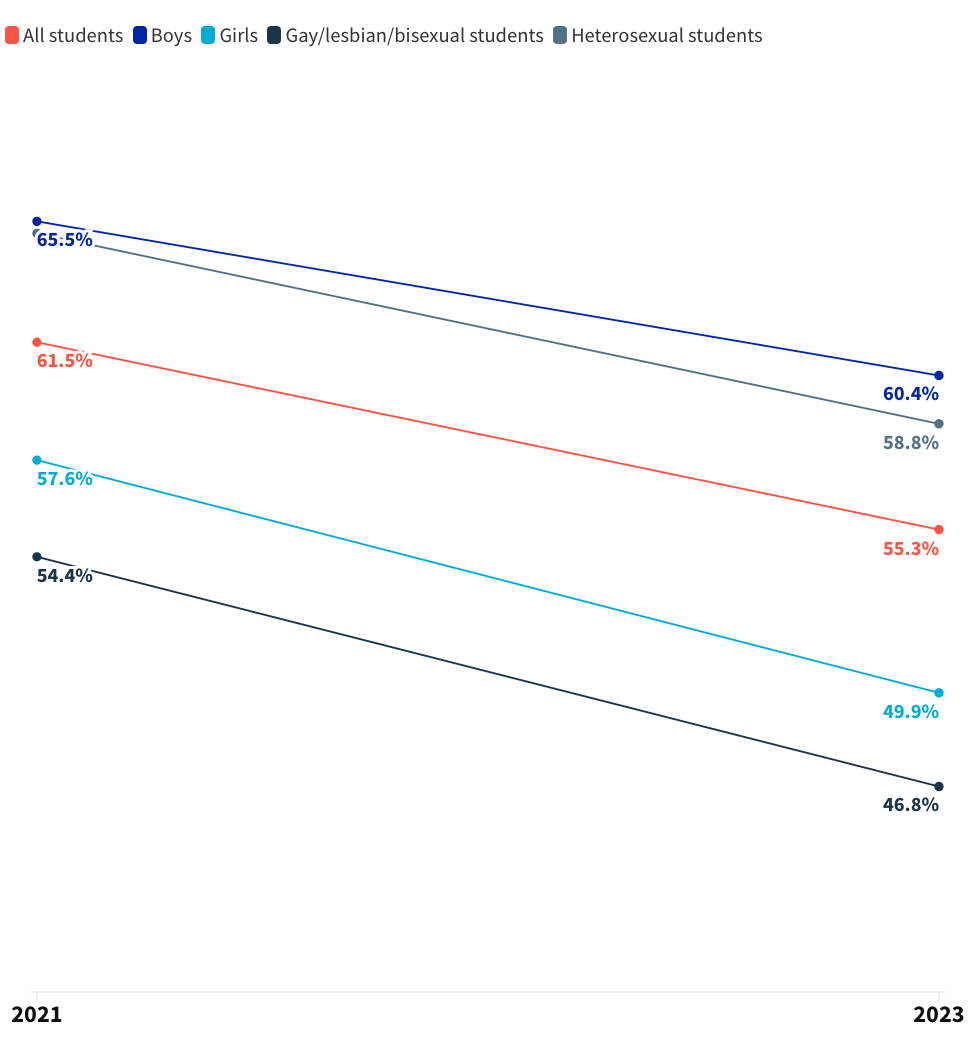
 Moreover, access to supportive relationships is not equitably distributed: factors like race, socioeconomic status, parental education, gender, and immigration status shape the extent and quality of students’ peer relationships and networks—and, consequently, the social capital available to them. For instance, LGBTQ+ students are shown to be over 10 percentage points less likely than their heterosexual and cisgender peers to feel close to others at school, while girls also report lower relational connectedness than boys by more than 10 percentage points. 

Students’ declining feeling of connectedness with consistent disparities for LGBTQ+ and female identifying students after the pandemic 2021-2023  (Peetz 2024)

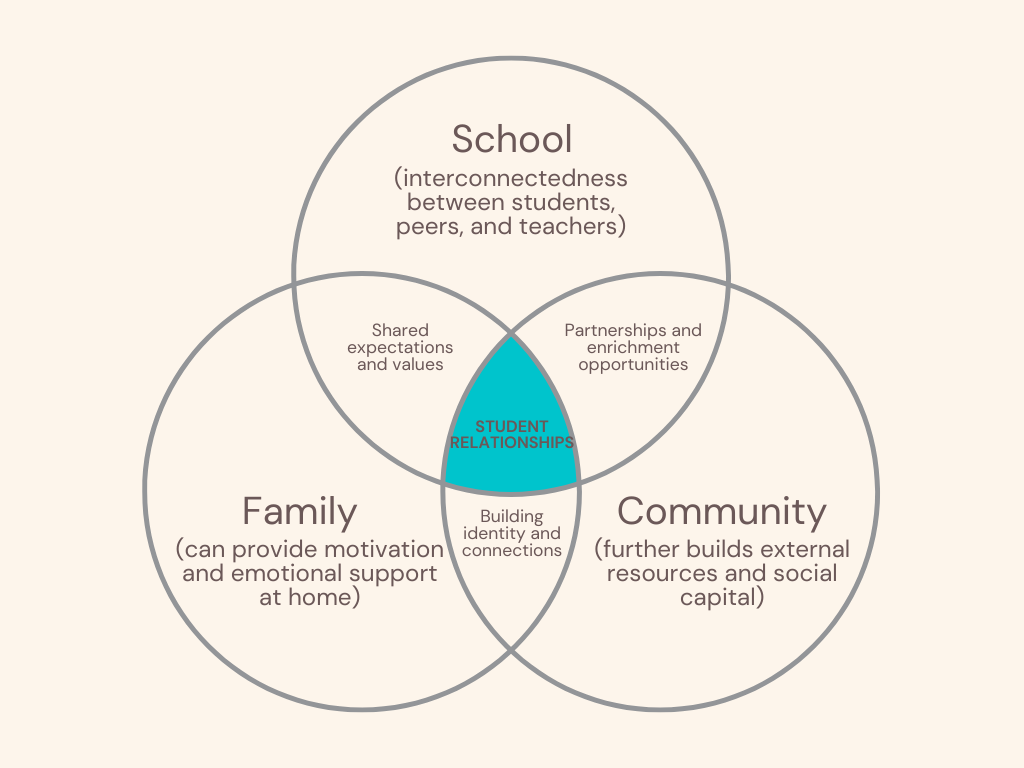
Addressing challenges of disconnection like these can certainly begin in classrooms and schools, but the external relationships in which students and schools are embedded—including those with mentors, families, and the broader community—are essential sources for the development of a whole system of supportive relationships. It’s important to note that students spend only 13% of their time in school, leaving 87% of their lives dependent on the relationships and environments beyond the classroom. Studies have shown that parental support strongly predicted lower levels of work avoidance, indicating that families of students play a primary role in keeping students motivated and goal-oriented. Furthermore, community conditions play a critical role in shaping students’ academic success, often rivaling or even outweighing the influence of family support. Children in high-poverty neighborhoods may be exposed to antisocial peers, leading to diminished academic progress—even in otherwise nurturing households. Yet, supportive communities with strong social cohesion and access to resources or social capital can buffer against these disadvantages, boosting early academic outcomes even in high-poverty areas. Together, these findings emphasize that relational networks—across school, home, and the community—lays the foundation for physical, mental, and academic support.

From this perspective, students’ relationships and networks can be seen as embedded in  a broader, community-wide ecosystem rather than as a product of isolated institutions. When one part of that system falters, the entire structure can be weakened or even collapse. This underscores the importance of an interconnected educational ecosystem, where overlapping relationships between students, educators, families, and community members form a foundation for a supportive and effective learning environment. 

Interconnectedness of schools, family, and broader community are essential for building a strong foundation for educational ecosystems that support student learning and engagement 

What can be done to foster strong relationships in and beyond schools? 

Developing a stronger, more equitable educational ecosystem begins with intentionally nurturing the relationships that fuel student learning and wellbeing. Fortunately, schools do not have to wait for large-scale reform: educators and communities are already implementing micro-innovations—small but powerful and tangible shifts in practices, routines, and resources—that foster connection and support. These include efforts to make visible the connections among students and between students and teachers; to deepen family-student ties through more inclusive school-family communication; and to expand community-student connections through partnerships with local organizations.  

Connecting students and teachers

  • Relationship mapping enables teachers to document and visualize the relationships and social networks among their students. In 5 Steps for Building & Strengthening Students’ Networks, Fisher and Charania describe several relationship building strategies including relationship mapping tools. Many of those tools begin with the development of color-coded lists that teachers can use to indicate students with whom they have strong relationships as well as those who may be more socially isolated. Teachers can also engage their own students in developing maps of the peer relationship in their class, and the same social network mapping strategy can be used to document students’ relationships beyond the school with members of their families as well as with mentors and members of community organizations and health and service agencies. As Fisher and Charania  put it, “Not only does relationship mapping provide more detailed information regarding whom your students know and turn to—it can also surface relationships that you could enlist more deliberately to expand supports or opportunities at your institution.” 
  • The Relationship Check Tool assesses the quantity of relationships and the quality of those relationships as well. The tool is a free survey offered by the Search Institute and discussed as well by Fisher and Charania. The survey is designed to support self-reflection and conversation to help practitioners, educators, and families assess where their connections with young people are strong and where they could grow. This tool helps adults gain insight by asking them to reflect on the quality of their relationships with youth, not as a formal assessment, but as a prompt for intentional dialogue and improvement. It is designed to spark meaningful conversations among peers or between adults and young people about the support, care, or challenge present in those relationships. While not built as a diagnostic instrument, the tool can empower users to identify strengths and gaps in their relational practice, creating awareness that can translate into more purposeful relationship-building in classrooms, schools, or home settings.
  •  Peer Partner programs take many different forms, but they generally involve connecting two (or more) students who support each other in one or more activities. In some cases, peers may support each other in carrying out a physical activity, like running, or in getting to school or showing up for extra-curricular activities or clubs. By engaging in shared activities, students can develop relationships with peers they might not normally come in contact with. Some programs also focus specifically on connecting students to support their academic work. For example, at Acton Academy, Running Partners are peer accountability partners who help one another set daily goals, review progress, and provide encouragement throughout the school day. Students begin each morning by articulating their goals with their running partner, who then checks in to hold them accountable and offer feedback—whether by reviewing an essay, asking clarifying questions, or challenging them to aim higher. In younger grades, teachers adapt the practice by forming “housemate” groups of four, which broaden perspectives and make feedback developmentally appropriate. According to Acton educators, running partners not only help students “hold each other to a high standard of work” but also become an emotional support system, cheering one another on and offering encouragement when motivation dips. 
  • Brief, reflective writing exercises can support students’ sense of belonging. In these exercises, students read first-person accounts from older peers describing common challenges—such as homesickness, academic struggles, or difficulty connecting with professors—and then reflect in writing on their own feelings and strategies for navigating similar experiences. The goal is to normalize these challenges and reassure students that feeling out of place is a typical part of the school experience. According to the researchers who have studied these exercises, students who participated reported feeling less anxious about fitting in and experienced slight improvements in academic performance, earning fewer Ds and Fs than peers who did not engage in the intervention. 

Connecting students, schools, families, and communities

  • App-based platforms provide a relatively new way to connect parents and teachers. Apps like ClassDojo, Seesaw, Remind, and ParentPowered allow educators to share updates, videos, and messages with families in real time, giving parents a window into classroom activities they might otherwise miss. Teachers use these apps to reinforce learning at home, provide reminders, and communicate about student progress, while students can showcase work directly to their families. As Helen Westmoreland, director of family engagement at the National PTA, explains, these apps are “a starting place for good family engagement, not the ending place,” emphasizing that the tools work best when paired with thoughtful in-person connections. 
  • Two-way (virtual) town halls were designed to give students and parents the chance to voice concerns, ask questions, and offer suggestions alongside updates from administrators. During the pandemic, these town halls were adapted from the usual, largely ceremonial,  “parents’ nights”, at Knowledge and Power Preparatory Academy (KAPPA) in New York City to both learn from parents and students  about their needs and to provide critical information about the schools’ response to the school closures. . These bi-monthly meetings became a critical means for understanding students’ social-emotional needs and academic challenges, allowing the school to make adjustments—such as changing start times to address students’ concerns about social distancing. Feedback from families also directly informed advisory lessons, social-emotional learning units, and academic goal-setting activities, ensuring programming responded to students’ needs. 
  • Newcomer Liaisons and Newcomer Coordinators provide support to recently arrived immigrant students and their families. Newcomer liaisons are individuals or teams who serve as  a dedicated point of contact who can work with immigrant families on issues like enrollment, programming, communication, and bilingual services. They can help students navigate school systems and access resources such as healthcare and clothing. By centralizing support, the liaisons aim to reduce the burden on teachers, improve students’ access to services, and foster a more equitable and responsive learning environment, particularly for newcomers in historically under-resourced schools.
  • Digital Directories have been created by organizations like Remake Learning to help students and schools connect with community members and organizations who can provide mentorship, apprenticeships and other learning opportunities. contact information for network members, programs, and organizations. At Remake Learning, the directory enables participants to see themselves as part of a larger network, access available resources, and browse calendars of events and engagement opportunities, strengthening connections across the ecosystem. 
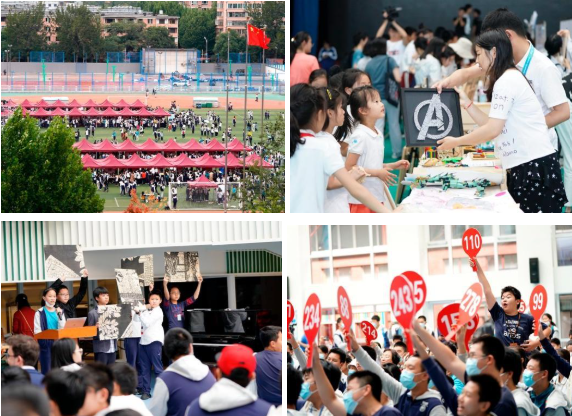
  • Learning Festivals  are events designed to bring together schools and other people and organizations to showcase some of learning opportunities across particular communities. For example, Remake Learning Days, launched initially in Pittsburgh, Pennsylvania in 2015, have now expanded to 10 different regions in four countries. These festivals provide creative, immersive learning experiences across diverse settings—including libraries, tech centers, schools, museums, parks, and community centers—who focus on hands-on, and maker-based education. Beyond providing opportunities for students to find out about learning opportunities in their community, these festivals can also help to foster connections among schools and other organizations in their communities and strengthen the whole learning ecosystem. 

By starting with micro-innovations like these for even one aspect of relationship building—supporting connections among students, between students and teachers or among students, schools and the wider community—schools can lay the groundwork for a system where every student is seen, supported, and connected.

Supplies, Cellphones, and Fear: Scanning the Local Back-To-School Headlines in the US for 25-26 (Part 3)

The third part of IEN’s annual scan of the back-to-school headlines highlights some of the issues that states and cities in the US are facing as students have returned to school. The first part of the scan shared stories from outside the US, and the second part gathered stories about some of the many policy changes, demands, and cuts that schools in the US are having to respond to this year.

For back-to school headlines from Fall 24: Politics, Policies, and Polarization: Scanning the 2024-25 Back-To-School Headlines in the US (Part 1); Supplies, Shortages, and Other Disruptions? Scanning the Back-to-School Headlines for 2024-25 (Part 2); Banning Cell Phones Around the World? Scanning the Back-to-School Headlines for 2024-25 (Part 3); Fall 23: Crises and Concerns: Scanning the Back-to-School Headlines (Part 1), (Part 2), (Part 3). Fall 22: Hope and trepidation: Scanning the back-to-school headlines in 2022 (Part 1)(Part 2) (Part 3); Fall 21: Going back to school has never been quite like this (Part 1)(Part 2)(Part 3); Fall 20: What does it look like to go back to school? It’s different all around the world…; Fall 19: Headlines around the world: Back to school 2019 edition.

          The many funding cuts, executive orders, and other demands from Washington dominated the local school headlines in the US this year, including fears that students might be deported and ICE agents may target schools. But a few of the usual concerns were covered as well, including concerns about the economy, the costs of supplies, and growing concerns about cellphones, AI, and other technologies.


Fears & Deportations

Immigrant Families Fear Trump’s Deportations as Children Return to School, ABC News

For Mixed Status Families, Deportation Fears Cast Shadow Over New Academic YearNPR

An 8-year-old second grade student, born in the U.S. to an undocumented family, stands holding a sign in her graduation cap and gown after her school ceremony outside the Federal Building, source NPR

‘So Many Threats to Kids’: ICE Fear Grips Los Angeles at Start of New School Year, The74

What Mass. Schools are Saying About Immigration Enforcement as Students Return, NBC Boston 

Federal Surge has Taken a Toll on Children of Immigrants in Washington, PBS


Costs & Supplies

Survey: Inflation Less Impactful this Year; Still, Nearly 1 in 3 Back-to-School Shoppers are Making Changes to Save, Bankrate

Back-to-School Prices are a Mixed Bag this Year, NBC News

Parents Say Back-to-School Feels Pricier than Ever, with Many Spending $500+ on Supplies and Activities, Yahoo News

Teachers are Spending More and More on School Supplies. Here’s Why, Indiana Capitol Chronicle

3,000 Teachers Beg for Donations for Basic Classroom Supplies — Despite NYC’s Record-Breaking per-Pupil Spending, New York Post

“There’s no other profession where you’re expected to provide literally the basics that you need to do your job on your own” Source: New York Post

School Lunches Are Costing Families More Than Ever: Here’s Why, Daily Voice


Cellphones, AI & EdTech

Most Students Now Face Cellphone Limits at School. What Happens Next? Education Week

More Students Head Back to Class Without One Crucial Thing: Their Phones, NPR

Students Turn Back to Books as More School Districts Implement Phone Bans, Newsweek

6 Ways Administrators are Handling Cellphone Bans in the New School Year, K-12 Dive

From ‘Bring It On’ to ‘This Policy Is Crazy,’ NYC Parents React to Cellphone Ban, The74

‘The New Encyclopedia’: How Some Kids Will Use AI at School this Year, CNN

ChatGPT Usage Skyrockets as Kids Return to School, Newsweek

Back to School: AI in the Classroom, the Negative Side, WNEP

Major Partnerships are Expanding K-12 AI Literacy, EdTech

Back-to-School Season Brings Spike in Cyberattacks, EdTech

Driver Shortage: Dozens of School Bus Route Cancellations Hit Mat-Su Students, KTUU

Source: KTUU

Arkansas

Arkansas School District Responses to Ten Commandments Law Mixed, Arkansas Advocate

California

California Schools Brace for Fallout from U.S. Supreme Court Decision on Religious Rights, EdSource

California Bill Requires Schools to Alert Families of Immigration Agents on Campuses, The Guardian

Colorado

Denver Schools Chief: Trump Administration is Weaponizing Title IX and Pushing ‘Anti-Trans Agenda’, Chalkbeat

Illinois

Chicago Public Schools Prepare for National Guard Threat, Chicago Tribune

About 200 Students with Disabilities Still Need a Classroom in Chicago, Chalk Beat

Florida

In the Name of Parental Rights, New Law Requires Sign-Off for Corporal Punishment in Florida Schools, Florida Phoenix

Florida Schools Will Test Armed Drones this Fall to Thwart Shooters , K-12 Dive

Massachusetts

What Massachusetts Parents Should Know this Back-to-School Season, Boston Globe

Boston Mayor Wu Expects Deportation Fears to Affect Boston School Attendance, WBUR

Michigan

Michigan Schools will have New Requirements for Teaching English Learners this School Year, Chalk Beat

Minnesota

 Minnesota Schools Adjust Breakfast Menus to Abide by New Federal Sugar Restrictions, Minnesota Star Tribune

Nebraska

Nebraska Students Adapt to Cellphone Ban in Schools, KETV

New Jersey

Newark Students Head Back to School. What’s New this School Year? Chalk Beat

New York

Adirondack Educators Contend with Dwindling Resources as Enrollment Dips, Times Union

New Year, New Rules in New York City: First Day of School Starts with Joy, Jitters, and a Cellphone Ban

Thousands of New Teachers to Start as NYC Pushes Historically Large Hiring Spree to Shrink Classes, Chalk Beat

What to Know About Vaccines in NY as Students go Back to SchoolGothamist

New N.Y.C. Food Standards Could Spell Doom for Chicken Nuggets, New York Times

Free Haircuts for NYC Kids Ahead of First Day of SchoolPIX11

Ohio

Ohio Students Face New Cellphone Ban as School Year Begins, WBNS

Oregon

Families, Staff Return to School Across Oregon, Some Under Fear of ICE Arrests, OPB

“Woodburn School Board urging board members to pass the original ‘Safe and Welcoming Schools’ resolution. The resolution reaffirms protections for students, regardless of immigration status.” Source: OPB

What to Know About Cellphones and Artificial Intelligence as Oregon Students Return to School, OPB

Pennsylvania

As Classes Begin, Pennsylvania School Districts Feel Pinch of Budget Impasse, York Dispatch

Two Susquehanna Township (PA) Schools Cancel Classes Due to Lack of Bus Drivers, WGAL

South Carolina

‘Why Don’t I See my Friends Anymore?’ Parents Fear Deportations are Coming to SC Schools, The Post and Courier

Tennessee

Gun safety classes required, starting in kindergarten, in Tennessee this year, Washington Post

Texas

‘A No-Win Situation’: How Houston School Districts are Responding to the Ten Commandments Classroom Law, Houston Chronicle

Trump’s Immigration Crackdown Upends Life at Austin Elementary School, Austin American-Statesman

Washington D.C.

‘Leave Our Kids Alone’: DC School Year Starts Amid Armed National Guard Patrols, NBC 4 Washington

Parents Mobilize to Protect School Commutes Amid Trump Deployment in DC, Bloomberg

“Members of the National Guard patrol near the Washington Monument on the National Mall in Washington, DC” Source: Bloomberg

Schools Reopen in D.C. With Parents on Edge Over Trump’s Armed Patrols, Education Week

Washington

Washington State District Finally Opens School After Support Staff Strike, The 74

Wisconsin

As Costs Rise, Wisconsin Teachers and Families Pay the Price on Back-to-School Supplies, The Wisconsin Independent

Economics, AI, Cellphones and More: Scanning the International Back-To-School Headlines for 25-26 (Part 1)

AI concerns, cellphone policies, economic worries, and questions about new schedules, new curricula and other changes fill up the back-to-school headlines this year. IEN’s annual scan of the sources of education news and research around the world begins with a look at the Northern Hemisphere headlines from outside the US. Next week, we’ll review the national and local headlines in the US along with some of the biggest changes in federal policy and funding that schools are dealing with this year. 

For back-to school headlines from Fall 23; Crises and Concerns: Scanning the Back-to-School Headlines (Part 1), (Part 2), (Part 3). Fall 22: Hope and trepidation: Scanning the back-to-school headlines in 2022 (Part 1), (Part 2) , (Part 3); Fall 21: Going back to school has never been quite like this (Part 1), (Part 2), (Part 3); Fall 20: What does it look like to go back to school? It’s different all around the world…; Fall 19: Headlines around the world: Back to school 2019 edition.

Africa


Asia & the Pacific

As the new semester approaches, study supplies are experiencing strong sales. Photo: VCG

Europe

Teacher collects pupils’ mobile phones at a school in Espoo. Photo: Vesa Moilanen / Lehtikuva

Middle East


The Americas

Abri, 9, Ecuador, by Chris DeBode for The Guardian

Building the Capacity to Improve and Sustain Foundational Learning Through Government and Local Partnerships in Malawi: Joe Wolf and Kira Keane on the Evolution of Imagine Worldwide (Part 2)

In the second part of this three-part interview, Joe Wolf and Kira Keane describe Imagine Worldwide’s efforts to develop a sustainable model for supporting foundational learning by building partnerships with government officials and local community members. Part one described the evolution of Imagine Worldwide’s approach and part three will discuss the role of teachers in the model and the efforts to adapt the model to three different contexts in Africa. The tablet-based program at the center of Imagine Worldwide’s work, developed by software partner onebillion, serves as a supplement for regular instruction, with each child in a school spending a targeted 150 minutes per week working independently on problems related to reading and mathematics. Imagine Worldwide partnered with the Government of Malawi to rollout the program in 500 schools in Malawi in 2023-24, with the ultimate goal of expanding to all 6000 primary schools, serving 3.8 million learners in standards [grades] 1-4 annually. Joe Wolf is the Co-CEO and Co-Founder of Imagine Worldwide, and Kira Keane is the Director of Communications. (Photos/graphics are from Imagine Worldwide unless otherwise noted.)

Thomas Hatch (TH): In the first part of our interview, when you talked about having the tablets delivered by the government trucks, that seems to me to reflect the idea that you’re trying to build capacity; you’re not just trying to get the equipment to the school. You’re trying to build a local infrastructure that makes it possible to sustain the supply and transportation of the necessary equipment. Is there anything you can add about that coordination and that effort to build capacity? Is it just that you have to be patient and maybe sometimes accept that things will go more slowly and it may take longer to build that kind of relationship with the government? 

Joe Wolf (JW): I think that’s a good question. There’s sort of a simple and beautiful framework that Malawi talks about where there’s an “I do,” and then “we do,” and then a “you do“ phase. The “I do” starts with Imagine and our local partners showing that this can be done. Showing that a certain number of schools have launched the program.  Showing how efficiently the school can be equipped for solar; that the tablets can get delivered; and that kids can get learning. In the “we do” period, where we’re working hand in glove with the government and establishing the different functions within the government. But we’re still providing a lot of support, acknowledging that some of these functions are new and that this is the phase that we’re in right now. Then there’s eventually the “you do” where the government is fully doing this on their own, because the functions have been fully built out. So yes, I think you have to be patient. I think you have to acknowledge that certain things take longer than if we could do them completely on our own all the time. You also have to be transparent in terms of the inevitable challenges that have to be faced. You have to talk about things like the recurring cost for governments. This is technology. It will eventually break, and we have to be in a position to fix it and get it returned into the schools, or else the learning will stop. These are crucial functions that have to be fulfilled for these solutions to be sustained over the long term. 

It’s not easy to get there, but I remember a moment when I was in Malawi and we were doing a co-creation workshop at the Ministry, and many people were saying, “Well, what about this, and what about this, and what about this?” At some point, the head of the program at the Ministry stopped the meeting and said, “Hey, everybody, you’re thinking about this the wrong way. This is not their program. It’s not their job to answer these questions. This is our program, and it is our job to answer these questions.” All of a sudden, the tone really shifted.  The head of ICT said “Oh, okay, let me brainstorm how this is going to work in Malawi.” The head of quality assurance said, “let me talk about how it’s going to work in our context.” So you have to find a way to really bring them in as co-creation partners. It’s saying, “Hey, we’ve got some knowledge. We have some experience here, and we’ll bring what we know to the table, but this is your program, and you have to want it.” In Malawi, it took us about seven years to have the right conversation with the right people about the right topics. But as we’re launching in Tanzania and other places the seven years of learning has been compressed a bit. Now, it’s a little bit easier because the starting point in Tanzania has included all the different departments within the Ministry of Education. It’s included the Ministry of Finance. It’s included the Ministry of Regional Administration and Local Government. 

Kira Keane (KK): In terms of sustainability, there was another lesson learned that I think was particularly important. At first, we were thinking that there would be ripple effects, like the creation of jobs for local fabrication or the development of training for local technicians to make repairs. But we quickly realized that these were far more than just ripple effects. We recognized that our government partners foresaw the impact of job creation, ICT training, digital skill training, bringing solar power into communities that hadn’t had it. So now we are trying to be more explicit about building the support for these into the communities and government systems. Now, countries like Sierra Leone and Tanzania are very interested in these additional benefits of the program. 

A close-up of a graph

AI-generated content may be incorrect.

TH: Those are great examples of some of the infrastructure and capacity that needs to be built to get the tablets into the school, what were some of sort of the key implementation challenges that you had to address at the school level to get the tablets into students’ hands for the right amount of time?

JW: First of all, data systems in many of the countries we are working in are really, really inadequate, so we first needed to answer a basic question: “How many kids are in this school?” Our model is predicated upon every child having a tablet every single day for up to an hour, and then that tablet rotates to many children. Just establishing how many kids are there drives the number of tablets, which drives the number of solar panels and lithium batteries needed. We’ve found that when the equipment goes into the school and the children start learning, enrollment spikes because kids that were out of school come to school. Then kids start moving to schools that have the tablets. Even low-fee private school kids are transferring back into the public systems. We have to anticipate that and have to make sure there are extra tablets available. We also have to have a buffer in terms of the solar capabilities: because sometimes the sun might not be shining. We have to do all these calculations to determine how much equipment each school needs. 

We also have to make sure the school is ready. It needs to have a watertight, secure, room to house all of this equipment, so sometimes we’ve had to do roof reinforcements and replace or repair windows and doors. It’s not a huge operational challenge in the grand scheme of things, and it’s not particularly expensive. But you do need to make sure that when the equipment shows up, you actually have a place where it can be securely and safely stored. That’s a process that has to be completed well before the equipment gets there. Then you have a logistical puzzle that stems from the fact that the solar energy and the tablets and the cabinets for charging and securely storing the tablets all handled by different entities. Someone has to coordinate everything to make sure the charging security cabinet is already there before the tablets arrive. Compared to the challenges of building a school, getting all the teachers to show up, keeping the teachers trained, and enabling them to teach effectively, these logistical things are fairly low on the complexity scale. But they have to get done on time and under budget. 

A table of information with text

AI-generated content may be incorrect.
Imagine Worldwide Theory of Change

We also have to take into account what we call community sensitization. Very often, this is the first technology that has gone into a community, and there can be a lot of skepticism and concerns about the content on the tablets – “What is this?” “What’s this going to do to my child?” We’ve found that a really important first step is to enable the community leaders, religious leaders, the tribal leaders, the PTA leaders to experience what their children will experience. That helps them to feel comfortable with what’s happening and to take ownership. We use language like “this is your equipment;” and emphasize that they are the ones that will benefit and it’s their responsibility to help us make sure that it’s taken care of. We’ve seen surprisingly low theft rates, given the value of the equipment in some of these contexts, and a big part of that is that communities are owning it as their work for their children. These aren’t third party assets that are controlled by some distant NGO. 

TH: Has that community sensitization become a standard part of the model now?

JW: Yes, it’s a workshop we’ve developed, and it brings together the power centers within a community. That happens before a child gets anywhere near the equipment. We also do trainings for all of the teachers and administrators within a school. We do that so that if a teacher isn’t there one day, or a teacher leaves, there are others that can step in to be facilitators. The facilitator role is relatively straightforward. The children are autonomously using the content, but people need to be trained in order to be able to take care of technical issues and things like that, and having the entire school get trained has proven to be very beneficial. It’s also technology-oriented training that’s valuable to the teachers. A lot of them haven’t had a lot of exposure to technology, so it’s a positive professional development opportunity for the teachers themselves.

A group of people sitting on the ground with headphones on

AI-generated content may be incorrect.
A community sensitization session in Malawi (CRECCOM)

KK: It’s also important to note that the people that are conducting these community sensitization workshops are usually from the community themselves. They’re trusted messengers. It’s either our implementation partners who are local and are known within the community, or teachers showing other teachers. 

TH: You’ve already talked about many of the key steps for implementation, is there anything else you want to highlight? 

JW: I think what we have on our side is that engagement is incredibly strong. When you walk into a classroom with 100 standard one learners, six-year-old and seven-year-old learners, it’s completely silent. Every student has the headphones on; they’re looking at the tablets; they’re completely immersed. 100% of the time when people come and see this work they tell me they’ve never seen a room with one hundred six- and seven-year-olds that’s completely silent with every kid totally on task. But the teachers have been very positive as well. Nearly 98% of teachers have said that the program has made them more effective; made their jobs more enjoyable and made their jobs more sustainable. Kids are coming to school more often. They’re paying more attention while they’re there. 

The tablets are also really good at helping with remediation, so kids are catching up faster, but it’s also good with acceleration for kids that are ready for harder content. That means you have stakeholders responding uniformly positively. We always ask, “what can we be doing better?” but it’s always “can you bring more?” “Can we do the older grades?” “Can you expand to the school next to us?” Once you make sure that you have enough equipment for all the kids, and once you do a good job of getting the adults to do what they need to do to get the equipment in the room and safe and secure, the rest of it kind of takes care of itself. 

Next Week: Scaling and Adapting Tablet-Based Supplemental Learning in Malawi, Sierra Leone, and Tanzania Joe Wolf and Kira Keane on the Evolution of Imagine Worldwide (Part 3)

Bringing a Tablet-Based Foundational Learning Program to all the Primary Schools in Malawi: Joe Wolf and Kira Keane on the Evolution of Imagine Worldwide (Part 1)

What does it take to scale a tablet-based foundational learning program to all the primary  schools in Malawi? In this 3-part interview, Joe Wolf and Kira Keane describe how Imagine Worldwide has approached that challenge and share some of what they have learned in the process.  The tablet-based program at the center of Imagine Worldwide’s work, developed by software partner onebillion, serves as a supplement for regular instruction, with each child in a school spending a targeted 150 minutes per week working independently on problems related to reading and mathematics. Imagine Worldwide partnered with the Government of Malawi to rollout the program in 500 primary schools in 2023-24, with the ultimate goal of expanding to all 6000 primary schools in Malawi, serving 3.8 million learners in standards [grades] 1-4 annually. Joe Wolf is the Co-CEO and Co-Founder of Imagine Worldwide and Kira Keane is the Director of Communications. (Photos/graphics are from Imagine Worldwide unless otherwise noted.)

TH: Can you describe for us some of the key steps or phases you went through as you developed your work to test and then to scale-up this tablet-based program in Malawi? 

Joe Wolf: The first phase of our work was all research oriented. We wanted to see if these learner-centric tablet models could work – were they really effective for children? – before asking under-resourced systems to spend time, energy, and capital on them. That meant we had a prolonged research phase that included nine randomized controlled trials. That was across different contexts, different languages, different implementation models, different countries – really exhaustively trying to prove that these solutions can, in fact, add significant value. 

The second phase was what we call “learning to scale:” What are the processes that need to be done repeatedly well to scale within these contexts? We purposely spread our work out across seven countries, with different implementation models, different implementation partners, different types of structures to really test what needs to be done repeatedly well so that these systems can adopt the work at scale. Then, only in the last three years, we’ve put the pedal down and said, “Okay, I think we’re ready to really think about scaling.” And we were only able to act on scaling thanks to the leadership of the government of Malawi, who saw the learning gains of our pilot programs and saw how this edtech intervention could support their national goals of improving foundational skills.  At that point in 2022, we served around 6000 children, but we increased it to about 700,000 children by the beginning of 2025. That’s a 100x increase in the last two years, which I think is a testament to the scalability of the model, the execution of the team, and the leadership of our government partners. 

A map of africa with a yellow circle

AI-generated content may be incorrect.

TH: What’s the third phase? Implementation? 

JW: I would say it’s scale plus continuous improvement. Now, our research is less efficacy oriented and more implementation oriented. How do we make it better and better and better? To address that, we have four levers we focus on: 

  • Access: How do we serve more and more children and make the solutions easier and easier to implement? 
  • Cost-effectiveness: How do we bring down the recurring costs to be as low as possible? We’ve brought costs down around 75% in the last five years, and we think there’s still room to go. Our key inputs are all highly deflationary, so we’re getting better economies of scale as we grow. Right now, we’re at about seven dollars (USD) per child per year. We think we can get that under five dollars (USD) as we get better economies of scale. 
  • Advocacy: How do we use data to improve the implementation model in the software so that the efficacy of the program continues to go up and up and up? It’s one of the beauties of technology that it can iterate and improve. You’re not building a building and putting in books and then five years later it’s deteriorated. We actually have the ability to use data to continuously improve through this flywheel of innovation.
  • Sustainability. How do we work with our government partners to build operational and financial sustainability?  And how do we do it starting day one, where we’re building the “muscles” within the existing education system, as opposed to the classic approach of starting off outside the system and then trying to hand it off to the system. Too often, if you haven’t done a good job of building that internal muscle, and then things fall apart. So we’ve really taken the system strengthening approach, acknowledging that there are capacity and infrastructure gaps within the countries where we work and that there are key functions that need to be built that don’t currently exist within some of these systems. We’ve tried to give it time so that, by the end of the implementation phase, the system has already been doing the work for an extended period of time. That way, you don’t have this fall off as you try to hand-off everything to the system itself.

Kira Keane: I just want to underscore a couple of points that Joe made. For Imagine, this notion of the continuous improvement loop, it’s not like we did things, something went wrong and we’re like, “Oh, we have to fix this.” This was an intentional design element from the very beginning: How do we get continuous feedback to improve both the software itself and the implementation model? And the other point is that our key question is “How do we serve as many children as possible?” The need is so immense and the population growth will be so intense over the next 10-15 years so we really need to be focused on scale. That means working with our government partners to aim for generational impact, really looking at country-wide scale, and focusing on how we design for that.

JW: I’ll add two more things to what Kira said. The ecosystem is exhausted by pilots – by small things that don’t scale, that don’t have evidence, that take a lot of time and resources. Scale from day one very much aligns with where the governments are. They have a big problem with the lack of foundational learning among their students, and they need big solutions. Little, tiny things are just distracting and take too much time and energy. The second thing is that we have positioned our organization to be temporary in nature, so our job is to put ourselves out of business as quickly as we possibly can. We don’t see these as “Imagine Worldwide” programs in Malawi or “Imagine Worldwide” in Sierra Leone. These are programs of the government in Malawi and of the government in Sierra Leone that we are helping to support. We’re helping to build capacity and infrastructure to build muscle within the systems. But as soon as the government is ready to maintain this on its own, we are more than pleased to step out of the way and to move on to the next challenge. I think that positioning is really important for the governments. It’s really important for the funders. It’s really important for us and our team. Too many times, an NGO establishes itself and 50 years later, the NGO is still there, doing the work. We need this work to be sustainable within existing systems. Part of that is a commitment for us to get out of the way. We have to believe in sovereignty and the power of governments to run themselves, while also acknowledging that the use of technology in a place like Malawi is new, and so there is going to be a period of time where we have to build some functions that do not currently exist.

TH: That certainly resonates with my experiences in the US where we’ve seen multiple improvement efforts collide in schools in ways that can actually undermine their capacity for improvement. What made Malawi a good context for you to work on scale-up?  

JW: The work in Malawi actually predates the partnership with Imagine. There was a program called “Unlocking Talent,” with the software developer onebillion that became our partner. The onebillion CEO went to Malawi, I think, 15 years ago, fell in love with the country, and developed the product. The first product they developed was in Chichewa, in Malawi. In other words, this was not developed in the West and then adapted to the context. This actually was developed within the Malawian context. We became a research partner to look at impact and to help do the RCT work. That has now evolved into a much more scalable model that we call the BeFIT Program. It’s serving standards [grades] one through four, whereas the first program was only standard two. 

A person holding a tablet

AI-generated content may be incorrect.
Key elements of the BeFIT program in Malawi

There have been a whole bunch of iterations along the way to develop our general approach, but it basically evolved by thinking about what it would take to actually scale the program much more cost effectively to many more students in more systems. If you look at the other places that we worked, you’ll see that we started with finding local partners, mostly local NGOs, some local social-oriented businesses, and then turned over a lot of the functions to those local partners to see what worked in different contexts. From that, we have built a series of centralized functions that we’re now drawing on in our country partnerships, as opposed to having it be completely decentralized. We learned a lot from the initial more decentralized exploration, but we’re now in the process of creating more standardization. Part of scaling depends on acknowledging that you can’t have fifty different bespoke operations. You need to have systems and standards and data systems. When you have 6000 children in Malawi, using a total of 1000 devices, you can do some things by hand; but now we’re trying to serve millions of children in Malawi, with hundreds of thousands of tablets. We now need data driven systems in order to be able to manage that equipment in the field. 

TH: Let’s follow the arc of that evolution in Malawi. What are some of the steps that were crucial to your learning and to the development of the model?

JW: In Malawi, we took seven or eight years to do the research and to get the right level of government buy-in to understand what was working. That included learning things like what’s the infrastructure for the typical school in Malawi? Just to give you the context, that means more than 100 children per teacher and inadequate levels of teacher training. There’s very rarely basic infrastructure in place, so no electricity and certainly no internet connectivity. That’s the reality of the average class in Malawi. So as you think about the components of our model that have emerged the first was what you would call the infrastructure component. We put solar power into all of our schools, addressing questions like: 

  • Where do solar panels go? 
  • How does the solar electricity feed a bank of lithium batteries? 
  • How do the tablets get stored and secured overnight so that they’re charged and they’re safe? 
  • How does all that equipment get distributed to children in a really efficient manner, so that you’re getting as much asset utilization as possible and as much learning time as possible? 

In the end, our research consistently shows that the number of minutes each student uses the content is directly correlated to the level of learning. So we’re addressing these 101 things that need to be done in terms of the infrastructure and operations to maximize that time on task. And that has to take into account that the school day and the school periods are very short in Malawi and you have a lot of children in the classroom. So even just getting kids in and out of a classroom is a lot harder than in many other contexts.

A group of children raising their hands

AI-generated content may be incorrect.
A classroom in Malawi

TH: You just described those complexities really effectively, but for those of us who aren’t familiar with the context, can you go into it even more deeply? What does it really take to get a program like this up and running at scale? 

JW: I think that in addition to a foundational learning organization, we are, in a lot of ways, also a supply chain logistics company. Learning gains are still our north star, but the reality is you’re talking about a phase one of BeFIT that involved launching the program in five hundred schools in five months across half of the country of Malawi, including very rural districts. So we have to deal with the logistics of getting five hundred secure storage cabinets into those schools. We have to deal with the logistics of getting 100,000 tablets distributed across those 500 schools and of getting the solar equipment put into 500 schools. That’s a significant operational lift, and you have to approach that with a level of rigor in terms of those key functions, if you’re going to be able to scale, and you’re going to be able to do that on time. And we had to do that on budget in the middle of a huge macro-economic meltdown in terms of currency and raw materials. In the grand scheme of things, once the equipment is in place, kids can get learning very, very quickly. There’s not a huge lift in terms of adult training. There’s not a huge lift in terms of the role of the adult in the model itself; the content has been built to be autonomous, meaning the child can be self-directed. The tablets themselves have been built to be very robust. A lot of enhancements have been made to make the tablet durable. There’s a long battery life so it can be used throughout the day. Every part of the tablet has been built with screws so that a component can be swapped out if something breaks. So every part of the context has been taken into account in order to get that equipment into the field and utilized. This is one of the big learnings: you have to start with the context in mind, and you have to start with the learning objectives in mind. You then make a series of software decisions, and then you make a series of hardware decisions. Too often in education, it goes the other direction, where people buy stuff, but then they haven’t really thought about what’s going to go on the stuff? What’s the training required? What are the charging and security components of it? What is our learning objective at the end of the day? You have to start with learning, move into the context, and think about all the infrastructure decisions that need to be made in order to make that learning possible in that context. 

KK: I think it’s also important to flag that in working on the logistics we included the government from day one. That means things like using the delivery trucks the government already had. Trying to manage that coordination may have been a little slower or less efficient in some ways, but too often people design an implementation model, put a bow on it, and then hand it to the government without including them from inception. 

Next Week: Building the Capacity to Improve and Sustain Foundational Learning Through Government and Local Partnerships in Malawi: Joe Wolf and Kira Keane on the Evolution of Imagine Worldwide (Part 2)

Back with Back to School Posts soon…

IEN will be taking a break for a bit, but we will be back August 20th with posts on efforts to support the development of student relationships post-pandemic; a large-scale initiative to implement a tablet based learning program in Africa; and our annual scan of news stories related to the start of the new school year in many parts of the world.

In the meantime, please check out some of our stories from this summer:

Mel Ainscow on reforming education systems for inclusion and equity

This week, Mel Ainscow discusses some of the key insights from his new book Reforming Education Systems for Inclusion and Equity. Ainscow is Emeritus Professor, University of Manchester, Professor of Education, University of Glasgow, and Adjunct Professor at Queensland University of Technology.

What’s the greatest challenge facing education systems around the world? Finding ways of including and ensuring the progress of all children in schools. In economically poorer countries this is mainly about the millions of children who are not able to attend formal education. Meanwhile, in wealthier countries many young people leave school with no worthwhile qualifications, whilst others are placed in special provision away from mainstream education and some choose to drop out since the lessons seem irrelevant. Faced with these challenges, there is evidence of an increased interest internationally in the idea of making education more inclusive and equitable. However, the field remains confused as to the actions needed in order to move policy and practice forward. 

Reforming Education Systems for Inclusion and Equity book cover

Reforming education systems

Over the last thirty years or so I have had the privilege of working on projects aimed at the promotion of inclusion and equity within education systems, in my own country and internationally. This leads me to propose a radical way of addressing this important policy challenge. This thinking calls for coordinated and sustained efforts within schools and across education systems, recognising that improving outcomes for vulnerable learners is unlikely to be achieved unless there are changes in the attitudes, beliefs and actions of adults. All of this echoes the views of Michael Fullan, an internationally recognised expert on educational change, who argues: “If you want system change you have to change the system!”

In Reforming Education Systems for Inclusion and Equity, I suggest six key ideas that can be used to guide reform efforts:

  1. Inclusion and equity should be seen as principles that inform educational policies. These principles should influence all educational policies, particularly those that are concerned with the curriculum, assessment processes, teacher education, accountability and funding.
  2. Barriers to the presence, participation and achievement of learners should be identified and addressed. Progress in relation to inclusion and equity requires a move away from explanations of educational failure that focus on the characteristics of individual children and their families, towards an analysis of contextual barriers to participation and learning experienced by learners within schools. In this way, those students who do not respond to existing arrangements come to be regarded as ‘hidden voices’ who can encourage the improvement of schools. 
  3. Schools should become learning communities where the development of all members is encouraged and supported. Reforming education systems in relation to inclusion and equity requires coordinated and sustained efforts within schools. Therefore, the starting point must be with practitioners: enlarging their capacity to imagine what might be achieved and increasing their sense of accountability for bringing this about. The role of school leaders is to create the organisational conditions where all of this can happen.
  4. Partnerships between schools should be developed in order to provide mutual challenge and support. School-to-school collaboration can strengthen improvement processes by adding to the range of expertise made available. In particular, partnerships between schools have an enormous potential for fostering the capacity of education systems to respond to learner diversity. More specifically, they can help to reduce the polarisation of schools, to the particular benefit of those students who are marginalised at the edges of the system, and whose progress and attitudes are a cause for concern. 
  5. Families and other community partners should be encouraged to support the work of schools. The development of education systems that are effective for all children will only happen when what happens outside as well as inside a school changes. Area-based partnerships are a means of facilitating these forms of cooperation. School leaders have a crucial role in coordinating such arrangements, although other agencies can have important leadership roles. 
  6. Locally coordinated support and challenge should be provided based on the principles of inclusion and equity. The presence of experienced advisers who can support and challenge school-led improvement is crucial. There is an important role for governments in creating the conditions for making such locally led improvements happen and providing the political mandate for ensuring their implementation. This also means that those who administer local education systems have to adjust their priorities and ways of working in response to improvement efforts that are led from within schools.
Mel Ainscow, Source: Alchetron

Using evidence

Evidence is the life-blood of inclusive educational development. Therefore, deciding what kinds of evidence to collect and how to use it requires considerable care, since, within education systems, what gets measured gets done. This trend is widely recognised as a double-edged sword precisely because it is such a potent lever for change. On the one hand, data are required in order to monitor the progress of children, evaluate the impact of interventions, review the effectiveness of policies, plan new initiatives, and so on. On the other hand, if effectiveness is evaluated on the basis of narrow, even inappropriate, performance indicators, then the impact can be deeply damaging. 

The challenge, therefore, is to harness the potential of evidence as a lever for change, whilst avoiding these potential problems. This means that the starting point for making decisions about the evidence to collect should be with agreed definitions of inclusion and equity. In other words, we must measure what we value, rather than valuing what can more easily be measured. Therefore, evidence collected within the education system needs to relate to the presence, participation and achievement of all students.

Implications

These ideas are guided by a belief that inclusion and equity should not be seen as a separate policy. Rather, they should be viewed as principles that inform all national policies, particularly those that deal with the curriculum, assessment, school evaluation, teacher education and budgets. They must also inform all stages of education, from early years through to higher education. In this way inclusion and equity must not be seen as somebody’s job. Rather, it is reform agenda that must be the responsibility of everyone involved in providing education.

New Pathways into Higher Education and the Working World? Scanning the Post-COVID Challenges and Possibilities for Access to Colleges and Careers in the US (Part 2) 

What can be done to reduce some of the barriers that limit students’ post-high school opportunities? In the second part of this two-part series, RJ Wicks scans recent news and research from the US to survey some of the “micro-innovations” that may help to expand the pathways into college and productive careers. The first part of this scan reviewed the current conditions for students in the US as they try to find their way into college and the workforce. 

COVID-19 accelerated longstanding challenges: college enrollment dropped especially at community colleges; financial insecurity forced some students to pause or leave school; equity gaps widened; and reports continue to suggest that many students are unprepared for life after high school. Yet educators are also developing a host of innovative practices and programs that are helping to address these and other issues. Initiatives such as guaranteed admissions, promise programs, career and technical education (CTE), dual enrollment offerings, early college high schools, and work-based learning are demonstrating the potential to create new and smoother pathways into post-secondary academic and professional environments 

Guaranteed Admissions Programs 

Guaranteed admissions programs seek to make college admissions more automatic and less selective by reaching out to students who meet admissions criteria and offering them a place. For example, a number of higher education institutions in Michigan formed the Michigan Assured Admission Pact (MAAP), which provides guaranteed admission to students graduating from a Michigan high school if they have earned a cumulative high school grade point average of 3.0 or above. Related state programs include Admit UtahWashington State’s Guaranteed Admissions Program, University of Texas Top 10% Rule, Direct Admission Minnesota, and SUNY’s Top 10% Promise. 

Promise Programs

Promise programs are tuition-assistance initiatives designed to increase access to higher education, particularly for low-income and underrepresented students. These programs often eliminate financial barriers by covering remaining tuition costs after other financial aid has been applied, effectively making college more accessible and affordable. As of 2023, there are over 400 promise programs across the United States with research-to- date suggesting that the most effective offer free or reduced-cost college tuition along with structured advising, explicit communication and messaging, and outreach. According to the National Conference of State Legislatures, all 50 states have at least one local or statewide program. Exhibiting a variety of different approaches, promise programs include “last-dollar” programs that fill in tuition gaps left after other aid has been used, as well as “first-dollar” programs that provide tuition support upfront. In some cases, in addition to covering tuition costs, some programs provide additional support for the many other expenses that can make completing college difficult. 

A study of 33 public community college promise programs across the U.S. found that these initiatives significantly increased enrollment among first-time, full-time students, with the largest gains seen among Black, Hispanic, and female students. According to that same study, initial first-time enrollment rose by 47% for Black men and 51% for Black women, while enrollment for Hispanic men and women increased by 40% and 52%, respectively.

  • Kalamazoo Promise is a first-dollar, place-based scholarship that covers up to 100% of tuition at any public—and select private—college or university in Michigan for students who graduate from Kalamazoo Public Schools. The program requires continuous enrollment in the district since at least ninth grade. Since its launch, it has led to a 14-percentage point increase in college enrollment overall and a 34-point increase for four-year college enrollment. Students in the program attempt more college credits—15% more in the first two years—and are more likely to complete a degree: six years after high school, credential attainment rose from 36% to 48%, driven largely by bachelor’s degrees. The program’s positive impacts were especially significant for low-income, nonwhite students, and women. Economically, the Promise has yielded an estimated 11% internal rate of return in lifetime earnings.
  • Tennessee Promise offers last-dollar scholarships for community and technical colleges that covers remaining tuition costs after federal and state financial aid is applied. In addition, the program requires students to participate in mentoring initiatives to 1) help them with completion of financial aid forms (FAFSA); 2) guide them through the college application process; and 3) provide ongoing support once enrolled. To foster a culture of accountability and civic engagement, students must complete eight hours of community service each semester and maintain a minimum GPA of 2.0.  The program contributed to a 11.4% increase in first-time freshmen enrollment at community colleges in Tennessee in its inaugural year. The program also helped increase retention rates and improve college completion.  Over 125,000 students benefited from the program in its first decade.
Source: Brookings

Early College and Dual Enrollment Pathways

Dual enrollment and early college high school programs offer high school students unique opportunities to earn college credits, reducing the time and cost required to attain a degree. While both initiatives aim to improve access to higher education, they differ in structure and outcomes. Dual enrollment allows students to take college-level courses alongside their high school curriculum. In contrast, early college high schools are structured programs where students can earn both a high school diploma and up to two years of college credit, often on a college campus and with integrated support systems. A study by the American Institutes for Research found that 84% of early college students enrolled in college after high school graduation, compared to 77% of their peers. Additionally, 45% of early college students earned a college degree within six years, compared to 34% of the control group. 

By getting students into college-level coursework before graduation, these programs aim to help students build momentum and save money. They also provide what can be called “stacked supports” across sectors. In the process, they intend to break down silos and align expectations across K-12, higher ed, and workforce systems. Some studies point to specific benefits for students in these programs, including increased college enrollment and completion rates, particularly among underrepresented groups. 

  • P-TECH (Pathways in Technology Early College High School) provides a six-year program where students earn both a high school diploma and a no-cost associate degree, all while working in “real world” placements in partnerships with companies like IBM. Launched in 2011 in Brooklyn, New York, through a collaboration between IBM, the New York City Department of Education, and the City University of New York, P-TECH provides a single high school program where students can take college-level coursework and build technical skills and receive industry mentorship in industries such as health IT and energy technology at the same time. In 2023, one evaluation of the model found that, seven years after entering high school, students in New York City’s P-TECH 9-14 program were 5 percentage points more likely to earn an associate’s degree — results driven particularly by young men, 13% of whom completed a degree compared to just 3% of their peers in other NYC high schools. After a 2014 visit by the Australian Prime Minister, Australia opened two P-TECH schools and since then the P-TECH network has grown to include 300 schools in 26 countries. 
P-TECH Six-Year Model
  • Boston Public Schools’ $38M Healthcare Career Training Expansion strives to build career pipelines in critical fields by embedding healthcare education directly into the high school experience. Students can begin focusing on a healthcare specialty as early as 10th grade and participate in hands-on training, job shadowing, and simulation labs. The initiative includes: 
    • Specialized vocational academies tailored to healthcare careers; 
    • Dual enrollment opportunities that allow students to earn college credit;
    • Paid summer internships at leading hospital systems like Mass General Brigham. 
    • Boston’s program is part of a broader $250 million Bloomberg initiative across ten major U.S. cities. 

Key Micro-innovations helping get students into and through college/career pathways 

Although the promise programs and dual enrollment and early college programs often strive to provide comprehensive support, they also encompass some seemingly small but strategic design choices that can be implemented on their own or in concert with other innovations.  

  • Mandatory mentorship and coaching. A number of Promise Programs assign trained mentors or success coaches to ensure students receive personal guidance—not just information. For example, Detroit Promise pairs each student with a full-time Campus Success Coach who provides personalized support, connects them to campus resources, and helps them overcome common barriers to persistence. This human connection helps demystify systems and boosts retention.
  • Just-in-time financial support. For many students, non-tuition costs – even a few hundred dollars – can serve as major barriers to completing courses and degrees. In anticipation of these financial burdens and to remove barriers before students hit a crisis point some promise programs, like CUNY ASAP, provide textbook and transport subsidies. Georgia State University’s Panther Retention Grants provides small amounts of financial support (“micro-grants”) to students with outstanding balances that would otherwise prevent them from registering for classes. 
  • Proactive communication and “nudges.” MATC’s FAFSA workshops and Admit Utah’s centralized digital tools make complex processes easier to understand, especially for first-gen or low-income students who may lack application support at home or school.
  • Using technology to support the college application process. Admit Utah uses technology to close “guidance gaps,” recognizing many high school students may not have access to counselors or college guidance. To do so, Admit Utah provides a centralized online platform where students can explore college options, learn about scholarships and financial aid, and use AI-powered tools to navigate the application process. 
  • Contextualized career learning. Boston’s healthcare pathways and P-TECH embed industry-aligned experiences – job shadowing, internships, and certifications – within the high school curriculum, helping students see the relevance of their education and build employable skills early.
  • Clear, student-friendly messaging. MATC’s “Free Tuition” campaign doesn’t just market affordability – it shapes perceptions and expectations about who belongs in college, often reaching students who wouldn’t have otherwise applied.

Acknowledging the challenges and continuing to expand the options 

As momentum builds around some of these new pathways into post-secondary success, challenges remain. Despite its growing popularity, access to dual enrollment remains uneven. Black and Hispanic students, English learners, and students with disabilities are consistently underrepresented. Key barriers include lack of funding, which shifts costs like tuition and textbooks onto students; limited access in schools serving low-income communities; inadequate advising; and a shortage of qualified instructors—often due to strict credential requirements for teaching college-level courses in high schools. These gaps limit who benefits from dual enrollment and highlight the need for targeted support and structural investment. 

The popularity of free college programs can also quickly overwhelm campuses if they can’t keep up with the demands for more faculty, advisors, facilities, and other resources. MassEducate, for example, covers the full cost of tuition for eligible students at any of the state’s 15 community colleges and even provides allowances for some students who need help paying for books, supplies and other costs. Launched in the fall of 2024, the program already contributed to a 14% rise in community college enrollment, with some campuses reporting enrollment increases of almost a third in one year. Under these conditions, even program advocates are worried that students, particularly first generation college students, will drop out if hiring and support for faculty does not keep pace. 

Furthermore, scaling does not always lead to success. For instance, Washington State’s efforts to replace high school exit exams with multiple graduation pathways encountered a number of implementation challenges. In 2023, after the changes were made, one in five seniors had no graduation pathway at all, and students in smaller or rural schools often lacked access to robust options. Some were funneled into lower-wage career tracks or military pathways by default, raising concerns about limited opportunity, inadequate guidance, and uneven access across schools and student populations.  At the same time, despite the challenges, states are continuing to try to increase the options and scale them to as many students as possible. For instance, Colorado, Delaware, and Indiana are expanding career-focused high school experiences. Colorado’s 2021 Successful High School Transitions bill allows students in internships to count as full-time learners; Delaware’s Colonial School District fosters interdisciplinary collaboration through interconnected career pathways; and Indiana is redesigning its diploma to combine core academics with two years of pathway-specific learning and work-based experience. In North Carolina, Guilford County Schools’ Signature Career Academies are preparing students for rapidly growing fields like AI and biotechnology. 

As these and other efforts to create new college and career pathways continue to grow, real progress will hinge on learning from what works, addressing persistent gaps, and ensuring every student has a structured path to postsecondary success.