Category Archives: Scan

High satisfaction, high demands, and changing demographics: Scanning the headlines on the results of the TALIS 2024 (Part 2)

Teachers’ workloads, AI use, and the status of the teaching profession overall are among the key issues highlighted by the media sources that covered the recent release of OECD’s Teaching and Learning International Survey (TALIS) 2024. In this second part of a two-part post, IEN rounds up some of the headlines that discuss the results for different countries. Part 1 provided a summary of OECD’s results, and Part 2 will For comparison, see previous coverage of the release of the results of TALIS 20218 (Volume 1; Volume 2).

Headlines around the world

Albania

Albania among top OECD countries in international teachers’ survey results, Albanian Telegraphic Agency

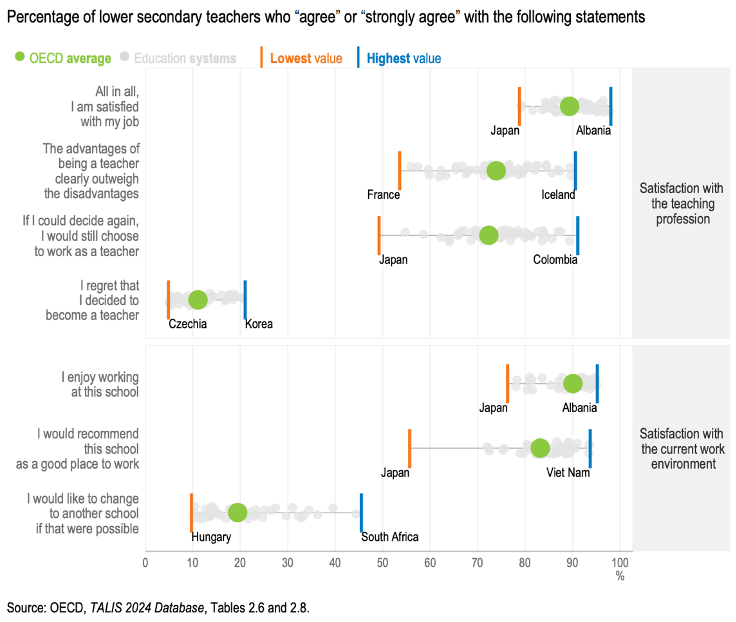
“…98% of Albanian teachers are satisfied with their profession, while only 3% experience high levels of stress—the lowest rate compared to the OECD average of 19%.”

Australia

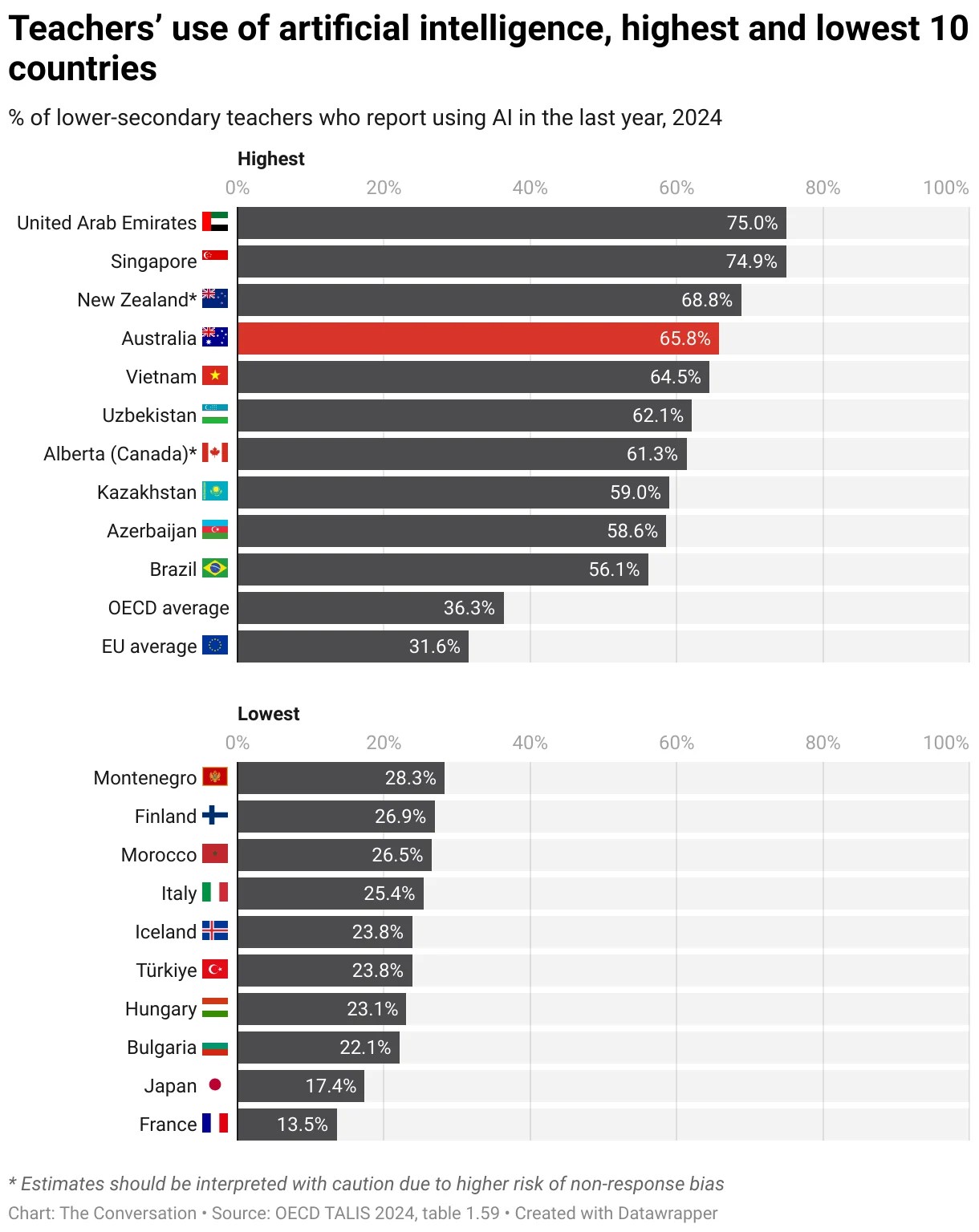
Australian teachers are some of the highest users of AI in classrooms around the world, Yahoo News Australia

Australian teachers are among the world’s most stressed – despite low class time, The Advertiser

Australian teacher shortage among worst in the OECED, SchoolNews.com

“Australia is now among the top three OECD countries for teacher shortages in public schools. That is unacceptable for a wealthy, developed nation.”

Austria

New teachers hardly feel prepared for everyday school, Vol.at

Belgium

Teachers report high stress due to administrative burden, Belganewsagency.eu

“A striking 70 percent of lower secondary school teachers in Belgium report stress from too much administrative work, far above the OECD average.”

Canada – Alberta

Alberta teachers report highest stress levels globally, CityNews Calgary

Source: Zach Dafoe, CityNews

Costa Rica

AI surges in Costa Rican schools ahead of official policy, TicosLand

Artificial intelligence, in this particular case, can likely contribute significantly to reducing the teacher’s workload. Because if it is used appropriately and efficiently, it can streamline many processes such as receiving information, reviewing in-class assignments, grading exams, and organizing activities.”

Croatia

Croatian teachers among the most education, however, the workload is constantly increasing, PortalHr

Czechia

Young teachers are disappearing: Why is the profession uninteresting even though salaries are improving, Iustecko.cz

“Despite higher satisfaction with salaries, the profession suffers from low social recognition. Only 22% of teachers feel that society values ​​their work, and only 15% of educators perceive recognition from political representation.”

Estonia

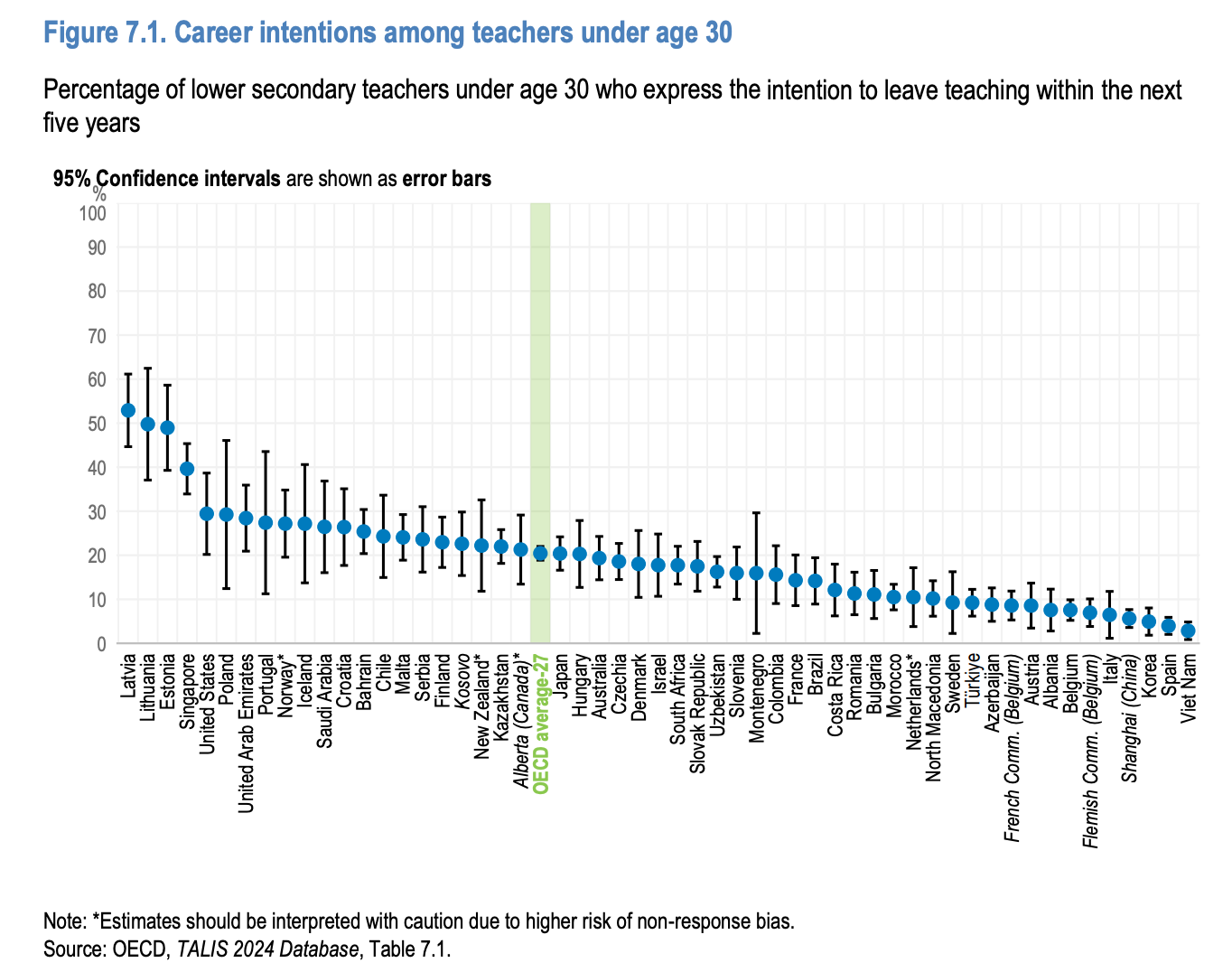
Study: Nearly half of teachers plan to change jobs in the coming years, ERR

Finland

TALIS 2024: Lower secondary teachers are satisfied with their work — Increasing diversity in schools challenges teachers to learn new skills, Valtioneuvosto

“The growing diversity in schools and the increasing need for student support are reflected in teachers’ professional learning needs. Areas for development included using artificial intelligence, teaching students with special education needs, supporting students’ social and emotional development, and teaching in multicultural or multilingual settings.”

France

Teaching in France: a despised and increasingly difficult profession on TALIS 2024 Survey, cafepedagogique.net

Hungary

Hungarian teachers report rising satisfaction and greater autonomy, OCED TALIS survey shows, The Hungarian Conservative

Source: Hungarian Conservative

Iceland

Almost all teachers satisfied with jobs — but pay worries persist, RUV.is

“Icelandic teachers are among the most dissatisfied with their pay: only 19% are content with their salaries, compared with an average of one third across the OECD.”

Israel

Israeli teachers satisfied but face staffing crisis, The Jerusalem Post

Japan

Japan’s teachers work longest hours among OECED peers, Nikkei Asia

Latvia

Half of new teachers in Latvia could leave the profession within five years, Baltic News Network

“Half — or 53% — of new teachers in Latvia may leave the profession within the next five years, according to the initial results of the OECD Teaching and Learning International Survey.”

Lithuania

Most Lithuanian teachers higher confident, happy with their working conditions, The Baltic Times

New Zealand

Initial teaching training needs strengthening, The National Tribune

OCED TALIS 2024: NZ teachers lack confidence in core teaching skills, gov’t acts, Devdiscourse

“Education Minister Erica Stanford acknowledged the findings, noting that 62% of graduate teachers lack confidence in teaching the content of all the subjects they handle, and 54% are unsure of how to teach these subjects effectively using proper pedagogical approaches.”

Portugal

Portugal faces an urgent need for 38,000 new teachers by 2034, Cnedu.pt

Portuguese teachers among the most satisfied in the OECED, Portugal Pulse

Singapore

Global survey finds Singapore teachers spend less time teaching and marking, but work longer hours, The Straights Times

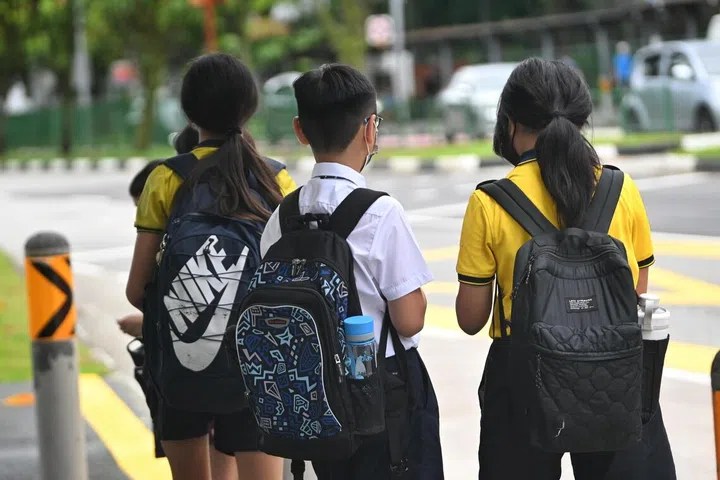
Source: MDDI

3 in 4 Singapore teachers use AI, more than double overseas peers: OCED Survey, The Straights Times

South Korea

Over half Korean teachers identify parental complaints as major source of stress, Korea JoongAng Daily

South Korean teachers top OECD in career regret due to stress, The Chosun Daily

“It has been found that the stress South Korean teachers experience due to parental complaints and students’ verbal violence is among the highest globally.”

Spain

Almost half of the secondary school teachers in the State believe that initial training is not adequate, Diari ARA

Spain is one of the countries where the fewest teachers consider leaving the profession, Sur in English

Source: Sur in English via Álex Sánchez

Sweden

Swedish Teachers Report Job Satisfaction Despite Stress and Challenges, Sweden Herald

“Nine out of ten upper secondary school teachers like their job, and the proportion who expect to stay in the profession has increased. But Swedish teachers also testify to stress and chaos.”

United States

For teachers, work-life boundaries are harder to keep than ever, Education Week

“[N]early 30% of U.S. teachers report frequent on-the-job stress, compared to less than 20% for OECD countries on average. U.S. teachers were also more likely to report that teaching had taken a toll on their mental and physical health. U.S. lower secondary teachers worked on average more than 45 hours a week in 2024, nearly five hours more than the OECD average.”

High satisfaction, high demands, and changing demographics: Scanning the headlines on the results of the TALIS 2024 (Part 1)

90% of teachers around the world say they are satisfied with their jobs, but many also face an increased workload that challenges their work life balance. In this two part post, IEN explores these and other findings from OECD’s Teaching and Learning International Survey (TALIS) 2024. Part 1 provides a summary of OECD’s results, and Part 2 will round up some of the headlines that highlight the results from different countries. For comparison, see previous coverage of the release of the results of TALIS 20218 (Volume 1; Volume 2).

Most teachers are happy in their jobs,” declared the OECD, but demographic and technological changes contribute to increasing demands on teachers around the world.  Those are two of the take-aways from the report on the results of the 2024 TALIS survey. Launched first in 2008 with a survey of 23 countries, OECD has also carried out the survey of teachers and school leaders in 2013 and 2018 to compare educator’s perceptions, working conditions, and learning environments. In 2024, around 280,000 educators from 55 education systems participated in the survey. Among the other key findings in 2024:

Job satisfaction

On average, almost 9 out of 10 teachers report that they are satisfied with their jobs.

  • In South Africa, teacher satisfaction has risen by 8% since 2018
  • In Colombia, 90% of teachers say they would become a teacher again.

Value of the teaching profession

Around 2 out of 3 teachers say they are valued by parents and guardians, but with significant variations:

  • Over 90% of teachers feel valued in Vietnam Saudi Arabia, United Arab Emirates, Uzbekistan
  • Less than 50% of teachers feel valued in French-speaking Belgium, Croatia, France, and Japan
  • Saudi Arabia, Bulgaria and Denmark have increased the share of teachers who feel valued by almost 20%

Age

The average age of teachers across the OECD is 45 years-old, but:

  • More than half of teachers are 50 or older in Estonia, Hungary, Latvia, Lithuania
  • The average age of teachers is 38 or 39 in Türkiye, Morocco, the United Arab Emirates and Uzbekistan

Workload and stress

Roughly half of teachers report excessive administrative work as a source of work-related stress

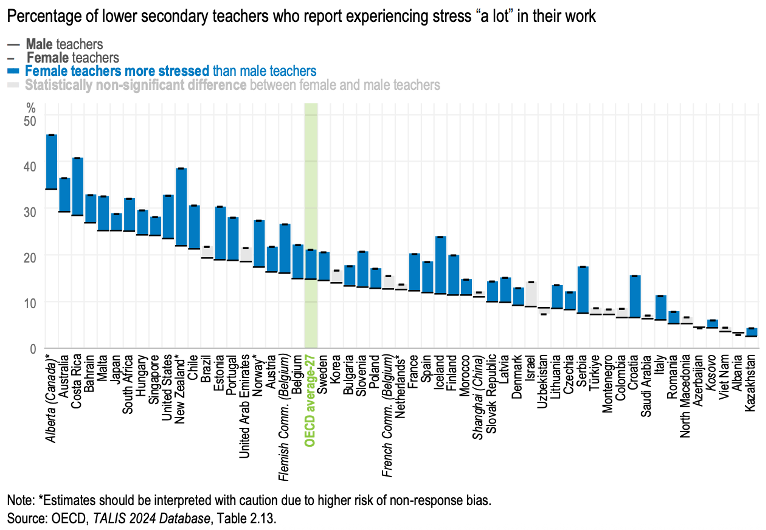
  • The share of female teachers reporting stress “a lot” in their work is 21% compared to 15% for male teachers.
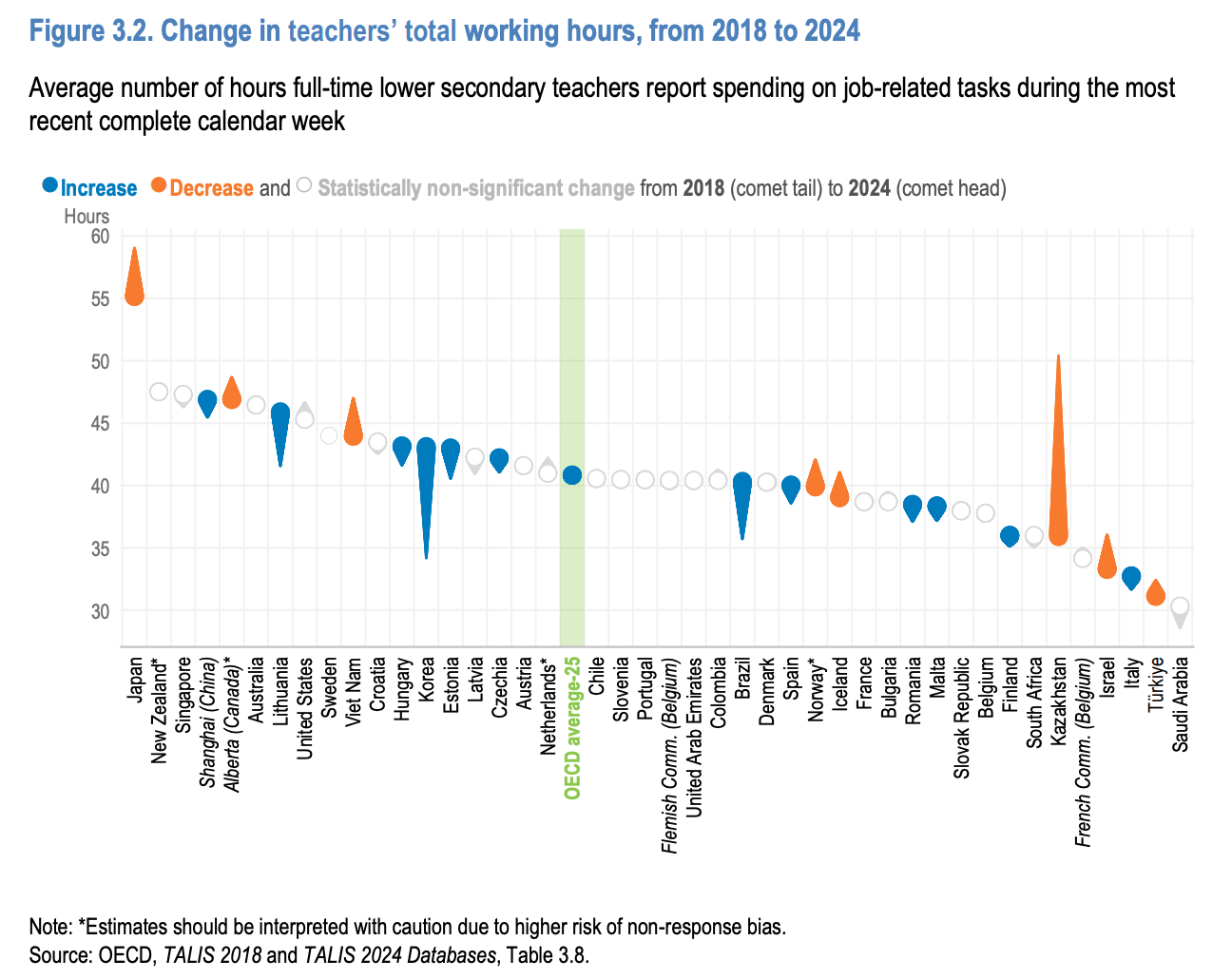
  • Japanese teachers work almost 55 hours a week (down from 60 hours a week in 2018, the highest in the world).
  • Teachers’ sources of stress are more closely linked to constant, unsupported change than to resource shortages

The amount of time spent maintaining discipline has increased in almost all education systems since 2018

  • About 1 in 5 five teachers, on average, report significant disruptive noise and disorder in their classrooms.
  • More than half of teachers in Brazil report such disruptions, compared to about a third of teachers in Chile, Finland, Portugal and South Africa
  • Less than 5% of teachers in in Albania, Japan and Shanghai (China) report facing such disruptions

Preparation

Almost 4 out of 5 teachers participated in regular teacher preparation programs to obtain their initial qualification, but:

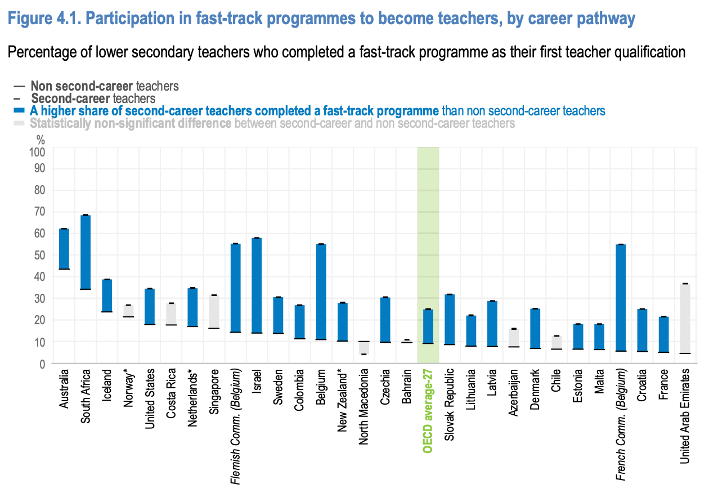
  • More than half of teachers in Australia, Costa Rica, Kazakhstan, Romania, Saudi Arabia and South Africa, do not follow the regular path through teacher education
  • Almost half of teachers in Australia and almost a third of teachers in Iceland completed “fast-track” or specialized teacher education program
Source: OECD, TALIS 2024

Teacher evaluation and support

Almost 90% of teachers work in schools where they are formally evaluated at least once a year by school leaders, and:

  • 65% of teachers are engaged in post-evaluations discussions about how to improve their teaching.
  • Slightly less than half of teachers are offered “development or training” plans, ranging from over 90% of teachers in Bahrain and Kazakhstan to under 15% in Iceland.
  • A little over 10% of teachers participate in programs where they are offered financial incentives and less than 5% participate in programs that include potential sanctions.

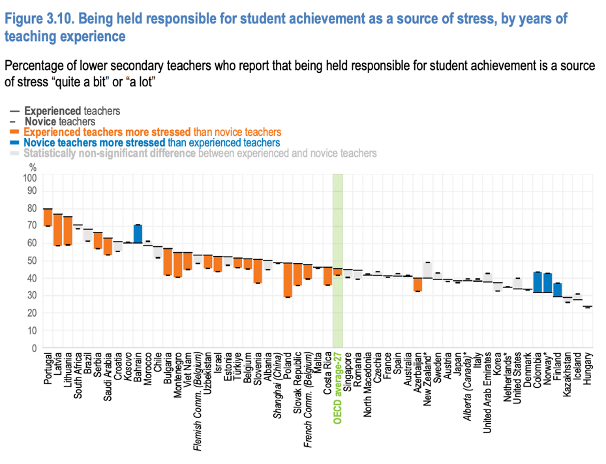
Almost half of teachers’ report that being held responsible for students’ achievement is a source of significant stress:

  • Over 70% of teachers in Latvia, Lithuania, Portugal and South Africa report such stress
  •  Less than a third of teachers in Finland, Hungary, Iceland and Kazakhstan report this stress
Source: OECD, TALIS 2024

Roughly 20% of teachers, on average, participate in mentorship programs: 

  • Almost 80% of teachers in Shanghai (China) report having an assigned mentor and over 60% of teachers with high self-efficacy report exchanging materials with peers, more than double the percentage of teachers with low
  • In systems like Uzbekistan over two-thirds of teachers with high self-efficacy report observing other teachers’ classes and providing feedback

AI and online learning

1 in 3 teachers, on average, report using AI in their work:

  • Roughly three-quarters of teachers in Singapore and the United Arab Emirates (UAE) use AI
  • Fewer than 20% of teachers in France and Japan use AI

Over 15% of teachers, on average, work in schools where at least one class was taught hybrid, but:

  • Over 80% of teachers in Singapore, and over 45% of teachers in Israel and the UAE report working schools where at least one class was taught hybrid or online

Next week: High satisfaction, high demands, and changing demographics: Scanning the headlines on the results of the TALIS 2024 (Part 2)

What’s Next for Schools in 2025? Scanning the Headlines for Predictions about Education in the New Year

AI, cellphones, and security – those are a few of the issues highlighted in this IEN’s scan of the predictions about education in 2025. To see the predictions for previous years, review the scans of the “looking ahead” headlines from 2024, 2023, 20222021 part 12021 part 2, and 2020. To discuss the trends and possibilities for education in the new year join Getting Smart’s annual town hall What’s Next in Learning 2025.

The education sources we follow in the US often provide predictions for schools, students, and teachers in the new year, but it’s been harder to find articles looking ahead from other parts of the world. The Ministry of Education in New Zealand, however, did offer a summary of What’s new for 2025 and the Education Review Office produced a series of best practice guides “to help educators effectively implement incoming changes for 2025.” In the US, to put developments in the new year in context, back in 2017, the National Center for Education Statistics shared Projections of Education Statistics 2025 which can be compared to their Report on the Condition of Education 2024

Education predication from the US and around the world

The education revolution: What Nigerian teachers must know for 2025, Business Day

Cleaner and better public schools in 2025 in the Philippines, Sun Star

“As we look forward to 2025, we hope that public schools will be a lot more conducive for learning. This means cleaner and properly ventilated classrooms, better classroom materials, and improved facilities for both teachers and students.

VAT, small firms, workers, education: Changes in France in 2025, The Connexion

“After disappointing results in maths and French tests at the 2024 rentrée, the Education Ministry announced there would be a “complete overhaul” of the curriculums for these subjects in 2025, ranging from maternelle to troisième (infant school to the fourth year of secondary).”

11 Critical Issues Facing Education at Home and Abroad in 2025, Education Week

5 education stories to watch in 2025, Chalkbeat

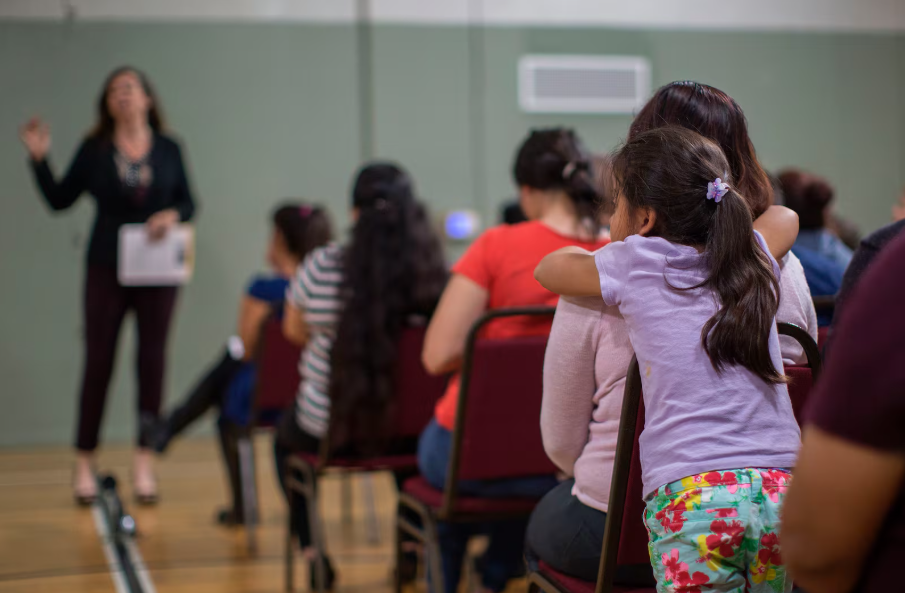
A girl watches during an immigrant rights workshop at Academia Avance charter school in Los Angeles in 2017.

Education leaders should focus on integrating AI literacy, civic education, and work-based learning to equip students for future challenges and opportunities.

Building social capital and personalized learning environments will be crucial for student success in a world increasingly influenced by AI and decentralized power structures.”


4 K-12 predictions to help you lead effectively in 2025, District Administration

K-12 trends to watch in 2025 amid budget, policy shifts, K-12 Dive

“K-12 schools are likely to face several challenges in 2025, including strained budgets due to the expiration of federal aid, cybersecurity threats and staffing shortages, particularly in special education. Additionally, the influx of AI in classrooms and the rise of book bans and curriculum restrictions are key trends to watch for in the upcoming year.”

What Should K-12 Education Focus On in 2025 and Beyond?, US Chamber of Commerce Foundation

Brown Center scholars look ahead to education in 2025, Brookings

Larry Ferlazzo’s 9 Education Predictions for 2025, Education Week

6 Predictions For Education And Workforce In 2025, Michael B. Horn, Forbes

6 Top Education Stories for 2025, Peter Green, Forbes

Five Education Predictions For 2025, Derek Newton, Forbes

 5 education innovation trends to watch in 2025, Julia Freeland Fisher, Christensen Institute

Key Trends to Watch in the Education Market in 2025, Education Week

What 2025 Could Bring for English Learners, Education Week

What’s In, What’s Out for AI, Cellphones, Cybersecurity, and Other Ed-Tech Stuff, Education Week

50 predictions about what 2025 will bring to edtech, innovation, and everything in between, eSchool News

Starring AI, VR, Microlearning and more: ETIH’s 10 predictions for edtech in 2025, EITH

Campuses will also further embrace AI, the cloud, and mobile credentials to improve effectiveness of lockdowns and guest management efforts.

Social Media Issues for Kids Shaping Up to Be ‘Unpredictable’ in 2025, Education Week

2025 Predictions for Video Surveillance in Education and Healthcare, Campus Safety

2025 Campus Lockdown, Visitor Management Predictions: More Installations, Integrations, Campus Safety

Driving Change: 5 Predictions Shaping the Future of Student Transportation in 2025, School Transportation News

2025 food trends shaping K-12 cafeterias, Food Service Director

“Chartwells K12 has identified 10 emerging food trends for school cafeterias in 2025, highlighting a shift toward diverse and nutritious options that align with the preferences of younger generations. Customizable bowls, inclusivity in the form of allergen-friendly and plant-based options and crunchy items are a few of the listed trends.”

25 Philanthropy Predictions for 2025, Inside Philanthropy

Seven Chicago education stories to watch in 2025, Chalkbeat

Five bold predictions for Ohio education policy in 2025, Aaron Churchill, Thomas B. Fordham Institute

New year starts in California with new laws impacting education, EdSource

“New California state laws will protect the privacy of LGBTQ+ students, ensure that the history of Native Americans is accurately taught and make it more difficult to discriminate against people of color based on their hairstyles.”

As lawmakers return to Albany, the fate of New York school funding looms, Chalkbeat

Banning Books and Cellphones but not Conflict: Scanning the Headlines for Reviews of Education in 2024

IEN’s annual roundup of the end-of-the-year education headlines features stories about efforts to ban books and cellphones in the US, while some of the international stories emphasize the conflicts and crises affecting children around the world. To see how education in 2024 compared to previous years, take a look at IEN’s scans from the end of the year of 2023, 2022202120202019 part 1, and 2019 part 2

Although relatively few of the international education media IEN follows reviewed the biggest stories from 2024, organizations focusing on children highlighted the crises affecting many young people, particularly those caught up in conflicts. In the US, many journalists and educators noted the impact of AI and other technologies and Education Week highlighted the efforts to limit technology use by declaring that “cellphone ban” was the word/phrase of the year (The education word of 2024 is…) Given the number of articles that discussed efforts to ban books and regulate curriculum and other aspects of schooling, just “ban” may have been a more appropriate choice. To get a sense of the extent of book banning, the American Library Association tracked books banned in 2024 and The Guardian reported on a survey rom PEN America showing that more than 10,000 books were banned in US public schools from 2023 to 2024. That same survey suggested that bans of books nearly tripled in the US from 3,362 the previous year (US public schools banned 10,000 books in most recent academic year). But bans were not limited to books or cellphones. The California legislature also passed a number of laws in 2024 banning or restricting a variety of practices including limiting libraries abilities to ban “books based on subject matter focused on race, gender identity, sexual orientation or other characteristics.” The California legislature also banned legacy admissions in private universities in California, and school districts can no longer institute policies requiring teachers or staff to disclose a child’s gender identity to the child’s parent or guardians (Ten things California is banning in 2025).  

Headlines from around the world

2024 in Review – One in three children in conflict and fragile countries out of school, Africa.com

‘Not the new normal’ – 2024 ‘one of the worst years in UNICEF’s history’ for children in conflict, Unicef

More than 52 million children in countries affected by conflict are estimated to be out of school. Children in the Gaza Strip, and a significant portion of children in Sudan, have missed out on more than a year of school, while in countries such as Ukraine, the Democratic Republic of the Congo, and Syria, schools have been damaged, destroyed or repurposed, leaving millions of children without access to learning.

The Top 15 Education For All Blogs of 2024, GPE

2024 Review of the Year in Comparative International Education: Some reflection on the past year – Gaza, Genocide, Higher Education Crisis and much more, The FreshEdPodcast

Kenya’s 2024 academic year marred by multiple crises, The Eastleigh Voice

Isiolo Secondary school teachers during a strike earlier this year.

“The 2024 academic year in Kenya faced significant disruptions, stemming from funding delays, natural disasters, industrial action, and social unrest, severely affecting learning activities across the country.”

Seven major events in Education Sector in Ghana in 2024, Ghana Web

2024 Review: Major events, reforms that shaped Nigeria’s education sector, Premium Times

Looking back 2024: Education sector in Bangladesh remains neglected, New Age 

Learning losses to the students of all levels [in Bangladesh] were caused by not only the mass uprising, which began with the student movement against government job quotas, but also natural calamities of cold wave, heatwave and flood that caused the closure of educational institutions several times in 2024.

The year of interrupted learning in Pakistan, T Magazine

How Crises Affect Students and Teachers, T Magazine

2024 wrapped: The biggest education stories of the year in Singapore, and what’s next, The Straits Times

Norway, IQ Tests and Child Care Deregulation: Our Favorite Early Ed Stories This Year, The Hechinger Report

In the UK From recruitment crisis to class war: 2024 in review, School Management Plus

Headlines from the US

Public Schools by the Numbers: How Enrollment, Funding, and More Changed in 2024, Education Week

The Year in Education: Our Top 24 Stories About Schools, Students and Learning, the 74

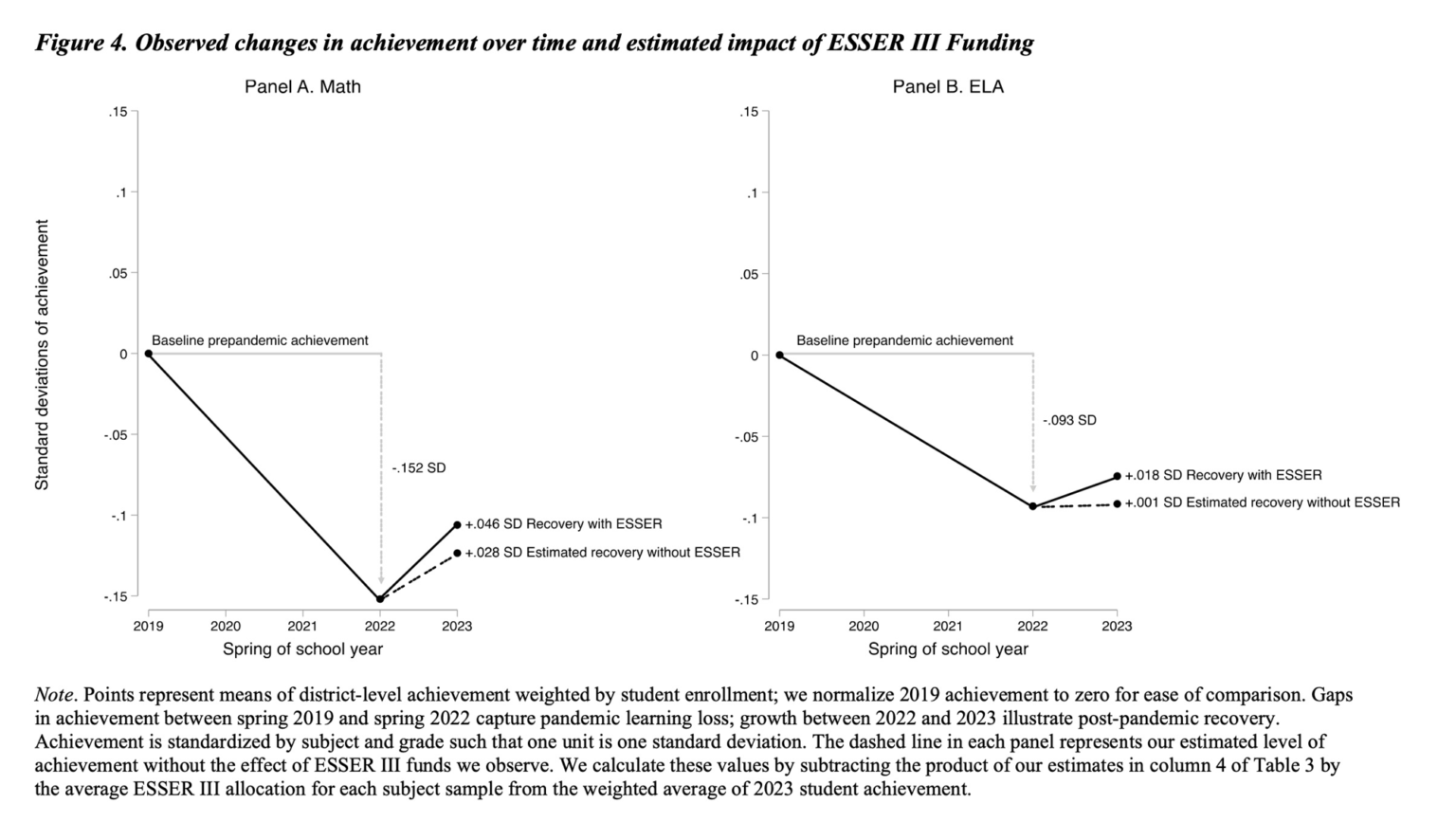
Federal Funds Lifted Learning — But Not Enough, The 74 (source: Calder Center)

2024 in Review, From Your Point of View, Edutopia

Pandemic, Politics, Pre-K & More: 12 Charts That Defined Education in 2024, the 74

The 10 Most Significant Education Studies of 2024, Edutopia

“Warm demanders are teachers who insist on the highest standards but remain sensitive to a student’s need to belong—and to succeed. By bracketing the most frustrating lessons with work that elicits a child’s feelings of competence, teachers can “bolster students’ math motivation and engagement” in a way that does not “involve reducing the rigor of the material that students learn.'”

Jealousy List: 16 Education Articles We Wish We Had Written in 2024, The 74

2024 Must-Reads: 9 Stories About Early Care and Education That We Can’t Stop Thinking About, The 74

A dozen of the best opinion pieces on education that we read in 2024, Michael Petrilli, Thomas B. Fordham Institute

The Best and Worst Education News of 2024, Larry Ferlazzo, Education Week

The best and worst of ed reform in 2024, Thomas B. Fordham Institute

2024 Year-in-Review: Reforming K-12 Education, Hoover Institution

Philanthropy Awards, 2024, Inside Philanthropy

7 Curriculum Trends That Defined 2024, Education Week

How AI Is Changing Education: The Year’s Top 5 Stories

The Best in K-12 EdTech—Last Year and Next, eSchool News

Cellphones in the Classroom: The Year’s Top 5 Stories, Education Week

School Shootings in 2024: More Than Last Year, But Fewer Deaths, Education Week

Local Education News You May Have Missed in 2024 (and Why It Matters), Education Week

Trump’s Education Priorities, Foundation Aid, and Mayoral Control: 2024 in ReviewNew York Focus

Schools continue to rebound, thanks to influx of funding: 2024 year in review, Cal Matters

Next week: What’s Next for Schools in 2025? Scanning the Headlines for Predictions about Education in the New Year

Supplies, Shortages, and Other Disruptions? Scanning the Back-to-School Headlines for 2024-25 (Part 2)

What’s in the education news as the school year begins in many parts of the Northern Hemisphere? This week, in part 2 of IEN’s annual back-to-school scan, we share the headlines from across the US and around the world that touch on issues like the costs of supplies and other materials for parents as well as teachers; hot weather and other disruptions; shortages – particularly of bus drivers in the US; and a variety of other topics. In Part 3, we will gather together some of the many stories discussing cell phone bans, particularly in the US and Canada. Last week, Part 1 of this year’s scan provided an overview of some of the many election-related education stories that have appeared in the press as students return to school Politics, Policies, and Polarization: Scanning the 2024-25 Back-To-School Headlines in the US (Part 1).

Back-to-school headlines around the world

Clash between tech and textbooks as Canadians head back to school, CityNews

Back to school could mean back to the hot seat for Big Tech. Social media platforms TikTok, Facebook, Instagram and Snapchat spent last school year embroiled in a lawsuit accusing them of disrupting learning, contributing to a mental health crisis among youth and leaving teachers to manage the fallout. When students return to class this September, experts say the clash between tech and textbooks will be reignited

French teachers wrangle with new reforms as children return to classroom, FRANCE24

Summer holidays end for school children in the south of the Netherlands, Dutch News

French teachers wrangle with new reforms as children return to classroom, FRANCE24

Ukrainian front-line students celebrate back-to-school despite ever-present air raid alarms, Local10

Ukrainian children return to school in underground shelter amid Russian bombardments, Firstpost

Thousands of Children Cut off from School by North Vietnam Floods, Cambodianess

Education Costs/Supplies

Thousands of children will struggle to return to school because of North Vietnam floods, CamNess

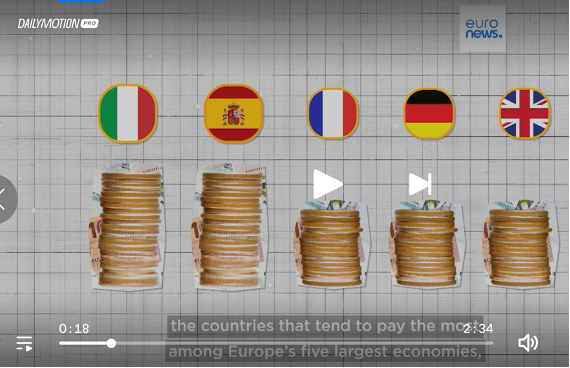
Back to school: Which of Europe’s ‘Big Five’ countries pays the most for school supplies?, Euronews

Although textbook prices vary from school to school, they add a substantial burden: €591,44 on average in Italy and €491.90 in Spain, the highest ever

Rising cost of living puts pressure on parents’ back-to-school finances in Germany, Euronews

Moroccan Families Break-the-Bank as Children Return Back-to-School, Morocco World News

Families with multiple children, in particular, are struggling to balance their budgets as they manage not only the cost of school supplies but also additional needs such as furniture and other essentials for their children.

Back-to-school spending averages $586 per student, Yahoo Finance

Educators Prepare Early, Spend Their Own Money for New School Year, Education Week

Shortages

Some districts are still struggling to hire teachers for the new year, Education Week

‘They have to have known’: Hawaii scrambles for solutions to bus driver shortage, Honolulu Civil Beat

Durham schools face second day of bus delays, district promises swift action, WRAL

Parents Scramble to Get Kids to School as Bus Shortage Hits St. Louis — Again, The 74

Back-to-School Issues Around the US

The School Year Is Off to a Hot Start—Again. What Districts Need to Know, Education Week

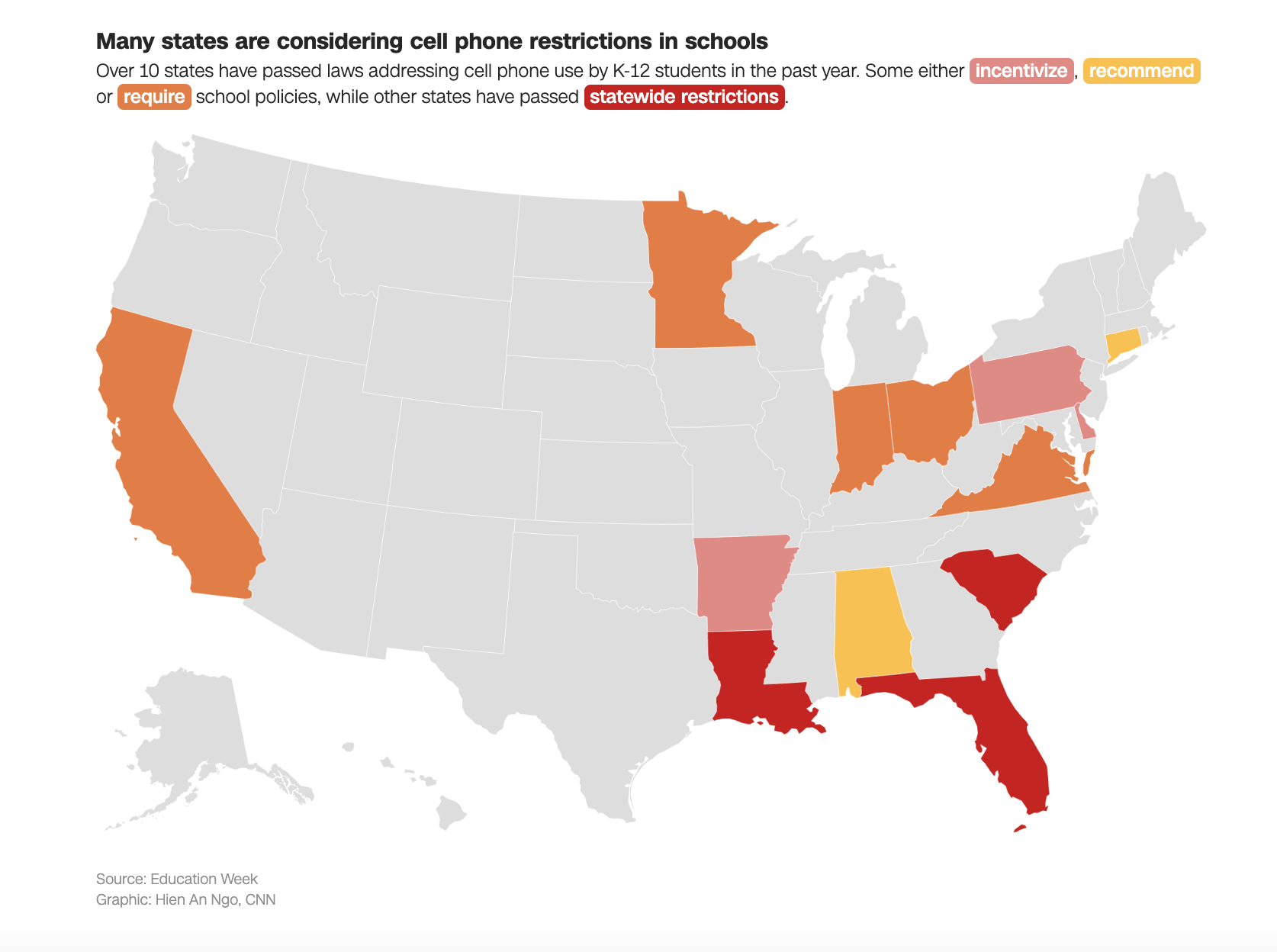
All-black outfits, hoodies, Crocs, cell phones and mirrors. Some students are returning to school with new bans in effect, CNN

What’s in: Nostalgic school supplies. What’s out: Leggings and cellphones, Axios

Top legal hurdles facing schools in 2024-25, K-12 Dive

Snuggles, pep talks and love notes: 10 ways to calm your kid’s back-to-school jitters, NPR

As a New School Year Begins, Ensuring All Students Feel a Sense of Belonging, The 74

Learning and Love: A Lesson from Mr. Rogers for the Start of a New School Year, The 74

Alabama

No Crocs, hoodies, backpacks? Figuring out shifting Alabama school dress codes, AL.com

Massachusetts

Back to school, back to COVID safety. What to know about best health practices in classrooms, The Boston Globe

California

New laws impacting education go into effect as the school year begins, EdSource

Legislation going into effect this school year will bring changes to California campuses. One new law requires elementary schools to offer free menstrual products in some bathrooms and another requires that all students, beginning in first grade, learn about climate change.

Students heading back to school may have cell phones banned as more states pass laws limiting use, WSB-TV

Too many kids are going back to school this month without functioning A/C, Los Angeles Times

LAUSD students are back to school with street safety measures in place and a cell phone ban, CBS News

Local school districts announce schedule changes amid record temps in Southern California, KTLA 5

Chicago

Chicago Public Schools heads back to class amid extreme heat, Chalkbeat

Florida

New metal detectors delay students’ first day of school in one South Florida district, AP

Each of the district’s high schools was allocated at least two metal detectors to screen their students, with larger schools getting four, like Cypress Bay High School in suburban Weston, which has more than 4,700 students. But even at smaller schools, kids were stuck waiting — leaving students and parents with more than the usual first-day nerves.

Iowa

Nearly two weeks before school starts, Iowa districts are navigating the implementation of the 2023 education law, WeAreIowa

Michigan

Cellphone bans, free meals, student funding: What to know as Michigan heads back to school, Detroit Free Press

New York City

Literacy overhaul to ChatGPT: 5 NYC education issues we’re watching this school year, Chalkbeat

Elementary school teachers and students will continue to adjust to the city’s literacy curriculum mandate. Schools will still grapple with how best to meet the needs of the thousands of asylum-seeking and other migrant students who have entered the school system. And tensions fueled by the Israel-Hamas war could persist in school communities this year.

Thousands of NYC special ed students denied services days before school starts, New York Post

With high-fives and dance moves, NYC’s nearly 900,000 students return for first day of school, Chalkbeat

New Pencils, New Folders … and New Schools, The New York Times

Seattle

Seattle Public Schools students return as district prepares for a year of change, The Seattle Times

For some historical perspective on how the issues have evolved since the school closures of the COVID-19 pandemic, explore the back-to-school headlines from previous years:

2023 in Review: Scanning the End-Of-The-Year Education Headlines

To look back on some of the key education issues and stories from 2023, Thomas Hatch shares IEN’s annual roundup of the end-of-the-year headlines from many of the sources on education news and research that we follow. For comparison, take a look at IEN’s scans of the headlines looking back in 202120202019 part 1, and 2019 part 2. The next post will look to 2024 by pulling together some of the education predictions for the coming year.

Reviews of education stories in 2023 highlighted:

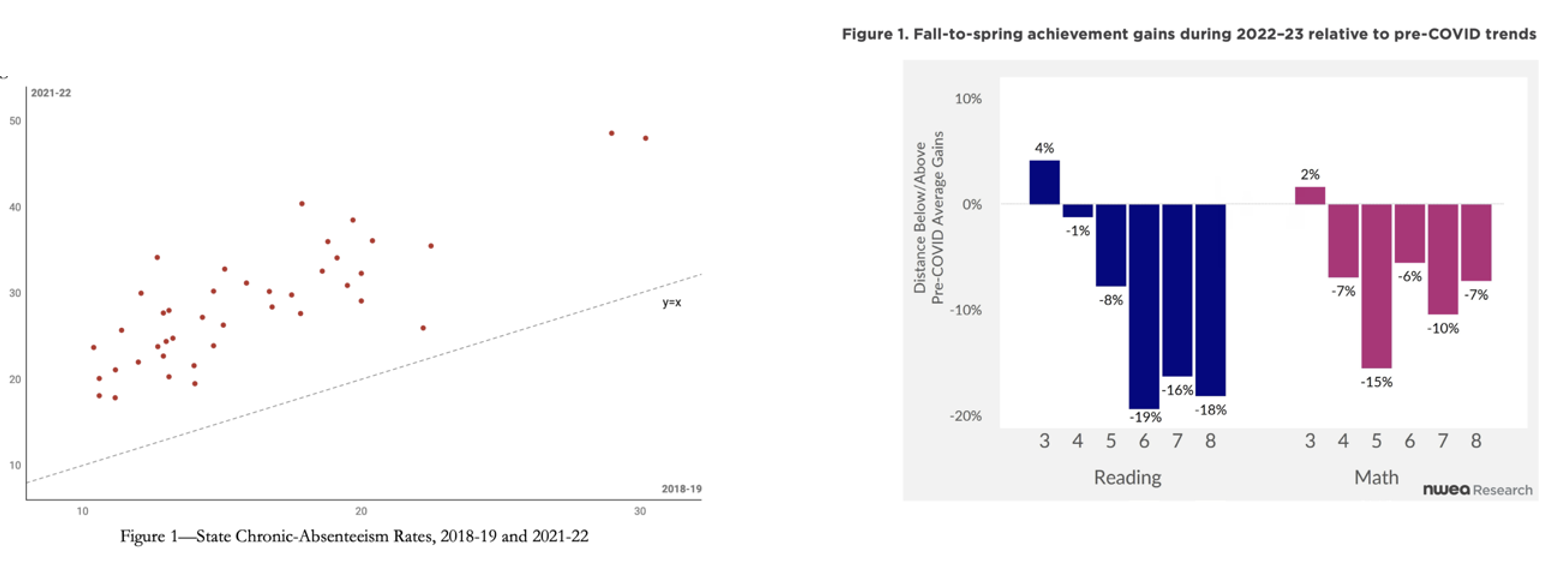
  • The continuing impact of the COVID-19 pandemic on student achievement, student absences, teacher shortages, and other aspects of student and teachers’ health and well-being
  • Pandemic recovery initiatives and concerns about a “fiscal cliff” that may cut off funding for those initiatives.
  • Developments in education technology and particularly the potential impact of artificial intelligence following the launch of ChatGPT in 2022
  • Advocacy for the “science of reading” and foundational learning in literacy and numeracy
  • Persistent concerns including inadequate education funding, inequities in educational performance and opportunities, and the challenges of innovation in assessment and instruction.

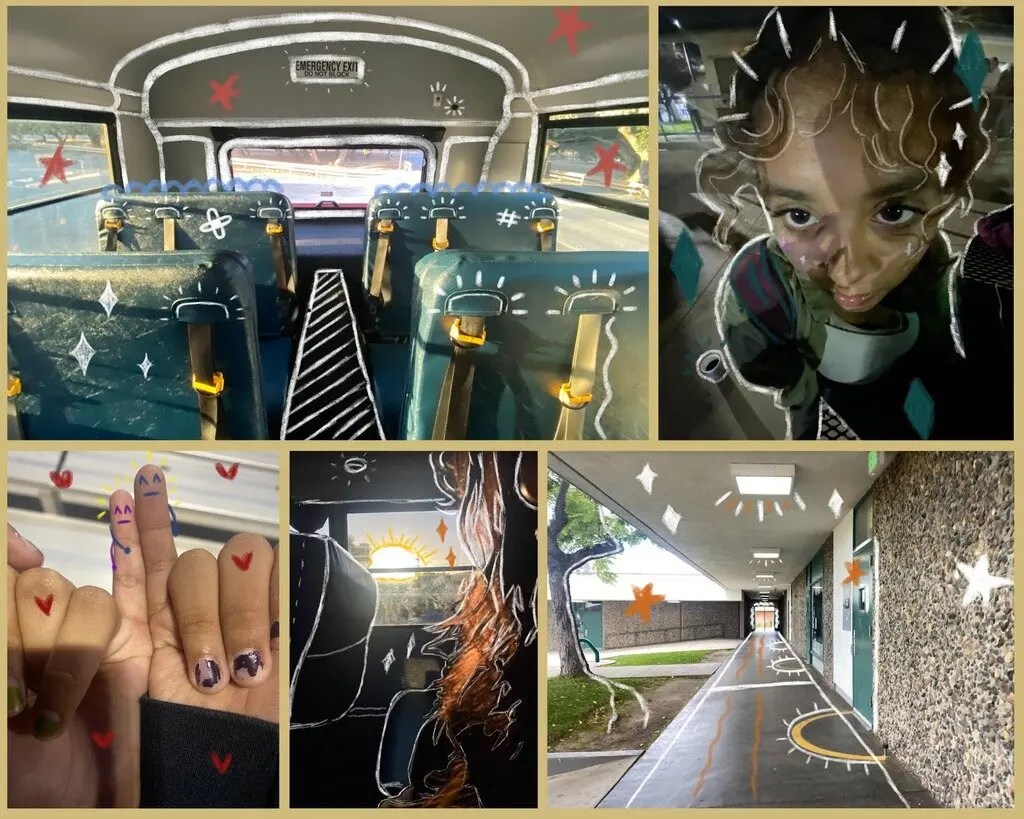
A Capture of Moments, Danna Ramirez, New York Times

What High School Is Like in 2023: 25 Essays, Poems, Videos, Photos, a Graph, a GIF, and a Diorama That
Reflect Students and Teachers’ Lives in School
, New York Times

Our Top Photos of the Year, Education Week

Key issues and trends

Funding, free school meals, education choice and student loan debt were among the policy topics lawmakers tackled in this year’s legislative sessions

The Top 10 Education Trends for 2023, National Conference of State Legislators

an unusual early childhood experiment up close; wrestling with large datasets to better understand education trends; getting over a fear of math to cover efforts to revolutionize the teaching of calculus; and, yes, talks with professors struggling with adjusting teaching to the presence of AI chatbots

Looking back on the biggest education trends of 2023, EdSurge

The 7 most memorable education stories of 2023, The Grade

from what AI can (and can’t) do to the neuroscience of brain synchrony

17 Articles About Students & Schools We Wish We Had Published in 2023, The74

The 10 Most Significant Education Studies of 2023, Edutopia

10 Education Studies You Should Know From 2023: new insights on social media, ChatGPT, math, and other topics, Education Week

These are some of the education questions Chalkbeat answered through data in 2023, Chalkbeat

Six Problems Philanthropy Barely Tried to Solve in 2023, Inside Philanthropy

2023 in education charts!

“School absenteeism is out of control” & “Catch up learning hit a wall,” The74

14 Charts that Changed the Way We Looked at America’s Schools in 2023, The74

The Teaching Profession in 2023 (in Charts), Education Week

Global and local reviews

Our top 5 education result stories of 2023, Global Partnership for Education

“changes range from advanced technical programs to revamped school initiatives and innovative examination methods”

Year in review: Five Key Changes In The Education Sector In Rwanda in 2023 , The New Times

“The Central Board of Secondary Education (CBSE) announced significant changes in 2023, including updated marking-schemes and increased number of exams that candidates can take.”

5 Important Changes Announced By The Central Board Of Secondary Education In India This Year, The Times of India

The top education issues in Massachusetts that captured our attention in 2023, WBUR

New Leaders, COVID Spending, Bus Troubles: 6 Chalkbeat Chicago Stories That Defined 2023, Chalkbeat Chicago

Chronic absenteeism, Democratic control, a fiscal cliff: These were Michigan’s big education themes of 2023, Chalkbeat Detroit

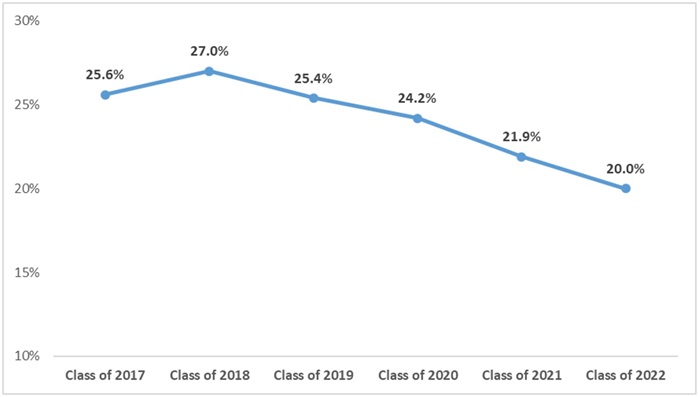
Students meeting state remediation-free standards on the ACT or SAT, class of 2017 to 2022, Thomas B. Fordham Institute

Ohio’s sluggish pandemic recovery in 2023 as seen through six charts, Thomas B. Fordham Institute

— Thomas Hatch

Scores Plummet Around the World: Scanning the Headlines on the Release of the 2022 PISA Results

Dramatic score declines dominated the headlines reporting on the release of the latest PISA scores, with many sources highlighting the impacts of the COVID-19 pandemic on teaching and learning. Some reports focused particularly on math scores, which, in a number of cases, experienced the most drastic drops from the 2018 results. In some instances, reports noted that some education systems (like the US) were able to rise up in the rankings because their scores did not decline as much as others. A few headlines also emphasized issues such as low levels school belonging for migrant students, increased student anxiety and reduced psychosocial well-being, and the effects of income inequality on score results. Numerous critiques have identified serious issues with the PISA findings and their use (see for example Two decades of havoc: A synthesis of criticism against PISA or PISA: Mission Failure and PISA Mission Failure), but for context on the reporting on PISA, this year’s scan of the headlines reporting on the release of the 2022 Program for International Student Assessment (PISA) results can be compared to  IEN’s previous PISA coverage, including: Around the World in PISA 2018 Headlines, and Headlines Around the World 2015 Edition.

Global 

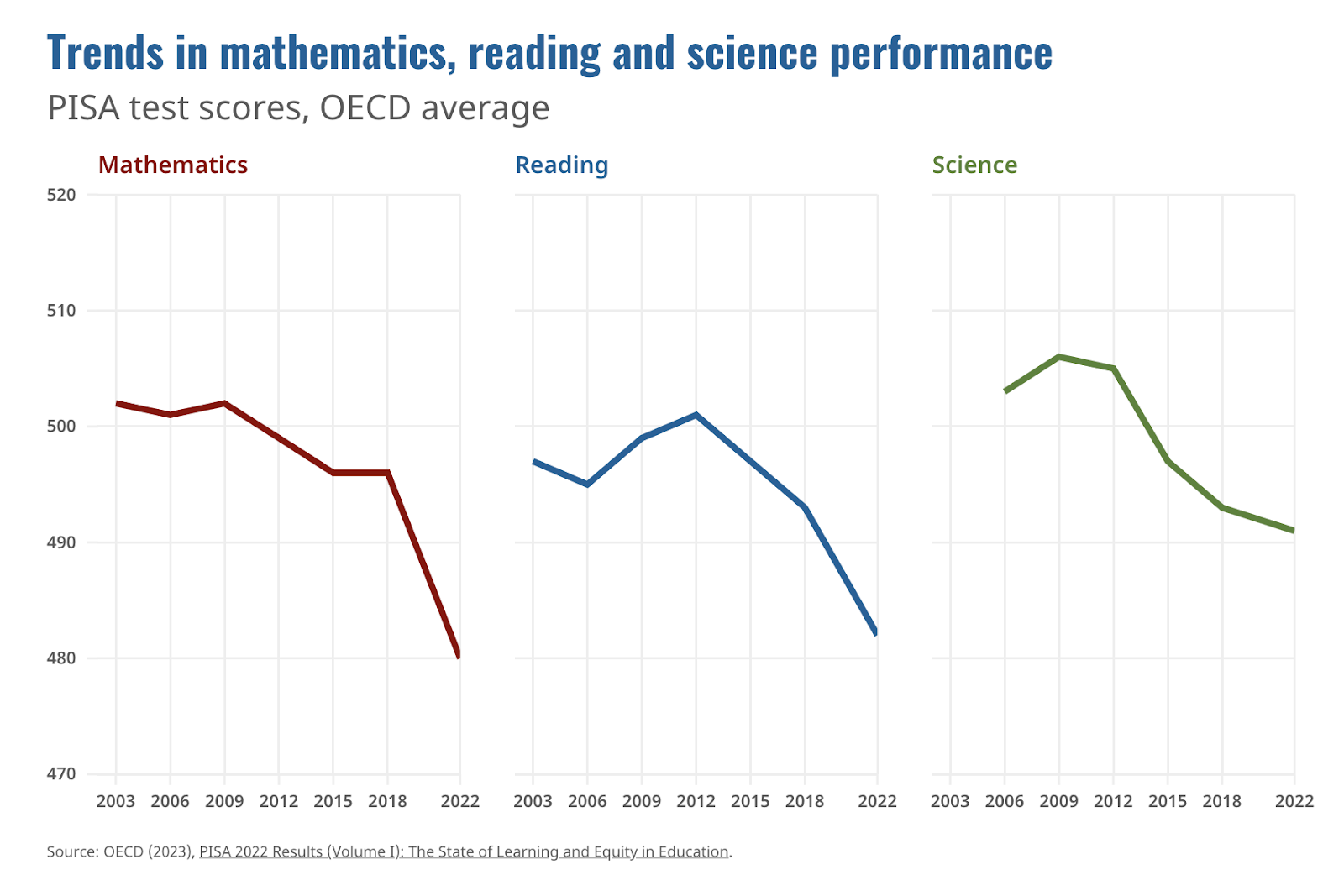
“Eighteen countries and economies performed above the OECD average in mathematics, reading and science in 2022. Between 2018 and 2022, mean performance in mathematics across OECD countries fell by a record 15 points. Reading fell 10 points, twice the previous record, whereas science performance did not change significantly. On average, reading and science trajectories had been falling for a decade, though math had remained stable between 2003-2018. Colombia, Macao (China), Peru and Qatar improved in all three subjects on average since they began to take part in PISA.”

PISA 2022 Results: Summary, OECD

“The average international mathematics score fell by 15 points since the 2018 tests, the equivalent of three-quarters of a year of learning, reading fell by the equivalent of half a year, with only science scores remaining more or less the same.”

‘Unprecedented’ decline in global literacy scores, OECD report says, AlJazeera 

OECD education survey shows ‘unprecedented’ drop in student performance, France 24

How Absenteeism, Math Anxiety, and Other Factors Shaped the Troubling Results From PISA, Education Week

Argentina

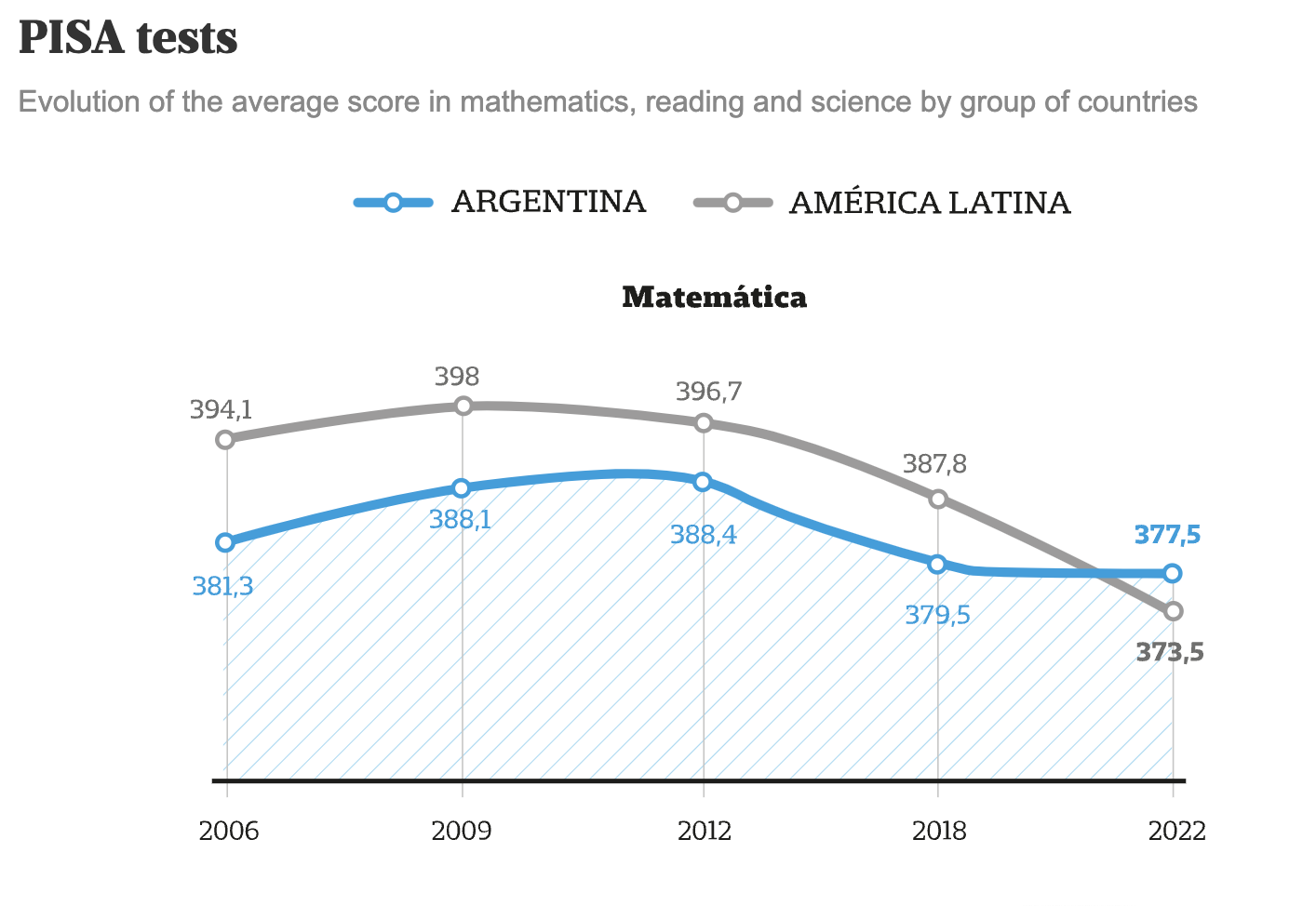
PISA tests: almost 73% of secondary students do not reach a minimum level in mathematics, La Nación

PISA tests: the crisis of basic learning contradicts all inclusion discourses, La Nación

Australia

Australian students’ Pisa scores still declining despite climb into OECD top 10, The Guardian

The Balkans 

PISA School Test Results See South-East Europe Pupils Falter, Balkan Insider

Canada 

Global high school test scores show ‘worrying’ decline. Here’s how Ontario students did, Toronto Star 

Chile

PISA 2022: Chile maintains results in science and drops again in mathematics and reading, La Tercera

PISA 2022 and the case of Chile: what is behind the averages, El País

Colombia

“In Colombia the decline was smaller (8 points less in mathematics, 3 in reading and 2 in science), but it is still significant given the complexities due to the confinements that teachers and students faced during the pandemic in a country with profound inequalities. . Colombia retained the best performance achieved compared to the results of 2006, when it participated for the first time in the test.”

The results of the PISA test reiterate the weaknesses of the educational model in Colombia, El País

Cyprus 

Majority of Cypriot students lack proficiency in reading comprehension, PISA results show, Philenews

El Salvador

El Salvador in the last places in the new PISA report on education, ElSalvador.com

Estonia

Estonia drops to fourth in latest PISA rankings, ERR News

PISA: Estonian 15-year-olds top the European knowledge scoreboard, Estonian World

Europe

European education slips downward, according to PISA report by OECD, EuroNews

The kids are not alright: Most EU pupils educational results tumble in PISA rankings, The Brussels Signal 

Finland

“Finnish 15-year-olds saw their mean score in mathematical literacy – the main focus of the latest assessment – decline by 23 points from 2018 to 484 points, 12 points higher than the mean score of pupils across the OECD.”

Finland’s Pisa results continue to decline, sparking concern, Helsinki Times 

Germany 

“The general state of global education has been slammed by the first PISA performance assessment report since the pandemic. German students fared particularly badly, but those in Asia performed highly.”

Germany’s students fare worse than ever in PISA school tests, DW

Ireland 

Irish teenagers ‘are second best in the world at reading’, The Irish Times

Hong Kong 

“Hong Kong pupils have dropped out of the top 10 to 11th place for mother tongue literacy in the Programme for International Student Assessment. But in a related study, Hong Kong ranked second worldwide in terms of effectiveness in digital learning and educational equity”

Hong Kong secondary school pupils’ performance falls in global Pisa study on reading and maths competency, with pandemic blamed for general decline, SCMP

Japan

Japanese Students Move Up PISA Rankings; Now 3rd in Reading; Shorter School Closures in Pandemic May Be a Factor, The Japan News 

Latin America and the Caribbean 

The PISA report measures the effect of the pandemic in Latin America: worse in mathematics, reading and science, El País

PISA 2022: How did Latin America and the Caribbean do?, Inter American Development Bank

Latvia 

Latvian students’ performance has weakened in maths and reading, improved in sciences – PISA, The Baltic Times

Malaysia 

Malaysian students’ Pisa scores drop in 2022, The Star

Mexico

“The economic condition of the students’ families is the most influential data in Mexican education. The gap in the evaluations is 58 points between rich and poor , although it is much smaller than in the rest of the OECD countries, where the difference is 93.”

Mexican students drop to the lowest level in reading and mathematics since 2006, El País

PISA Report: How did Mexico do on the exam? It came out WORSE in these subjects, Milenio

Morocco

New report underlines deteriorating academic performance of Moroccan students, Morocco World News

The Netherlands

Dutch kids reading, maths, and science skills declining: OECD, NL Times

New Zealand

“This country’s 15-year-olds’ average scores in the PISA dropped a disastrous 15 points in maths to 479 points, their science and reading scores fell just 4-5 points to 504 and 501 points respectively, and the gap between rich and poor students grew.”

NZ records worst ever PISA international test results, amid global decline, RNZ

Student hunger, bad teachers revealed in latest PISA tests showing dip in NZ teens’ scores, RNZ

Philippines 

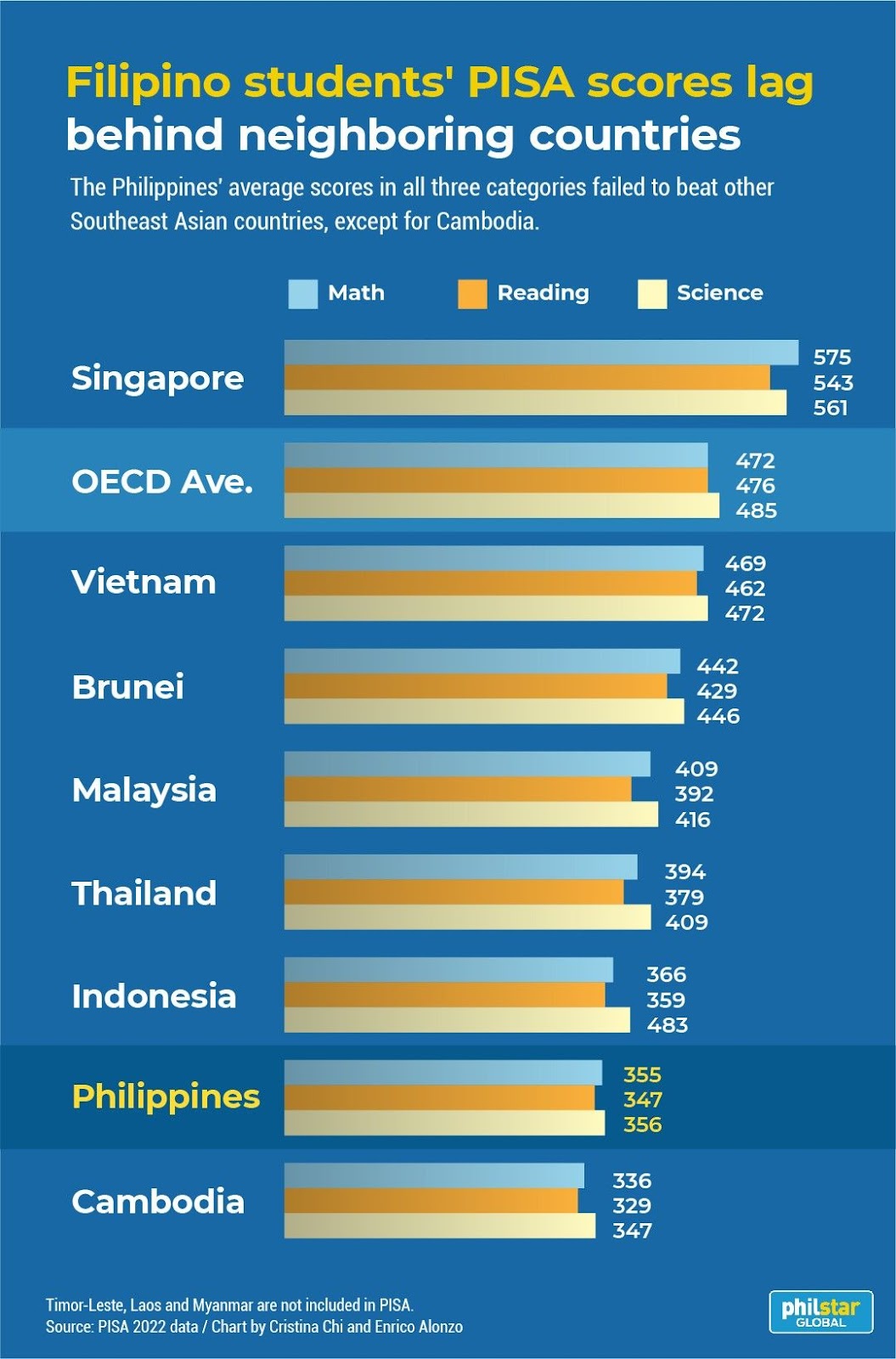
Philippines still lags behind world in math, reading, and science — PISA 2022, Philstar

Saudi Arabia

Saudi schools ‘doing better at maths but still lagging behind’, AGBI

Singapore

“Singapore was ranked No. 1 for mathematics, science and reading in the Programme for International Student Assessment (Pisa) 2022. Compared with 2018, Singapore students who took part in Pisa 2022 maintained their performance in mathematics and improved substantially in science, but their performance declined slightly in reading.”

Singapore students rank top in maths, science and reading in OECD study, The Straits Times

Spain

“Spanish students in the last year of secondary education have dropped 8 points in mathematics compared to the previous edition, in 2018 – in which they already fell a lot -, until they remain at 473. They have gone back three in reading comprehension, to 474. And they have risen two points in science, to 485. The global setback has been, however, of such caliber…that Spain had never been so close to the average of both organizations.”

PISA Report: Spain obtains its worst result, but resists the global educational setback better than its surroundings, El País

Catalonia attributes the poor results in the PISA Report to an excess of immigrant students in the sample, El País

Taiwan

“Taiwan maintained student well-being and math performance across all social groups, with 87 percent of Taiwanese students reporting a sense of belonging at school, which improved from 85 percent in 2018, the report said.”

Taiwan demonstrates ‘overall resilience’: report, Taipei Times

Thailand 

Thai students ranked lower on every PISA index, The Nation

Turkey

PISA report shows Turkey’s scores below OECD average in education, Turkish Minute

United Arab Emirates 

“For the first time ever, Dubai private schools have ranked among the top 14 in the world in mathematics, science and reading in the most recent cycle of the Programme for International Student Assessment (PISA), exceeding the National Agenda target of top 15.” 

Dubai private schools rank in top 14 in global assessment for maths, science and reading, Gulfnews

United Kingdom 

PISA 2022: Rise in maths, but warning over inflated results, Schools Week

Pisa: Wales slumps to worst school test results, BBC

United States

US teendagers decline in global test of math, but hold steady in reading, science, Education Week

“In the first comparable global results since the coronavirus pandemic, 15-year-olds in the United States scored below students in similar industrialized democracies like the United Kingdom, Australia and Germany, and well behind students in the highest-performing countries such as Singapore, South Korea and Estonia — continuing an underperformance in math that predated the pandemic.”

Math Scores Dropped Globally, but the U.S. Still Trails Other Countries, The New York Times

Uruguay

PSA 2022 Tests: Uruguay worsened results in mathematics, improved in science and remained unchanged in reading, El Observador

Vietnam

Pisa 2022: Vietnamese students experience decline in performance rankings, The Star

Tutoring takes off – Scanning the news on the emergence of tutoring programs after the school closures (Part 1) 

How effective are tutoring programs likely to be? What kinds of challenges need to be addressed for tutoring to contribute to real improvements in schooling on a large scale? In this extended series of posts, IEN continues to scan the news and research on the emergence of tutoring as a key strategy to help students “recover” from the school closures of the COVID-19 pandemic. The first part of this series describes some of the funding initiatives contributing to the emphasis on “high-dosage” tutoring as a “recovery” strategy, as well as some of the initiatives to expand access to tutoring being pursued in the US in particular. Part 2 of this scan will describe some of the challenges educators are experiencing as they try to develop and implement tutoring approaches, and Part 3 will survey some of the specific new developments and “micro-innovations” that could make tutoring more effective in the future. This series is part of IEN’s ongoing coverage of what is and is not changing in schools and education following the school closures of the pandemic. For more from the series, see “What can change in schools after the pandemic?” and “ We will now resume our regular programming.” For IEN’s previous coverage of news and research on tutoring, see Scanning the News on High Dosage Tutoring, Part 1: A Solution to Pandemic Learning Recovery, and Part 2: Initiatives and Implementation So Far. This post was written by Thomas Hatch and Jonathan Beltran Alvarado.
In the wake of the COVID-19-related school closures, “high dosage” tutoring represents a rare instance of a “recovery” strategy that seems to have wide support, willing funders, and available resources. Under the circumstances, it’s no surprise that over the past two years, tutoring initiatives have taken off around the world, particularly in the US. 

Tutoring around the world 

The global interest in tutoring has always been reflected in the enormous investments in “shadow education” – often private programs that children attend to supplement and support their schooling. In China, survey estimates suggest that while 65% of families with school-aged children took advantage of private tutoring in 2016, that number may have surged to 92% by 2021. In response, the Chinese government passed regulations designed to ban for-profit companies from tutoring in core curriculum subjects. 

In China, survey estimates suggest that while 65% of families with school-aged children took advantage of private tutoring in 2016, that number may have surged to 92% by 2021

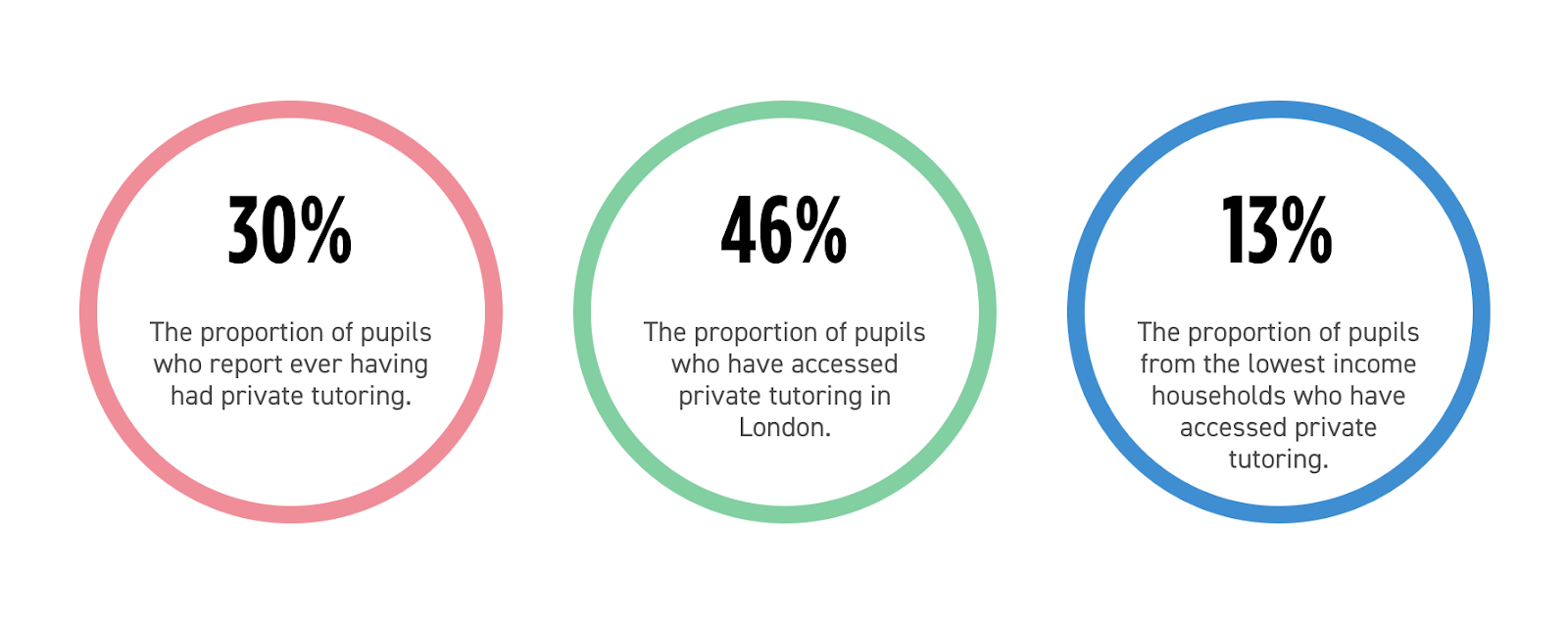
Although the size, scale, and pressure of private tutoring are often highlighted in Asian countries, the interest in tutoring is evident across the globe. In England, according to the Sutton Trust’s 2023 report “Tutoring: The New Landscape,” almost 1 in 3 young people aged 11 – 16 report they have had private tutoring, up from 18% in 2005.  In Spain, nearly half of families pay for children to get private lessons, with those families spending about 1.8 billion dollars (USD) on classes with languages – particularly English – as the main priority. In Egypt, the New York Times reports, “Students in Egypt are flocking to private tutoring centers as the country’s public schools remain overcrowded and underfunded,” explaining that estimates suggest that Egyptian families are spending over one and a half times more on pre-college education than the government does.  A “mind-blowing” amount, as Hania Sobhy, an expert on Egyptian education, described it. 

Tutoring: The New Landscape, The Sutton Trust

At least for wealthy elites, private tutoring may have no international boundaries or many other constraints.  Sarah Thomas, in “My Surreal Years Tutoring the Children of the Super-Rich,” explained: “I wanted a job that allowed me free time, so I registered with a tutoring agency. A few weeks later, I found myself in a speedboat cutting across the Indian Ocean towards a superyacht the size of a ferry.” That job soon led to other tutoring arrangements where her “classrooms would be on yacht decks surrounded by dolphins, in Monaco penthouses with infinity pools, and in Mayfair townhouses with halls full of Mapplethorpes.”

I wanted a job that allowed me free time,” she writes, “so I registered with a tutoring agency. A few weeks later, I found myself in a speedboat cutting across the Indian Ocean towards a superyacht the size of a ferry. – Sarah Thomas, My Surreal Years Tutoring the Children of the Super-Rich

To some extent, the recent growth in tutoring has been fueled by the pandemic (as predicted by the Economist). In South Korea, for example, post-pandemic spending on private supplementary education reached a record high of 20 billion dollars. As that headline put it, “Korean households spend more on tutoring than food, housing.” In places like South Africa, private initiatives like Ikamva Youth and the Kliptown Youth have long drawn on tutoring as a crucial strategy to improve learning. Still, a number of new tutoring ventures have been launched since the school closures of the COVID-19 pandemic (Nonprofit help2read steps in to help save a ‘lost generation’; Free maths and science tutoring for all grade 11 and 12 learners).

On top of these private initiatives, numerous countries have also made significant public investments in expanding tutoring both in school and out in response to concerns about learning loss related to school closures. England was one of the first countries to embark on a major, public tutoring initiative (£1bn catch-up tutoring fund for England’s pupils; Funding for national tutoring programme in England to be doubled next academic year); but public tutoring initiatives are also being pursued in places like the Netherlands (Are the Dutch Solving the Covid Slide with Tutoring? Netherlands to spend €105 million to reduce classroom sizes, add tutoring); Australia (New South Wales Labor promises permanent tutors, end to ‘underfunding’ public schools; Victoria and NSW are funding extra tutors to help struggling students); and New Zealand (where 20 million dollars have been dedicated to additional teaching and tutoring services). 

Tutoring takes off in the US 

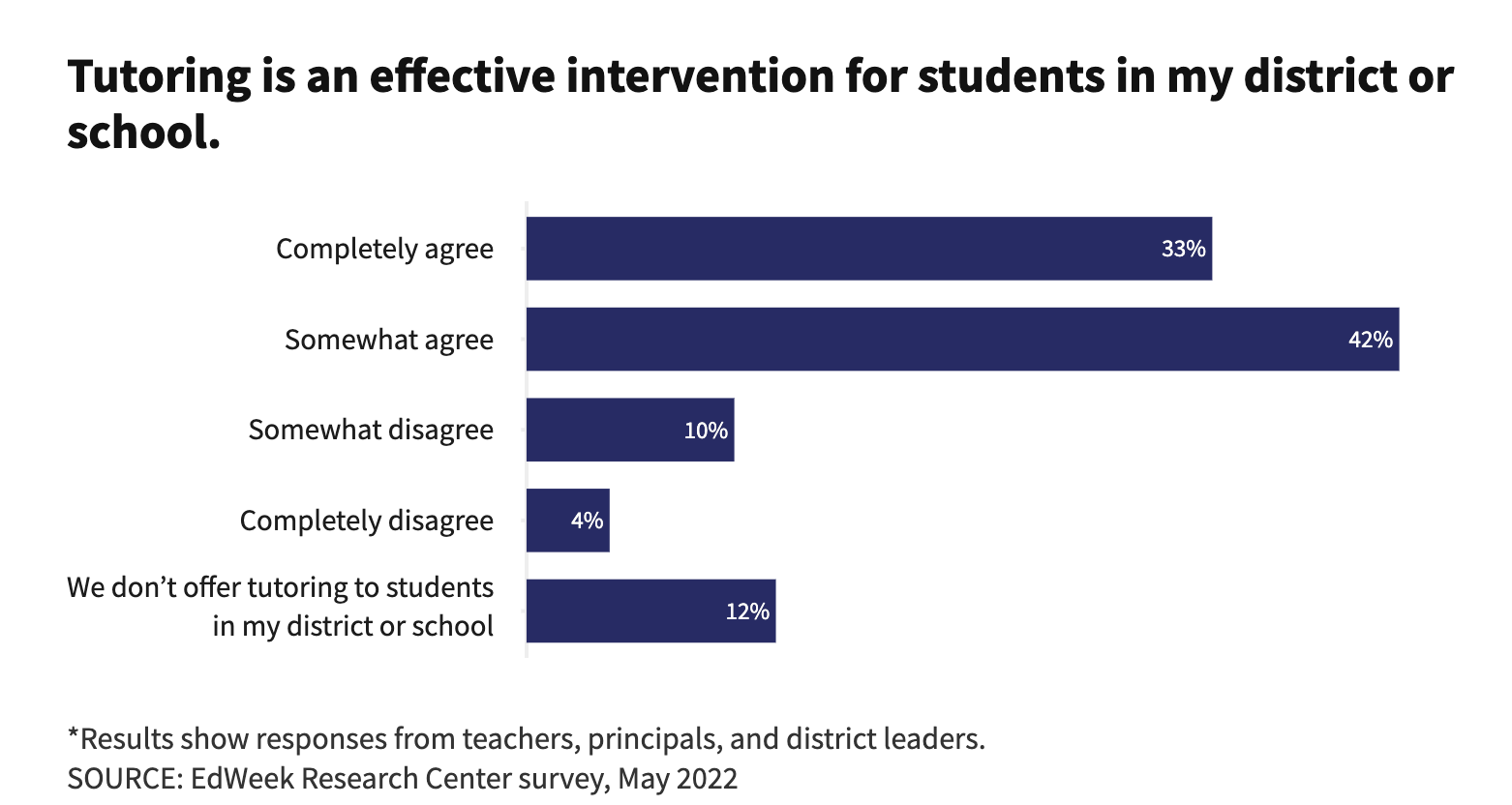
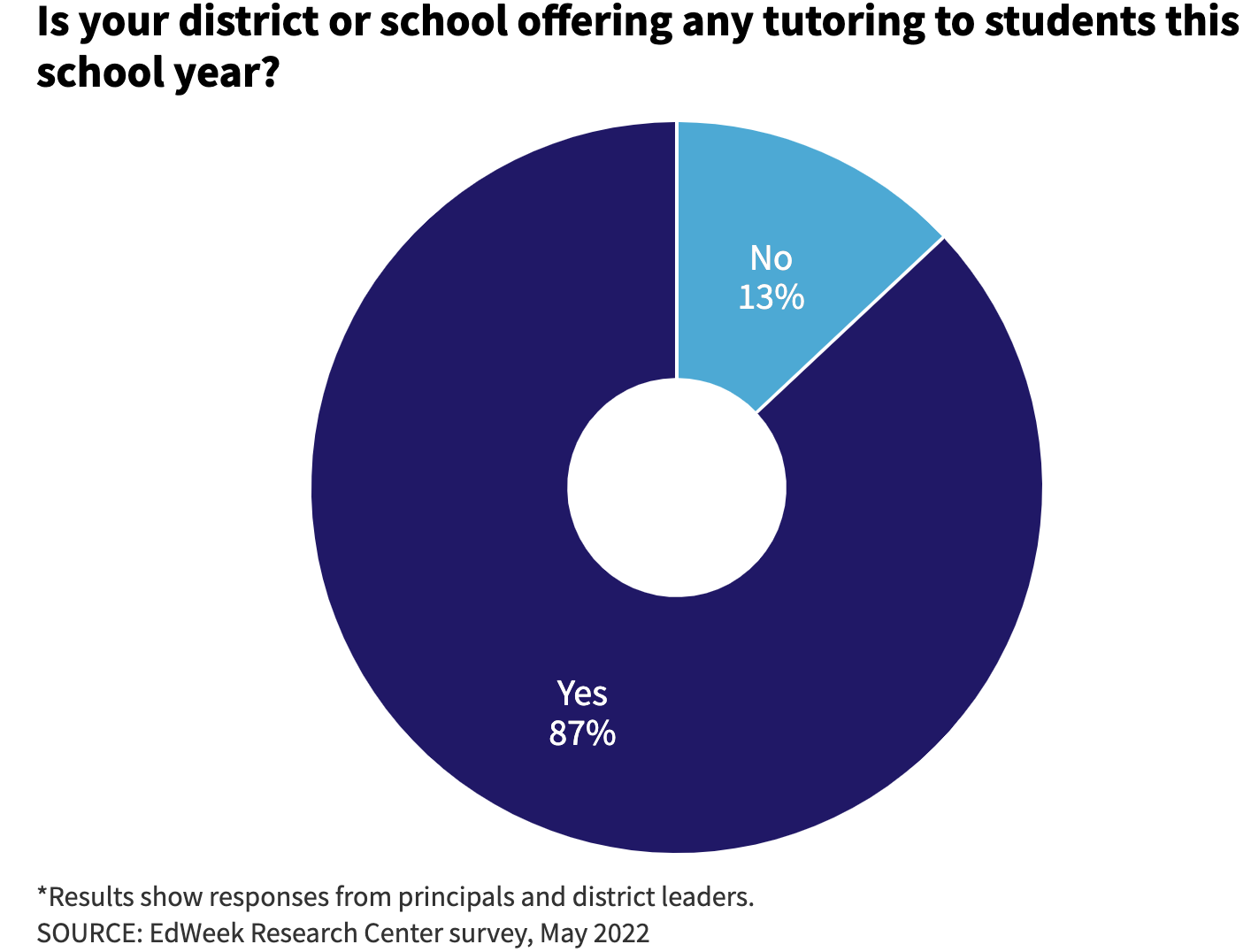
In the US, tutoring has always been a popular strategy for providing “extra help,” but following the school closures, tutoring is emerging as a more integral part of schooling across the US. According to a Education Week survey of school leaders and teachers in 1,287 districts at the end of the 2021-22 school year, almost 90% of those responding said that their school or district was offering some kind of tutoring (interesting, only 75% said that they “somewhat agreed” or “completely agreed” that “tutoring is an effective intervention for students in my district or school”).  Backing up those numbers, by the spring of 2022, estimates suggest that districts had dedicated over $1.7 billion in Federal funding to tutoring-related efforts and predicted spending could reach 3.6 billion by 2024. Correspondingly, the Department of Education reported that in the 2023-24 school year, more than four out of five schools reported offering tutoring programs, ranging from traditional after-school homework help to intensive tutoring. 

The Rise of Tutoring and Where It Falls Short, in Charts, Education Week

A whole series of funding initiatives have contributed to this widespread use of tutoring. With (unusual) bipartisan support, Congress and the Biden administration included support for tutoring in the package of $123 billion in emergency federal aid to schools. The U.S. Secretary of Education, Miguel Cardona, has urged schools to use their funds to provide at least 90 minutes of weekly tutoring to students most affected by the pandemic. Furthermore, in 2022, the Biden administration launched the National Partnership for Student Success – a three-year effort to create a coalition of organizations to “recruit, screen, train, support, and engage an additional 250,000 caring adults in roles serving as tutors, mentors, student success coaches, wraparound service coordinators, and post-secondary transition coaches”.

Private funders are also supporting tutoring efforts by establishing Accelerate, a new organization dedicated to developing and scaling affordable “high-impact” tutoring programs across the country. With funding from The Bill & Melinda Gates Foundation, Arnold Ventures, and the Overdeck Family Foundation, Accelerate set out to raise at least 100 million dollars to develop a network and make grants to support some of the most innovative tutoring models. According to later reports, Accelerate has provided 10 million dollars to 31 organizations developing “innovative” tutoring models and a million dollars to five different states to establish support and “infrastructure” for integrating tutoring into the regular school day that can serve as a model for other states.

States and cities have also participated in increasing the number of tutoring programs available around the country. New Hampshire’s approach includes offering a Yes, Every Student scholarship providing $1,000 for private tutoring from “state-approved educators” for “any young person whose education was negatively impacted by the pandemic.”  New Hampshire Education Commissioner Frank Edelblut described the reaction to the program this way: “When I explain the program to [parents], they become very excited, like, ‘Oh, this is great. In some cases, they’re almost like, ‘It’s too good to be true. How can this possibly be?’”

“When I explain the program to [parents], they become very excited, like, ‘Oh, this is great. In some cases, they’re almost like, ‘It’s too good to be true. How can this possibly be?’”

–New Hampshire Education Commissioner Frank Edelblut Quoted in ‘Too Good to Be True’: NH Gives Students $1,000 for Tutoring, The74

 Tennessee has launched a three-year tutoring project called Tennessee Accelerating Literacy and Learning Corps (TN ALL Corps), expected to cost almost 200 million dollars. The initiative hopes to serve 150,000 in 79 districts students who are just below proficiency in reading or math. In Texas in 2021, the state legislature passed a bill requiring schools to provide at least 30 hours of tutoring for students who did not pass the state tests in math or reading in grades three, five, or eight. To help meet the ensuing demand for tutoring, the Texas Education Agency established the Vetted Texas Tutor Corps, which seeks to offer support for over one million students by reviewing and approving eligible tutoring providers and offering a High Impact Tutoring Toolkit. 

In Ohio, most families now qualify for $1,000 to pay for tutoring. Through its Afterschool Child Enrichment program, called ACE, the Ohio State Department of Education supports educational activities for students who “experienced learning disruptions during the COVID-19 pandemic.” In Ohio’s case, however, families who meet the income restrictions can use those funds for a range of activities, including summer camps, language and music lessons, and after-school programs, in addition to tutoring. 

Next week: “Predictable challenges and possibilities for effective tutoring at scale – Scanning the news on the emergence of tutoring programs after the school closures (Part 2)

SCANNING THE HEADLINES FOR RESULTS FROM TALIS 2018: TEACHING, LEARNING, AND LEADERSHIP

This week IEN provides a glimpse of how a few media outlets around the world have characterized the results from the OECD’s recent release of Volume II of the TALIS 2018 results, Teachers and School Leaders as Valued Professionals. This volume summarizes the results of a survey of teachers and school leaders from 48 countries, with a focus on questions related to 1) how society and teachers view the teaching profession, 2) employment contracts and salaries, 3) how teachers work together and 4) how much control teachers and leaders have over their work. This week’s online search for “TALIS 2018 volume II OECD” turned up very few stories in English. However, there were a number of headlines in smaller outlets and other languages, some of which were (google) translated below. More English headlines appeared in a scan of the TALIS headlines last June following the release of Volume I.

Australia

TALIS 2018: Valuing teachers and school leaders as professionals, Teacher Magazine (Australia)

9 out of 10 teachers from all OECD countries and economies are satisfied with their job, but only 26% think the work they do is valued by society; 14% believe that policy makers in their country or region value their view, and only 24% believe that they can influence education policy.

Croatia

Teachers overwhelmingly feel they have control over things (translated), srednja.hr

“About 98% of Croatian teachers believe that they have control over the choice of teaching methods and student evaluation, 93% of them have control over the discipline of students (92% in secondary school), 94% of them have control over the choice of homework.”  But only 9% of teachers agree that the teaching profession is valued in society.

Denmark

Danish teachers are more stressed than their Nordic colleagues (translated), folkeskolen.dk

43% of Danish teachers are considering another job, and 31% of “feel that their job has a negative impact on their mental health to some extent. In comparison, only 24 per cent of Swedish teachers, 23 per cent of Icelandic, 13 per cent of Finnish and 10 per cent of Norwegian teachers.”

England

England’s teachers ‘most stressed’ in developed world, Times Education Supplement

“70% of lower secondary teachers report being stressed either ‘a lot’ or ‘quite a bit’… 77% of teachers are ‘all in all’ satisfied with their job, however, this is the lowest rate in the OECD, with all the other countries having rates of above 80%.”

France

Talis: The French teachers, the most despised in the world? (translated), Café Pedagogique

“85% of French teachers feel satisfied with their work, but Talis demonstrates that French teachers are not only isolated and underpaid but also despised by their institution.”

Italy

80% Italian teachers perceive various degrees of stress, low salary always a reason for dissatisfaction (translated), Orizzontescuola.it

“Only 12.1% of teachers in upper secondary schools feel valued, without particular differences by geographic areas and by order of school. The data also shows that 7% of the entire teaching staff think they are listened to by the country’s political leadership class.”

Japan

TALIS — Teachers’ stress factors: “Amount of work” “Parents” (translated), Kyoiku Shimbun

“The percentage of Japanese elementary and junior high school teachers who have a lot of administrative work and stress on dealing with parents exceeded the average in participating countries. Principals at elementary and junior high schools were also stressed about their responsibility for their students’ abilities and dealing with parents.”

Korea

1 out of 4 middle school teachers “will quit teaching in the next 5 years” (translated), Chosun Edu

“Nevertheless, the proportion of teachers who agree that the teaching profession is valued is 67%, much higher than the OECD average of 26%.” However, only 54% OF teachers and 62% of principals said they were satisfied with their working conditions, slightly lower than the OECD average (66%).

Latvia

Almost all Latvian teachers are satisfied with their work, the survey shows (translated), nra.lv

“23% of teachers surveyed agree or totally agree with the statement that their profession is valued in the community, while 91% of Latvian teachers indicate that they are generally satisfied with their work”

Norway

Norwegian teachers work well together (translated), NEA Radio

95% of teachers say that there is a good culture for supporting each other and working together at the school…Teachers also feel that they have good control over their own teaching.”

Slovakia

Survey: Our educators receive little respect (translated), Felvideck.ma,

“Only 4.5% of teachers in Slovakia feel that teachers’ work has a high degree of social appreciation, while only 2.1% of school principals believe it”

Slovenia

They are not appreciated by the public or by policy makers (translated), Večer

The majority of “Slovenian teachers and principals were satisfied with their profession and workplace, and slightly less satisfied with their salary… but only 3% of teachers say policy makers value their views and opinions.”

  • Thomas Hatch

Scan of Ed News: U.S. travel ban and higher education

On January 27, 2017, United States President Donald Trump issued an Executive Order temporarily withholding entry to the U.S. to individuals from seven predominantly Muslim countries. In addition, aspects of the current visa and refugee program were suspended. The order has affected many people and caused confusion worldwide. Since it was established, news reports show that the order is also having an impact on higher education institutions around the world. Therefore, we decided to conduct a brief scan of reports that share information on how the ban will effect higher education, and how school leaders in the U.S. and around the world are responding.

Image: Getty

Image: Getty

Universities and scholars are grappling with what the restrictions of the travel ban means for students and scholarship. One primary concern is for international students and faculty who are  studying and working in U.S. institutions, but who happened to be outside of the country when the order was signed and are now unable to return.  Additional concerns have been raised about the future of longstanding partnerships between universities in the US and in affected countries, such as Iran.  Terry W. Hartle, senior vice president at the American Council on Education, was quoted in the Times Higher Education: “What we have is, frankly, a matter of significant concern and a great deal of confusion and very little clarity.”

According to Business Insider, tens of thousands of students across the country could be affected. Dallas News detailed how the ban will impact students in colleges and universities in Texas. Southern Methodist University has 49 students from the seven affected countries; The University of North Texas has 85 students; the Dallas County Community College District has 47; UT-Dallas has 127; Texas Tech University has 149; UT-Austin has 110; and the University of Houston has 280. Students and staff are being warned not to travel and to avoid the Texas-Mexico border checkpoints.

A coalition of 598 college and university presidents signed a letter to President Trump urging that the travel ban be rescinded. As reported by The Hill, this letter was sent to Homeland Security Secretary John Kelly through the American Council on Education (ACE). As reported in The Boston Globe and in Time Magazine, these higher education leaders said that the order “specifically prevents talented, law-abiding students and scholars from the affected regions from reaching our campuses. American higher education has benefitted tremendously from this country’s long history of embracing immigrants from around the world.”

Additional reports share individual responses from presidents of Princeton, RutgersHarvard, MIT and Carnegie Mellon.  The Association of American Universities and the International Congress for School Effectiveness and Improvement also issued statements. Also, as reported in The Independent UK, more than 4,500 scholars from Europe, Asia, Australia, Canada, Latin America, Africa and the Middle East have signed a petition calling for a boycott of international conferences held in the U.S.

Since the implementation of the Executive Order, there has been some speculation that the travel ban could benefit countries wiling to take the displaced students and faculty—such as Canada, Australia, and Ireland. For example, Memorial University of Newfoundland, in Canada, has offered to waive the application fees of students applying from the seven countries named in the Executive Order—hoping to attract new talent to the school. In an article just published in the New England Journal of Medicine, two physicians at the University of Pittsburgh Medical Center explore the consequences of the travel ban and point out that international medical graduates currently fill gaps in the American healthcare system, particularly in rural areas.

Meanwhile, protests and demonstrations continue. Yesterday, hundreds of New York City high school students walked out of school in protest of the ban. As reported in Chalkbeat, students filled Manhattan’s Foley Square, chanting “No hate! No fear! Refugees are welcome here!” College students have also been protesting in many states, including Vermont, Maine, Illinois, California, Massachusetts,  and even in the UK.

Deirdre Faughey