Initial School Closures and Suspensions of Exams in the Netherlands: An Interview with Melanie Ehren on the Educational Response to the COVID-19 Pandemic in the Netherlands (Part 1)

In this two-part interview, Melanie Ehren talks with Thomas Hatch about how the Dutch education system responded to the COVID-19 pandemic and what has happened since. Ehren is Professor and Director of Research of LEARN! at Vrije Universiteit Amsterdam. This interview is one in a series exploring what can change in schools after the pandemic? Previous interviews and posts have looked at developments in Italy, PolandFinlandNew Zealand, South Africa, and Vietnam. Other IEN blog posts from Melanie Ehren include A view from the Netherlands: Melanie Ehren on school closures and the pandemic; Lead the Change Interview with Melanie Ehren; A call to action in the Netherlands: Addressing rising inequality in a decentralized system.

Thomas Hatch (TH): Can you give us an overview what happened in schools in the Netherlands after the COVID-19 outbreak? When did schools close and how long were they closed?

Melanie Ehren (ME): The national government closed schools three times. The first national closure lasted from March 16 to 10 May 2020 (for primary schools) and until the 2nd of June (for secondary schools). Teaching and learning was fully online during that time. The second national closure went from the 16th of December 2020 until the 8th of February 2021 and then the third national closure went from 14 December 2021 until 10 January 2022, although this was more of an extended Christmas break. All the closures were in response to a rise in cases, but around the time of the second closure there was also a discussion about whether closing schools was the best measure to prevent virus spread. The argument for closing schools included that it would help enforce the working from home policy. Too many people were still going into work and by closing schools, parents had to stay home with their children.

Melanie Ehren

When schools reopened after the first and second closures, schools had to ensure social distancing of 1.5 metres between people inside and ensure good hygiene. Schools were allowed to decide on how to meet these guidelines, with support and proposed models by the national councils for primary and secondary education. In response, schools did things like splitting classes in half with some students attending during the first part of the week and the rest attending at the end of the week. Even though the periods of national school closure were relatively short in comparison to some other countries, the disruption lasted much longer. For example, even when schools were technically open, many teachers and classes had to quarantine for periods of time. Since the beginning of the school closures, the Dutch Ministry of Education, Culture, & Science has monitored the reduction in lesson hours due to COVID over the pandemic in a series of monthly reports. The Dutch Inspectorate of Education also documented the timeline of COVID-related decisions in 2020 (including the start of the second closure in December of 2021) and then again in 2021 in their annual reports on the state of education.

March 2020 – January 2021
Timeline of school closures and related decisions for primary schools (closures = yellow)
The State of Education 2021, Dutch Inspectorate of Education
January 2021 – January 2022
Timeline of school closures and related decisions for primary schools (closures = yellow)
The State of Education 2022, Dutch Inspectorate of Education

TH: What was the initial response from policymakers and others in terms of support?

ME: In the Netherlands, there was a coordinated approach by the national councils for primary and secondary education, the ministries for education and economic affairs and a national association of school boards. That approach focused on ensuring that all students had access to online learning when schools were closed. These organisations collectively investigated how many students and teachers did not have internet connections or laptops at home. Based on this information, telecom providers searched for the best solutions together with the parties involved. Those solutions included issuing hotspots and creating public Wi-Fi networks and arranging laptops for children who needed them. In addition, NPO Z@ppelin, a national broadcaster, initially offered instruction on television for children without a laptop/tablet.  But I also saw schools where teachers would just hop on their bicycle and tour around the city to check in with families and have conversations on the doorstep.

A lot was left up to the initiative of the boards of each school and the networks responsible for ensuring inclusive education in each region. Honestly, because the Dutch school system is so decentralized, we just don’t know what happened at the school level in a lot of communities. All this raises a really interesting question: are highly centralized systems or more decentralized systems are best equipped to deal with a crisis like the pandemic?  To me, the examples of teachers going door to door to check in with kids really speaks to teacher agency and how teachers understand their role and responsibility.  That agency is a really important thing to have during a pandemic, but also when thinking about school quality in general. My colleagues and I wrote about some of these issues of teacher agency from the perspective of several different education systems (Teaching in the COVID-19 Era: Understanding the Opportunities and Barriers for Teacher Agency).

Overall, though, there was not much focus on internet access because the entire country has good coverage and good broadband access. At the same time, the Dutch government created some exceptions to online learning so that children from parents in key professions like health, education, police, public transport and the fire department could go to school. Local schools could also make exceptions so that children from what the government called “vulnerable populations” could come to school. That included children who were living in confined spaces, did not have access to devices, or who were experiencing other problems at home that might be preventing them from accessing online education.

TH: What happened with exams and testing at the end of the 2019-2020 school years?

ME: The school closures in 2019-2020 meant that standardized tests at the end of primary education (8th grade; age 11/12) and in secondary education were cancelled. The cancellations of the exams at the end of primary education had a particularly significant impact because, in the Netherlands, students are tracked into different types of secondary schools according to tested ability level. Only those students in the highest track in secondary school will get access to a university. Getting into a higher secondary school type is therefore a defining point in a child’s life. In a normal school year, students are placed into secondary school types on the basis of their primary school teacher’s advice. This can be adjusted upwards (never downwards) on the basis of the national standardised test at the end of primary education. However, estimates from the national planning bureau (CPB) suggest that in the year 2019-2020 when the test at the end of primary school was cancelled, 14,000 pupils were placed in a lower track for secondary school than they would have been if they’d been able to sit the national test. This group represents 8% of all pupils – 2 to 3 students per class in a secondary school – and includes an over-representation of students with parents with low levels of education.
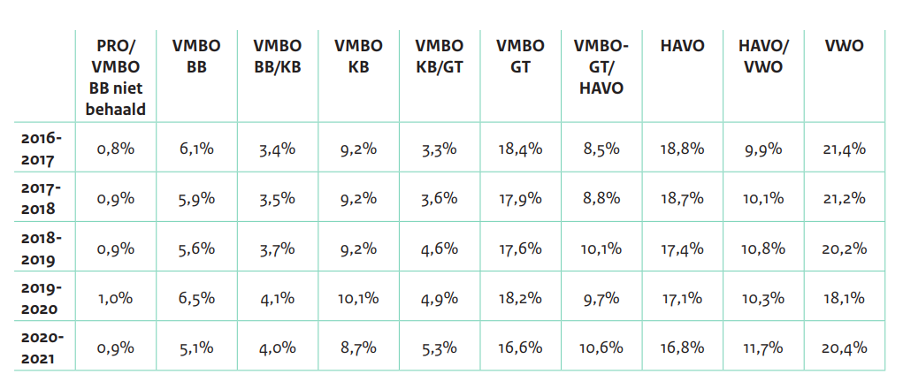
% of students placed in each track of secondary education by year.
Tracks are indicated at the top and range from “lower” and vocational tracks on the left to “higher” tracks preparing students for entrance to polytechnics (HAVO) and universities (VWO)

Due to these results, the Minister of Education sent out a letter to secondary schools, asking them to implement a range of formative assessments in year 1 to target the students who might have been mis-placed and to put in place transition arrangements to enable them to move upwards if warranted. The next year, in 2020-2021, primary schools were advised to give children the benefit of the doubt in their recommendations for secondary education and err towards a higher track. However, for the most part, this does not seem to have happened.

In contrast, the cancellation of standardized secondary school exams had a more positive effect for students in the Netherlands who wanted to enter university because their final grades were based only on their school-based assessments with no information from the cancelled national exams. Normally, at the end of secondary school, students receive a mark for each subject where 50% is based on school-based exams and 50% on a standardized national exams. The Government decides on which content should be included in the school-based exams and which will be assessed in the national exams. The school decides when and how it assesses the school-based component and can spread this over multiple months and even school years. The only requirement is that the assessments are finalized before the national exams and that the organisation of the school-based assessments (including how it is marked and how the assessment is quality assured) is included in a formal programme of assessment which is approved by the school’s exam board. The exam board decided on the adaptations so this would vary by school (for the official description see School Examens 2023).

For the 2019-20 school year, when the national exams were cancelled, estimates by from the national planning bureau (CPB) suggest that 8% of secondary students would have received a different outcome if they had sat the national exam. To mitigate negative consequences and to give everyone a fair chance to pass, the Dutch Ministry of Education offered all students additional re-tests of their school-based assessments in up to three subjects. This resulted in an overall pass rate above 98%, with almost 7% higher than in preceding years.

Source: Effect of scrapping central exam without additional measures, Central Planning Bureau (CPB)

Then in 2020-21, standardized tests in primary education returned as normal. However, exams in secondary education were adapted in two ways.  First, following a formal in-school consultation process and including adaptations in the formal ‘programme of assessment’ which is scrutinized by the Dutch Inspectorate of Education during regular inspections, schools were allowed to make their own adaptations to the school-based assessments.

Second, national exams were adapted by having an additional opportunity to sit for the exam, so if you failed twice, you were given a third try.  Schools were also allowed an extended timeframe in which students could sit exams in their various subjects, and students could choose one subject that wouldn’t count towards their final pass/fail decision.

(To be continued in October…)
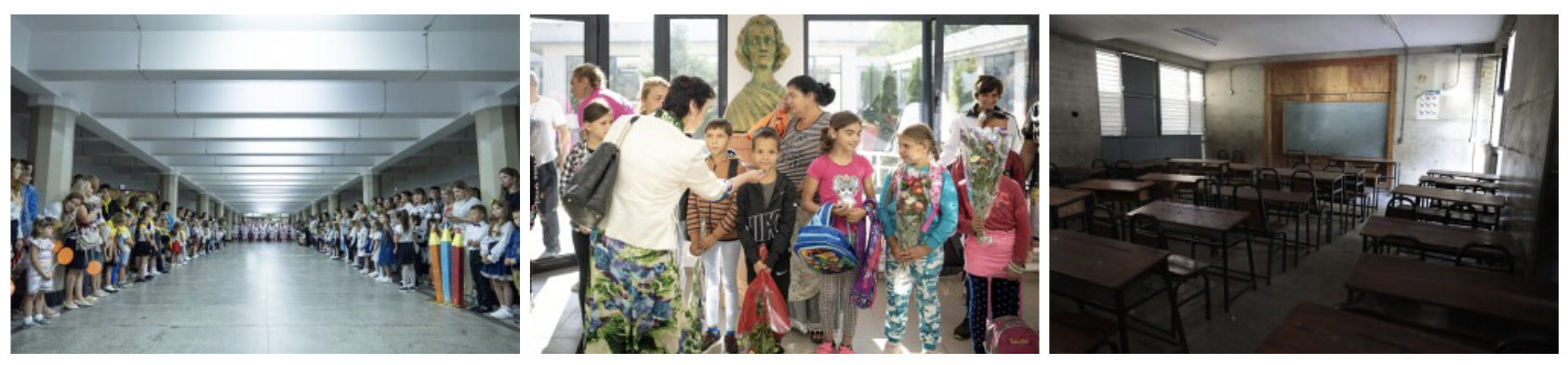
Educational Issues in the News Across the US: Scanning the Back-to-School Headlines (Part 3)

The final post in IEN’s 2023 Back-to-School series features some of the latest issues – like the use of AI – that many teachers and students are dealing with and surveys some of the education-related topics that are in the headlines in different states and cities in the US. Part 1 of the series shares headlines highlights some of the critical challenges that students, educators and schools are facing in 2023. Part 2 focuses on the stories that covered the natural disasters and climate-change related heat that many schools have had to deal with this year as well. For back-to school headlines from fall 2022 see Hope and trepidation: Scanning the back-to-school headlines in the US“Over it” but unable to escape it: Going back to school with Covid in 2022Going back to school in 2022 (Part 3): Scanning headlines from around the world; for fall 2021 see Going back to school has never been quite like this (Part 1): Pandemic effects in the USGoing back to school has never been quite like this (Part 2): Quarantines, shortages, wildfires & hurricanes; for fall 2020 see What does it look like to go back to school? It’s different all around the world…; for 2019 see Headlines around the world: Back to school 2019 edition.

Even as the school year continues for many students in the southern hemisphere, the end of summer vacation and the start of school in many northern school systems provides an opportunity to see what education issues are being covered and highlighted. Among them, the impact of AI – and how to prepare for it – as well as the consequences of the end of COVID relief funding are common topics in the US.

Take a round-the-world tour of the return to school, Education Week

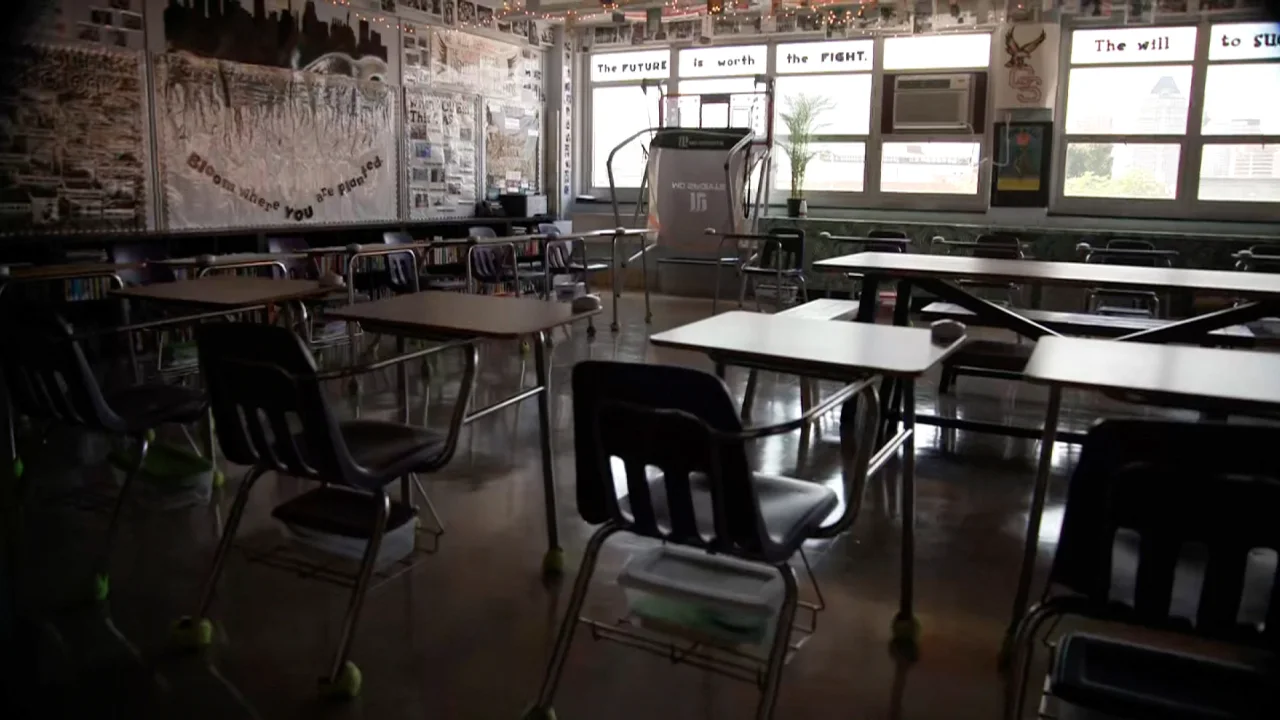
From left to right: “1.) Schoolchildren attend a ceremony for the first day of school in a safe place in an underground subway station, in Kharkiv, Ukraine, on Sept. 1, 2023; 2.) A teacher adjusts the posture of a little boy as children attend a school opening ceremony in Ghergani, Romania, on Sept. 11, 2023. 3.) A classroom sits empty at the closed National School of Republique des Etats-Unis d’Amerique, a public school in Port-au-Prince, Haiti, on Sept. 11, 2023, on what should have been the first day back to school after summer break. According to a few teachers and a parent on site, classes did not resume due to parents’ inability to afford tuition, uniforms and school supplies, as well as families being afraid to go out amid gang violence.”

New Year, New AI?

How widespread will AI be in classrooms this year? Teachers offer some clues, Education Week

A version of OpenAI’s GPT-4 will be ‘teaching’ thousands of kids this fall, Popular Science

“The education nonprofit service Khan Academy, is expanding its Khanmigo AI access to over 8,000 educators and K-12 students as part of its ongoing pilot program for the new technology.”

Beyond ChatGPT: The other AI tools teachers are using, Education Week

Instructors rush to do ‘assignment makeovers’ to respond to ChatGPT, EdSurge

How can educators respond to students presenting AI-generated content as their own?, Open AI

Issues in the Education News around the US

5 signs a district will be at risk when elementary and secondary school emergency relief fund runs out, Education Week

“Once federal relief funds expire, districts nationwide stand to lose an average of $1,200 for each student… That’s an 8 percent reduction in the average amount spent per K-12 pupil nationwide. In some states where per-pupil spending is lower than the average, that $1,200-per-student loss will account for an even larger share. In Arizona, for instance, the end of federal relief funds will translate into a 12 percent loss.”

When can schools consider race in classrooms and events? Biden officials have guidance, ChalkBeat

K-12 teachers shift away from textbooks, K-12 Dive

“Use of printed textbooks has declined in K-12 classrooms by 9% and a slight increase in digital-only textbook usage by 2% during the past school year, according to a survey by Bay View Analytics. The findings indicate a growing utilization of digital and teacher-created materials, with 77% of teachers saying they are supplementing or replacing textbooks with their own content and 78% saying they are sourcing supplemental materials online.”

For teachers, a new year — and new book bans — means more work, Rolling Stone

Issues to watch in States and Cities

California

Gov. Newsom poised to sign legislation to counter book bans and school boards’ censorship, EdSource

“The bill, authored by first-term Assemblymember Corey Jackson, D-Perris, in Riverside County, would expand existing state law, including the 2011 FAIR Act, which requires instructional materials to accurately portray the history, viewpoints and experiences of California’s diverse and underrepresented racial, ethnic, and other groups, including LGBTQ+ Californians.”

Temecula Valley Unified School District anti-CRT resolution prompts lawsuit from parents and teachers, Education Week

Florida

New laws make teachers anxious about school year, Axios Miami

“[Teacher] Hernandez-Mats says the first couple weeks of school are typically filled with excitement, but this year feels different… She says teachers are confused about what they’re allowed to teach in the classroom. Some have removed literary or historical posters from their walls and others have blocked access to their bookshelves.”

Florida’s new rules for classrooms could get teachers in trouble, Tampa Bay Times

Iowa

An Iowa district used AI to figure out which books to ban, Education Week

“While book bans have proliferated across the country over the past two years, this is the first time a district has relied on artificial intelligence to determine which books should be removed from school libraries, according to Deborah Caldwell-Stone, director of the American Library Association’s Office for Intellectual Freedom.”

How Des Moines Metro Schools are applying anti-LGBTQ law, Iowa Starting Line

Massachusetts

School meals in Massachusetts will remain free next school year, Axios Boston

“Massachusetts lawmakers passed a budget agreement, allocating $172 million to continue the pandemic-era program that offers free school meals to all K-12 students, ensuring access to essential nutrition and removing social stigma. Governor Maura Healey is expected to sign the budget, freeing up funds for schools as they prepare to reopen in the upcoming weeks.”

Montana

Montana scores rare federal testing waiver in favor of through-year assessment, K-12 Dive

“Montana has been granted approval by the US Department of Education to field test a revamped through-year assessment system in reading/language arts and math for third-through eighth-grade, replacing the existing annual assessment. The move is expected to offer timely insights into student progress while allowing participating schools some waivers from federal assessment and accountability requirements for the 2023-24 school year.”

New York

As NYC’s school year kicks off, here are 5 issues to watch, ChalkBeat

Enrollment drop and fiscal cliff loom as NYC starts school year, The City

NYC school year set to begin with thousands of new migrant students, Gothamist

“Schools Chancellor David Banks said in a briefing on the asylum seeker crisis that… ‘Our focus remains undeterred on the education, well-being and holistic development of every student that steps into a New York City public school, regardless of where they come from or the language that they speak at home.’”

New York City Schools preparing for influx of children of asylum seekers: “We are very confident that the students will be ready“, CBS News

Some migrant families still waiting for school placements, ChalkBeat

“Some families have waited weeks for school placements or don’t have seats at all yet, sparking concerns that some kids won’t have their school plans finalized by the start of classes on September 7.”

Ohio

The Great Recession offers insight about the impact the impending fiscal cliff will have on Ohio school districts, The Fordham Institute

Pennsylvania

All Philadelphia schools set to open in September amid asbestos challenges, ABC

Texas

State takeover ushers in changes to Houston schools, The New York Times

“A state takeover of the Houston Independent School District in Texas, one of the nation’s largest, has sparked contentious changes, including firing librarians and repurposing school libraries for discipline and computer rooms. The takeover, imposed by Governor Greg Abbott, aims to improve reading and math scores in struggling schools, but critics argue the changes are disenfranchising and may further divide the district’s predominantly Black and Hispanic students.”

First day of school comes with mixed student emotions after Texas took over Houston ISD, The New York Times

Natural Disasters, Climate Change and the Start of School in 2023: Scanning the Back-to-School Headlines (Part 2)

Part 2 of IEN’S Back-to-School series shares headlines and stories focused on the natural disasters, heat and climate change-related crises that have interfered with the start of school in many parts of the US. This three part series highlights some of the key issues that the education sources we follow are talking about as school resumes in many parts of the Northern hemisphere. Part 1 pulled together headlines that highlight some of the other critical challenges that students, educators and schools are facing in 2023. Part 3 collects some of the back-to-school guidance and the issues to watch in the coming year — including the use of AI in schools. For back-to school headlines from fall 2022 see Hope and trepidation: Scanning the back-to-school headlines in the US“Over it” but unable to escape it: Going back to school with Covid in 2022Going back to school in 2022 (Part 3): Scanning headlines from around the world; for fall 2021 see Going back to school has never been quite like this (Part 1): Pandemic effects in the USGoing back to school has never been quite like this (Part 2): Quarantines, shortages, wildfires & hurricanes; for fall 2020 see What does it look like to go back to school? It’s different all around the world…; for 2019 see Headlines around the world: Back to school 2019 edition.

This fall, a number of the back-to-school headlines have shifted focus from the COVID crisis to the many climate change related concerns and disasters like the intense heat in many parts of the world and the tragic fires in Hawaii. As Alexander Russo and colleagues with The Grade, who regularly document and summarize the latest education-related journalism in the US, noted, the big education story of the first week of school was the heatwave that blanketed much of the Northeast and other parts of the country. The unusually high heat created a major challenge for schools trying to launch the new year — and an irresistible topic for news outlets. Reporters covered schools closing, kids sent home early, canceled recess time, and the lack of AC in many buildings” (Heat wave welcome: The big story of the week).

Hawaii wildfires thrust educators into disaster response roles, Education Week

“Schools across Maui closed Wednesday—days after the start of a new school year—after a wildfire ravaged a historic region of the Hawaiian island”

Are the challenges of Puerto Rico’s schools a taste of what other districts will face? The Hechinger Report

Sweltering classrooms due to inadequate cooling systems are hindering student learning and causing health concerns among educators in several US states. Budgetary constraints and the increasing frequency of heat waves are exacerbating the issue, prompting educators to call for better classroom conditions and investments in upgraded cooling systems.” 

Hot classrooms are impairing student learning and health amid record-hot year, teachers say, NBC News

Are heat days the new snow days? Schools are canceling class as temperatures soar, CNN

“Schools really need to be thinking about how climate change is going to impact them and how they can develop and build plans in place to adequately respond…”

As classes resume in sweltering heat, many schools lack air conditioning, NPR

“Heat days:” More than a dozen Denver schools releasing students early Tuesday, ChalkBeat

“With outdoor temperatures soaring into the high 90s, some Denver schools without air conditioning are releasing students early Tuesday. Roughly one-fifth of Denver schools lack cooling systems.”

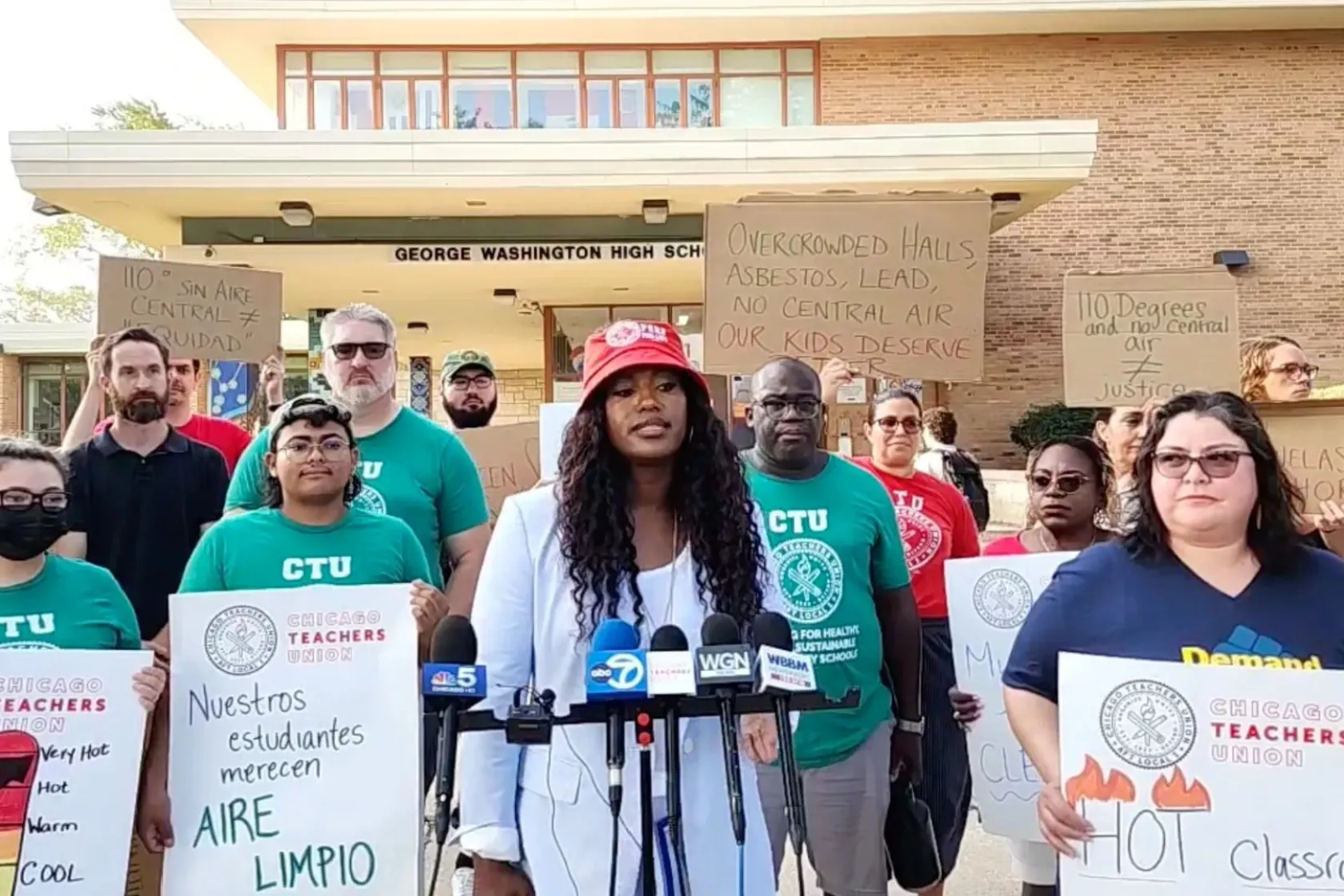
Chicago public schools teachers adjust to keep classrooms cool as extreme heat bakes city, ChalkBeat

“Teachers, parents and union organizers said they are managing the tough conditions, but it’s time for the district to commit to long-term upgrades instead of “quick fixes and bandaids.”

Philly school dismissals: How extreme heat impacts families, NPR

“What we’re seeing is that climate change is boosting heat not only in Philadelphia, but all over the world.”

Seattle-area teachers brace for sweltering classrooms during heat waves, Seattle Times

“Heat waves have historically fallen outside of the school year, sparing kids and educators. But not so over the past six or seven years.”

What educators need to know about schools and hot weather, Education Week

“With record-setting high temperatures, schools struggle to keep their students cool.”

Crises and Concerns: Scanning the 2023-24 Back-To-School Headlines (Part 1)

To get a sense of some of the key issues people are talking about as the new school year begins in many parts of the Northern hemisphere, we’re scanning the back-to-school related headlines of the education sources we follow. Part 1 of 2023’s Back-to-School Series pulls together headlines that collectively show many of the different problems that students, educators and schools are facing in 2023. Part 2 will share the many headlines and stories focused on the natural disasters, heat and climate change related crises that have interfered with the start of school in many parts of the US. Part 3 collects some of the back-to-school guidance and the issues to watch in the coming year — including the use of AI in schools.

For back-to school headlines from fall 2022 see Hope and trepidation: Scanning the back-to-school headlines in the US; “Over it” but unable to escape it: Going back to school with Covid in 2022; Going back to school in 2022 (Part 3): Scanning headlines from around the world; for fall 2021 see Going back to school has never been quite like this (Part 1): Pandemic effects in the USGoing back to school has never been quite like this (Part 2): Quarantines, shortages, wildfires & hurricanes; for fall 2020 see What does it look like to go back to school? It’s different all around the world…; for 2019 see Headlines around the world: Back to school 2019 edition.

If it’s not one crisis it’s another. That sentiment seems to sum up many of the 2023 back-to-school headlines. Around the world, those crises included the:

In the US, along with the threats from heat and natural disasters, reporters chronicled start of the year challenges for students, teachers, and schools like continuing concerns about COVID-19; lack of funding and supplies; the need to support the many immigrant students who arrived in in cities like New York this year; shortages of teachers, bus drivers, and other personnel;

Under these circumstances, perhaps it’s no surprise that one Washington Post headline declares “In some schools, dread over the new year: ‘We’re scared to teach’.  At the same time, some articles try to set a happier tone even as they chronicle the challenges: “For many students,” Chalkbeat NYC reported, “Thursday marked a joyous return to school. But a possible bus strike and air conditioning issues dimmed some of the good vibes (“First day of school for NYC’s nearly 900,000 kids: Smiles, sweat, and bus strike concerns.”)

COVID-19 & Health Concerns

A new school year, a new COVID-19 variant. What are schools to do?, Education Week

Cleaner air could keep schools open, The New York Times

Some US schools return to face mask requirements, The Washington Post

“Cases of COVID-19 have risen in some areas of the US, and some schools have reinstated face mask mandates, rekindling debate about whether the requirement is necessary or an impingement on personal freedoms. COVID-19 hospitalizations are well below what they were a year ago, but some experts have expressed concern about the fall season as most Americans have not yet gotten the latest updated booster vaccines that are due out soon.”

As children return to school, parents fret over shortage of ADHD meds, KFF Health News

Colorado launches free school lunch, mental health support, CBS Colorado

“The Cherry Creek School District in Colorado is welcoming students back with the launch of “Healthy School Meals for All,” a free school lunch program funded by Prop FF, aiming to support learning. Superintendent Christopher Smith also highlights partnerships with Hazel Health, offering free virtual mental health sessions, and the upcoming opening of Traverse Academy, a unique facility for students dealing with serious mental health challenges.”

Concerns about costs and funding

Enrollment, funding, supply chain issues throw wrench into school construction projects, K-12 Dive

Schools’ insurance costs are soaring—and climate change isn’t the only reason, Education Week

“Districts are seeing higher premiums thanks to a surge in natural disasters and other challenges.”

Cost of school supplies is at an all-time high, NPR

As back-to-school costs soar, more parents & teachers turn to charities for help, The 74

Most teachers spend their own money on school supplies. Should they?, Education Week

School supply funding varies widely across US, Education Week

‘Food is the biggest expense’: Mass. families welcome permanent free school meals for students, WBUR

School lunch prices rise amid challenges, USA Today

“As the new school year approaches, schools nationwide face the challenge of increasing lunch and breakfast costs due to inflation, the end of federal subsidies and potential new regulations — causing the School Nutrition Association to urge federal action. “School meal programs need permanent reimbursement-rate increases to cope with long-term, higher labor costs — especially as many schools still struggle with labor shortages and need to raise wages to fully staff their kitchens,” said Diane Pratt-Heavner, SNA’s director of media relations.”

More students eating for free as growing number of states offer universal school meals, Chalkbeat

Shortages

From ‘crisis’ to ‘catastrophe,’ schools scramble once again to find teachers, NBC News

To fight teacher shortages, schools turn to custodians, bus drivers and aides, Hechinger Report

West Virginia schools facing staffing problems amid new teaching assistant law, The 74

Districts aim to address teacher housing crisis, Axios

“School districts in the US are turning to homebuilding to address the chronic teacher shortage and housing affordability challenges. The move aims to improve teachers’ quality of life and educational outcomes, as many educators struggle to afford living near their schools, potentially leading to increased burnout and reduced time spent with students.”

The shortage in school bus drivers is getting worse, The New York Times

Wake County school bus driver shortage affecting 2,000 students, ABC 11

Severe bus driver shortage in Baton Rouge leads to an emergency school board meeting, WAFB

A district’s bus ‘disaster’ highlights a nationwide driver shortage, Education Week

GOP lawmakers call for special session after school bus debacle, canceled classes, The 74

“After a disastrous first week of school, when some buses didn’t get students home until 10 p.m. and classes were subsequently canceled for two days, Jefferson County Republican lawmakers want to call a special legislative session to enact changes — including a school choice amendment and the possible splitting up of the district. In our latest partnership with the Kentucky Lantern, McKenna Horsley reports that 12 lawmakers signed an open letter last week, saying the district failed to “keep our kids safe” and that structural changes are needed.” 

Why is there a shortage of school bus drivers? Problem worsened by COVID reaches crisis level, USA Today

Revisting Back to School in 2022

We’re off until the beginning of September, but we will be back with new posts about the start of the 2023-24 school year, an interview about the COVID response and “catch-up” efforts in the Netherlands, and virtual visits to schools in Chile. In the meantime, please revisit some of our back-to-school posts from previous years and be sure to check out our twitter feed for the latest international education news.

Hope and trepidation in 2022: Scanning the back-to-school headlines in the US

 Going Back to School Has Never Been Quite Like This (Part 1): Pandemic Effects in the US

Going back to school in 2022 (Part 3): Scanning the headlines from around the world

What does it look like to go back to school in 2020? It’s different all around the world…

Headlines Around the World: Back to School 2019 Edition

Revisiting Interviews from 2022-23

IEN is on vacation, but we will be back in two weeks with new posts about the start of the 2023-24 school year, an interview about the COVID response and “catch-up” efforts in the Netherlands, and virtual visits to schools in Chile. In the meantime, please revisit some of the interviews we did over the past school year and be sure to check out our twitter feed for the latest international education news.

A view from Poland (Part 1) – Jacek Pyżalski discusses the impact of school closures and the COVID-19 Pandemic on students and teachers

The Recent Development of Innovative Schools in China – An Interview with Zhe Zhang (Part 1)

← The Evolution and Scaling of the Whole Child Model (Part 1): An Interview with Cynthia Robinson Rivers

School Closures, Internet Access and Remote Instruction in Vietnam:  A Conversation with Chi Hieu Nguyen (Part 1)

Workforce Development in Finland and in the U.S.

In case you missed it, earlier this summer, Sam Abrams shared some of his latest reflections on what he’s learned about vocational education in Finland. Abrams is an Adjunct Assistant Professor of Education at Teachers College, Columbia University. At Teachers College, he also serves as Director of the National Center for the Study of Privatization in Education. During the 22-23 academic year, Abrams was a Fulbright Visiting Professor at the University of Turku in Finland. This post was originally published on June 15th, 2023, by the Fulbright Finland News Magazine.

In studying Finnish primary and lower-secondary schooling for a book I was writing on comparative education policy early in my academic career, I took a detour in 2010 to visit an upper-secondary vocational school in Lohja called Luksia. The late Matti Saarinen, a Social Democratic MP from Lohja I had come to know, told me that to understand Finnish education, I had to spend time at a school like Luksia, which he knew well as a former administrator there.

Esa Karvinen, the head of Luksia, hosted me for breakfast at the start of the day and then showed me one sparkling program after another, from cosmetology and culinary arts to auto maintenance, before returning to the cafeteria for lunch prepared by students in the culinary arts program. Karvinen afterward gave me a tour of the Emergency Medical Services (EMS) program and then drove me around Lohja to visit businesses where students were doing apprenticeships.

The final stop was a serpentine drive from the center of town. Karvinen didn’t tell me where we were heading. He merely said that he was now going to show me something truly special. He pulled the car over at the edge of a flooded former stone quarry. For a minute, I thought this was the end. I had entered a chapter in an unwritten Stieg Larsson novel.

Karvinen beamed, “This is our diving program!” Karvinen explained that students dive in this former quarry 365 days a year and learn how to do underwater ship and pipeline repair and much more. The visibility is unparalleled, he added.

With that introduction to Finnish vocational education, I knew Saarinen was right. In particular, it was clear that all the attention to Finland’s impressive results on the OECD’s Program for International Student Assessment (PISA) had obscured an equally if not more important story. The world has as much to learn from Finland’s robust vocational system as it does from the country’s progressive pedagogical philosophy and rigorous approach to teacher preparation. I resolved after that visit to someday write a comparative analysis of vocational education. To that end, I applied in 2022 for a Fulbright to study the evolution of vocational education in Finland.

With the University of Turku as my base, I have been shadowing teachers at the Turku Vocational Institute as well as visiting similar programs in Raisio and Jyväskylä and interviewing apprenticeship counselors.

Differences Between Systems

U.S. vocational education does not compare to the Finnish version. While 40 to 45 percent of students at the upper-secondary level in Finland attend vocational schools, only 5 percent do so in the U.S. While Finland spends 1 percent of GDP on job training, the U.S. spends only 0.1 percent.

The consequences of these distinctions for the U.S. are grim. So many students at the upper-secondary level in the U.S. miss out on working with their hands as well as their minds. In addition, while passage of a trillion-dollar infrastructure bill in 2021 marked an important victory for President Joe Biden, we don’t have the skilled labor to meet the bill’s goals to build solar and wind farms, expand broadband, and upgrade mass transit. More fundamentally, without a strong vocational school system, we don’t have the foundation for a healthy middle class.

Replicating the Finnish model, however, represents a daunting task because the success of the system has as much to do with the country’s social contract as it does with teaching methods and facilities. The wage and benefit penalties for someone in the U.S. with a diploma in auto maintenance or culinary arts, for example, can be severe. Not so in Finland. Because of income compression, the salary of a garage mechanic or baker will not, as in the U.S., be dwarfed by that of a doctor, lawyer, or engineer. Because of everyday equity, the garage mechanic or baker will not, as in the U.S., have to worry about maternity/paternity leave, solid health-care coverage, affordable daycare, paid vacation, and decent retirement funding.

The challenge to improving vocational education in the U.S. is accordingly steep. Conceding that is the necessary first step to making progress.

Relationship Building for Educational Advocacy: Lead the Change Interview with Nicole Patterson

In this month’s Lead the Change (LtC) interview Nicole Patterson shares her experiences as a principal working to create equitable opportunities and sustain educational change for her students. Patterson recently completed her Doctoral degree in Educational Leadership at Saint Joseph’s University. She has worked as a teacher, instructional coach, assistant principal, and is currently a principal — all within inner-city communities.The LtC series is produced by Alex Lamb and colleagues from the Educational Change Special Interest Group of the American Educational Research Association. A pdf of the fully formatted interview is available on the LtC website.

Nicole Patterson: Educational change scholars have a responsibility to ensure they operate with a sense of urgency as they advocate for sustainable change for those entrusted in our care. In short, this looks like educational scholars staying updated on the latest research on racial injustices, applying these findings to their everyday work, committing to the feeling of discomfort, and understanding change is often on the other side of this feeling. 

Nicole Patterson

My latest research titled, Taking a Knee (Patterson, 2022) is connected to the 2024 AERA theme of “Dismantling Racial Injustice and Constructing Educational Possibilities: A Call to Action” by examining the level of cultural competence and awareness of structural inequities educators used in their daily teaching practice of Black and Brown students. 

“Taking a Knee” is a phrase with various meanings. To some, taking a knee was perceived as a disrespectful act to the flag of the United States of America. To some, taking a knee was a stand against an American history of oppression and injustice. Forothers, the phrase represents the lack of regard for human life evidenced by the Minneapolis police officer’s murder of George Floyd. The difference between these aforementioned perspectivesis that oftentimes when Black and Brown people take a stand to uplift and overcome the plight and oppression that they’ve experienced for over 400 years by promoting their natural given birth right to live without oppression and within a life full of joy, opportunities, and advancement, the intent is misconstrued. Individuals without awareness of the plight of Black and Brown people, in turn, can intentionally or unintentionally use the same behavior of continuous oppression to crucify the dreams and ambitions of Black and Brown people, and this process can be defined as cognitive dissonance.

“Overt and covert acts of violence and disservice represent the need for increased levels of cultural competence for all educators.”

For me “Taking a Knee” represents the consistent murder of Black and Brown people through police brutality and how such events mirror the treatment of Black and Brown children in the United States’ educational system. We are currently amid two global pandemics, the COVID-19 pandemic and the pandemic of Social Injustice. The pandemic of Social Injustice in America begins in 1619 when chains were worn instead of masks and the only viable vaccine was the risk of traveling the underground railroad with Harriet Tubman. We see evidence of this pandemic in the field of education when educators unintentionally and intentionally “kneel” on the necks of Black and Brown students, sucking the breath of air, knowledge, passion, and opportunity from Black and Brown youth. These overt and covert acts of violence and disservice represent the need for increased levels of cultural competence for all educators including educators who mean well but show levels of cognitive dissonance by participating in actions they previously stated they would not. Educators need to engage in reflectionand engage in the process of unlearning and relearning or dismantling and constructing a system full of possibilities. 

NP: It is truly a blessing to serve in the capacity as school principal and scholar. I truly did not understand the blessing until I was within my dissertation work. I felt such liberation in the access to relevant information to inform my practice as an educator.  Lessons I have acquired along the way are: 

●      Power of relationships

●      Advocacy

●      Consistent Action 

Relationships have been the greatest lesson in this sphere. Meeting like-minded individuals and others that challenge perspectives has been an asset to my overall paradigm in education. These relationships have afforded me the privilege to get into the spaces and places of those who came before me. These relationships have also allowed me to lift those up that come after me to bring them into the same spaces and places as I was. I often say, “relationships are worth more than money.” The power of a relationship can take you so much further than any dollar amount. My professional and personal relationships have allowed me to develop into the scholar- practitioner that I am today. I will continue to reach back and support those as was done for me. 

Each day as scholar-practitioners we are either moving closer to a more equitable system or further away.

As a scholar-practitioner I have found my voice as an advocate in my field. Understanding and having the level of discernment on when and what to advocate for is paramount. This season and growth in advocacy that did not occur until I realized the power and privilege I have as a Black female educator. In other words, although I have intersections of race and gender, I still have a privilege regarding access to educational advancement and financial means to attain schooling. Understanding this, I use my education to empower and educate others. On a daily basis, the power of advocacy is a lesson learned and utilized to ensure I continue to pave the way for the students and families that are so deserving of an educational and life experience that is oftentimes not equitable. 

Last, consistent action! One of my favorite quotes is, “What you do every day matters more than what you do every once in a while.” This quote applies to all areas of life, and while I typically reference this regarding my health and fitness journey, these words hold true in service in the educational field. Each day as scholar-practitioners we are either moving closer to a more equitable system or further away; I do not believe that anything stays the same. With this mindset, I am committed to ensuring consistency in all that I do for educational advancement. I am also cognizant of those who are constantly watching what I do and say. I need to model leadership to empower those in my care.

“Each day as scholar- practitioners we are either moving closer to a more equitable system or further away.”

NP: My research allowed the space for educators to evaluate their sense of cultural competency on a pre-existing Cultural Competence Self-Assessment for Teachers (Adapted from Lindsey, Robins & Terrell [2009] Cultural Proficiency: A Manual for School Leaders). This survey paired teacher voices to the interpretation of their score to their daily instructional pedagogy. Once the teacher was provided their numerical cultural competence score, the teacher was able to answer a series of questions to bring life to that number. Their responses were able to transition a number to words and experience of current teaching practice based upon their belief systems and lived experiences. The findings and lived experiences display that there is a clear need for educators to be aware of their level of cultural competence and differences with those they interact with. My recent work reviewed cultural competence in the context of three structural inequities: healthcare, housing, and education and all three of these structural inequities show the need for cultural competence of educators and individuals.  

The implications for practice of school leaders and classroom teachers are as follows:

  1. use cultural competence as an umbrella for the development of teachers,
  2. provide consistent relationship building opportunities,
  3. fund programs focused on financial literacy and entrepreneurship to reach diverse populations of post-secondary student interest
  4. use embedded/required instructional materials that reflect student cultures and address current/future structural inequities that will mutate from current ones
  5. stay up to date on the digital world and provide students with needed resources
  6. mentor teachers in the field to address and develop understanding of their bias/feelings,
  7. codify a process to continue the work of educators self-assessing their cultural competence and awareness of structural inequities. 

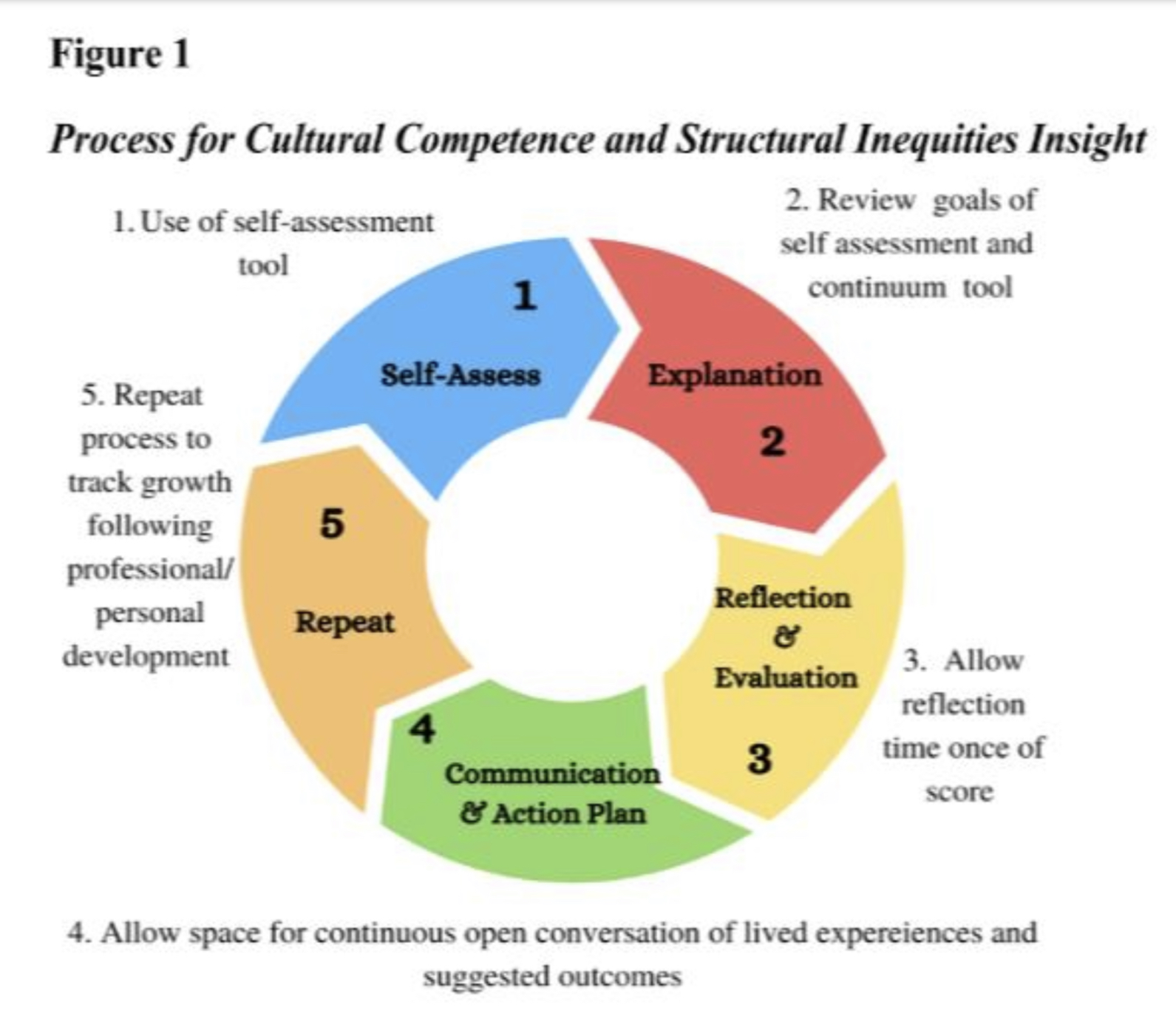
Through the findings of this work, a new process emerged that will assist educators, researchers, and students to gain an understanding of their cultural competence level and awareness of structural inequities.

This process of authentic self-assessment must takeplace for sustainable change within the educational system. This process allows educators to self-assess where they currently stand with cultural competence and structural inequities and where they think they can continue to grow and develop to make a difference through their instructional practice.

From Patterson 2022

NP: Prior to supporting those who are in our care, we have to first understand and evaluate the change we are asked to spearhead and transform. Individuals in our care are in an organizational structure. It is important that teachers use this self-assessment on a continuous basis and that reflection take place at all levels to enact sustainable change. Connected to self-assessment, there must be collaboration and support systems for leaders facilitating these transformation efforts. Leaders are chameleons, and we must adapt to the needs of those we support but also use wisdom in the supports we are in need of. At times, support for leaders can be as simple and impactful as a listening ear, mentorship, and self-care,to name a few examples. 

Expectations, accountability, and support are the key ingredients to needed educational change of academic and life outcomes for marginalized communities. Additionally, in order to evoke change we must include those whom the change will impact in the conversation. I often think of the saying, “nothing for me, without me.” Courageous conversations must happen at the individual and group level to ensure we are uplifting the voices of those who are involved in the change process. Everyone wants to be heard. Everyone also wants to be a part of something bigger than themselves. This can be achieved through transparency, consistent communication, and partnership during the transformational process. 

NP: Hope is amazing and the strongest thing to hold on to! I hope that with the rise of advocacy for cultural competence and access to relevant research, the field of education will truly become a space that benefits all the children we are blessed to serve. I am excited and encouraged by the youth! Working with such brilliant, bold, and brave students on a daily basis excites and inspires me to continue to work for educational change. The innovation, creativity, and relentlessness of our youth is a joy to experience as an educator and leader. I am encouraged by the advocacy I see young people engage in, by the multiple ways success is defined for them, and the no fear mindset that allows them to go for the goals they desire without a fear of failure. I am encouraged that as current scholar-practitioners we can contribute to the future success of students by keeping an open mind and holding onto hope. Hope is one of the most powerful things this world has to offer. Maintaining a growth mindset is needed to experience the true value of hope and dealing this hope to others. 

I foresee continuous growth in the areas of educational technology. I am curious to see how artificial intelligence will continue to influence education. Currently, there are several systems that are being used by scholar-practitioners and students regarding artificial intelligence. I can only hope that as the times continue to change, schools will be ahead of the curve by providing opportunities and spaces to educate students and educators on how to best use these various technologies. I hope to see a major change in the mandates regarding curriculum and instruction to focus on financial literacy requirements, fostering entrepreneurship, courses in social emotional well-being, and courses that teach conflict resolution/self-regulation. These courses are especially imperative in Black and Brown communities where we see and experience tragedy due to gun violence on a daily basis. 

Last, at the policy level, I hope to see change connected to continuous efforts to encourage and uplift the Black vote. These are the views of the silent majority and reflect the importance of the future of elections for us and our children. I am fully aware that this process is not an immediate one and will take strategic and intentional advocacy, collaboration, and resistance. I am also fully aware that the students, families, and individuals for whom we continue this heart work, will bring about a promising future for those that come after them.

References: 

Guerra, P. L., & Wubbena, Z. C. (2017). Teacher beliefs and classroom practices cognitive dissonance in high stakes test-influenced environments. Issues in Teacher Education, 26(1), 35-51.

Lindsey, R. B., Robins, K. N., & Terrell, R. D. (2009). Cultural proficiency: A manual for school leaders (3rd ed.). Corwin Press

McGrath, A. (2020). Bringing cognitive dissonance theory into the scholarship of teaching and learning: Topics and questions in need of investigation. Scholarship of Teaching and Learning in Psychology, 6(1), 84-90. 10.1037/stl0000168

Patterson, N. (2022). Taking a knee: A mixed methods study evaluating awareness of structural inequities and levels of cultural competence of middle school in-service teachers of Black and Brown students (Publication No. 28967538) [Doctoral dissertation, Saint Joseph’s University]. Saint Joseph’s University ProQuest Dissertations Publishing

The Threat & Promise of Advanced Technology in Education: Reflections from the Atlantic Rim Collaboratory 

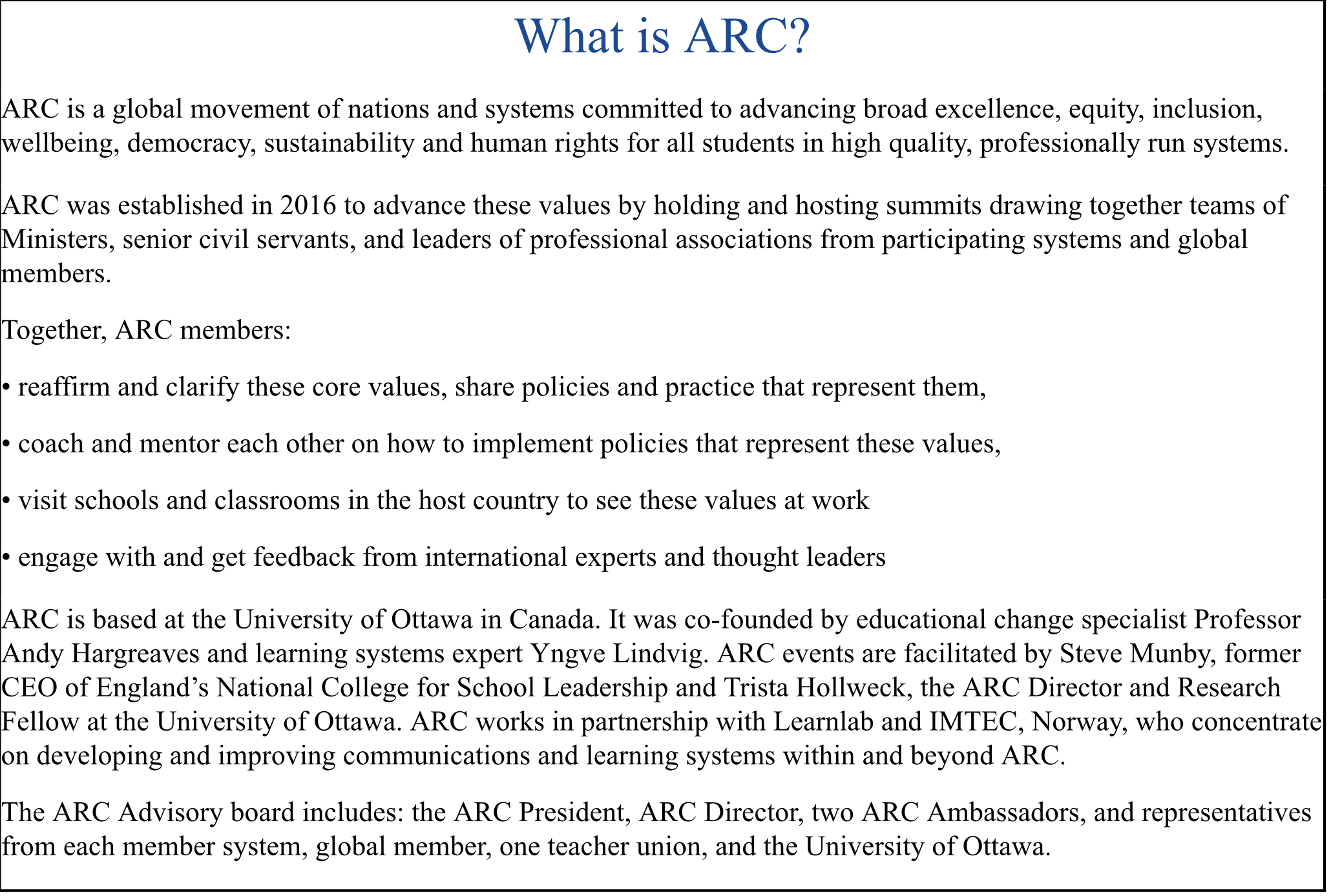
This week IEN shares key ideas and resources from two meetings of the Atlantic Rim Collaboratory (ARC) that engaged policymakers and education leaders in exploring the potential of AI in education. The meetings included an ARC pre-Summit ThoughtMeet with A Focus on Democracy & AI Advanced Technology (like ChatGPT) in Schools, and the annual in-person Summit in Oslo, Norway that included a “Focus on AI and Education”. ARC co-founder and Learnlab CEO, Yngve Lindvig, offered some provocations as well as an opportunity to play with ChatGPT. 

ARC brings together members of education systems and organizations such as Ireland, Iceland, Scotland, Uruguay, Wales, and the Canadian provinces of Nova Scotia, and Saskatchewan, and the International Confederation of Principals (ICP). Summaries and materials from previous ThoughtMeets are available on the ARC Education Project website. This article was written by Mariana Domínguez González, Sarah McGinnis & Trista Hollweck.  

Ready or not, advanced technology (like ChatGPT) is part of the educational landscape, Yngve Lindvig declared. Even as the debate continues on the possibilities and consequences for schools and higher education, educational leaders must make policy decisions on artificial intelligence in their systems that take into account key questions like: 

• How can we make sure that pedagogy drives technology and not the opposite?

• How do we make AI generated data relevant for teachers and students to support learning?

• How can teachers and students be data generators and critical users?

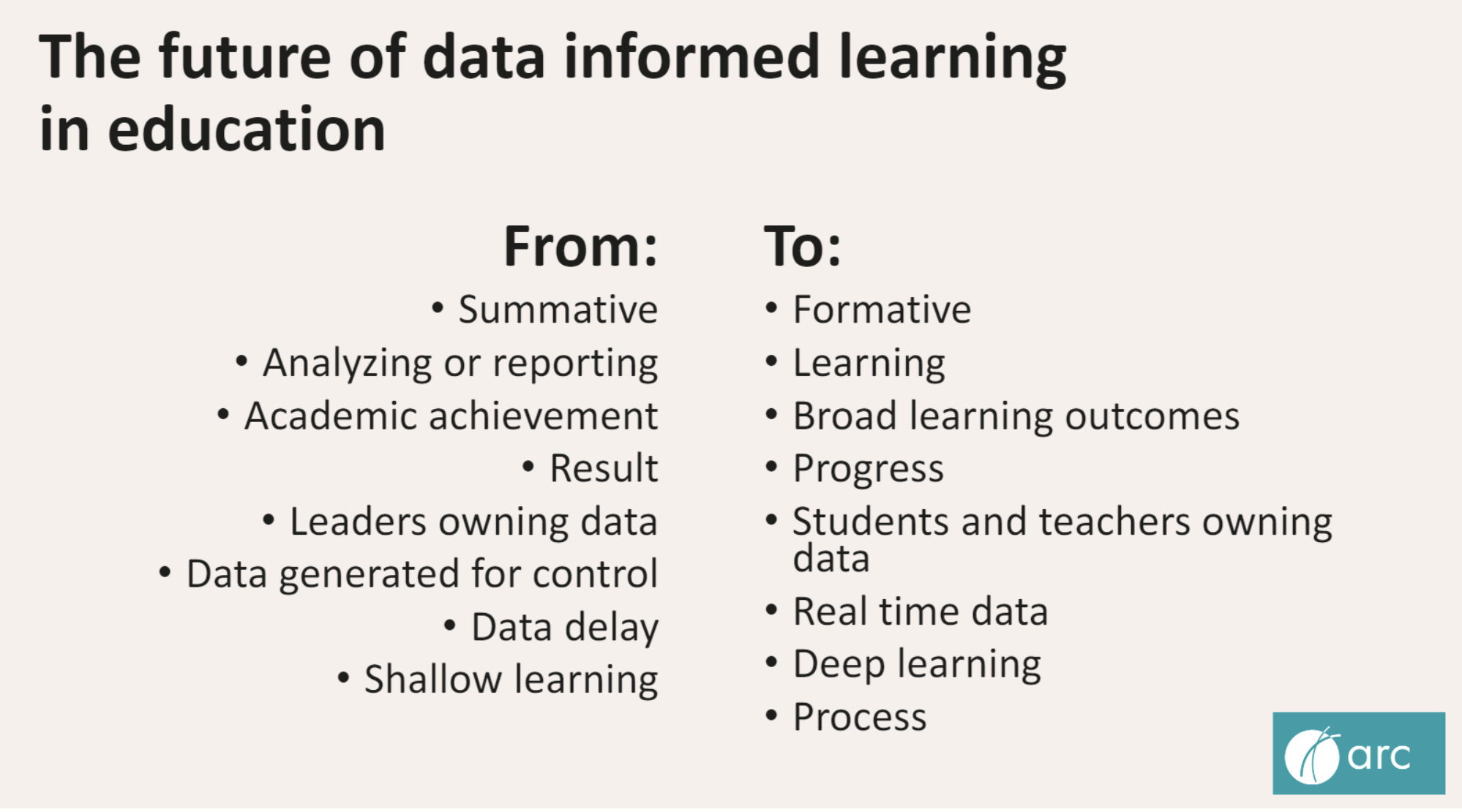
• How can teachers be their own data managers and have access to effective tools for data informed feedback in real time?

• How do we know the data we use is ethical and complies with General Data Protection Regulations (GDPR)

In this context, Lindvig argued, ChatGTP and advanced technology should be embraced, rather than feared, but in a thoughtful and reflective way. Although many governments and system leaders are concerned about the speed of change and a lack of control over AI, banning its use in schools and higher education is not the answer, he continued. AI has the possibilityto disrupt established instruction and assessment practices tosupport student learning in new and powerful ways, but its threats must not be taken lightly, he warned.

Addressing both threats and opportunities, Lindvig described how data-informed learning can be a critical element of effectiveAI use in schools, where data are generated by the students andare used in the learning situation. Since the origin of content in most data management systems is unknown, however, a number of risks must be considered when using AI generated data in schools. These include lack of diversity in content, creating an echo chamber of self-reinforcing opinions and sources, and promoting content that may not be aligned with priorities in educational systems. The main problem is that when a student uses AI generated data, the output is not derived from the student’s critical thinking, reflection, ideas, or product, but it is outsourced to a machine that disconnects the student from the learning. On the other hand, Lindvig explained, if you are able to make an AI-empowered solution within your system, controlled by your system, linked to the curriculum, tagged with curriculum goals, incorporating student feedback based on the intentions in the curriculum, then we have a system that could actually change something.

For Lindvig, perhaps one of the most powerful changes that AI could bring to education is a shift from more traditional assessment practices (such as essay writing and tests) to production-based formats where students must demonstrate their learning in multiple ways using a variety of multi-modal formats. When AI is assessing multi-modal products aligned with the goals that the teacher sets for the learning experience, then the teacher also gets something in return for using advanced technology. Additionally, AI used for assessment can engagestudent learning and provide immediate feedback within the classroom. Of note, AI implementation guided by teachers’ goals ensures that the feedback provided to students is aligned with the educational system’s curriculum and not “big tech” controlled algorithms.  After testing this type of AI implementation in Scandinavian schools in May and June, Lindvig noted that teachers reported that the AI feedback on student work was aligned with the values in the curriculum and that it provided them with more time to communicate with their students.

So where do system leaders start in order to implement an AI-empowered solution that is pedagogically relevant? According to Lindvig, systems should:

• Own the login platform, even if a company runs it for the system. 

• Control the student catalog which contains the data.

• Implement very strong General Data Protection Regulations, and decide –at a federal, provincial and/or municipal level- which applications are allowed to be used.

• Own the curriculum by making sure that the applications filter the information so that it includes only the content that is relevant and pertinent to the national/provincial curriculum.

ARC Pre Summit March 2023 Yngve Lindvig

Yngve Lindvig´s ARC Talk on The Promise & Threat of Advanced Technology in Education

Previous IEN posts from ARC include A Focus on (Imperfect) Leadership: Snapshots from the 9th ARC Education ThoughtMeetWell-Being, Social Emotional Learning (SEL) and the COVID-19 Pandemic: Snapshots from the 8th ARC Education Thoughtmeet; and The ARC Education Project: Rethinking Secondary Examinations and Credentials. Previous IEN posts on AI include: ChatGPT on ChatGPT in education: Clear summaries and fake citations (The ChatGPT six month anniversary edition Part 1)Ban It or Use It? Scanning the Headlines: The Chat GPT six month anniversary edition Part 2Scanning the headlines for international perspectives on ChatGPT in schools: The Chat GPT six month anniversary edition Part 3and What difference will AI make in schools? Scanning the headlines on Chat GPT’s six-month anniversary (Part 4).

Italy’s response to the COVID-19 school closures from a comparative persepctive – A Conversation with Barbara Gross (Part 2)

In Part 2 of this interview Barbara Gross talks with Thomas Hatch about the effects of the school closures on Italian schools and discusses some her comparative studies with colleagues in Austria, England, and Germany during the height of the COVID-19 pandemic. Part 1 focuses on Gross’ research and observations of the immediate response to the school closures in Bozen-Bolzano, a multi-lingual region in Northern Italy.  Gross is currently Junior Professor in Educational Science with a Focus on Intercultural Education at the Faculty of Philosophy at the Chemnitz University of Technology in Germany. Until October of 2022, she was an Assistant Professor at the Free University of Bozen-Bolzano, in Northern Italy. Some of Gross’ work explores this linguistic diversity as Italian is the language of instruction in Italian language schools and taught as a second language in German-language schools; German is the language of instruction in German-language schools and taught as a second language in Italian-language schools (Further Language Learning in Linguistic and Cultural Diverse Contexts: A Mixed Methods Research in a European Border Region). Because of the right to schooling in these official languages teacher education also has to prepare future teachers to work in the respective systems(Approaches to Diversity: Tracing Multilingualism in Teacher Education in South Tyrol, Italy).

This interview is one in a series exploring what has and has not changed in education since COVID. Previous interviews and posts have looked at developments in PolandFinlandNew ZealandSouth Africa, and Vietnam.

Thomas Hatch: What about now? Have their been changes in terms of the uses of technology and “digitization”? Is that something that’s still going on or that is a focus for professional development during the summer? 

Barbara Gross: The focus on digitalization was also there in the beginning of the pandemic and that’s an emphasis that’s continuing. But there was very different handling of this depending on the capacity of the school and the capacity of the teachers. The teachers often had to have their own devices, and they had to have digital competencies. The response depended on the individual effort of teachers, not just what the government expected teachers to do. 

TH: Were there other issues that the government tried to address? 

BG: They thought about trying to be innovative with buildings and facilities. In fact, they bought a lot of chairs during this period. The aim was to provide chairs with wheels, but soon it emerged that to ensure for social distancing that wasn’t really helpful. There were also some governmental decisions about how to use funding which weren’t always supported by the community or by teachers.

TH: What about other repercussions from the pandemic? Are there particular concerns around education that have emerged or is it more like the pandemic is over and we’re moving on?

BG: What is still discussed are teachers’ and students’ digital competencies. In addition, there have been some concerns about student learning and also about drop-out rates. There were higher dropouts because students didn’t see the necessity any more of going back to school. This is especially a problem for students from families who are already marginalized. There are also reports stating that students from families with the lowest levels of economic resources decided not to go to a secondary school or to a university, but instead to do more vocational training. So there has been some “catch-up” discussion, particularly about having longer school hours or schooling on Saturdays, or adding school time in June. But there were also many voices that were opposed to this, and one of the things we’ve written about is that learning isn’t so linear, so just adding more school hours doesn’t necessarily mean you are adding more learning. We know that learning is much more complex. We can’t just say “you lost 10 hours, so now we’ll give you 10 more back.”

There was also some data that children from vulnerable families were not getting enough healthy food or getting as many support services during the COVID lockdown as they were before. Many of those children before COVID went to school and afterschool all day and got a proper meal at lunch; but during COVID, when the schools were closed, they didn’t have those services either and that affected their health. There have also been a lot of reports about the wellbeing of all students and how they missed out on all the social aspects of schools. The consequences are likely to continue to affect their lives. 

TH: Can you tell me a little bit about the comparative research you’ve done about how different education systems are talking about and responding to the COVID crisis in education? 

BG: In our comparative research we looked at educational policy responses to the pandemic in countries like Italy, Austria, Germany and England. We’ve seen it’s all about trust and what research governments trust. The priorities have been on health, security, and on the economy so policymakers have been listening to the medical experts and economists. Educational research has not been referred to and included very much. For example, in Italy we’ve seen that a lot of women have lost their jobs because of the pandemic, so now there’s more interest in having more early childhood services and more interest in creating special programs for enhancing specific competencies for women. 

We’ve also seen that differences among countries depending on how states define who is “vulnerable” or “in need.”  For example, we have seen that the focus in Italy has been on inclusive schooling. From the 70’s on, Italy has had schools for all, including children with disabilities or learning difficulties. During COVID, in the discussions of which students needed support, there was a focus on making sure that students with disabilities and learning difficulties got extra support, but it was mostly left up to the teachers to figure out how to give them more attention or other kinds of support. In Italy, there was not as much focus on other aspects of diversity, for example, on children whose home language is different from the language of instruction, and, compared to other countries, less focus in Italy on socioeconomically disadvantaged learners.

TH: And how did the Italian response compare to what you saw in other countries?

BG: In Italy, the reopening of schools was more delayed, as there wasn’t as much of a focus on reopening as there was in England, Germany and Austria. In Germany and Austria, for example, there were re-openings at least for some students in May of 2020. There were also differences in terms of who was considered “vulnerable.” In Germany, there was more of a focus on immigrant students and less on students with special educational needs. In Austria, in the government documents we see the focus on linguistic diversity and the children who did not speak German. They argued that if these students didn’t go to school, then they would not learn to speak German, and the consequences would be severe. 

There were also differences in terms of digitization. Both England and Austria were well-prepared before the COVID outbreak, but Germany was not. In Germany digitization overall is still an issue, and there were discussions about it during the pandemic. In Italy, they were aware of the digital gap so the focus during COVID was on filling this gap. In terms of “catch-up,” we’ve also seen that equality was prioritized of equity. After the first wave, in Germany, England and Italy there was a discussion about who was most in need, but then when it came to actually giving support, no differentiation in the provision of support measures was made. Of course, this is also a source of inequality – equity does not come with equality. 

We also found in our work in Italy and Austria that schools have also learned from COVID that they have to emphasize wellbeing, particularly the social aspects of wellbeing and students’ relationships with their peers. If those relationships are missing, if students can’t go to school, they don’t have the same opportunities to develop their social competencies. We found that how the schools and teachers in different countries have responded to that depends on how “output oriented” they are – how much they focus on producing particular outcomes. For example, we’ve seen a stronger output-orientation in England than Italy.  But in all the countries, one of the main messages of the pandemic in education has been that already existing difficulties exacerbated.