Category Archives: equity

Celebrating Extraordinary Educators from Africa’s Aspire Fellowship Programme

As we look back on 2025, we’d like to celebrate some of the extraordinary work in education we learned about this year. In this case, we’re highlighting  the work of the Aspire Leadership Fellows of the Africa Leadership Academy. The Aspire Fellowship Programme is a cohort-based program that brings together leaders from across Africa who have started or are leading innovative schools and educational organizations. The Fellows work with global education leaders to expand and sustain their organizations. For those interested in learning more about this work or making a donation, we’re providing the Aspire profiles and websites of several of the Fellows who shared their work with graduate students from Teachers College, Columbia University, in Thomas Hatch’s class on School Change this fall.

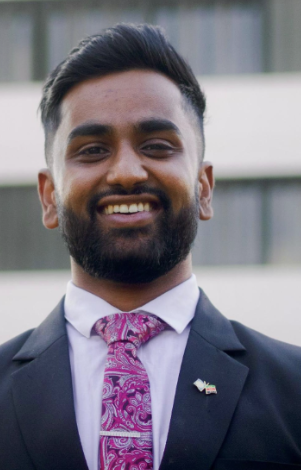
Soofia International School 

JAYANT VIJAYAKUMAR 
Soofia International School 
Butha, Buthe, Lesotho

Highlight: Running a lean Cambridge model at a community-funded school catering to children from diverse families in rural Lesotho- some facing significant socio-economic challenges and other instabilities

Year Founded: 1990

Grade: Nursery/Pre-Primary, Primary, Secondary, AS & A Level

School Vision: To deliver affordable, globally benchmarked education with a strong emphasis on equity, innovation, and holistic development.

Jayant Vijayakumar is Chief Academic Advisor at Soofia International School in Lesotho, where he leads strategic planning, academic innovation, and AI integration. Under his leadership, Soofia—serving over 1,300 students—has embraced flipped learning, launched coding and robotics programs, and pioneered student-led engagement models. Jayant’s approach blends academic rigour with emotional intelligence, technology, and values-based education, ensuring access and excellence for learners from all backgrounds. He trains educators, drives curriculum reform, and builds partnerships that extend Soofia’s impact across Lesotho and beyond. Passionate about transforming outdated education systems, Jayant’s work is driven by a belief that inclusive, holistic education can empower the next generation of thinkers, leaders, and changemakers in Africa and the world. Donation/Support link

Planning for Tomorrow Youth Organization

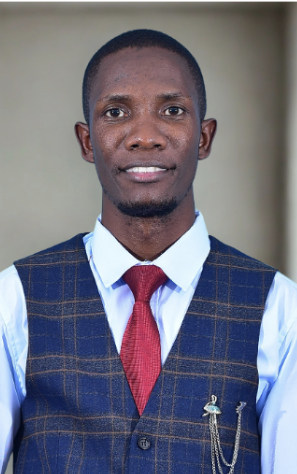
Daniel Ameny & Kevin Dovinna Candia 
P4T – Planning for Tomorrow Youth Organization
Kyangwali Refugee Settlement, Uganda

Highlight: Refugee-founded and refugee-led education which started with 26 students in a boardroom, and has grown to serve more than 800 students

Year founded: 2007

Grade Focus: K-12

School vision: A healthy and self-reliant community with knowledge and skills.

Daniel, also known as Khalid, is a Congolese Refugee who has resided in Uganda for the past 26 years. Leveraging the DAFI scholarship, Khalid earned an MS in Environmental Health and a Bachelor of Statistics Degree. He leads this refugee-led youth initiative dedicated to empowering vulnerable refugees and Ugandans towards becoming healthy and self-reliant. P4T Schools delivers comprehensive educational services, including improved teaching methodologies, a school feeding program, engaging children in debate, games, and sports. The overarching goal of these schools is to evolve into centers of excellence, with a focus on nurturing Innovative Leaders and Changemakers.

Kevin is an Education Coordinator and Early Childhood Development project manager at P4T. She attained a BS in Education under MasterCard Foundation Scholarship. She did teaching practice at Mandela Secondary school, taught at the North Green School and had a one-year volunteer experience as a teaching assistant at Lancaster Mennonite School in Pennsylvania, USA. Kevin uses her positive attitude to encourage others to work hard and bring about a positive impact in their communities. She is very passionate about giving back “because in one way or the other it is what made her who she is, a transformative leader.” Donation/Support link

Inmates Educational Foundation (IEF) 

MAHFUZ ALABIDUN 
Inmates Educational Foundation
Nigeria (Lagos, Oyo, Osun, Kano, Abuja, and Ebonyi states)

Highlight: Running a school system in Nigerian correctional centers to provide access to formal and informal education as a form of reformation and reintegration for inmates.

Year Founded: 2018 

Grade: Nursery/Pre-Primary, Primary, Secondary, National Open University 

School Vision: To provide educational opportunities to inmates, empowering them to reintegrate into society and become productive citizens..

Mahfuz Alabidun is the Founder and Executive Director of Inmates Educational Foundation, a nonprofit delivering education in Nigerian correctional centers. With over 500 learners across six states, IEF offers academic, vocational, and reintegration programs that support inmates’ transformation and reintegration into society. Under his leadership, the foundation has received national recognition, including the Governor of Lagos State Social Impact Award. A TEDx speaker and education reform advocate, he is passionate about building inclusive systems that restore dignity and create second chances. Through education, Mahfuz is rewriting the narrative of incarceration in Nigeria—one learner, one center, one future at a time. Cohort 5 Year Founded: 2018 Grade: Nursery/Pre-Primary, Primary, Secondary, National Open University School Vision: To to provide educational opportunities to inmates, empowering them to reintegrate into society and become productive citizens. Donation/Support link

Humanitarian Services Action (HuSA)

SUMI HAMID 
Humanitarian Services Action (HuSA) 
Kikuube, Uganda

Highlight: Running a school model that not only educates but also heals and empowers children, especially those affected by conflict, displacement, and poverty; with focus on Protection and Integrated Mental Health and Psychosocial Support Services (MHPSS).

Year Founded: 2020 

Grade: Nursery/Pre-Primary, Primary 

School Vision: To create a new generation of African leaders and change-makers who are self-reliant and capable of lifting others.

Sumi Hamid is a refugee leader and the Founder and Executive Director of Humanitarian Services Action Organisation (HuSA) in Kikuube, Uganda. A survivor of displacement himself, he grew up in Kyangwali Refugee Settlement and now leads community-based initiatives that provide education, mental health support, and protection services to refugee children and families. After overcoming years of interrupted education, Sumi pursued a career in social work and made the bold decision in 2023 to leave formal employment and fully commit to building HuSA. His organization now serves over 130 children with early education and supports women and youth with microgrants, GBV response, and psychosocial care. Rooted in lived experience, his work champions dignity, empowerment, and community-led change—offering vulnerable children and families the opportunity to learn, heal, and thrive. Cohort 5 Year Founded: 2020 Grade: Nursery/Pre-Primary, Primary School Vision: To create a new generation of African leaders and change-makers who are self-reliant and capable of lifting others. Donation/Support link

Ajibu Community

TIMOTHY DAVID WAMBI
Ajibu Community
5Mayuge, Uganda

Highlight: They produce their own play-learning resources which are used to combine play-based learning interventions with life skills development, ensuring that children not only succeed academically but also explore their innate talents and build strong social-emotional and entrepreneurial skills to reach their full potential

Year Founded: 2021 

Grade: Nursery/Pre-Primary, Primary, Vocational Training for mothers

School Vision: To create a model Play-Based Learning school in Eastern Uganda where education is focused on academic excellence and skills development so that there’s a clear path for every child to succeed in life.

Timothy David Wambi is the Founder of Ajibu Community Organisation (Ajco) in rural Mayuge, Uganda. Timothy leads grassroots education reform through a dual-impact model: supporting public primary schools and running a vibrant community learning center. Ajco currently educates 77 children aged 3–7 and empowers young women—many of them survivors of early marriage—to become trained educators. Timothy’s model integrates play-based, life-skills learning and develops low-cost teaching materials to improve literacy, numeracy, and STEM outcomes in under-resourced schools. Timothy works to ensure that no child is denied the right to quality education and that local solutions are part of lasting transformation in Uganda’s rural education landscape.  Donation/Support link

Itinga Charity Education Foundation

Acen Kevin 
Itinga Charity Education Foundation
Northern Uganda

Highlight: The only inclusive secondary school in Northern Uganda catering to students with diverse abilities such as the blind, low vision, cerebral palsy, intellectual disabilities, and physical challenged, studying alongside their abled peers.

Year Founded: 2024

Grade: Secondary 

School Vision: To empower students to thrive, regardless of ability, and promotes a culture of acceptance and inclusion

Acen Kevin (Daniela) is the Founder and Executive Director of the Itinga Charity Education Foundation (ICEF) and Director of St. Mary Goretti Secondary School Ngetta in Northern Uganda. Holding a Bachelor’s degree in Accounting and Finance, Kevin spearheads initiatives that deliver inclusive education to students with and without disabilities, including learners who are blind or physically challenged. Under her leadership, ICEF partnered to establish the region’s first inclusive secondary school, now serving 45 students from across Uganda. She drives accessibility through scholarships, assistive technologies, and inclusive teacher training. As Board Chair of the school’s academic committee, Kevin is dedicated to upholding quality and equity in education. In 2025, she was awarded the MTN Changemaker Grant for her groundbreaking work in assistive learning. Kevin is deeply passionate about creating a future where all learners— regardless of ability—have the opportunity to thrive. Donation/Support link

Isrina School

Grace Amuzie Ajegungle, 
Isrina School; Linktree
Lagos Nigeria

Highlight: Spearheading the “Recycles Pay” project at Isrina School which empowers parents to offset children’s fees by generating income from recyclable materials

Year founded: 2016

Grades served: K-6

School vision: A world where every child, regardless of their economic background has equal access to quality education

Grace is a fervent champion of inclusive education, dedicating herself to this cause since the age of 15. Fueled by her personal experiences, she remains resolute in her mission to guarantee equitable access to quality education for every child, irrespective of their background. Notably, she advocates for environmental sustainability and spearheads the innovative “Recycles Pay” project, empowering parents to offset their children’s fees through the use of recyclable materials. With her certification as a Microsoft Educator, Grace actively pursues the enhancement of learning experiences and seeks to broaden educational access, aiming to disrupt the cycle of poverty through the delivery of high-quality education. Donation/Support link

Tsion Academy 

ADEOLA TOLULOPE ABAYOMI 
Tsion Academy 
Ile-Ife, Osun state, Nigeria 

Highlight: Focused on providing free, quality education to out-of-school children in underserved communities using a personal and scalable funding model called the “Big Brother or Sister where each child is matched with a “Big Brother or Sister”—an individual donor who would commit to supporting the child’s education monthly or by term.

Year Founded: 2022

Grade: Nursery/Pre-Primary/Primary/Secondary 

School Vision: To restore dignity, build character, and equip each child with the tools they need to thrive academically, emotionally, and socially.

Adeola Tolulope Abayomi is the Founder and Executive Director of Tsion Academy, a free school for out-of-school children in Ile-Ife, Nigeria. A trained lawyer (LLB, BL) and the visionary force behind Evolufy Africa. Tsion Academy currently serves over 140 children aged 4 to 13, delivering quality, inclusive education to underserved communities. Through Evolufy Africa’s two branches—Tsion Academy and Maendeleo Africa— Adeola advances access, equity, and youth empowerment. She is passionate about building sustainable, replicable school models that drive genuine transformation. Her work bridges grassroots action and systemic change, offering hope and opportunity to the next generation of African leaders. Donation/Support link 

Smart Bilingual Academy 

Tchanlandjou Kpare
Smart Bilingual Academy 
Fatick, Senegal

Highlight: Creating equitable education access to students in second cities.

Year founded: 2022

Grades served: K-6

School vision: All children reach their full-potential and are agents of change in their schools, communities and the world.

With a remarkable 15-year background in supporting social innovations, Tchanlandjou has been instrumental in mapping key actors and organizations within ecosystems for collective systemic impact. Since joining Ashoka in 2013, he has held the pivotal role of Regional Director for the Sahel region, where his strategic vision and ability to inspire and mobilize diverse partners have yielded significant accomplishments. Notably, Tchanlandjou spearheaded the creation of the Education and Youth Clusters, pivotal initiatives that have greatly enhanced Ashoka’s impact in the Sahel. In 2016, he further demonstrated his entrepreneurial spirit by founding ‘SeddoInvest,’ a start-up focused on identifying and preparing a pipeline of young social ventures and attracting investments to accelerate their development. He founded SBA after seeing first-hand the profound disparity between the quality of education available to students in Dakar, and in rural and per-urban areas in Senegal. Donation/Support link

Centering Equity Through Historical Grounding and Collective Educational Change with Latrice Marianno

In December’s Lead the Change (LtC) interview Dr. Latrice Marianno argues that meaningful educational improvement must be historically grounded and explicitly centered on equity and justice, not treated as a side effort within school improvement. Despite current challenges, she calls for collective, systems-focused approaches that dismantle structural barriers and urges educators and scholars to continually act as if radical transformation in education is possible. The LtC series is produced by Elizabeth Zumpe and colleagues from the Educational Change Special Interest Group of the American Educational Research Association. A PDF of the fully formatted interview will be available on the LtC website.

Lead the Change (LtC): The 2026 AERA Annual Meeting theme is “Unforgetting Histories and Imagining Futures: Constructing a New Vision for Educational Research.” This theme calls us to consider how to leverage our diverse knowledge and experiences to engage in futuring for education and education research, involving looking back to remember our histories so that we can look forward to imagine better futures. What steps are you taking, or do you plan to take, to heed this call? 

Dr. Latrice Marianno (LM): Recently, I had the opportunity to attend the Association for the Study of Higher Education’s (ASHE) annual conference in Denver. During my time there, I visited the Museum for Black Girls and encountered this quote from Angela Davis above one of the exhibits: “You have to act as if it were possible to radically transform the world. And you have to do it all the time.” For me, this quote embodies the work before all of us. To heed this year’s call, I am continuing to deepen my work around equitable school improvement in a few ways.

Latrice Marianno, Ph.D.

First, I am ensuring that my work is continually grounded in the historical context that has produced and/or maintained the inequities we continually see in education. Critical policy genealogy, which focuses on understanding the origin and evolution of policies (Brewer, 2014; Meadmore et al., 2000), is something I have been drawn toward and intend to engage with more deeply. I find it critically important to understand how policies came to be and the issues those policies were intended to address as that insight can shed light on how educational policies create or maintain inequities. One example that illustrates the importance of understanding the histories of educational policies is the history of state teacher certification policies. While characterized as a policy aimed to enhance the professionalization of teachers (e.g., Hutt et al., 2018), requirements for teachers to pass exams to become certified have long reinforced inequities in access to entering the teaching profession (e.g., Carver-Thomas, 2018). Understanding the history of these policies means an awareness that these certification policies were popularized as a way to justify lower pay for Black educators and later the displacement of Black educators (e.g., Fultz, 2004; Tillman, 2004). Remembering our histories is a necessary foundation if we are to reimagine educational systems.

Second, I will continue focusing on interrogating systems, policies, and practices in educational spaces both in my teaching and scholarship. My work focuses on examining how school improvement systems can be reimagined and redesigned to better support educational leaders to engage in meaningful and justice-centered improvement. For example, Marianno et al. (2024) focuses on state-influenced school improvement plan templates and the extent to which educational leaders are prompted to think about and address inequities. This work opens a conversation regarding how this tool (i.e., school improvement templates) might be redesigned to support educational leaders to center equity in the school improvement planning process. Currently, I teach in a principal preparation program which has allowed me to continually engage with educators and aspiring educational leaders around what this could look like in practice. My teaching allows opportunities for me to learn from and alongside my students as we collectively think about the supports, tools, and professional learning that support educational leaders to think critically about equitable school improvement and act on those commitments in sustainable ways. For example, in my course on data-driven school improvement, we use Bernhardt’s (2017) program and process evaluation tool to prompt them to think about ways school policies and practices create or maintain inequities – an activity they have found useful in prompting them to notice and reflect on inequities within their schools and districts.

Featured Exhibit at the Museum for Black Girls

Finally, I am committed to supporting and engaging in collective futuring in educational spaces. This commitment means sharing my work in practitioner-friendly formats (e.g., policy reports, and/or practitioner journals like Educational Leadership or Phi Delta Kappan), rather than solely academic journals. This commitment also means continuing to challenge assumptions about what it means to improve a school and supporting educators and educational leaders to think critically about school improvement and educational justice as intertwined endeavors. To envision beyond our current system and imagine what could be. To “act as if it were possible to radically transform the world” and “to do it all the time.”

LiC: What are some key lessons that practitioners and scholars might take from your work to foster better educational systems for all students?

LM: Recently, my work has focused on understanding school improvement planning (SIP) processes and how educational leaders think about and work toward redressing inequities through those processes (Marianno, 2024; additional work forthcoming). Through this research, I found that educational leaders viewed equity as either an implicit part of school improvement planning or absent from that process, and that school leaders were not prompted to think about equity within the SIP process. These views and approaches undermined the district’s expressed equity focus by creating a disconnect between their policy intent and implementation. In my work, I argue for the need to explicitly connect equity with school improvement and begin to identify opportunities to center equity within a process that can often be thought of as parallel to school improvement rather than an integral part of those efforts. 

Ultimately, I hope my work inspires folks to be transgressive – to push against the boundaries of what is typically considered improvement within the current educational system (e.g., lack of explicit focus on redressing inequities within improvement efforts). To continually question the assumptions that undergird our collective work in improving education for all students, especially those from historically marginalized backgrounds. To believe in radical transformation and work toward it in our pursuit of educational justice. Toward this end, there are a few key lessons I hope folks can take from my work which collectively emphasizes the importance of being systems-focused, centering the knowledge and experiences of marginalized students and communities, and then leveraging that knowledge to design more just futures. 

First, there can be no educational improvement without a focus on redressing inequities. Too often equity is treated or understood like a side project rather than integral to the work of educational improvement (Marianno, 2024). However, as scholars like Gloria Ladson-Billings and Michael Dumas have argued, substantively improving education requires explicitly attending to the racism and antiblackness that shape the current educational system (Dumas, 2016; Ladson-Billings, 2006). 

Second, we must focus on reimagining our systems, policies, and practices toward educational justice (Welton et al., 2018). There has been a popular illustration that people, particularly in education, have used to describe equity. This illustration shows three individuals of varying heights standing outside of a fence watching a baseball game. One individual is tall enough to see over the fence without additional support while the other two need additional and varied support. While this illustration has multiple iterations, there is often a comparison between equality and equity in which equality represents everyone getting the same number of boxes to stand on, and equity representing everyone getting what they need to, in fact, see over the fence. The version that most resonates with me includes a visual representation of liberation as the removal of the fence. For me, this representation highlights how education broadly and schools specifically have been designed with particular people in mind (in this case the individual tall enough to see without additional support) and how the removal of the fence would serve everyone. I firmly believe that to ensure marginalized students have equitable and just educational opportunities, experiences, and outcomes, it is critical that our collective work (practitioners and scholars alike) focuses on removing the fences (i.e., barriers) that marginalize students and lead to inequities. Engaging in educational improvement in this way centers the experiences of marginalized students, such that educational spaces are designed with them in mind.

Finally, we must recognize the value of collective knowledge and experiences. Brandi Hinnant-Crawford (2020) notes that we need to “intentionally harvest the collective wisdom of many” to “envision better and plot a course for how to get there” (p. 43). That is, futuring for education requires honoring and valuing the knowledge and expertise of diverse stakeholders – teachers, educational leaders, students, and caregivers. In particular, we need to view students and caregivers as valuable partners who can aid in both addressing the educational problems schools are facing and support imagining an otherwise. 

LtC: What do you see the field of Educational Change heading, and where do you find hope for this field for the future?

LM: Honestly, I’m not sure where I see the field of educational change heading. The current climate makes that picture a bit hazy for me. We’re in such a significant period of retrenchment with attacks on academic freedom in higher education, undermining of public education through funding cuts and dismantling the Department of Education, and backlash for anything remotely equitable or inclusive. It is disheartening, though unsurprising. This moment in our history reflects longstanding patterns in American history where movements toward justice are met with resistance and retrenchment. As Decoteau Irby’s (2021) work and the Angela Davis quote shared earlier both remind us, the current moment is a reminder that systems of oppression are constantly at work. We have to act as if we can radically transform the world all the time because systems of oppression are constantly mutating and reinventing. With that in mind, I do have hopes for the field moving forward. 

I hope we move toward deeper recognition that equity and justice must be central to educational improvement, not a side project or parallel effort. This is the work. There is no meaningful school improvement work divorced from a focus on educational justice. In my own work, I’ve seen how educational leaders are often unclear about how to integrate equity into improvement work or treat equity as an implied focus undergirding their improvement efforts but in ways that actually undermine those efforts (Marianno, 2024). Specifically, district leaders viewed equity as an implied focus and foundation of all of their school improvement efforts. However, this approach led school leaders in that district to believe that equity was absent from the process altogether and left them unsure of where and how to integrate equity in their improvement efforts because it was not explicitly discussed. Moving forward, I hope we regard equity and justice as non-negotiables that guide how we define problems, reorganize educational systems, and measure the success of educational improvement efforts. 

I hope we move toward a more historically grounded approach to school and systems improvement. To meaningfully redress inequities, we must understand how past policies and practices created the systems we currently have. Tracing policy histories, such as the racialized roots of teacher certification requirements or gifted education (e.g., Mansfield, 2016), reveal that many present-day inequities are not accidental, and reinforces the understanding that policies are not neutral. I hope the field continues to deepen its engagement with historical analysis, recognizing that remembering the past is essential for imagining futures that depart from it. 

I hope the field continues to shift toward more systemic and collective approaches to educational improvement. When working with aspiring educational leaders in my course on data-driven school improvement and building on the work of scholars like Brandi Hinnant-Crawford (2020), I find they often leave the course with a better understanding of how school systems, policies, and practices shape disparities within their schools and districts and the importance and value of collective approaches to their improvement work. This is my hope for the field – that we engage these ideas not just intellectually but as part of our praxis. 

Despite the current moment we’re in, I hope that both scholars and practitioners act as if radically transforming education is possible – and that they do it all the time. 

Justice-Oriented Educational Change Through Community-Led Solutions: A Conversation with Edwin Nii Bonney

In November’s Lead the Change (LtC) interview Edwin Nii Bonney emphasizes that educational research and practice must “look back” by acknowledging colonial legacies and marginalized histories while “looking forward” by centering Indigenous, vulnerable, and community voices. His work highlights deep listening, intergenerational collaboration, and community-designed solutions as essential to dismantling deficit narratives and creating equitable educational systems. The LtC series is produced by Elizabeth Zumpe and colleagues from the Educational Change Special Interest Group of the American Educational Research Association. A PDF of the fully formatted interview will be available on the LtC website.

Lead the Change (LtC): The 2026 AERA Annual Meeting theme is “Unforgetting Histories and Imagining Futures: Constructing a New Vision for Educational Research.” This theme calls us to consider how to leverage our diverse knowledge and experiences to engage in futuring for education and education research, involving looking back to remember our histories so that we can look forward to imagine better futures. What steps are you taking, or do you plan to take, to heed this call? 

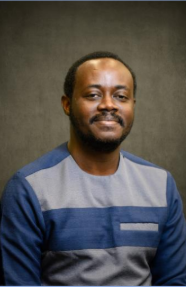
Dr. Edwin Nii Bonney

Edwin Nii Bonney (ENB): As someone who grew up in Ghana and went through K–12 and college there, I have come to appreciate the wisdom of my elders. That wisdom, often carried in proverbs and the principle of Sankofa, reminds us to look back and learn from the past so that we do not repeat its mistakes. In my scholarship, I wrestle with the reality that educational systems remain deeply embedded in coloniality. We are still grappling with the legacies of colonialism especially in the global South, and those legacies have not disappeared (Bonney, 2022). They persist in the languages we speak and use to instruct students, the books we read, our perceptions of ourselves, our standards of beauty, and even our justice systems (Bonney, 2023; Bonney et al., 2025a). Colonialism continues to shape much of who we are and how our societies function. It is essential that we acknowledge that the legacies of colonialism are still with us. It was not that long ago, and its effects continue to reverberate in our educational systems and beyond. 

Having lived and schooled in four different countries, I have come to realize that in every society there are marginalized and vulnerable groups. The dominant discourses in any context, whether social, cultural, or educational, are often so pervasive that marginalized voices, ideas, and ways of knowing are easily erased or silenced. Indigenous wisdom, local knowledge, and community customs are frequently pushed aside. This understanding shapes how I approach my scholarship. We must continually examine how educational leadership, policies, and practices have historically and presently marginalize the ways of being, speaking, and doing of those who are not part of dominant groups. Whether in the United States, Ghana, or elsewhere, there are always minoritized voices whose perspectives are excluded from how education is designed and enacted. Because of that, I believe it is vital to ask how we center the ways of speaking, knowing, and being of Indigenous, marginalized, and vulnerable communities in education. How do we ensure that their experiences and insights shape what we study, how we study it, and how we interpret what we learn?

In my own scholarship and service, I see my role as coming alongside communities and families, not as an expert above them but as a partner who recognizes them as experts of their own experiences. They understand the root causes of the challenges they face and often hold the wisdom to identify meaningful solutions. In Bonney et al. (2025a) in listening to students who had not been able to obtain passing grades in Math, many of them, after retaking the exam multiple times, I learned that they struggled to understand and make sense math concepts taught in English. They felt like failures until they went against the norm as experts of their own experiences to learn in their native languages. Learning in their own native language according to these students brought them success on the first try even though the system told them it was impossible. As we think about the future of education and research, we must keep asking: whose voices are missing from the table? Whose perspectives are absent from the design process? Which families are not engaged in our schools, and how do we empower them to participate fully? We must always ask who we are not serving well and how we can do better. When we look back at history, we see that we have not always served everyone equitably. Therefore, it must remain at the forefront of our work in education to ask, whose voices are we still not hearing?

LtC: What are some key lessons that practitioners and scholars might take from your work to foster better educational systems for all students?

ENB: Much of the work I do alongside educational leaders, students, and families begin with listening. It starts with listening deeply to the experiences of different groups and how they encounter systems of oppression. This kind of listening is to not to defend or to critique but to learn from their perspectives, their realities, and their ways of knowing and being. The next principle is building relationships across generations and forming coalitions among groups who are affected by similar problems of practice or systems of oppression. When these coalitions come together around community-informed problems and community-designed solutions, we are better able to address the issues that matter most to them. In Bonney et al. (2025b), I share about a community-based organization that brings together everyone in their village from as young as seven years to as old as 80 years. The organization gathers the elders to recount stories about the history of their community in their native language. The young people record and document the oral history and then create plays in their native language, where they dramatize the stories on digital media and on stage to be a resource for local schools because there were no resources to teach their native language other than English. This community led movement was in decreasing use of their native language. Communities understand their own challenges, and when they help design the solutions, those solutions are more authentic, effective, and sustainable (Costanza-Chock, 2020). Through these relationships and through genuine listening, we can begin to challenge deficit discourses and narratives that blame individuals instead of systems for the inequities we see in education. Deficit thinking overlooks structural causes and often misplaces responsibility. But lasting change requires us to shift our attention to the systems, policies, and practices that create and sustain inequity. 

Change in education will come only through broad coalitions that include not only researchers and educational leaders but also students, teachers, families, community members, elders and even naysayers. Their knowledge, lived experiences, and cultural wisdom are essential for reimagining a more just and equitable educational future. As we engage in this work, it is important to keep asking which solutions are working, for whom, and under what conditions (Hinnant-Crawford, 2025). Sometimes a solution may appear successful in one area but create unintended problems in another. When that happens, we must be ready to respond quickly to stop any harm. Change is not static; it is a continuous and reflective process. At the heart of this work is a simple but powerful truth: we must be intentional about involving those most affected by the problems we aim to address. We must center community expertise, engage families and students as co-creators of change, and together expose even small variations in outcomes for students as opportunities to learn. Finally, we must continue to seek out and listen to the voices and stories of those still impacted by systems of oppression or persistent inequities. Because meaningful change in education begins with listening, building relationships and broad coalitions that endure when we work together to challenge inequitable systems and co-create a more just future. These are the foundational blocks to a justice-oriented improvement approach to undo oppressive systems in education.

LtC: What do you see the field of Educational Change heading, and where do you find hope for this field for the future?

ENB: The nature of change is that it always comes with uncertainty. Sometimes that uncertainty can bring frustration on one hand or excitement on the other. We can never fully know what the future holds or what the field might look like. We cannot predict what new policies, reforms, or interventions will emerge, or what discourses will shape the field. What I do know is that we can always look back to learn. We can recognize that, as a society and as a field, there are things we’ve done well and others we have not. One of our core goals must be to serve all children well. That means preparing researchers, educational practitioners, students, and teachers so that we can meet the diverse needs of all types of learners. It also means continuing to prepare teachers for a field that is increasingly complex with diverse students who have diverse needs. It also means preparing educational leaders to create inclusive and collaborative environments that enable teachers and staff to do their best work to serve students equitably. 

So, although there is uncertainty about the future, one thing we can hold on to is that we know what we value and how to prepare for that future, whatever it looks like. More than what gives me hope is what energizes me. In Bonney et al., (2024) we created an edited volume, to center and hear from educational practitioners on the front lines and how they work with students, teachers, parents, and community to tackle problems of practice in their local schools and districts. In times of uncertainty, the best people to hear from are those on the front lines. Working alongside with these scholars, educational leaders, and practitioners, in the trenches trying to figure out how to serve all students well makes me expectant that things will change continuously for the better. They’re asking critical questions: How do we better support our teachers? How do we solve problems of practice? How do we address discipline issues or chronic absenteeism? How do we engage families more effectively? How do we reduce the overrepresentation of Black and Brown students in special education? How do we increase their representation in gifted and Advanced Placement courses? These are the kinds of questions that inspire hope for the future. Even though the future may be uncertain, we can still prepare for said future. Personally, I am not as concerned about where the field of educational change is heading but rather about preparing my students and practitioners for today’s challenges. I believe that the same justice-oriented and community-centered approach to solving today’s problems will help us address the problems of tomorrow.

Access to food and school meals in the US and around the world: Scanning the headlines for new ways to support students’ health and development after the pandemic (Part 1)

One of the many repercussions from the COVID-19 pandemic was a world-wide hit to students’ health and wellbeing. In particular, proper nutrition and food insecurity was greatly affected by the pandemic and the lockdowns as many students around the world could not get food and food related support at their schools. In Part 1 of this two part series, Sierra Bickford takes stock of the impact school nutrition programs have globally and highlights the effects of these high-impact interventions. Part 2 will scan recent news and research to find  some of the many micro-innovations – new developments in practices, structures, and resources in different contexts – that have been implemented to combat this rise in student food insecurity. These posts are part of IEN’s ongoing coverage of what is and is not changing in schools and education following the pandemic school closures. For more on the series, see “What can change in schools after the pandemic?”  For related examples of micro-innovations in other areas, see IEN’s coverage micro-innovations to strengthen student relationships, to increase access to college and careers and to improve tutoring: Building Student Relationships Post-Pandemic in School and Beyond; Still Worth It? (Part 1); New Pathways into Higher Education and the Working World? (Part 2)Tutoring takes off and Predictable challenges and possibilities for effective tutoring at scale.

Food insecurity, particularly among children, was one of the critical problems exacerbated by the COVID-19 pandemic and the related societal shutdowns. Estimates suggest that, during the pandemic, the number of people experiencing food insecurity doubled from about 135 million to more than 270 million. In India alone, household food insecurity skyrocketed from 21% in December 2019 to 80% in August 2020, at the same time that diet quality decreased. By the end of 2021, the UN warned that over 43 million people in 38 countries, including Ethiopia, Somalia, South Sudan, Afghanistan, and Yemen, were at risk of experiencing famine or famine-like conditions.

Even in wealthier countries household food insecurity increased substantially. In the United States, that meant a rise in households experiencing food insecurity from 11% in 2018 to 38% in March 2020.  In a report from 2020, the US Census’s Household Pulse Survey estimated the rates of food insecurity had doubled overall, and tripled among households with children. In the wake of the pandemic, school systems, despite vastly different conditions and challenges in different contexts, are working to reestablish nutrition programs and create new strategies to get children access to nutritious balanced meals.

The impact of school based nutrition worldwide

Across the world, school meals have been shown to be a worthwhile intervention with high positive impact on health and learning outcomes. In high income countries, such as those in the United Kingdom, access to nutritious school meals are associated with lower obesity rates. In Sweden, school meals with regulated nutrition requirements have been shown to increase educational attainment, health outcomes, and income across lifetime. One study found that low income families with children in Sweden who received free school meals increased their lifetime income by 6%. The effects that these interventions have on European health care costs estimate “that the return from investment in school meal programs is at least sevenfold, up to a possible €34 for every €1 spent.”   

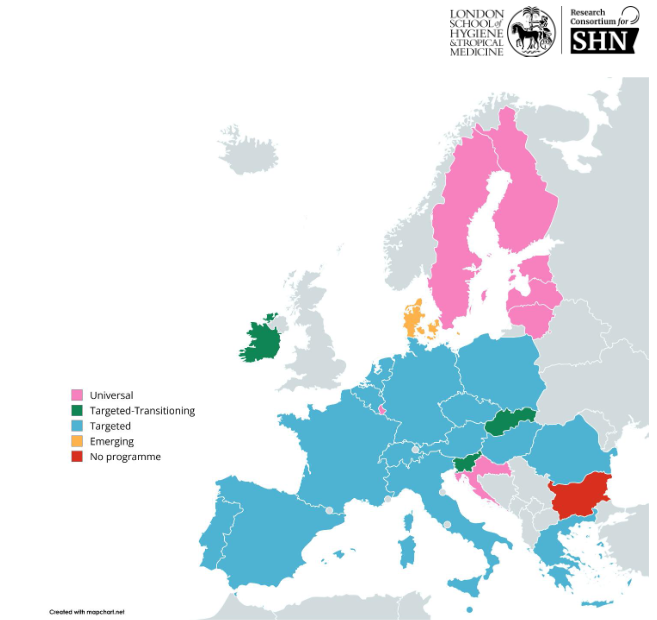
Graphic depicting which European Countries have an official, nationwide program for school meal provisioning

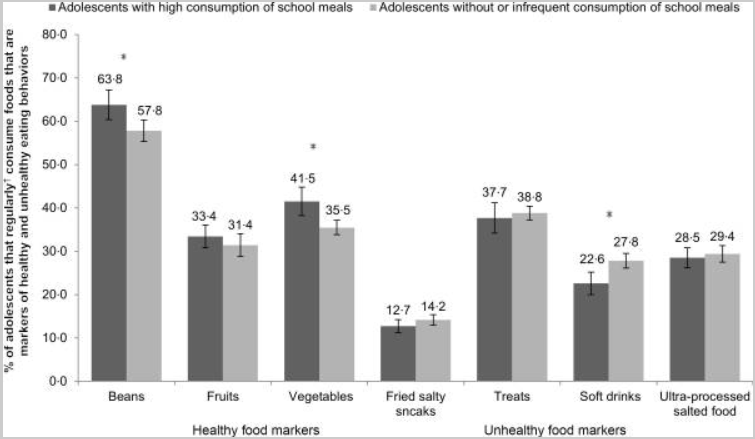
Data from low and middle income countries also support the implementation of free school meals,  particularly for increasing attendance and retention. In Burkina Faso female students who were given take-home food attended school at least 90% of the time. Similarly in Bangladesh, the introduction of free fortified biscuits “increased enrollment by 14% and reduced school dropout by 7%.” Nutrition programs in low and middle income countries have been shown to positively affect learning outcomes as well. In India, access to free school meals is associated with higher cognitive outcomes and an 18% increase in literacy test scores. As in the United Kingdom, in Brazil students who were being supplied meals at school were more likely to reduce their intake of unhealthy foods and increase the presence of nutritious food in their diet, which leads to better health outcomes.

Figure shows the regular consumption of healthy and unhealthy food markers according to consumption of school meals; from School meals consumption is associated with a better diet quality of Brazilian adolescents: results from the PeNSE 2015 survey

The impact of school based nutrition in the United States

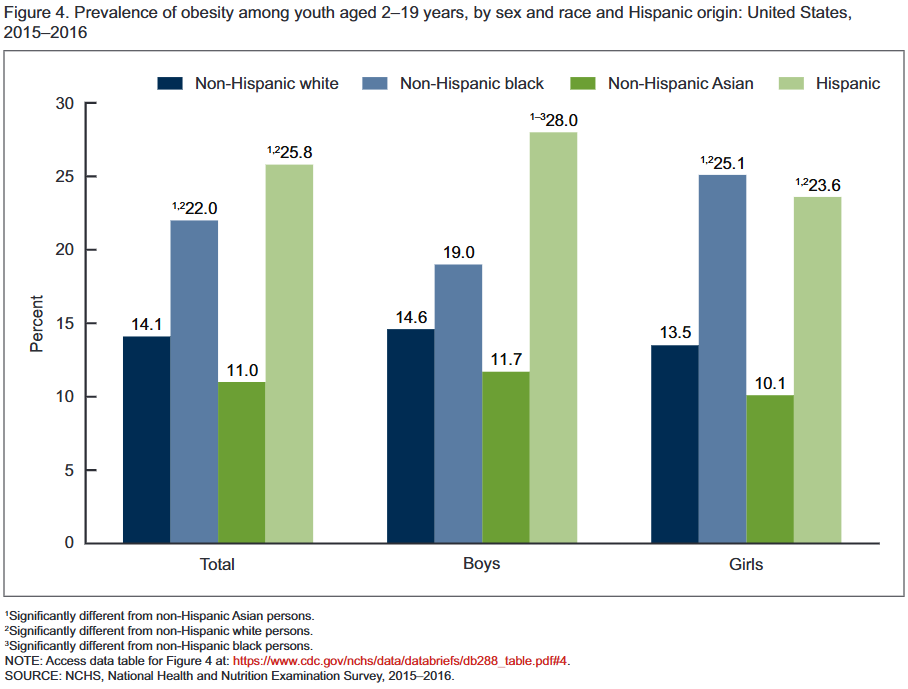
In the US, the National School Lunch Program has long been the primary vehicle for supporting students’ nutritional needs. Around 95% of US elementary, middle, and high schools take part in the program and about 75% of the meals provided through it go to children from low-income families who qualify for free or reduced-price lunches. Students who consistently consumed these meals were more often from low-income households and more likely to be non-Hispanic Black or Hispanic compared to those who didn’t participate. As a consequence, the program is one key means of addressing  nutritional and health inequalities in the US, where non-Hispanic black and Hispanic children are more likely to be overweight or obese and have lower quality diets than white children. 

School meals matter: federal policy can improve children’s nutrition and health (Jia et al. 2020) – PMC↗

In fact, US students who eat school meals daily ate less saturated fat and sugar than students not eating school meals and had less prevalence of obesity.  In addition, in the US, school meals help to reduce food insecurity, and, in some cases, provide up to half of a child’s daily energy intake. Studies from the US show that left unaddressed, food insecurity and a lack of nutritious food can interfere with students academic and cognitive development and can have a negative impact on their social development and behavior in school.  

Despite this evidence, the budget bill promoted by the US administration and passed by Congress this past summer reduces funding for federal health and food programs. Estimates from the School Nutrition Association suggest that the bill could create a ripple effect of food insecurity for American children. This ripple effect will include fewer children automatically being eligible for SNAP and school lunch programs as well as fewer schools being able to enroll in Community Eligibility Provision. Nonetheless, even as these cuts are being made, schools and communities across the US and around the world are continuing to develop new ways of reaching more and more children and families and increasing access to higher quality and healthier food.

Next Week:  Innovations in providing children with food and nutrition:  Scanning the headlines for new ways to support students’ health and wellbeing after the pandemic (Part 2)

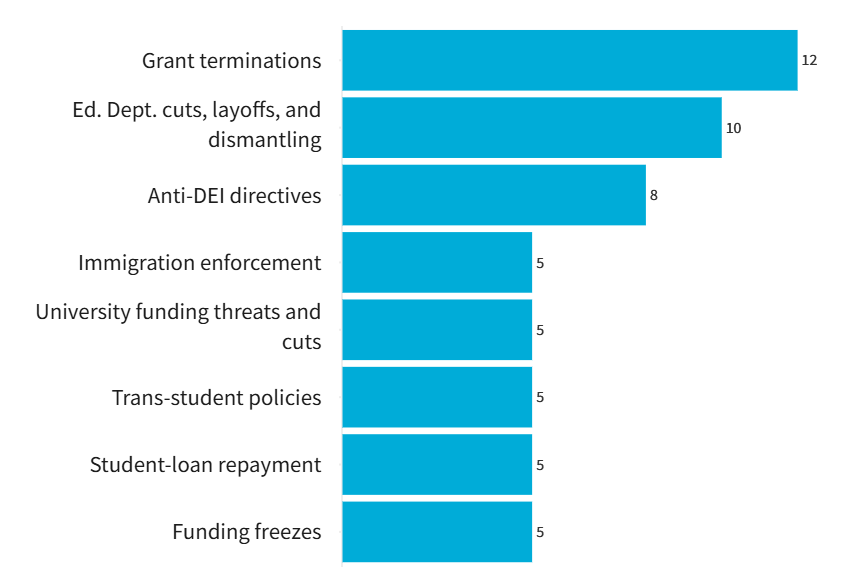
New Policies, New mandates, Uncertainty and Chaos: Scanning the Back-To-School Headlines in the US for 25-26 (Part 2)

This second part of IEN’s annual scan of the back-to-school stories brings together some of the headlines that focused on the effects of a flurry of executive orders and policy changes from Washington. The first part of the scan shared stories from outside the US, and, next week, we’ll review some of the other back-to-school headlines in the national and local press in the US. 

For back-to school headlines from Fall 24: Politics, Policies, and Polarization: Scanning the 2024-25 Back-To-School Headlines in the US (Part 1); Supplies, Shortages, and Other Disruptions? Scanning the Back-to-School Headlines for 2024-25 (Part 2); Banning Cell Phones Around the World? Scanning the Back-to-School Headlines for 2024-25 (Part 3); Fall 23: Crises and Concerns: Scanning the Back-to-School Headlines (Part 1), (Part 2), (Part 3). Fall 22: Hope and trepidation: Scanning the back-to-school headlines in 2022 (Part 1)(Part 2) (Part 3); Fall 21: Going back to school has never been quite like this (Part 1)(Part 2)(Part 3); Fall 20: What does it look like to go back to school? It’s different all around the world…; Fall 19: Headlines around the world: Back to school 2019 edition.


Tracking Trump: His actions on education, The Hechinger Report 

Introducing the Trump K-12 education litigation tracker, Brookings

As Students Return to School, Educators Grapple With Chaos From Washington, The74


Funding

Your Guide to the Evolving Federal Budget and What It Means for Schools, Education Week

State Funding for Schools Is a Mess This Year, Too. Here’s Why, Education Week

$5 Billion in Federal Funding for Nine K–12 Formula Grant Programs Hangs in the Balance Between White House and Senate Proposals, LPI

House panel approves 26% cut to Title I funding for FY26, K-12 Dive

The House meets to vote on the bill that would cut the U.S. Department of Education’s budget by 15% for fiscal year 2026. Source: K-12 Dive

House Lawmakers Endorse Some—But Not All—of Trump’s Education Cuts, Education Week

Trump administration cancels dozens more grants, hitting civics, art, and higher ed, Education Week

Trump shifts millions of dollars to HBCUs and tribal schools amid deep education cuts, USA Today

Trump administration boosts HBCU funding after cutting grants for Hispanic-serving colleges, CNN

Trump Department of Education rolls out latest step to expand school choice nationwide, Fox News

Half of the states won’t comply with Trump’s push to defund schools over DEIThe74

Nation’s Report Card at risk, researchers say, The Hechinger Report

How At-Risk Federal Data Is Being Rescued and Preserved, New America

Trump Admin. Wants to Scale Back Data Collection on Career and Technical Programs, Education Week

How Schools Will Feel the Federal Funding Cuts to Libraries and Museums, Education Week

Trump administration axes federal Blue Ribbon program that recognized high-achieving schools, Chalkbeat

FCC proposal would disconnect school bus Wi-Fi, hotspots from E-rate coverage, K-12 Dive

Students, schools race to save clean energy projects in face of Trump deadline, The Hechinger Report

 Colorado state capitol rally in support of “The Green New Deal for Colorado Schools.” Source: Emma Weber, The Hechinger Report

Most—But Not All—Imperiled Federal Grants for Special Education Will Continue, Education Week

Trump Canceled Millions for Special Education Teacher Training. What’s Next?, Education Week


Health

Schools prepare for the worst as RFK Jr. reshapes the vaccine landscape, The Hill

Confusion as Kids Head Back to School and RFK Jr. Calls the Shots on Vaccines, The74

Decreasing immunization rates among kindergarteners, Source: The74

Childhood Vaccinations Are Down. Schools Are Bracing for Outbreaks, Education Week

Schools brace for federal changes to lunch, The Hill

Trump law will cut food stamps for 2.4 million people as work rules widen, The Guardian


Civil Rights

How the Education Department is using civil rights laws to bring schools to heel, NPR

Trump’s Civil Rights Agenda Comes for Public Schools, Education Next

See Which Schools Trump’s Education Department Is Investigating and Why, Education Week

Some State Leaders Cheer as Trump’s Ed. Dept. Investigates Their Schools, Education Week

Schools Sue Trump, But It’s Getting Harder for Them to Recoup Money, Education Week

Trump administration targets race-focused school programs, The New York Times

Programs for vision and hearing loss harmed by Trump’s anti-diversity push, ProPublica

40 states could lose federal funds for sex ed if they keep gender identity in curriculum, ChalkBeat

“Posters are displayed in a Los Angeles Unified high school health education classroom in 2018. The Trump administration told 40 states to remove references to gender identity from a federally funded sex ed program and stripped California of its funding when it refused to do so.” Source: ChalkBeat

Ed. Dept. Will Release New Guidance on School Prayer, Trump Says, Education Week

Trump administration rolls back pivotal guidance about educational rights of English learners, Chalkbeat

For mixed status families, deportation fears cast shadow over new academic year, NPR

Next Week: Supplies, Support, Lunch and Fear: Scanning the National and Local Back-To-School Headlines in the US for 25-26 (Part 3)

Scaling and Adapting Tablet-Based Supplemental Learning in Malawi, Sierra Leone, and Tanzania: Joe Wolf and Kira Keane on the Evolution of Imagine Worldwide (Part 3)

In the third part of this three-part interview (see Part 1 and Part 2), Joe Wolf and Kira Keane discuss the role of teachers in a table-based supplemental learning model and the efforts to adapt the model to three different contexts in Africa. Part one described the evolution of Imagine Worldwide’s approach and part two discusses Imagine Worldwide’s approach to make the work sustainable by building partnerships with government officials and local community members. The tablet-based program at the center of Imagine Worldwide’s work, developed by software partner onebillion, serves as a supplement for regular instruction, with each child in a school spending a targeted 150 minutes per week working independently on problems related to reading and mathematics. Imagine Worldwide partnered with the Government of Malawi to rollout the program in 500 schools in Malawi in 2023-24, with the ultimate goal of expanding to all 6000 primary schools, serving 3.8 million learners in standards [grades] 1-4 annually. Joe Wolf is the Co-CEO and Co-Founder of Imagine Worldwide, and Kira Keane is the Director of Communications. (Photos/graphics are from Imagine Worldwide unless otherwise noted.)

Thomas Hatch (TH): What can you tell us about the work that has to be done with teachers to scale and sustain the tablet-based model? 

Joe Wolf (JW): The role of facilitator in the model is relatively straightforward. You don’t need a highly trained adult, and they don’t have to be a teacher. It can be a community volunteer or someone else, and that’s made it a very scalable model in terms of human capital. That’s important, because there just aren’t enough humans in these educational contexts. What makes this so scalable, in my opinion, is that when you have a single child and you have a single tablet, there’s an interaction between the child and the content that creates learning gains. When you move to one hundred kids, that linkage doesn’t change. When you move to a million kids, that linkage doesn’t change, you still have the relationship between the child and the content. Things do get more complex in that you have more equipment, and you have more schools, and you need to make sure that the equipment doesn’t get stolen. But when you have a model that depends on human capital, you need more and more and more teachers; and those teachers need to stay trained; and they need to show up every day; and they need to be able to engage one hundred children at the same time. It’s ten out of ten in terms of complexity when you have an inadequate number of teachers and you have to train those teachers to somehow be effective for those one hundred learners. 

TH: This is definitely a critical problem – how can programs be effective if they depend on more qualified teachers than can ever be supported? But then there are legitimate concerns that programs that don’t rely on teachers are sending the message that teachers aren’t important and that we don’t need those adults. How do you address those concerns that you’re trying to replace teachers with technology? 

KK: That issue has really been top of mind for us, particularly as we think about our communications around the program.  One very conscious decision we’ve made is to go back into the community to report on our research results. This means going back to teachers and saying, “Look, this is how your students are doing. This is what we’re learning. This is how this work can support you. This is how it reinforces your instruction.” From the beginning, we’ve really tried to include teachers as well as parents and community leaders in saying that “what you’re part of has implications not only for your own children and your students, but for the country.” We’ve had to be very mindful of that and of making sure that we build in feedback opportunities for teachers. Now in our implementation research, we have researchers going out into the community, conducting workshops and creating opportunities to hear from teachers so that we can continue to improve that process. But so far, our early implementation results and qualitative information coming from teachers is that it’s highly, highly popular.

Photo: IRC

JW: I also think that we just have to be realistic and fact-based with the current situation. In Malawi, there are one hundred kids per classroom and the average age in Malawi is 16 or 17 years old. It’s one of the youngest countries in the world. That means the number of kids is going to go up dramatically, but the level of resources is not going to go up dramatically.  So you already have a problem, and the problem is going to get worse. You cannot build enough schools or hire enough teachers quickly enough or at low enough cost to solve this problem. That’s just the reality, and, in that context, many of these countries are eager to pursue innovative approaches. They’re not building bank branches. They’re going to mobile banking and now their mobile banking is so much better than ours. It had to be. It’s classic Clayton Christensen and his theories of disruptive innovation: where does innovation take root? It takes root in areas of non-consumption, where the status quo is not entrenched. The government of Malawi is really open about this and there is a real thirst for innovation. This is being well received by the government, by the communities, because what’s currently happening is not producing learning gains. 

In addition, we have purposely situated ourselves in a supplemental, complimentary part of the government school’s timetable. There is already literacy and numeracy on the timetable, teacher led instruction, and that stays the same. Then we have a complementary supplemental period where every student is learning adaptively, and what we’re finding is that some of the biggest fans of that model are the teachers, because they’re saying, I have a little bit of a break during the tablet program, because the kids are super immersed in their own learning. The kids are showing up more often. Attendance is going up. They’re learning more; their attitude toward learning is improving. The teachers and the parents are seeing a higher return on investment of keeping the kids in school.  There are just a lot of positive things that are happening for that teacher so that it isn’t in any way positioned as a replacement, as much as an aid that just makes their jobs easier and more sustainable.

TH: I think that’s so crucial. What a difference it might make for a teacher to have a period like that where they can see every student engaged. That’s just such a classic win-win. As we wrap-up, I’d love to hear more about scale-up. What have you learned from scaling across different contexts? 

JW: We’ve come up with what we think are the preconditions for success in partnership with governments. We want to find governments that are already committed to: 

  • Bringing technology into the classroom for teachers and students; 
  • Boosting foundational learning; and
  • Providing solar electrification for their schools. 

We want governments to be already moving on this journey. Then we’re helping them get there, as opposed to trying to convince them to do things. We are out of the convincing game. It doesn’t serve anybody. But we know we need strong government buy in, so we need strong leaders within the government that are committed. We also need a strong local ecosystem of partners that can execute. To help with that, we fill the position we call the “ecosystem coordinator.” That helps us act as a group that is solely dedicated to bringing together the disparate pieces and stakeholders and having them all march forward together to do this work. If you don’t have somebody who has this as their only job, the work will not happen because there’s too much else going on. The jobs are too overwhelming. 

We also need a funding community that is interested in the places that we’re working. We need bold philanthropic capital that’s willing to go first and willing to do the things that need to be done to get the full government buy in. We need support to get to a critical mass of schools. We need evidence that’s generated specific to that context. We need the ecosystem to be organized in a way that you can create an executable plan. Nobody can make decisions on whether this should go to scale, whether that’s the government or whether that’s funders, without having that done first. And it’s the perfect role of philanthropy to be that risk capital early within a country. What we’re in the process of proving, is that if we do that well, the program is in a position to go to scale with government support and they government is also in a position to mobilize more international and multi-lateral funding. 

Organizationally, we’ve seen that the demand is everywhere. Every week, there are countries asking us work with them, but we’ve decided to focus on four countries of different sizes, with four different languages. We want to work in partnership with these government and prove that the model can, in fact, scale. Then at the end of that phase, we’ll just open source everything and try to bring in a lot more players beyond us. We’ve decide to hone in on what we’re calling our “scale portfolio” with Malawi, Sierra Leone and Tanzania being the first three countries that we’re prioritizing. Then we’ll also have a Francophone country in that portfolio. If we do this well, I think that will provide the evidence that’s needed to figure out how to scale this. At this point, adding a fifth or sixth or seventh country, that’s not what the world needs. We know the demand is there. It’s more important that we show how we can build a system, in partnership with a national government in different contexts. 

TH: Have you had to make adjustments or adaptations so that the model you developed in Malawi can work in these different contexts? 

JW: Absolutely. I think continuous improvement is the DNA of our organization. How do we make the procurement better? How do we make the training better? How do we make those community sensitizations better? How do we better collect data in super low-connectivity areas? How do we take that data so we can improve the software and the implementation model? Innovation is a messy game, and it’s filled with fits and starts, so every day there’s a whole bunch of challenges that come up and a whole bunch of solutions that make the model even better. We have to acknowledge that as much as we want to create standardization in systems, every place is different. Our model in Tanzania will look slightly different than our model in Malawi, and we have to allow for those bottom-up adjustments.  It’s back to that relationship between the child and the content. That relationship probably doesn’t change all that much. There are slight adaptations as you go from language to language or from national curriculum to national curriculum, but those are pretty minor. There’s a lot of overlap in the instruction. It’s really the behavior of the adults surrounding the program that may look different in Tanzania. Just as an example, one of the districts that we’re launching in Tanzania is bigger than the entire country of Malawi, so the logistics of working in smaller and larger countries have to be considered. In terms of other differences, in Sierra Leone, we’re working in standards one through six and in a context that is post- civil war and Ebola and everything else. That means there are a lot of overage kids that are way behind in foundational skills. In Tanzania, we’re only working in standards one through three, because that’s been a more stable place. Malawi is in between, as we’re working in standards one through four. That comes from very different realities in terms of number of kids that have to be served with that same tablet and that same content.

TH: Is there anything you’d like to add that you haven’t already mentioned?

JW: I just want to hammer home the importance of philanthropic capital. The governments do not have the early-stage capital. The Big Aid organizations are not going to be early – that’s not their job. Nearly half of the world’s youth will be African by 2030 – half!  Yet there’s not a single foundation that any of us can name that writes million dollar checks for primary schools in Africa. The disconnect between the size of the challenge and the amount of institutional capital focused on it is stunning. So I do think that when people say, “What can we do about this?” Providing capital has to be part of it. A big reason why the work in Malawi has advanced is because some of our supporters decided to make a big philanthropic bet. It wasn’t just, ”Let’s fund 10 schools and see what happens.” This was, “Let’s fund five hundred schools in a year and see what happens.” That made it a really different conversation, and we’re having success in finding other bold philanthropists that think about things the same way. But it’s not easy. There’s not a lot of institutions that focus on this. Under these conditions, I think part of the work is saying, “Hey, whatever you care about world, if it’s environment, if it’s economy, or if it’s global peace, foundational learning is directly tied to all of that, and we have to pay attention to the region that will have half of the world’s youth in a few years.” 

Building the capacity for high quality education at scale: Can Vietnam transform the conventional model of schooling (Part 2)?

Despite a much more limited budget and a much larger population than “high performing” countries like Finland and Singapore, some common factors help explain Vietnam’s educational success. Drawing on observations from a trip to Vietnam, the second post in this 4-part series from Thomas Hatch focuses on some of the key elements that helped Vietnam make substantial improvements in education. Future posts explore Vietnam’s subsequent efforts to shift to a competency-based approach and some of the critical issues that have to be addressed in the process. For other posts related to Vietnam, see part 1 of this series, Can Vietnam transform the conventional model of schooling? Educational improvement at scale, and earlier posts including Achieving Education for All for 100 Million People: A Conversation about the Evolution of the Vietnamese School System with Phương Minh Lương and Lân Đỗ Đức (Part 1); Looking toward the future and the implementation of a new competency-based curriculum in Vietnam: A Conversation about the Evolution of the Vietnamese School System with Phương Lương Minh and Lân Đỗ Đức (Part 2); The Evolution of an Alternative Educational Approach in Vietnam: The Olympia School Story Part 1 and Part 2; and Engagement, Wellbeing, and Innovation in the Wake of the School Closures in Vietnam:  A Conversation with Chi Hieu Nguyen (Part 1 and Part 2).

What does it take to create a “high-performing” education system? For long-standing top-performers like Singapore and Finland a comprehensive educational infrastructure includes: 

  • Technical capital – adequate funding, facilities, curriculum materials, and assessments 
  • Human capital – well-prepared, well-supported, and well-respected educators
  • Social capital – shared understanding and strong connections and relationships among educators, policymakers, community members and between schools and the education sector and other parts of the society.

In Vietnam, a more limited budget and a much larger population have made it harder to produce and sustain high-quality facilities, a well-prepared and supported workforce, and a tightly connected and coherent education system. Nonetheless, the Vietnamese education system has been able to draw on and develop some key aspects of technical, human, and social capital that have contributed to the establishment of a system that provides almost universal access to education through 9th grade at a relatively high level of effectiveness.

Technical capital: Funding, Facilities, and Textbooks 

In terms of funding, the Vietnamese government demonstrated its commitment to education by increasing public spending on education from about 1% of GDP in 1990 to about 3.5% in 2006. Those investments were essential for the construction of large numbers of new primary and lower secondary schools in the 1990s and for the production and distribution of free textbooks for students whose families could not afford them. In turn, these efforts contributed to the substantial increases in enrollment and access to education during that time. 

Vietnam has continued that financial commitment to education by spending nearly 20% of its budget (almost 5% of its GDP) on education from 2011 – 2020,  a level of spending higher than countries like the US and even Singapore. That commitment was put into a law passed in 2019 that stipulates that the government should spend at least 20% of its budget on education moving forward, though it has not quite reached that level. Notably, the government commitment has included an investment in equity as Vietnam allocates more spending per capita to disadvantaged provinces and municipalities and pays higher salaries to teachers serving in those areas.

A graph of red bars

Description automatically generated with medium confidence

Government-produced textbooks have also played a critical role in the evolution of Vietnam’s education system. These textbooks served as the “de facto” curriculum for some time, with teachers trained to deliver the content in the textbooks and large classes of students moving through the textbooks in a lock-step fashion. Like “managed instruction” approaches that have raised test scores and achievement levels in some districts in the US, textbooks produced by the government with centrally established learning goals may have provided the rapidly increasing student population with access to a common educational experience aligned to conventional assessments and international tests. As a history of the education system in Vietnam explained it, the replacement of textbooks at all school levels in the early 1990s “brought consistency to general education across the nation.” 

Human Capital: Respect for teachers and teachers’ expertise 

In Vietnam, explanations of the development of the educational system often cite the respect for teachers and their work and dedication as critical factors in the development of the education system. Notably, in OECD’s 2018 TALIS survey of teachers and teaching 92% of Vietnamese teachers report feeling valued by society, some of the highest rates among all OECD countries and astoundingly high compared to the OECD average of 26%. By comparison, slightly over 70% of teachers in Singapore (#2 in the rankings) and slightly less than 60% of teachers in Finland say they feel valued by society. In addition, 93% of teachers in Vietnam reported that teaching was their first choice of career (versus an average of 67% of teachers in other OECD countries).  Correspondingly, teacher absenteeism is virtually unknown in Vietnam. 

There is also some evidence to suggest that, overall, teachers in Vietnam have a relatively high level of expertise. For example, data from the Young Lives project shows that primary school math teachers’ pedagogical skills are the one school variable that explains a significant amount of the difference in the gap between the scores of students in Vietnam and their counterparts in India and Peru. Furthermore, the variance in the effects that teachers have on their students’ learning is much smaller in Vietnam than it is in many other countries, suggesting that there are relatively few really bad teachers. 

A graph of the teacher's values

Description automatically generated with medium confidence

Social capital: Shared values, common commitment, and relationships

Along with Asian countries like China and Singapore, Vietnam shares Confucian traditions that have placed high value on education for hundreds of years. That commitment to education has also been a critical part of the economic and social development of Vietnam over the last half century of the 20th Century. In 1945, for example, Ho Chi Minh declared Vietnam’s future depended on the education of its children, and that same year, the government issued decrees announcing a call for “anti-illiteracy” campaigns and the establishment of literacy classes for farmers and workers. Shortly thereafter, 75 thousand literacy classes with nearly 96 thousand teachers were serving 2 and a half million people. 

The intertwining of education and national development was also evident in the 1980’s as Vietnam’s shift towards a more market-based economy aligned well with the interests of international NGO’s like the World Bank and the Asia Development Bank. These and other international organizations have provided crucial funding and guidance for economic and educational development in Vietnam since the 1990’s.  

Those I talked to in Vietnam also emphasized the importance of the commitment to education that parents demonstrate in their support for schools. Vietnam’s education minister in 2015, put it succinctly:  “Vietnamese parents can sacrifice everything, sell their houses and land just to give their children an education,”

Importantly, students also demonstrate a belief in the power of education and respect for their teachers. 94% of the Vietnamese students surveyed as part of the PISA tests in 2015 agreed with the statement that “It is worth making an effort in math, because it will help us to perform well in our desired profession later on in life,” and surveys from the latest PISA test in 2022 showed that the proportion of class time teachers in Vietnam have to spend keeping order in the primary classroom (9%) is one of the smallest among all participating countries. 

Along with these shared values and commitments, Vietnam also appears to have developed some strong relationships between educators, government officials, and community leaders and parents.  Attention to these relationships may have played a particularly valuable role in the effort to extend and support schooling in rural ethnic minority areas. Phương Minh Lương, who has worked and conducted research with several ethnic minority communities, explained it to me this way:  “That is the power of the collective or what we might call the ‘power with.’  There’s close coordination between authorities at grassroots levels and schools, with monthly meetings between the village or what we call the commune authorities and school leadership and educators. These include school officials like the headmaster and representatives of mass organizations like the Women’s Union, Youth Union, and Study Promotion Associations at the village level. These meetings are organized by the commune authorities, and they discuss all the problems related to the life of the local people in the village and in the school.  Then if there is a problem, like there are children who have dropped out, then the authorities can support the school in that area and they can come to see what are the reasons these children dropped out, and are there any solutions to get these children back to school.”

Critical Consciousness, Digital Equity, and Critical Unschooling in the United States: Lead the Change Interviews (Part 6)

This week’s post includes excerpts from interviews with presenters discussing “Redefining leadership and equity in evolving educational spaces” at the Annual Conference of the American Educational Research Association next week. For previous posts featuring presentions at this year’s AERA conference see Part 1 “Leveraging Partnerships, Networks and Teacher Collaboration for Educational Change,” Part 2 “Leaders, Leadership Practices, and Educational Change in the US, Korea, and Hong Kong: Lead the Change Interviews (Part 2),” Part 3 “Educational Transformation in Schools and Colleges in the US and South Africa: Lead the Change Interviews (Part 3),” Part 4 Teacher Education, Teacher Certification, and Teacher Meetings in Israel, Korea, Switzerland and the US: Lead the Change Interviews (Part 4), and Part 5 “Anti-discrimination policies in Massachusetts and socioeconomic education reform in Türkiye.” The Lead the Change interviews are  produced by Elizabeth Zumpe and colleagues from AERA’s Educational Change Special Interest Group. The full interviews can be found on the LtC website


Action spaces to support teaching critical consciousness: Risk-taking within professional learning communities – Christina L. Dobbs, Boston University – Madora Soutter, Villanova University – Daren Graves, Simmons University – Elianny C. Edwards, College of the Holy Cross – Scott Seider, Brianna C. Diaz, Babatunde Alford, Kaila Daza, Sarah E. Fogelman, Trang U. Le, Alexandra Honeck, Hannah Choi, Yuwen Shen, & Hehua Xu, Boston College.

Lead the Change (LtC): What are some of the ideas you hope the field of Educational Change and the audience at American Education Research Association (AERA) can learn from your work related to practice, policy, and scholarship?

CD, MS, DG, EE, SS, BD, BA, KD, SF, TL, AH, HC, YS, & HX: We will present a project from the past several years called the Critical Crew Project. This project sought to teach middle grade students about critical consciousness (Freire, 1973), the ability to challenge and navigate oppressive forces, and to document how those schools used professional learning community (PLC) spaces to learn and teach critical consciousness with students during advisory meetings….We learned a great deal across this project about systems of multi-level change to build support for learning at a range of levels. Teachers needed space and support to learn about teaching critical consciousness that had structure without prescription. Our approach of having flexible tools with lots of space for specialization for contexts and particular students seemed to resonate with teachers. We found also that, as university partners, we served as conduits to research and other materials for PLCs and to use their feedback for refining the work, without being overly directive about the project. We also learned about producing a range of work products as a result of the project – academic papers, curricular materials, videos from classrooms, etc. – which has helped us push different levers, such as publishing research or presenting teacher workshops or building curriculum and participate in different conversations as a result of the work.

From Left to Right: Dr Christina Dobbs, Dr Scott Seider, Dr Daren Graves, Babatunde Alford

From Left to Right: Brianna Diaz, Dr Elianny Edwards, Kaila Daza

From Left to Right: Dr Trang Le, Alexandra Honeck, Hannah Choi
From Left to Right: Sarah Fogelman, Hehua Xu, and Dr Madora Soutter

Digital Equity and Inclusion: Insights into Educational Change and School Initiated Improvements – Christopher Sanderson, University of Arizona 

Lead the Change (LtC): What are some of the ideas you hope the field of Educational Change and the audience at American Education Research Association (AERA) can learn from your work related to practice, policy, and scholarship?

CS: My research offers insights into the challenges and strategies facing K-12 school districts in their efforts to promote digital equity and inclusion, providing valuable lessons for practice, policy, and scholarship. My work emphasizes the importance of integrating digital tools and providing professional development for educators to address disparities effectively. For example, I highlight the need for further training to bridge digital literacy fissures. From a policy perspective, I encourage sustained district-level planning and collaboration to tackle systemic barriers, such as the expiration of temporary programs like the CARES Act and ACP (Federal Communications Commission, n.d.; US Department of Education, 2024). Digital equity must be treated as a long-term priority rather than a short-term response to crises like the COVID-19 pandemic (Petersen, 2024).  

I also emphasize holistic definitions of digital equity and inclusion, which include access to affordable internet, devices, and the necessary digital skills. Collaborative approaches are essential, and I focus on engaging administrators, teachers, parents, and community members in co-creating solutions to foster a shared vision of digital equity and inclusion. My research highlights the importance of addressing systemic inequities and recognizing biases in policy and practice. For instance, I noted that federal programs often exclude K-12 schools, advocating for tailored, inclusive, sustainable, district-level strategies (National Telecommunications and Information Administration, 2024).  

My work offers frameworks to explore the intersections of digital inclusion, systemic inequities, and community collaboration in educational change. It contributes to the growing body of literature on digital equity by providing insights into how schools can navigate barriers to ensure every student has the tools for success. Focusing on localized, context-driven solutions and collaborative efforts, this research aims to inform and create more equitable learning environments that address both immediate needs and long-term goals. This study may support school districts in assessing their progress toward digital equity and inclusion, offering recommended actions for transformative change. Through the collection and analysis of data, districts can identify patterns and make informed decisions on future steps.  

The findings from this study can serve as a catalyst for action-oriented planning beyond its conclusion. The ultimate goal is to develop actionable strategies that help school districts achieve equitable student access. While an outsider can only begin to grasp the challenges students, communities, and schools face regarding technology access, internet connectivity, and digital skills development, addressing these barriers requires strategic, locally driven planning. Schools are complex and diverse, with digital equity and inclusion needs varying from one site to another. For example, one school might require more digital literacy training for caregivers, while another may need additional internet hotspots to ensure students can access devices outside school hours. 

Dr Christopher Sanderson

Achieving Excellence Academy: Critical  Unschooling and the Promise of a  Humanizing Education – Dr. María del Carmen Salazar & Nadia Saldaña-Spiegle, University of Denver, Ashlea Skiles, Denver Public Schools

Lead the Change (LtC): What are some of the ideas you hope the field of Educational Change and the audience at American Education Research Association (AERA) can learn from your work related to practice, policy, and scholarship?

MS, NS, AS: One of the central contributions of this research is the expansion of the concept of critical unschooling. We, the researchers, extend this concept by conceptualizing “home-based” as one’s sense of “home” which is inclusive of home culture, community, native language, intersectional identities, history, heritage, ancestors, and ultimately, of one’s full humanity. We, the researchers, put the concept of critical unschooling on the ground and bring to live a real-world example in an educational setting with secondary students and teachers of color. This is an important contribution to the field because it extends theory into practice.

Another important contribution of this research is that student voices are centered and the concept of critical unschooling is shaped by their experiences and insights. One of the most impactful findings is how students redefine excellence as a result of the Achieving Excellence Academy (AEA). As an example, one student stated, “Excellence is not just holding onto your goals, it’s going after and representing yourself, and reflecting yourself in your goals.” Another student emphasized, “Before, I only thought about excellence athletically and academically, but after this program, I think it’s cultural too…pride in your own culture, accepting other people’s cultures, and being woke.” The AEA expanded students’ perceptions of excellence to include a focus on their well-being and cultural pride. Moreover, teachers of color extended this concept into teaching and learning by sharing how they enacted critical unschooling.

Dr María del Carmen Salazar
Nadia Saldaña-Spiegle
Ashlea Skiles

Anti-discrimination policies in Massachusetts and socioeconomic education reform in Türkiye

In Part 5 of the Lead the Change (LtC) interviews, IEN shares excerpts from interviews with the presenters discussing “Critical analysis of policy and school reform: Reimagining more just futures” at the upcoming Annual Conference of the American Educational Research Association.  For the other posts featuring presenters from this year’s AERA conference see Part 1 “Leveraging Partnerships, Networks and Teacher Collaboration for Educational Change,” Part 2 “Leaders, Leadership Practices, and Educational Change in the US, Korea, and Hong Kong: Lead the Change Interviews (Part 2),” Part 3 “Educational Transformation in Schools and Colleges in the US and South Africa: Lead the Change Interviews (Part 3),” Part 4 Teacher Education, Teacher Certification, and Teacher Meetings in Israel, Korea, Switzerland and the US: Lead the Change Interviews (Part 4). These interviews are a part of a series produced by Elizabeth Zumpe and colleagues from AERA’s Educational Change Special Interest Group. The full interviews can be found on the LtC website


‘Even-handed treatment of all sides’: A critical policy analysis of Massachusetts anti-discriminatory school committee proposals – Erin Nerlino (EN), Clark University, & Lauren Funk (LF), Boston University

Lead the Change (LtC): What are some of the ideas you hope the field of Educational Change and the audience at American Education Research Association (AERA) can learn from your work related to practice, policy, and scholarship?

EN & LF: By engaging in this work, we aim to enhance the knowledge that the field of Educational Change and the audience at AERA have about how some threats to equal education and student belonging occur locally within cities, towns, and school district communities. While much attention has rightly been focused on states that have more widespread discriminatory laws in place, such as Florida and Texas (Johnson, 2020), local communities in states such as Massachusetts are also facing divisive and discriminatory policies. Educators, parents, students, and community members are organizing in response to resist such policies in many districts; however, an increasing number of these discriminatory and divisive policies are arising (Feingold et al., 2023). We hope to shed light on the communal threat that these policies pose and break the silos of individual districts facing these policies to share resources, strategies, and experiences in successfully resisting.

Furthermore, much of the language and concepts used in these policies can initially seem benign, suggesting that all viewpoints are just and reasonable. For example, the four policies under study in this work use words and phrases such as “neutral,” “unbiased,” and “even-handed treatment of all sides.” These phrases assert the false idea that presenting all sides of a social policy issue constitutes neutrality and that neutrality itself is ideal and not taking a position. Many of the underlying implications impact already vulnerable student populations and hamper the efforts of educators. To refer back to the previously-mentioned phrase of an “even-handed treatment of all sides” as an example, this assertion opens up the classroom as a space that has the potential to deny students’ identities as it allows for individuals to voice problematic ideas based on race, sexual orientation, religion, social class, etc., in the name of covering “all sides” of an issue. By elucidating some of the problematic language, we hope to prepare fellow allies in practice, policy, and scholarship to productively challenge ideas that might threaten the belonging of all students in schools.

Dr. Erin Nerlino 
Dr. Lauren Funk

The implications of educational change on socioeconomically disadvantaged students – Elif Erberk (EE) Van Yuzuncu Yil University, & Yasar Kondakci (YK) Middle East Technical University

Lead the Change (LtC): What are some of the ideas you hope the field of Educational Change and the audience at American Education Research Association (AERA) can learn from your work related to practice, policy, and scholarship?

EE & YK: This study critically evaluates the impact of educational reforms on socioeconomically disadvantaged students and invites both policymakers and practitioners (e.g., teachers and principals) to tailor measures that mitigate the negative impact of the reform on those students. The active involvement of teachers and principals in the design phase of the reform, empowering them during the implementation by providing additional resources, and granting decision-making latitude to contextualize the implementation in socioeconomically disadvantaged areas are practices highlighted by the teachers and principals. However, specific recommendations are made for policymakers, who are encouraged to demonstrate participatory and democratic practices during the design phase of the reform. Additionally, fostering a collaborative climate and inviting both internal (teachers and principals) and external (e.g., universities, labor unions) stakeholders to contribute to the design and implementation of reforms is vital for diminishing the impact on socio-economically disadvantaged students. 

Dr Yasar Kondakci
Dr Elif Erberk

Lead the Change Interview with Patricia Virella, Tayeon Kim, Lauren Bailes, and Elizabeth Zumpe

This month’s Lead the Change (LtC) interview features the new leaders of the Educational Change Special Interest Group of the American Educational Research Association, Patricia Virella, Tayeon Kim, Lauren Bailes, and Elizabeth Zumpe. This week IEN shares excerpts from those interviews focusing on the connections between their work and the work of the SIG and the wider field of educational change. The LtC series is produced by Elizabeth Zumpe and sponsored by the Educational Change SIG. A pdf of the full interview will be available on the LtC website.

Lead the Change Interview with Patricia Virella

Lead the Change (LtC): What are some of the ideas that you hope the field of Educational Change can learn from your work to inform practice, policy, and scholarship?

Patricia Virella (PV): Over the past year, I prioritized immersing myself in school environments, spending approximately 30 days actively engaging with students, teachers, and staff. This hands-on experience allowed me to gain profound insights into the unique challenges that students are facing in today’s educational landscape, including mental health issues, ongoing crises, and persistent inequities. Witnessing the resilience and joy demonstrated by students in the face of these challenges was incredibly inspiring. It reinforced the importance of understanding the realities of schooling in the present moment. All of us must pause and truly comprehend the current state of education before forging ahead with our plans and initiatives. This firsthand exposure has deepened my commitment to advocating for comprehensive support systems that address the multifaceted needs of students and educators alike. It has also fueled my passion for promoting holistic approaches to education that prioritize well-being and equity. I am driven to leverage these insights to inform my work and to champion initiatives that empower schools to create environments where every student can thrive.

LtC: What excites you about the field of Educational Change, and how might we further those ideas through the work of the Educational Change SIG?

PV: The idea of change is inherently exhilarating. While change often implies embracing entirely new approaches, I also ponder whether it involves a return to foundational concepts and theories that have yet to manifest their full potential, such as liberation, transformation, and experiential learning. This dual perspective prompts me to consider how we, as a collective of academics, can effectively support change that embodies the spirit of equity. I recognize that achieving equity can sometimes feel elusive, but it does not have to remain this way. My commitment to exploring the multifaceted nature of change and equity has deepened my resolve to advocate for inclusive and transformative practices within academic and institutional settings. By critically examining the intersections of change and equity, I am dedicated to fostering environments where all individuals have equal opportunities to thrive and contribute meaningfully. I am driven to channel these reflections into actionable strategies that promote systemic change and advance the realization of equity within educational and academic spheres.

Patricia Virella

Dr. Patricia M. Virella is an Assistant Professor in the Department of Educational Leadership at Montclair State University. Dr. Virella’s research focuses on implementing equity-oriented leadership through leader responses, organizational transformation and preparation. Dr. Virella also studies equity-oriented crisis leadership examining how school leaders can respond to crises without further harming marginalized communities.

Lead the Change Interview with Taeyeon Kim

LtC: What are some of the ideas that you hope the field of Educational Change can learn from your work to inform practice, policy, and scholarship?

TK: My research offers several contributions to the field of Educational Change, focusing on three main areas: revisiting policy through the voices of equity leaders, critically examining policies and systems by centering racially and linguistically marginalized communities, and promoting cross-cultural dialogue using transnational and decolonial perspectives. Given that my work was previously featured in the Lead the Change series (See the Lead the ChangeOctober issue of 2023), I would like to highlight some insights from my recent publication on leadership learning.

As a leadership educator, I view learning as a core tenet of leading educational change. My scholarship on educational leadership and policy has led me to explore how to guide meaningful learning for aspiring leaders who pursue equity and social justice. My recent work, published in the Journal of School Leadership (Kim & Wright, 2024), presents a conceptual-pedagogical framework that on guides students through emotional discomfort when learning about inequities and injustice. This research underscores the importance of emotion in learning, which can drive change at both individual and social levels. When negative emotions are not properly addressed and processed, meaningful learning cannot occur, undermining leaders’ efforts to redress inequities, injustice, and harm. However, with appropriate guidance, emotional discomfort can be a valuable source for transformative learning and changes (see Mezirow 1997). Traditional scholarship on educational change often relies on rationalistic approaches; however, my recent study emphasizes the role of emotions and the holistic aspects of learning in effecting change. It also highlights the crucial role of facilitators and educators in developing equity leaders. 

Thus, my work reveals that effective leadership learning involves addressing the emotional dimensions of learning about social justice issues. By integrating these emotional and holistic aspects, educational leaders can foster more profound and lasting changes in their practice, policy, and scholarship. This approach can help prepare leaders, better equipping them to navigate and address the complex challenges of inequity and injustice in education.

LtC: What excites you about the field of Educational Change, and how might we further those ideas through the work of the Educational Change SIG?

TK: The field of Educational Change is particularly exciting due to its emphasis on partnerships and interdisciplinary approaches, and its appreciation for international perspectives. As a transnational scholar, I often notice that AERA’s discourse tends to be US-centric and predominantly features scholarly thoughts and contexts published in English. This observation underscores the importance of the Educational Change SIG’s foundations and history, as it can potentially extend the boundaries of our educational scholarship.

To advance the field, I urge educational change scholars to critically engage with issues of geopolitics, coloniality, and global whiteness (e.g., Chen, 2010; Mignolo, 2008; Leonardo, 2002) that influence knowledge creation and dissemination. When we embrace “interdisciplinary” and “international” perspectives, it is crucial to interrogate whose knowledge is being prioritized and how it is being represented.

With our new leadership team, I aim to extend the field of Educational Change through several focuses. First, I urge the field to integrate diverse onto-epistemological understandings. The field can benefit significantly from including non-Western, indigenous, and other marginalized ways of being and thinking. By incorporating these perspectives, we can challenge the dominance of Eurocentric paradigms and enrich our understanding of educational practices and policies. Second, educational change scholars need to consider the power dynamics involved in knowledge production and dissemination. This means questioning who has access to academic platforms, whose voices are amplified, and whose are marginalized. Future activities organized by the Educational Change SIG could better support multilingual scholarship and inclusive platforms that are accessible to scholars from various regions and backgrounds, ensuring that a variety of voices are heard and valued. This will eventually promote cross-cultural and transnational collaborations. Finally, integrating critical theories such as postcolonial theory, critical race theory, and feminist theory can provide valuable lenses through which to examine and address systemic inequities in education. These theories can help scholars and practitioners understand the historical and structural factors that perpetuate educational inequalities and identify pathways to more just and equitable educational systems.

By taking these steps, the Educational Change SIG can play a pivotal role in promoting a more inclusive and globally informed approach to educational change, ensuring that the field continues to evolve and respond to the complex needs of educational communities worldwide.

Taeyeon Kim

Taeyeon Kim is an assistant professor in the department of Educational Administration at the University of Nebraska Lincoln. Her scholarship explores intersections of policy and leadership, with a particular focus on how educational leadership can challenge unjust systems and humanize educational practices to empower marginalized students and communities.The Educational Change SIG would like to acknowledge and congratulate Taeyeon Kim as the recipient of the 2024 Educational Change SIG Emerging Scholar Award. Her work was featured in the Lead the Change in October, 2023.

Lead the Change Interview Lauren Bailes

LtC: What are some of the ideas that you hope the field of Educational Change can learn from your work to inform practice, policy, and scholarship?

LB: I aim to share with the field a clear emphasis on systems change for equity, especially in the ways we think about who leaders are. My research focuses on identifying the systems, practices, and mindsets that perpetuate inequities in the careers of educational leaders. Most of my work problematizes the notion of ‘pipelines,’ especially in educational leadership and how career experiences like preparation, promotion, and evaluation are differentially distributed by race and gender (e.g., Bailes & Guthery, 2020; Bailes et al., 2023). When we consider careers to be pipelines, we might wrongly believe those pipelines are neutral, and that everyone has an equal chance of entering or flowing through the pipeline. That is fundamentally untrue: Women and People of Color, as well as people with intersectional identities, experience sorting at every career juncture, even when they are equivalently qualified relative to white or male peers. Further, these career inequities often result in adverse outcomes for faculty and students—especially faculty and students of color. 

A second thing I hope to share is the critical importance of partnering with current practitioners and myriad ways of incorporating their perspectives to deepen, clarify, and implement approaches to and findings of research. The profound systems changes required to shift unjust organizational practices are unlikely to come only from the academy. While research like mine can and does inform practice, I value, seek, and incorporate the perspectives of folks who have experienced injustice in their career trajectories. They are uniquely capable of showing me what I might be missing and how to better capture and learn from what they have experienced or what they know might work to change the system. I also want to be clear that there is much I am still learning from colleagues in this SIG and throughout our field. I’m looking forward to deepening those connections and bringing my own learning to bear on my research and partnership efforts to shift systems in service of equity. 

LtC: What excites you about the field of Educational Change, and how might we further those ideas through the work of the Educational Change SIG?

LB: I think there is a broad appetite—among researchers, policymakers, practitioners, and families—for change in education. That appetite often results in misguided and harmful movements toward neoliberalism, isolationism, or the erosion of schooling as a public good, but there may be opportunity for broad and supportive coalitions for some of the interventions, innovations, and structures that do preserve and enhance equitable and accessible education for every student. 

Lauren Bailes

Lauren P. Bailes is an associate professor of education leadership in the School of Education at the University of Delaware, where she is the coordinator of UD’s EdD in Educational Leadership. After teaching middle school language arts in New York City, she earned her doctorate at The Ohio State University. Now, she researches school leadership preparation, promotion, and evaluation; school organizational characteristics; and the intersection of school leadership and policy. Lauren’s favorite days are still the ones spent in schools alongside teachers and leaders. 

Lead the Change Interview with Elizabeth Zumpe

LtC: What are some of the ideas that you hope the field of Educational Change can learn from your work to inform practice, policy, and scholarship?

EZ: Prevailing ideas about Educational Change tend to come from scholars and policymakers who work far from the realities of schools. Too often, these ideas rest upon wildly false assumptions about existing capacities in schools, overlooking how many operate amid chronic adversity. Chronic adversity occurs when schools regularly face inadequate resources to meet their community’s needs, unproductive pressures to improve, and a lack of support for the profession. When designed from afar, educational reforms tend to presume that school challenges stem from educators’ ‘lack’ of motivation or competence and that improvement thus depends upon intensive intervention from the outside. 

My research offers a different perspective: school improvement amid adversity as a struggle to develop collective agency (Zumpe, 2024). Agency is an inherent driver of human motivation and of educational improvement. But agency can become constrained when people are regularly subjected to demands for which they do not have adequate resources and experience inevitable failure.

As part of one RPP described above, I collaborated closely with a school facing challenging circumstances (Zumpe, 2024). At the start of our collaboration, we realized that our partnership’s theory of action had not considered this school’s needs and context. Across years of being labeled as ‘failing’ and facing daily struggles to ‘reach’ students and cover classrooms, the school’s leaders had tried various initiatives to improve. However, most of their efforts faltered and sputtered out, leaving conflict and cynicism behind.  By their own account, the faculty struggled with the “basics” to get along well enough to launch and sustain improvement. 

When the school’s leadership team invited me to help, I tried to capture their efforts to develop a foundational capability to work together to solve problems, which I called collective agency. Through participant observation with several work groups, I traced how their collective agency became enabled and what shut it down. I also launched and studied a new group using action research.

Comparing groups, I found that efforts to develop collective agency collapsed when educators faced overwhelming and complex problems for which they could see no solutions within reach. In these situations, they avoided their problems, pointed fingers at each other, and expressed a sense of helplessness that nothing could be done. On the flip side, efforts to develop collective agency surged when someone charged the group to ‘do something,’ and when this initiative was combined with a simple solution that the group felt they had the capacity to enact. In these situations, members affirmed each other, perceived the group’s potential for success, and pulled together to make progress towards addressing a problem.

These findings suggest a need for policies and reforms aimed at enabling school improvement in the ‘next level of work’ (City et al., 2010). To do this, we need to partner with educators in challenging circumstances to define and frame goals for improvement within reach and incrementally build organizational problem-solving capacity. Policymakers and scholars need to recognize educators as partners in research and development, without whom our educational system cannot remedy or repair.

LtC: What excites you about the field of Educational Change, and how might we further those ideas through the work of the Educational Change SIG?

EZ: I find hope in the growing number of education researchers seeking answers to existential questions about the role of research in education. Many educators and scholars are deeply concerned about the future of our planet and our democratic values. Looking around at the pernicious grip of racism, the fracturing of civic values, and the erosion of our public education system, many scholars are asking, how does our research relate to this? What are we – as scholars– doing about it? Out of our collective angst comes a growing willingness to expand how we think about academic research and to innovate.

I am excited by the growing number of scholars, especially early career scholars, working to build a more humanistic and justice-forward academic culture. Within our Educational Change SIG and scholarly communities working in RPPs and continuous improvement in education, I am inspired by efforts to actively build a culture in which academics care about each other as people, carry our status with humility, open ourselves to be vulnerable as learners, and treat social impact as a core value. 

To further those ideas, I think the Educational Change SIG should reimagine how we organize and schedule AERA sessions with the intention involving more PK-12 practitioners. One way the SIG can do this is to develop a conference call and session formats that encourage and elevate practitioners’ voices and expertise. The SIG might consider offering sponsored conference registration awards for presenting practitioners. The SIG executive committee can also advocate with AERA to schedule specially designated conference sessions for practitioners that are held during after work hours.

I think the Educational Change SIG should support the diversification of our membership and international learning as a facilitator of cross-national and trans-global exchange. One way to do this is by furthering our existing partnerships with the International Congress for School Effectiveness and Improvement (https://www.icsei.net/about-icsei/) and journals that explicitly seek scholarship with an international perspective, including the Journal for Educational Change. I would also like to see our SIG do more to promote and support international participation in AERA and other remote events for scholarly exchange throughout the year.

Elizabeth Zumpe

Elizabeth Zumpe is an assistant professor in the Department of Educational Leadership and Policy Studies at the University of Oklahoma. A former K-12 public school teacher for over a decade with National Board Certification, Elizabeth holds a Ph.D. in Education from the University of California, Berkeley.

References

Freire, P. (1970). Pedagogy of the oppressed. Herder and Herder.

Virella, P., & Liera, R. (2024). Nice for what? The contradictions and tensions of an urban district’s racial equity transformation. Education Sciences14(4), 420.

Chen, K. H. (2010). Asia as method: Toward deimperialization. Duke University Press.

del Carmen Salazar, M. (2013). A humanizing pedagogy: Reinventing the principles and practice of education as a journey toward liberation. Review of Research in Education37(1), 121-148.

Kim, T., & Mauldin, C. (2022). Troubling unintended harm of heroic discourses in social justice leadership. Frontiers in Educationhttps://doi:10.3389/feduc.2022.796200

Kim, T., & Wright, J. (2024). Navigating emotional discomfort in developing equity-driven school leaders: A conceptual-pedagogical framework. Journal of School Leadership, 10526846241254050.  

Leonardo, Z. (2002). The souls of white folk: Critical pedagogy, whiteness studies, and globalization discourse. Race Ethnicity and Education, 5(1), 29–50. doi:10.1080/13613320120117180 

Mezirow J. (1997). Transformative learning: Theory to practice. New Directions for Adult and Continuing Education, 1997(74), 5–12.

Mignolo, W. D. (2008).  The geopolitics of knowledge and the colonial difference. In M. Moraña, E. Dussel & C. Jáuregui (Ed.), Coloniality at large: Latin America and the postcolonial debate 

Bailes, L. P., Ahmad, S., Saylor, M., & Vitale, M. N. (2023). Quality or control: High-needs principals’ perceptions of a PSEL-based evaluation system. Journal of Research on Leadership Education18(4), 622-648.

Bailes, L. P., & Guthery, S. (2020). Held down and held back: Systematically delayed principal promotions by race and gender. Aera Open6(2), 2332858420929298.

City, E. A., Elmore, R. F., Fiarman, S. E., & Teitel, L. (2009). Instructional rounds in education (Vol. 30). Cambridge, MA: Harvard Education Press.

J., & Steup, L. (2021). Research-practice partnerships in education: The state of the field. William T. Grant Foundation.

Mintrop, R., & Zumpe, E. (2019). Solving real life problems of practice and education leaders’ school improvement mind-set. American Journal of Education125(3), 295-344.

Mintrop, R., Zumpe, E., Jackson, K., Nucci, D.,& Norman, J. (2022). Designing for deeper learning: Challenges in schools and school districts serving