Category Archives: Educational change

Bringing a Tablet-Based Foundational Learning Program to all the Primary Schools in Malawi: Joe Wolf and Kira Keane on the Evolution of Imagine Worldwide (Part 1)

What does it take to scale a tablet-based foundational learning program to all the primary  schools in Malawi? In this 3-part interview, Joe Wolf and Kira Keane describe how Imagine Worldwide has approached that challenge and share some of what they have learned in the process.  The tablet-based program at the center of Imagine Worldwide’s work, developed by software partner onebillion, serves as a supplement for regular instruction, with each child in a school spending a targeted 150 minutes per week working independently on problems related to reading and mathematics. Imagine Worldwide partnered with the Government of Malawi to rollout the program in 500 primary schools in 2023-24, with the ultimate goal of expanding to all 6000 primary schools in Malawi, serving 3.8 million learners in standards [grades] 1-4 annually. Joe Wolf is the Co-CEO and Co-Founder of Imagine Worldwide and Kira Keane is the Director of Communications. (Photos/graphics are from Imagine Worldwide unless otherwise noted.)

TH: Can you describe for us some of the key steps or phases you went through as you developed your work to test and then to scale-up this tablet-based program in Malawi? 

Joe Wolf: The first phase of our work was all research oriented. We wanted to see if these learner-centric tablet models could work – were they really effective for children? – before asking under-resourced systems to spend time, energy, and capital on them. That meant we had a prolonged research phase that included nine randomized controlled trials. That was across different contexts, different languages, different implementation models, different countries – really exhaustively trying to prove that these solutions can, in fact, add significant value. 

The second phase was what we call “learning to scale:” What are the processes that need to be done repeatedly well to scale within these contexts? We purposely spread our work out across seven countries, with different implementation models, different implementation partners, different types of structures to really test what needs to be done repeatedly well so that these systems can adopt the work at scale. Then, only in the last three years, we’ve put the pedal down and said, “Okay, I think we’re ready to really think about scaling.” And we were only able to act on scaling thanks to the leadership of the government of Malawi, who saw the learning gains of our pilot programs and saw how this edtech intervention could support their national goals of improving foundational skills.  At that point in 2022, we served around 6000 children, but we increased it to about 700,000 children by the beginning of 2025. That’s a 100x increase in the last two years, which I think is a testament to the scalability of the model, the execution of the team, and the leadership of our government partners. 

A map of africa with a yellow circle

AI-generated content may be incorrect.

TH: What’s the third phase? Implementation? 

JW: I would say it’s scale plus continuous improvement. Now, our research is less efficacy oriented and more implementation oriented. How do we make it better and better and better? To address that, we have four levers we focus on: 

  • Access: How do we serve more and more children and make the solutions easier and easier to implement? 
  • Cost-effectiveness: How do we bring down the recurring costs to be as low as possible? We’ve brought costs down around 75% in the last five years, and we think there’s still room to go. Our key inputs are all highly deflationary, so we’re getting better economies of scale as we grow. Right now, we’re at about seven dollars (USD) per child per year. We think we can get that under five dollars (USD) as we get better economies of scale. 
  • Advocacy: How do we use data to improve the implementation model in the software so that the efficacy of the program continues to go up and up and up? It’s one of the beauties of technology that it can iterate and improve. You’re not building a building and putting in books and then five years later it’s deteriorated. We actually have the ability to use data to continuously improve through this flywheel of innovation.
  • Sustainability. How do we work with our government partners to build operational and financial sustainability?  And how do we do it starting day one, where we’re building the “muscles” within the existing education system, as opposed to the classic approach of starting off outside the system and then trying to hand it off to the system. Too often, if you haven’t done a good job of building that internal muscle, and then things fall apart. So we’ve really taken the system strengthening approach, acknowledging that there are capacity and infrastructure gaps within the countries where we work and that there are key functions that need to be built that don’t currently exist within some of these systems. We’ve tried to give it time so that, by the end of the implementation phase, the system has already been doing the work for an extended period of time. That way, you don’t have this fall off as you try to hand-off everything to the system itself.

Kira Keane: I just want to underscore a couple of points that Joe made. For Imagine, this notion of the continuous improvement loop, it’s not like we did things, something went wrong and we’re like, “Oh, we have to fix this.” This was an intentional design element from the very beginning: How do we get continuous feedback to improve both the software itself and the implementation model? And the other point is that our key question is “How do we serve as many children as possible?” The need is so immense and the population growth will be so intense over the next 10-15 years so we really need to be focused on scale. That means working with our government partners to aim for generational impact, really looking at country-wide scale, and focusing on how we design for that.

JW: I’ll add two more things to what Kira said. The ecosystem is exhausted by pilots – by small things that don’t scale, that don’t have evidence, that take a lot of time and resources. Scale from day one very much aligns with where the governments are. They have a big problem with the lack of foundational learning among their students, and they need big solutions. Little, tiny things are just distracting and take too much time and energy. The second thing is that we have positioned our organization to be temporary in nature, so our job is to put ourselves out of business as quickly as we possibly can. We don’t see these as “Imagine Worldwide” programs in Malawi or “Imagine Worldwide” in Sierra Leone. These are programs of the government in Malawi and of the government in Sierra Leone that we are helping to support. We’re helping to build capacity and infrastructure to build muscle within the systems. But as soon as the government is ready to maintain this on its own, we are more than pleased to step out of the way and to move on to the next challenge. I think that positioning is really important for the governments. It’s really important for the funders. It’s really important for us and our team. Too many times, an NGO establishes itself and 50 years later, the NGO is still there, doing the work. We need this work to be sustainable within existing systems. Part of that is a commitment for us to get out of the way. We have to believe in sovereignty and the power of governments to run themselves, while also acknowledging that the use of technology in a place like Malawi is new, and so there is going to be a period of time where we have to build some functions that do not currently exist.

TH: That certainly resonates with my experiences in the US where we’ve seen multiple improvement efforts collide in schools in ways that can actually undermine their capacity for improvement. What made Malawi a good context for you to work on scale-up?  

JW: The work in Malawi actually predates the partnership with Imagine. There was a program called “Unlocking Talent,” with the software developer onebillion that became our partner. The onebillion CEO went to Malawi, I think, 15 years ago, fell in love with the country, and developed the product. The first product they developed was in Chichewa, in Malawi. In other words, this was not developed in the West and then adapted to the context. This actually was developed within the Malawian context. We became a research partner to look at impact and to help do the RCT work. That has now evolved into a much more scalable model that we call the BeFIT Program. It’s serving standards [grades] one through four, whereas the first program was only standard two. 

A person holding a tablet

AI-generated content may be incorrect.
Key elements of the BeFIT program in Malawi

There have been a whole bunch of iterations along the way to develop our general approach, but it basically evolved by thinking about what it would take to actually scale the program much more cost effectively to many more students in more systems. If you look at the other places that we worked, you’ll see that we started with finding local partners, mostly local NGOs, some local social-oriented businesses, and then turned over a lot of the functions to those local partners to see what worked in different contexts. From that, we have built a series of centralized functions that we’re now drawing on in our country partnerships, as opposed to having it be completely decentralized. We learned a lot from the initial more decentralized exploration, but we’re now in the process of creating more standardization. Part of scaling depends on acknowledging that you can’t have fifty different bespoke operations. You need to have systems and standards and data systems. When you have 6000 children in Malawi, using a total of 1000 devices, you can do some things by hand; but now we’re trying to serve millions of children in Malawi, with hundreds of thousands of tablets. We now need data driven systems in order to be able to manage that equipment in the field. 

TH: Let’s follow the arc of that evolution in Malawi. What are some of the steps that were crucial to your learning and to the development of the model?

JW: In Malawi, we took seven or eight years to do the research and to get the right level of government buy-in to understand what was working. That included learning things like what’s the infrastructure for the typical school in Malawi? Just to give you the context, that means more than 100 children per teacher and inadequate levels of teacher training. There’s very rarely basic infrastructure in place, so no electricity and certainly no internet connectivity. That’s the reality of the average class in Malawi. So as you think about the components of our model that have emerged the first was what you would call the infrastructure component. We put solar power into all of our schools, addressing questions like: 

  • Where do solar panels go? 
  • How does the solar electricity feed a bank of lithium batteries? 
  • How do the tablets get stored and secured overnight so that they’re charged and they’re safe? 
  • How does all that equipment get distributed to children in a really efficient manner, so that you’re getting as much asset utilization as possible and as much learning time as possible? 

In the end, our research consistently shows that the number of minutes each student uses the content is directly correlated to the level of learning. So we’re addressing these 101 things that need to be done in terms of the infrastructure and operations to maximize that time on task. And that has to take into account that the school day and the school periods are very short in Malawi and you have a lot of children in the classroom. So even just getting kids in and out of a classroom is a lot harder than in many other contexts.

A group of children raising their hands

AI-generated content may be incorrect.
A classroom in Malawi

TH: You just described those complexities really effectively, but for those of us who aren’t familiar with the context, can you go into it even more deeply? What does it really take to get a program like this up and running at scale? 

JW: I think that in addition to a foundational learning organization, we are, in a lot of ways, also a supply chain logistics company. Learning gains are still our north star, but the reality is you’re talking about a phase one of BeFIT that involved launching the program in five hundred schools in five months across half of the country of Malawi, including very rural districts. So we have to deal with the logistics of getting five hundred secure storage cabinets into those schools. We have to deal with the logistics of getting 100,000 tablets distributed across those 500 schools and of getting the solar equipment put into 500 schools. That’s a significant operational lift, and you have to approach that with a level of rigor in terms of those key functions, if you’re going to be able to scale, and you’re going to be able to do that on time. And we had to do that on budget in the middle of a huge macro-economic meltdown in terms of currency and raw materials. In the grand scheme of things, once the equipment is in place, kids can get learning very, very quickly. There’s not a huge lift in terms of adult training. There’s not a huge lift in terms of the role of the adult in the model itself; the content has been built to be autonomous, meaning the child can be self-directed. The tablets themselves have been built to be very robust. A lot of enhancements have been made to make the tablet durable. There’s a long battery life so it can be used throughout the day. Every part of the tablet has been built with screws so that a component can be swapped out if something breaks. So every part of the context has been taken into account in order to get that equipment into the field and utilized. This is one of the big learnings: you have to start with the context in mind, and you have to start with the learning objectives in mind. You then make a series of software decisions, and then you make a series of hardware decisions. Too often in education, it goes the other direction, where people buy stuff, but then they haven’t really thought about what’s going to go on the stuff? What’s the training required? What are the charging and security components of it? What is our learning objective at the end of the day? You have to start with learning, move into the context, and think about all the infrastructure decisions that need to be made in order to make that learning possible in that context. 

KK: I think it’s also important to flag that in working on the logistics we included the government from day one. That means things like using the delivery trucks the government already had. Trying to manage that coordination may have been a little slower or less efficient in some ways, but too often people design an implementation model, put a bow on it, and then hand it to the government without including them from inception. 

Next Week: Building the Capacity to Improve and Sustain Foundational Learning Through Government and Local Partnerships in Malawi: Joe Wolf and Kira Keane on the Evolution of Imagine Worldwide (Part 2)

New Frontiers for Educational Improvements in India? Critical educational issues in India post-pandemic (Part 2)

What are the critical education issues facing India following the school closures of the pandemic? What are some of the practices and initiatives that could serve as building blocks for improving one of the largest educational systems in the world? Haakon Huynh explores these questions in the second part of a two-part series on K-12 education improvement efforts in India. The first part looked at some of the long-standing barriers hindering the development of India’s educational system. For previous posts related to education in India see: From a “wide portfolio” to systemic support for foundational learning: The evolution of the Central Square Foundation’s work on education in India (Part 1 and Part 2); and Sameer Sampat on the context of leadership & the evolution of the India School Leadership Institute.

Beyond the largely school-based, academic concerns of foundational learning and increasing access to colleges and careers, four other interwoven issues – including chronic absence, mental health, nutrition and sustainability – have been receiving increasing attention in the aftermath of COVID-19 related pandemic in India. The discussion of these issues illustrate both the critical challenges as well as the kinds of initiatives and innovations that are already being pursued that can give hope for the future in India and beyond. 

Chronic absenteeism: When enrollment isn’t enough

For some time, the Indian government has focused on increasing enrollment, but in recent years, chronic absenteeism may have taken over as a critical issue. In fact, the Annual Status of Education Report (ASER) 2024 shows that enrollment now exceeds 98% among 6–14-year-olds. Encouragingly, early childhood enrollment has also risen significantly, and digital access among adolescents has become nearly universal. At the same time, data from ASER 2021 showed that over 20% of rural primary school children were not attending school at all even after reopening, and school-level data reported that 21% of schools had fewer than half their students attending regularly, though the extent of absences varied extensively by region. In some states, absence rates were slightly more than 10%, but in places like Bihar, West Bengal and Madhya Pradesh they ranged from 40% to 50%. In rural Telangana 75% of students missed 10 % or more of all school days and more than 50% missed 15% or more.

As in the United States and other countries, poor attendance and chronic absenteeism in India are connected to negative learning outcomes and increased chances of dropping out, particularly for already disadvantaged populations (National Collaborative on Education and Health, 2015; Uppal et al., 2010). Although research in India has been limited, common factors contributing to absences include disinterest in school, illness, weather, transportation, work demands, family obligations, (Malik, 2013) poor peer relations and being overage  (Shah, 2021). Girls also have a  lower attendance rate than boys, reflecting cultural and gender-related issues such as menstruation, child marriage, household responsibilities, and societal expectations (Raj et al., 2019). Although programs like mid-day meal offerings can increase attendance for part of the day, students may still leave after lunch, so that even students who are counted in a morning roll-call may still miss a substantial part of the school day. Complicating matters, most schools in India still rely on a manual system for tracking attendance which makes it difficult to collect, review, and act on the data in a timely way at the school level, and a lack of digitization means it’s difficult to aggregate and analyze the data across schools. All of which means reporting of attendance is subject to fraud and manipulation.

Responding to some of these specific issues, one pilot effort in ten schools – the Chronic Absenteeism Assessment Project (CAAP) – in the state of Telangana developed a way to measure student attendance using a fingerprint scanner connected to a tablet which allowed data to be analyzed relatively quickly. Beyond the technology, this approach included the development of “Education Extension Workers” (EEWs) who could follow-up with absent students and their families, investigate the reasons for absences, and respond appropriately. 

Mental health: Entering the mainstream?

Although attendance and chronic absence began receiving attention before the pandemic, mental health has been a neglected and often taboo topic. None of India’s 22 languages have words for “mental health,” “depression,” or many other mental illnesses, yet a national survey in 2016 documented 50 derogatory terms used for people suffering mental illnesses. At the same time, even before the pandemic, India had one of the highest suicide rates in Asia. Furthermore, according to the same national survey, over 80% of those who did report mental health problem could not access adequate treatment – not surprising given that India only had three psychiatrists for every million people and even fewer psychologists (in contrast, the US has almost 400 psychiatrists and psychologists for every million people). 

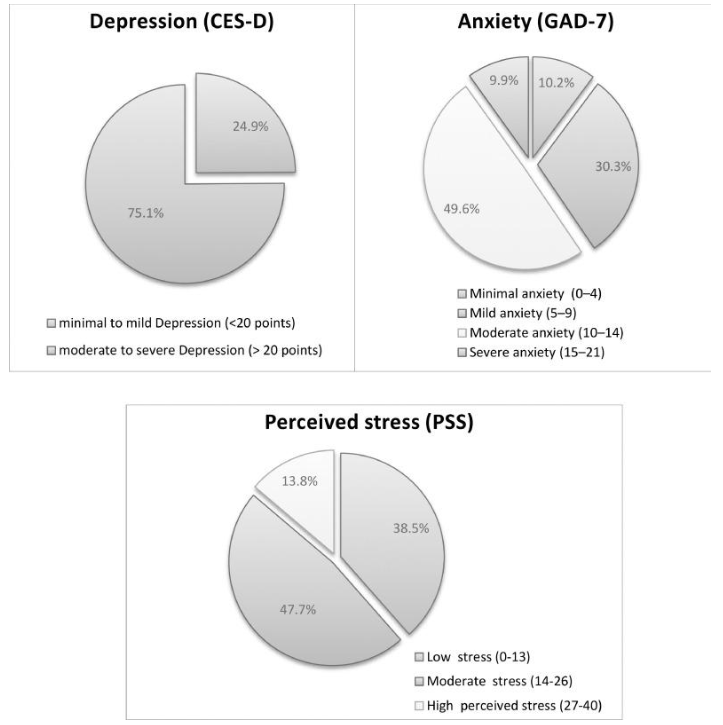
The pandemic and associated lockdowns only made the situation worse. Even by the middle of 2020, surveys were suggesting that as many as 40% of participants reported suffering mental health problems and more than 65% of mental health professionals surveyed reported in increase in self-harm behaviors among their patients. By 2021, the mental health of Indian university students had worsened significantly, with over 75% experiencing moderate to severe depression and nearly 60% experiencing moderate to severe anxiety. School counselors have also noted rising mental health concerns, with one study reporting that counselors are dealing with challenges ranging from heightened anxiety and social isolation to increased aggression and cyberbullying.

 These increases, however, also may reflect a growing willingness to recognize, report and seek treatment for mental health issues. Furthermore, as early as 2020, the Indian government launched the Manodarpan initiative to provide psychosocial support for students, families, and educators. Among other things, the initiative provides counseling resources, a national helpline, and school-based mental health programs.   

Source: The Manodarpan Website

Attention to socio-emotional learning is also growing in some schools in India as approaches like “feelings check-ins” are supported by programs like the Simple Education Foundation and Apni Shala. This practice invites students to begin the school day by identifying and sharing how they feel, often using a simple visual chart or prompt. Other initiatives include POD Adventures, a smartphone-based mental health intervention co-developed with Indian adolescents. Among other components, the app prompts youth to identify their feelings, name the source of their stress, and plan responses. 

A group of children looking at a book

AI-generated content may be incorrect.
Source: HundrED

Nutrition: India’s triple burden

Nutrition is another concern receiving more attention post pandemic. India faces a so-called “triple burden” of undernutrition, micronutrient deficiency, and obesity. About 6% of children are overweight or obese and over 65% are anemic

Although some progress had been made on these health issues, the pandemic set that work back.  Disruptions to India’s food systems included interruptions of food programs, reduced access to healthy foods, and increased costs. Illustrating the challenges, the COVID-19 lockdown in the state of Karnataka led to the suspension of the Mid-Day Meal (MDM), iron–folic acid (IFA) supplements, and deworming programs. In turns, those disruptions likely contributed to increases in the rates of children who were underweight from about 30% in 2017 to 45% in 2021 while anemia rates nearly doubled from 21% to 40% during the pandemic. 

These disruptions, however, along with government and civil society awareness campaigns may also have brought greater attention to these issues in recent years. Even before the pandemic, the Ministry of Education sought to support children’s nutrition and healthy eating by implementing School Nutrition (Kitchen) Gardens. That national program, launched in 2019, recommends that every class spend one to two hours per week in the school’s garden and encourage the integration of garden activities into the school curriculum. The produce from these gardens is intended to supplement school meals, supporting both nutrition and experiential learning. 

Although India has issued national guidelines mandating school nutrition gardens in all schools, progress has been uneven. Some states have taken it further by encouraging families to develop their own gardens. The Nutrition Garden program, implemented in rural areas of the states of Tamil Nadu and Odisha, trained families to cultivate diverse vegetables and offered structured nutrition education. In a similar program in rural schools in in the state of Andhra Pradesh, a 2025 study found that after receiving gardening kits and nutrition education through their government schools, students established kitchen gardens at home and increased their vegetable consumption by 90%. 

Sustainability: Preparing for a warmer planet

Climate change has also emerged as both a critical challenge but also a potential driver of innovation in education in India. In 2019, India was ranked number seven among a list of the countries affected by the changing environment, but 65% of the Indian population had not heard of climate change. As one step in raising awareness about the issue, India’s 2020 National Education Policy (NEP), emphasized the need for environmental education in schools and suggested a shift from content-based learning to skill-based learning in climate education. At the same time, some Indian universities have emerged as global leaders in sustainability with India being the best-represented nation in the 2024 Times Higher Education Impact Rankings assessing universities’ contributions to each of the 17 United Nations sustainable development goals (SDGs). Institutions such as Saveetha Institute, Shoolini University, and JSS Academy are ranked among the world’s top performers, contributing to clean energy (SDG7), health (SDG3), and sanitation (SDG6). 

Although the costs can be prohibitive, architects in India have also been exploring sustainable schools designed explicitly to respond to and take advantage of the environmental conditions in their local contexts. One of those schools serves a desert township in Ras that houses families of those working in a cement plant. To minimize the impact of the harsh sun and make the structure as energy-efficient as possible, the architects created a fragmented layout of sheltered and semi-enclosed spaces to maximize shade and ventilation. A Central Board of Secondary Education school run by the Rane Foundation in a rural village of Tamil Nadu relied on local and recycled materials to create a design that eliminates the need for air-conditioning. Another private, international school in Bengaluru sought to take advantage of its setting near a national park to cultivate respect and curiosity in the natural environment. To do so, the design creates both inside and outside learning spaces and allows students to get perspectives on the trees and plantings from multiple perspectives. 

A collage of different buildings

AI-generated content may be incorrect.
Sustainable schools (top left to bottom right) designed for a desert climate in Ras, Rajasthan; for rural Tamil Nadu, and for a natural setting in Bengalaru

The green economy’s rapid expansion and the promise of high-paying jobs in fields like renewable energy and environmental policy have also contributed to a surge in the numbers of students interested in sustainability education.  Supporting those interests, several initiatives seek to engage students in learning about and promoting sustainable practices. For example, the Green School Initiative involves over 35,000 students, more than a 1000 teachers across 110 schools in supporting student-led efforts to promote sustainability in their local communities. In addition to providing environmentally-based curricula, the Initiative sponsors action projects and capacity-building activities related to the UN’s Sustainable Development Goals, particularly in areas of Energy, Water, Forests & Biodiversity, and Waste. 

The Green Schools Programme and other efforts support student engagement in issues of sustainability by giving them the opportunity to both study and grade their schools on their environmental performance. For example, Birla Vidya Niketan a school of 4,000 students in New Delhi has become known for its attention to sustainability and its student-led electricity audits. By appointing student monitors to ensure fans and lights are switched off when classrooms are empty, the school promotes peer-led accountability in daily energy use. The chosen students complete simple forms to track behavior and encourage energy-saving habits among classmates. To assess impact, the school analyzes changes in its electricity bills. Principal Minakshi Kushwaha emphasized the role of peer education, noting that students are more receptive to feedback from fellow students than from teachers alone. Another public school in Delhi, RK Puram, involves students in energy audits and also involves them in projects related to renewable energy and waste management that build on the school’s commitment to developing sustainable facilities. Demonstrating the international power of these efforts, student audits and related projects can also be found in the  PowerSave Schools Program in Southern California in the Let’s Go Zero campaign in the UK

Common denominators and synergies?

The challenges of mental health, chronic absence, nutrition, and sustainability are deeply rooted and disproportionately impact the most marginalized; but these are not isolated challenges. The challenges interconnect and build on each other creating a set of barriers that can undermine learning and development. Although the complexity and scale of the education system in India compounds the challenges, coordinated efforts to address these critical challenges could also provide cascading benefits in the largest education system in the world. 

How Do You Build a Learning Ecosystem? Gregg Behr on the Evolution and Expansion of Remake Learning and Remake Learning Days (Part 2)

What does it take to expand support for learning in and across communities? In the second part of this 2-part interview, Gregg Behr talks about the development of the first Remake Learning Days in Pittsburgh, Pennsylvania and how they spread to community-wide efforts in 15 different regions in 4 countries. In 2007, Behr, the executive director of The Grable Foundation, founded Remake Learning as a network of educators, scientists, artists, and makers supporting future-driven opportunities for children and youth in Pittsburgh. Celebrating its 10th edition this month. Remake Learning Days began in 2016 as a local learning festival with hands-on learning events for children of all ages at libraries, schools, parks, museums, and other community spaces. Behr is also the author with Ryan Rydzewski of When You Wonder, You’re Learning, sharing the science behind the  work and words of Fred Rogers and Mister Rogers Neighborhood, a well-known television show that ran for over thirty years.  This interview has been edited for length and clarity.

TH:  Let’s turn to one of the activities that I think has become a signature of your work – Remake Learning Days. What were some of the critical “aha’s” in their development? 

GB: The first “aha” happened in one of the human centered design sessions. In Pittsburgh, we had a firm called Maya Design, and they had a retreat room surrounded by whiteboards where they would facilitate these amazing sessions. In 2015, we convened about 30 people, including folks who came from the White House Office of Science and Technology Policy. We were asking these big questions about how far Remake Learning had come and where we might go – asking, essentially, how do you build out a learning ecosystem? What would that look like? It was during that session that it became clear that the network was serving professionals like teachers and afterschool directors, librarians, and designers really well, but that we weren’t really designed to serve parents, families and caregivers. There was a clear “aha” that if we didn’t seriously engage with these members of our community, we’d risk being incredibly faddish, and we started wrestling with what we could do to engage this group. There wasn’t an obvious way to just plug parents and families into our different programs and activities, but through this user design process two things came to light. One was that someone talked about how open houses were one of the singular moments when parents, families and caregivers really come to schools and engage with educators, as surface level as it might be. Then totally separately, someone talked about how, at least in Pittsburgh, we have lots of neighborhood festivals like the Pickle Festival, the Perogie Festival, etc. I can’t even remember who it was, but someone said “Hey, what if we put these two ideas together? This idea of neighborhood festivals with the idea of an open house?” And so we started to talk about having a kind of festival of open houses of all of these places for kids and learning that had been built over the past couple of years. At that point, we had dozens, if not hundreds of makerspaces. We had STEM labs. We began to wonder what might happen if there was a chance for parents, families and caregivers together with their kids to get into all of these spaces and to get beyond their schools and to go into into the Carnegie Museum of Art or whatever it might be. That was the germ of the idea of what became Remake Learning Days, but I can’t even recall what it was called initially. 

A screenshot of a website

AI-generated content may be incorrect.

Within a year, we had the first Remake Learning Days in 2016 because all sorts of organizations said they wanted to participate. There were more 250 events over the course of about nine days. 25,000 people came out in that very first year! That was the second aha – seeing all of those people come out and realizing “Oh, there’s something here!” The other big realization was that there were 250 events that were self-organized: they did it and they weren’t paid to do it. Clearly something had traction, in 2025 in Pittsburgh, we’ll celebrate 10th edition of Remake Learning Days. 

TH: That’s an incredible story. In 2019, other cities in the US and in other countries started hosting their own Remake Learning Days: How did they start to spread? 

GB: The same people from the White House Office of Science and Technology Policy challenged Remake Learning to document its work in what became the Playbook. In fact, someone from that Office left the White House to work with the Sprout Fund in designing the Playbook. The basic idea behind the Playbook was to create something that would be as helpful to people and organizations in Pittsburgh as it would be to Flint, Michigan or Oklahoma City. After seeing how the Remake Learning Days had taken hold in Pittsburgh, we started looking for financial support to develop the Playbook. We got some funding primarily from the Carnegie Corporation of New York, and created what we initially called a toolkit that communities could use to host their own Remake Learning Days.  At the time, Remake Learning was deeply involved with other national organizations and associations that were involved with STEM, the maker movement, and other things like that. We just put the toolkit out there to say, “Who else might want to host Remake Learning Days?” And that’s how they began to spread. 

TH: As I understand it, you’ve tried to let these Remake Learning Days grow and spread more or less on their own?  Are there any particular lessons you’ve learned, either any lessons you’ve learned, either vicariously or from your interactions with those in other communities? 

GB: In terms of letting them spread, yes and no. We’ve tried to provide just enough guardrails so that, if a Martian comes down and goes to Remake Learning Days in Pittsburgh and then Doncaster, England and then southern Wisconsin, it would seem like these things are connected.  If Remake Learning Days are going to be successful, you have to have that connection, but they also have to feel contextualized in these different places. 

Along the way, the team has learned a thousand lessons. They’re going to continue to iterate as they look ahead to years 11 and 12, but like so many other community-based initiatives, you need to have that “backbone” organization; you have to have that clear champion who’s going to lead the work. In one instance, there was an amazing woman who made Remake Learning Days happen where she lived. But after she left, it hasn’t been the same thing. It was so tied to one person and one organization that it just didn’t stick; so we’ve learned that lesson. We’ve also learned the lesson that sometimes things have beginnings and ends. Chattanooga and Chicago hosted phenomenal Remake Learning Days, and they met the needs of the Public Education Foundation in Chattanooga and the Chicago Learning Exchange. But they plateaued in their utility, and both said, essentially, “We’ve loved this, but we’re not going to continue with this,” and we’ve learned that’s totally fine. We’ve seen places like Sarasota and Doncaster completely adopt this approach; raise lots of local money; and Remake Learning Days are now integral to their local efforts. If we were to shut down Remake Learning here in Pittsburgh, they would continue on in some of these other places. We’ve learned all sorts of lessons about leadership, about local financing, about making it local so people feel connected to it. It’s not just a franchise that someone imports; the Remake Learning team has worked hard in terms of monthly meetings and all sorts of things to make sure there’s quality control for successful festivals. 

A group of people standing outside

AI-generated content may be incorrect.
Gregg Behr at a Remake Learning event (photo: Ben Filio)

TH: I didn’t realize how much work the Remake Learning team is putting into these. I thought you put the Playbook out there, and then just let people use it. But you actually have a team that coordinates with these other places, and in a sense sanctions these other events, and says, “Yes, these are Remake Learning Days. This is one of our partner events”? 

GB: Again, the answer is yes and no. Everything that Remake Learning has done, maybe to its detriment, is through Creative Commons licensing, so people have used the Remake Learning Network playbook and also the Remake Learning Days toolkit to their own effect. In New Hampshire, they have used the playbook to support the development of their local learning networks but never with any formal coordination with Remake Learning— – and that’s okay. Places like Qatar have had “Doha Learning Days” and have used the Remake Learning Days playbook. I’d say it’s a loosely sanctioned process. But then there are two producers of Remake Learning Days, and they in turn work with the team in Sarasota or the team in Doncaster, or wherever it may be. 

TH: How does that work? Does Sarasota have to pay the producers or are they providing pro bono services to the places that want to do it? 

GB: Yes, they have a remarkable team supported by The Patterson Foundation in Sarasota; and, for Sarasota and elsewhere, Remake Learning has borne the costs for some of the regional and national marketing, because with an event like this, the most significant costs are marketing. 

TH: Have you run into challenges where you wish that some place wouldn’t call their events Remake Learning Days? 

GB: There have been some challenges along the way, with some places that want to call it something else like “STEM Days,” and the team has had some tough conversations with some cities, saying if we’re going to be part of this, then there are a few things you need to do. Some cities have just said, “We’re going to have our own thing.”  There are also challenges around quality control and questions about what kinds of events to connect with.  There are now some pop-up festivals which have been hugely successful.  People have staged events in Tel Aviv and Antarctica, but sometimes these are singular events on a particular day, and they’re branded and connected to Remake Learning Days, and they’re on the website, but it’s not a multi-day festival the way it is in Sarasota or southern Wisconsin or Kansas City. 

Dates are also difficult. Even with the pop-up events, Remake Learning Days have had a set date range, something like April 23rd through May 23rd. For example, the six regions in Pennsylvania that now host Remake Learning days, they all happen at the same time. That is very deliberate, and they are coordinated statewide. But in 

Tennessee, they valued Remake Learning Days, but May didn’t work for them because of state testing, and it turns out that May is not a great time for Remake Learning Days in Uruguay. That raises the question: does it have to be around the same dates around the world for it to be called Remake Learning Days? The team is wrestling with a whole bunch of questions like this as they go forward. They’re trying to provide greater flexibility while maintaining quality control. 

TH: Can you say anything more about the next steps or the challenges ahead for Remake Learning Days and Remake Learning? 

GB: In terms of challenges, like a lot of these things, no one ever imagined there being a 10th edition. But even with that, ongoing fundraising is a challenge. Yet, for corporate funders, sponsoring an event like Remake Learning Days is a lot easier than sponsoring a network. For fundraising, it certainly helps that they have built up a body of data, including qualitative evidence – write-ups and videos – to support it. Quantitative data, too! For example, they worked with Heather Weiss, who led the Harvard Family Research Project to document their impact on parents. Their goals included helping parents understand how learning is being remade; helping parents understand how they can support their own kids if they find their kids are lit up by art and design or coding or maker-centered programs; and building up demand among parents so they might go to school board meetings, parent-teacher conferences, or their local library to ask questions about these approaches to learning that are clearly lighting up their kids. Heather’s work demonstrated that parents were gaining familiarity with STEAM and new approaches to learning and building their interest and support for those approaches.  

Looking toward the future, I think we’ll see fewer sites that host Remake Learning Days, but they will be more embraced by their region, with significant regional funding. In addition to seeing that in southern Wisconsin, on the west coast of Florida, and Doncaster, the Pennsylvania Department of Education has invested significantly in Remake Learning Days and different units from the state government are also providing in-kind support. I think we may see more changes like that where public funding also helps to drive further engagement and support from local and state governments.  

TH: Looking to the future, let’s return to Remake Learning in Pittsburgh. What do you think it will take to sustain and deepen this work overall?  Are there particular problems that have to be addressed or changes that have been made? 

GB: There are always lots of answers to a question like that!  One thing we have to address is leadership. The leadership has evolved over the years. When it was time for the Sprout Fund to sunset, and they wrapped up their work, we hired what amounted to a director for Remake Learning, and there have been a number of directors since that time, each of whom has held the position for at least two or three years. But incredibly, it wasn’t until around 2014 or 2015 that we convened what we call the Remake Learning Council. This is a council of CEOs, learning scientists, leaders of cultural institutions and others who meet regularly with the director and the Remake Learning team and provide advice and support.  Of course, the people in these roles change positions all the time. There are new museum directors, new superintendents and so on. We have to pay attention to that churn and make sure we have the right people and the right support, and that’s a great leadership challenge. It’s also what makes Remake Learning sustainable – it’s crucial to have a large number of leaders across the community who value this work, who are contributing to the design of it and advancing it. 

Relatedly, Remake Learning, if you can believe it, has never been its own separate 501 (c) (3) [which would allow it to be a charitable organization collecting tax exempt donations]. That’s because part of the strategy in the beginning was to demonstrate that this was not going to be something that competed for funding with other charitable organizations, like museums and some of our other charitable partners. Instead, Remake Learning has been fiscally sponsored by other organizations, and I think that’s been a real benefit – so that the focus could be the work itself. Initially, Remake Learning was fiscally sponsored by the Sprout Fund; then it was fiscally sponsored by our regional association of grantmakers called Grantmakers of Western Pennsylvania. It’s currently fiscally sponsored by the Allegheny Intermediate Unit, our region’s educational service agency. But we always have to check in on our structure: Do we have the right home? Do we have the right governance? That’s an ongoing challenge for the network. 

Another challenge with any organization that reaches 20 years is that you’ve got people who’ve been involved for nearly 20 years, and there are people who just joined two weeks ago. We have to keep the work fresh and relevant for the newcomers as much as for the veterans. This is a programmatic challenge.  It’s hard to keep things fresh for most everyone involved. As one example of “keeping things fresh,” Remake Learning started in the past few years to distribute what they call Moonshot Grants. Regionally, I think they’ve spent about three or four million dollars in grants to local organizations and schools that are really trying to push the edge of what constitutes great learning, especially as such much around us is changing. That’s one example that’s kept the work really fresh. 

Remake Learning has also really leaned into some of its national and international partnerships, which has pushed its work forward. Just last week Remake Learning announced ten national moonshot grants, which came out of the Forge Futures Summit, which brought together organizations involved in learning ecosystems from around the US, and even a few other places worldwide. This speaks to the spread and the tension: Remake Learning is committed to being a regional organization and it has to continue to do basic things brilliantly at the regional level. It’s not a national or international organization, but it sometimes has – or could have – a national and international role to play. That’s what Remake Learning Days have done, and Remake Learning is figuring out how to do that as a network while not distracting ourselves from our core mission regionally. 

TH: Can you say a bit more about what Remake Learning has done internationally? 

GB: Remake Learning has partnerships with a number of international organizations including HundrED in Finland, Big Change out of London, OECD, and the Global Education Leadership Partnership.  Just as an example, Remake Learning got connected to Big Change pre-pandemic because they had done a report and Remake Learning ended up being one of their case studies. Now Remake Learning and Big Change are funding a loose federation of international organizations that meet almost monthly. Along with Remake Learning and Big Change, it includes Learning First out of Bermuda, People for Education in Canada, Learning Creates Australia, Innovation Unit, Zizi Afrique in Kenya, Fundacio Bonfill in Spain, Educate! in Uganda, and Dream a Dream out of India. You’ve got people who represent different geographies. In some cases, they are more metropolitan like Remake Learning, but in others are more nationwide, like Uganda Educate! The first meeting focused on Bermuda’s transforming education system. The second one was a showcase of some of the work in Australia. It’s become a global learning community.

Building the capacity for high quality education at scale: Can Vietnam transform the conventional model of schooling (Part 2)?

Despite a much more limited budget and a much larger population than “high performing” countries like Finland and Singapore, some common factors help explain Vietnam’s educational success. Drawing on observations from a trip to Vietnam, the second post in this 4-part series from Thomas Hatch focuses on some of the key elements that helped Vietnam make substantial improvements in education. Future posts explore Vietnam’s subsequent efforts to shift to a competency-based approach and some of the critical issues that have to be addressed in the process. For other posts related to Vietnam, see part 1 of this series, Can Vietnam transform the conventional model of schooling? Educational improvement at scale, and earlier posts including Achieving Education for All for 100 Million People: A Conversation about the Evolution of the Vietnamese School System with Phương Minh Lương and Lân Đỗ Đức (Part 1); Looking toward the future and the implementation of a new competency-based curriculum in Vietnam: A Conversation about the Evolution of the Vietnamese School System with Phương Lương Minh and Lân Đỗ Đức (Part 2); The Evolution of an Alternative Educational Approach in Vietnam: The Olympia School Story Part 1 and Part 2; and Engagement, Wellbeing, and Innovation in the Wake of the School Closures in Vietnam:  A Conversation with Chi Hieu Nguyen (Part 1 and Part 2).

What does it take to create a “high-performing” education system? For long-standing top-performers like Singapore and Finland a comprehensive educational infrastructure includes: 

  • Technical capital – adequate funding, facilities, curriculum materials, and assessments 
  • Human capital – well-prepared, well-supported, and well-respected educators
  • Social capital – shared understanding and strong connections and relationships among educators, policymakers, community members and between schools and the education sector and other parts of the society.

In Vietnam, a more limited budget and a much larger population have made it harder to produce and sustain high-quality facilities, a well-prepared and supported workforce, and a tightly connected and coherent education system. Nonetheless, the Vietnamese education system has been able to draw on and develop some key aspects of technical, human, and social capital that have contributed to the establishment of a system that provides almost universal access to education through 9th grade at a relatively high level of effectiveness.

Technical capital: Funding, Facilities, and Textbooks 

In terms of funding, the Vietnamese government demonstrated its commitment to education by increasing public spending on education from about 1% of GDP in 1990 to about 3.5% in 2006. Those investments were essential for the construction of large numbers of new primary and lower secondary schools in the 1990s and for the production and distribution of free textbooks for students whose families could not afford them. In turn, these efforts contributed to the substantial increases in enrollment and access to education during that time. 

Vietnam has continued that financial commitment to education by spending nearly 20% of its budget (almost 5% of its GDP) on education from 2011 – 2020,  a level of spending higher than countries like the US and even Singapore. That commitment was put into a law passed in 2019 that stipulates that the government should spend at least 20% of its budget on education moving forward, though it has not quite reached that level. Notably, the government commitment has included an investment in equity as Vietnam allocates more spending per capita to disadvantaged provinces and municipalities and pays higher salaries to teachers serving in those areas.

A graph of red bars

Description automatically generated with medium confidence

Government-produced textbooks have also played a critical role in the evolution of Vietnam’s education system. These textbooks served as the “de facto” curriculum for some time, with teachers trained to deliver the content in the textbooks and large classes of students moving through the textbooks in a lock-step fashion. Like “managed instruction” approaches that have raised test scores and achievement levels in some districts in the US, textbooks produced by the government with centrally established learning goals may have provided the rapidly increasing student population with access to a common educational experience aligned to conventional assessments and international tests. As a history of the education system in Vietnam explained it, the replacement of textbooks at all school levels in the early 1990s “brought consistency to general education across the nation.” 

Human Capital: Respect for teachers and teachers’ expertise 

In Vietnam, explanations of the development of the educational system often cite the respect for teachers and their work and dedication as critical factors in the development of the education system. Notably, in OECD’s 2018 TALIS survey of teachers and teaching 92% of Vietnamese teachers report feeling valued by society, some of the highest rates among all OECD countries and astoundingly high compared to the OECD average of 26%. By comparison, slightly over 70% of teachers in Singapore (#2 in the rankings) and slightly less than 60% of teachers in Finland say they feel valued by society. In addition, 93% of teachers in Vietnam reported that teaching was their first choice of career (versus an average of 67% of teachers in other OECD countries).  Correspondingly, teacher absenteeism is virtually unknown in Vietnam. 

There is also some evidence to suggest that, overall, teachers in Vietnam have a relatively high level of expertise. For example, data from the Young Lives project shows that primary school math teachers’ pedagogical skills are the one school variable that explains a significant amount of the difference in the gap between the scores of students in Vietnam and their counterparts in India and Peru. Furthermore, the variance in the effects that teachers have on their students’ learning is much smaller in Vietnam than it is in many other countries, suggesting that there are relatively few really bad teachers. 

A graph of the teacher's values

Description automatically generated with medium confidence

Social capital: Shared values, common commitment, and relationships

Along with Asian countries like China and Singapore, Vietnam shares Confucian traditions that have placed high value on education for hundreds of years. That commitment to education has also been a critical part of the economic and social development of Vietnam over the last half century of the 20th Century. In 1945, for example, Ho Chi Minh declared Vietnam’s future depended on the education of its children, and that same year, the government issued decrees announcing a call for “anti-illiteracy” campaigns and the establishment of literacy classes for farmers and workers. Shortly thereafter, 75 thousand literacy classes with nearly 96 thousand teachers were serving 2 and a half million people. 

The intertwining of education and national development was also evident in the 1980’s as Vietnam’s shift towards a more market-based economy aligned well with the interests of international NGO’s like the World Bank and the Asia Development Bank. These and other international organizations have provided crucial funding and guidance for economic and educational development in Vietnam since the 1990’s.  

Those I talked to in Vietnam also emphasized the importance of the commitment to education that parents demonstrate in their support for schools. Vietnam’s education minister in 2015, put it succinctly:  “Vietnamese parents can sacrifice everything, sell their houses and land just to give their children an education,”

Importantly, students also demonstrate a belief in the power of education and respect for their teachers. 94% of the Vietnamese students surveyed as part of the PISA tests in 2015 agreed with the statement that “It is worth making an effort in math, because it will help us to perform well in our desired profession later on in life,” and surveys from the latest PISA test in 2022 showed that the proportion of class time teachers in Vietnam have to spend keeping order in the primary classroom (9%) is one of the smallest among all participating countries. 

Along with these shared values and commitments, Vietnam also appears to have developed some strong relationships between educators, government officials, and community leaders and parents.  Attention to these relationships may have played a particularly valuable role in the effort to extend and support schooling in rural ethnic minority areas. Phương Minh Lương, who has worked and conducted research with several ethnic minority communities, explained it to me this way:  “That is the power of the collective or what we might call the ‘power with.’  There’s close coordination between authorities at grassroots levels and schools, with monthly meetings between the village or what we call the commune authorities and school leadership and educators. These include school officials like the headmaster and representatives of mass organizations like the Women’s Union, Youth Union, and Study Promotion Associations at the village level. These meetings are organized by the commune authorities, and they discuss all the problems related to the life of the local people in the village and in the school.  Then if there is a problem, like there are children who have dropped out, then the authorities can support the school in that area and they can come to see what are the reasons these children dropped out, and are there any solutions to get these children back to school.”

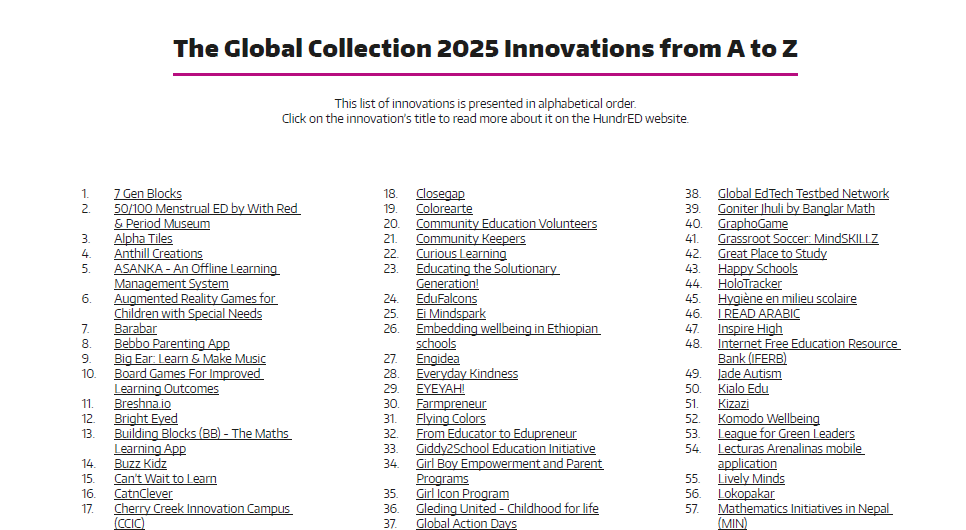
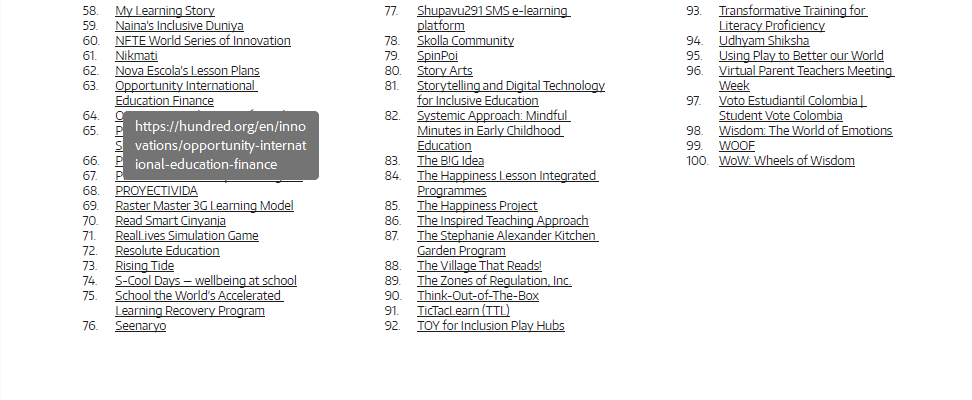
The HundrED Global Collection for 2025

This week’s post highlights the 2025 HundrED Global Collection of education innovations and shares links to some of the panels from the HundrED Innovation Summit.  This year’s Global Collection featured one hundred solutions from six continents selected from more than 700 submissions. Major themes in this year’s collection were access to education, equity, wellbeing, and creativity as well as a 100 percent increase in the number of innovations using some form of educational technology. To see how this year’s collection of innovation compares to previous years, see the IEN posts on the HundrED Global Collection for 2024, 2023, 2022, 2021, & 2019.

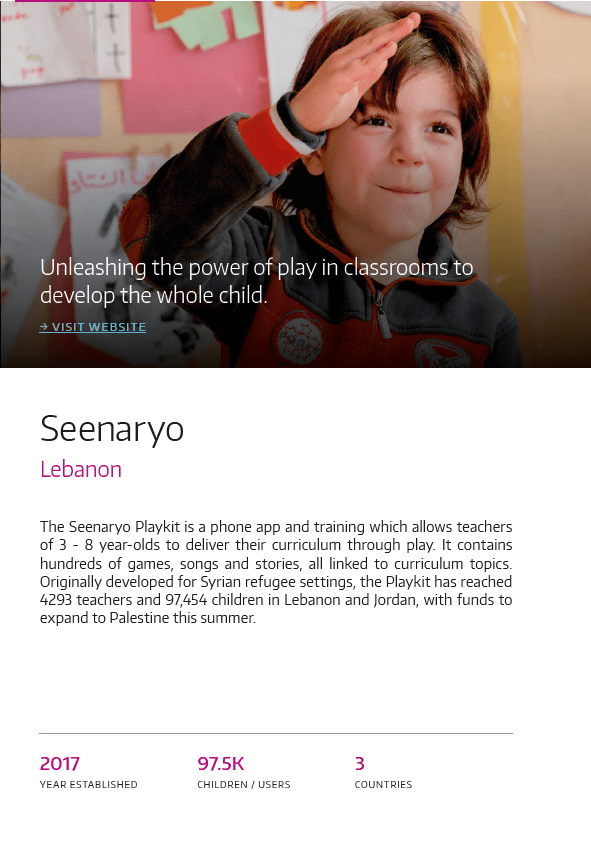
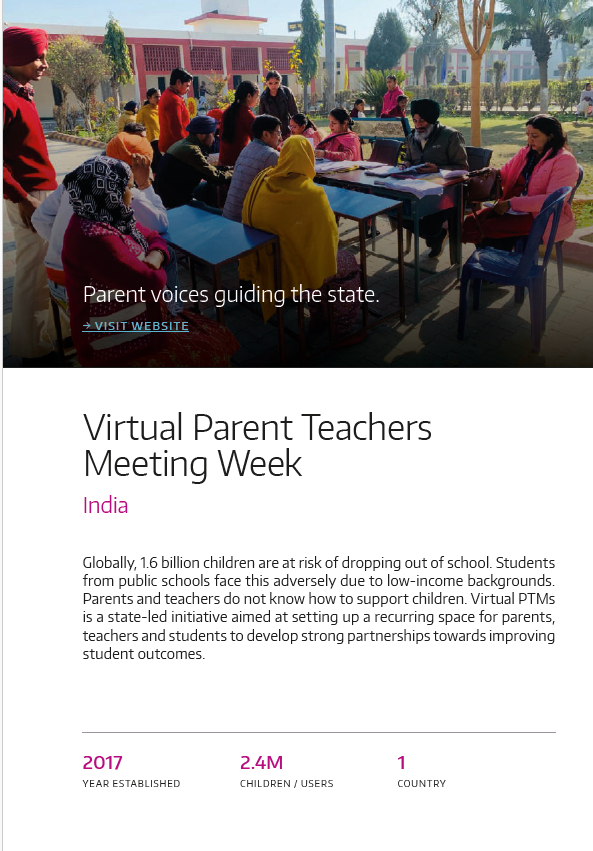
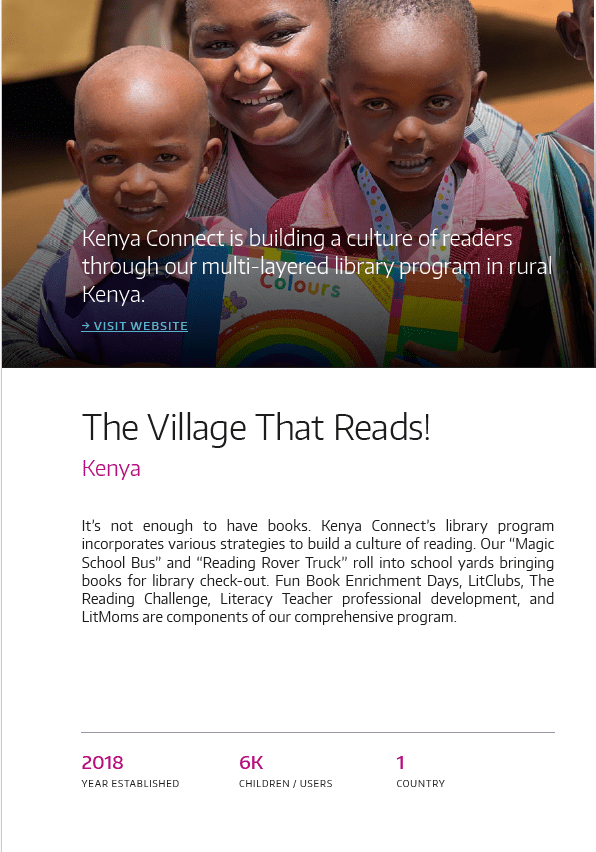
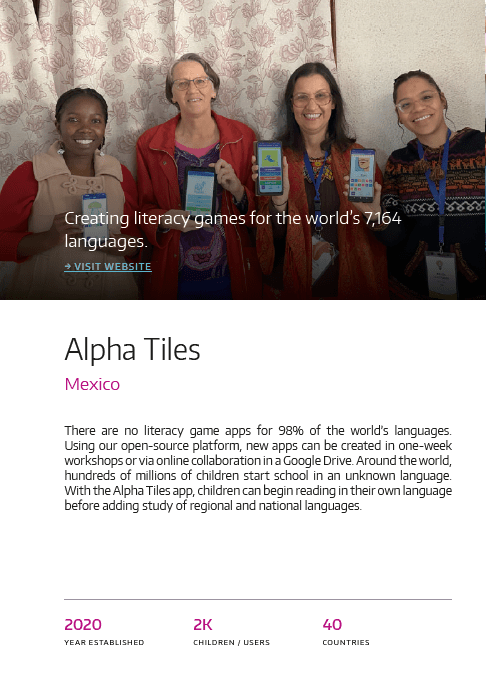
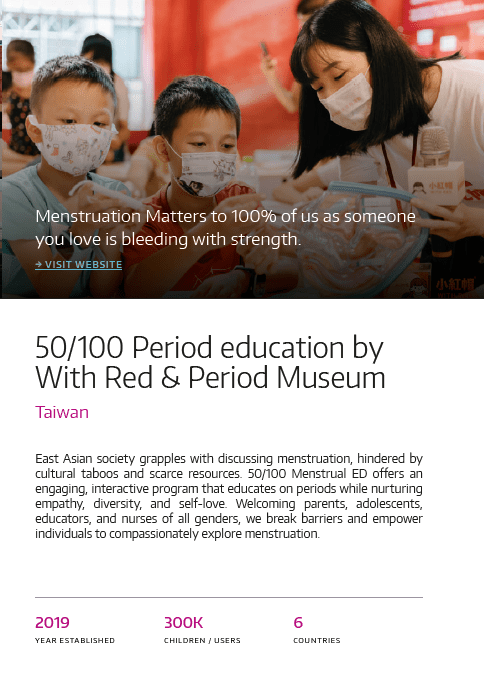
Images & excerpts from the the HundrED Global Collection 2025 report

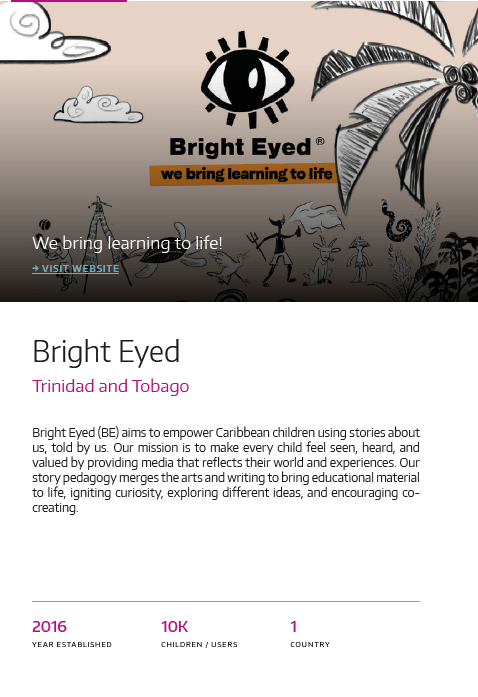
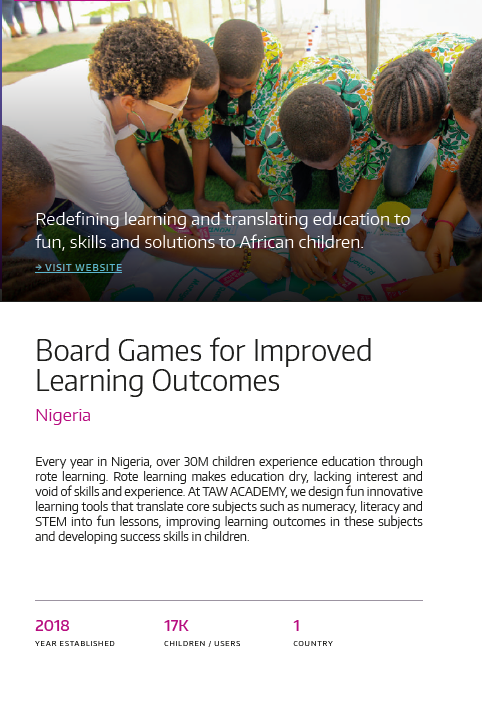
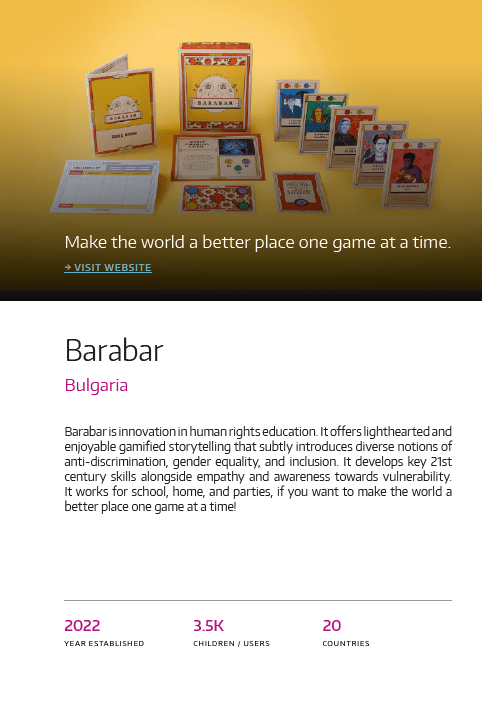
This year’s selections for the global collection include: Alpha Tiles (Mexico); 50/100 Period Education (Taiwan); Bright Eyed (Trinidad and Tobago); Board Games for Improved Learning Outcomes (Nigeria); Barabar (Bulgaria); 7 Gen Blocks (United States).

Towards a Collaborative, Open-Minded, Respectful Community of Global Learning: Lead the Change Interview with Tracy X. P. Zou

In the latest Lead the Change (LtC) interview, Tracy X. P. Zou discusses her efforts to develop a collaborative approach to scholarship and to incorporate global, international, and intercultural dimensions into the teaching and learning. Zou is an assistant professor in the Department of Educational Administration and Policy at the Chinese University of Hong Kong. The LtC series is produced by Elizabeth Zumpe and colleagues from the Educational Change Special Interest Group of the American Educational Research Association. A pdf of the fully formatted interview is available on the LtC website.

Lead the Change (LtC): The 2025 AERA theme is “Research, Remedy, and Repair: Toward Just Education Renewal.”  This theme urges scholars to consider the role that research can play in remedying educational inequality, repairing harm to communities and institutions, and contributing to a more just future in education. What steps are you taking, or do you plan to take, to heed this call? 

Tracy Zou (TZ):  I believe that cultivating collaborations can be a meaningful approach to addressing inequality, repairing harm, and contributing to a more just future by giving voice to important stakeholders to enhance the relevance and impact of educational change research. In many education change projects in higher education, faculty members and students are only informed about, not involved in, the change. Such projects do not usually lead to a desirable impact on teaching and learning practices. To be impactful, changes need to be initiated with people, not imposed on them. 

Globally, many scholars are calling for a collaborative approach to scholarship, but in practice, we encounter many barriers, including faculty members’ heavy workload. Faculty face increasing demands to generate more research more quickly and with higher impact. This means that, in many parts of the world, including Hong Kong where I am based, engaging in educational change is less rewarded than doing research. Against this backdrop, much of my research has involved teaching and learning-focused collaborations among faculty members and between faculty members and students. My studies have included research on students as partners (SaP) and faculty member collaborations for cultivating communities of practice. 

The SaP study (Zou et al., 2023a) involved working with 43 undergraduates as partners in three research projects across two research-intensive universities in Hong Kong. SaP is considered challenging in Asia because it requires an equal relationship in teacher-student collaborations, and there is typically a larger power distance in many Asian regions. We show SaP is achievable in Hong Kong with proper alignment between SaP project designs and the student partners’ roles. Conducive designs include involving students in project configuration, providing them with peer collaboration opportunities, and designing project topics that interest the larger student community. We found that faculty who were previously skeptical about collaborating with students as ‘equals’ came to see the potential and became inspired to experiment with this practice.

In a faculty member collaboration study (Zou et al., 2022; 2023b), I investigated four government-funded cross-institutional teaching enhancement projects involving faculty from six universities in Hong Kong and Mainland China. While these collaborations aimed to bring systemic changes to teaching practices and curriculum design, we encountered various challenges including heavy workload of faculty members and incompatible credit systems in different universities. Our findings show that creatively aligning the larger project outcomes with the priorities of the institutions or departments of individual faculty members can tackle some of these challenges. Achieving this alignment requires faculty members to adjust elements of the larger project outcomes to match local needs and negotiate with the research team about new ways of achieving the planned outcomes. In this process, faculty members have opportunities to exercise considerable leadership at a local level.  These findings suggest a possibility of breaking down inequities in higher education by providing means for faculty—especially teaching-track faculty at research-intensive universities—to have voice and provide leadership in large-scale projects on educational change. 

I believe that this research on collaboration can enable a more equal and just educational system in two ways. First, the research involves carefully designed interventions that bring small, yet important collaborative initiatives that have the potential to be scaled up, introducing changes developed from the bottom up. Additionally, the findings provide implications that can encourage similar projects for a wider impact collectively. 

LtC: Your work has involved collaborative approaches to researching how teachers and students in higher education develop professional capacity and problem solving skills. What are some of the major lessons that practitioners and scholars of Educational Change can learn from your work and experience?

TZ: The most important lesson that can be learned from my research on collaborative approaches is that faculty members should involve students in educational change, trust them, and provide them with autonomy and freedom to experiment. This is easier said than done. One challenge is that project funding mechanisms, at least those in Hong Kong, tend to hold faculty members accountable if project outcomes deviate from the proposal. In some of my projects, faculty members have been concerned that giving students the autonomy to make decisions would be risky. 

However, our findings showed that giving students autonomy typically enhances their engagement. In a project about students’ learning experiences during the COVID-19 pandemic, we involved students as co- researchers starting from the project planning stage, giving them voice in defining the specific topic and the scope of the research (e.g., what aspects of learning, which groups of students to be researched), designing the methodologies, and constructing the budget. These are tasks that are not typically handled by students, but we found that students became extremely committed to the project as they focused on the matters that were most relevant and exciting to them. For example, one group of students investigated the impact of the pandemic on international students studying in Hong Kong from developing countries and revealed how financial and resource constraints influenced students’ learning and well-being. 

Another important lesson learned is about proper and flexible project designs. Collaborative endeavors cannot be fully predicted up front and often require revision and re-direction in project outcomes. Our research findings provide evidence for the need for embedding flexibility in the research design.

Thirdly, my research suggests that practitioners, scholars, and grant-makers interested in collaborative research need to allow creativity in conveying the project outcomes. If you want to involve students, for example, you might find that students are less enthused about or academically prepared for writing rigorous reports—which scholars and grant-makers might typically expect as a project outcome—but can get excited about making a short video and creating memes to demonstrate their learning. Allowing creativity empowers students to use their expertise rather than being required to conform to traditional methods. 

Finally, regarding projects and initiatives that involve collaborations among faculty members, my research suggests that intervention designers, researchers, and grant-makers need to take into consideration the holistic professional development needs of the faculty members involved and build those needs into the design of the collaborative initiatives. For example, the collaborative projects could take into account how the research can result in learning and artifacts that might become part of participating members’ portfolios that they may need for longer-term career development. It is important to note that an equal and respectful relationship is the key to any collaborative professional capacity building.

LtC: One major strand of your work has focused on the internationalization of teaching and curriculum in higher education. What might practitioners and scholars take from this work to foster better school systems for all students?

TZ: Internationalization of teaching and the curriculum concerns the incorporation of global, international, and intercultural dimensions into the teaching and learning processes and the curriculum (Leask, 2015). It is basically about creating an open-minded, respectful community of global learning that aims to benefit all students. The notion of internationalization is sometimes misunderstood as merely developing intercultural skills or including international examples in teaching material. Internationalization fundamentally involves not only acknowledging other cultures but also deeper transformational work to become critically aware of one’s own identity and the cultural and political assumptions underpinning our curriculum and teaching practice. 

In my research, facilitating internationalization of teaching and the curriculum starts from understanding how faculty members make sense of the concept of internationalization and how they relate it to their courses and programs (Zou et al., 2020). This initial step helps build a common understanding between academic/educational developers and faculty or practitioners, engaging everyone in an open and critical discussion. For example, we discussed with a journalism faculty member about what it looks like to be an ethical and professional journalist in a global world, and which parts of the curriculum prepare students (or not) for the relevant attributes. We reached a consensus that, while there are international learning opportunities in the existing curriculum, they remain insufficient. This understanding allowed for further discussion on what actions to take. 

Furthermore, we found that educational developers should start these conversations by connecting internationalization efforts with specific faculty members’ disciplines. This connection is important because our study (Zou et al., 2023c) shows that faculty members from different disciplines engage internationalization differently according to what is seen as ‘knowing’ and ‘being’ in their disciplines. For example, in hard disciplines such as science, learners are expected to acquire foundational scientific knowledge before they can develop the identity of a scientist. In soft disciplines such as humanities, ‘knowing’ is achieved as learners use their own perspectives and experiences to make sense of the content. Accordingly, internationalization of the curriculum in hard disciplines may make more sense at a later stage of the learning process, such as through a capstone. In contrast, soft disciplines may productively leverage students’ diverse cultural experiences throughout their programs to develop multiple perspectives and critical thinking. Situating internationalization in disciplinary contexts also allows for deeper learning beyond superficial approaches such as language and skills training, becoming embedded in students’ development of professional identities and civic capacity to work and live together with people from different backgrounds. 

The SaP concept discussed earlier can also contribute to internationalization of teaching and the curriculum. Faculty members and scholars of Educational Change can consider involving students in collaboratively re-designing teaching materials and curricula, such as by asking students to share which topics inspire them and how they prefer to learn these topics. It is important to involve students from all backgrounds, particularly with representatives from local communities as well as from abroad, to build an open-minded, inclusive, and respectful community in which every student can find their place and thrive. 

LtC: Educational Change expects those engaged in and with schools, schooling, and school systems to spearhead deep and often difficult transformation. How might those in the field of Educational Change best support these individuals and groups through these processes?

TZ: Indeed, transformation is often difficult. Resistance to change is common in many school systems. I believe those in the field of Educational Change can offer support by encouraging more diversity in the formats through which we share our knowledge about transformation in various contexts at various scales and forms. For example, typically, the research field prefers journal articles written in the educational research genre. However, my previous 6-year experiences of editing a teaching and learning e-newsletter in a research-intensive university in Hong Kong taught me that some faculty members have important educational change expertise to share but lack skills and time to publish in venues designed for educational research. To encourage more diverse authors and perspectives, the journal, International Journal for Academic Development, for which I serve as an associate editor, welcomes ‘reflection on practice,’ a shorter piece (1,000-1,500 words) about the authors’ conceptualizations and reflections on academic development practices in their work contexts. This format offers a platform for practitioners to share their practices and thoughts, which helps engage more stakeholders and move the field towards a more inclusive space. 

The Educational Change field can also offer support by creating collaborative spaces that bring scholars and educators from different disciplines and cultures together. The space could be physical or virtual. What is important is to define a shared area of interest and create attractive themes within that area. Some scholars might describe these spaces as communities of practice (Wenger, 1998). In my own collaborative research with faculty members from different disciplines, including science, social science, engineering, and business, we cultivated many synergies when we focused on themes (e.g., undergraduate research, SaP) that interested all of us. Many of my research ideas emerged from the collaborative process, and some of my collaborators found my ideas useful to their teaching enhancement or course development. 

LtC: Where do you perceive the field of Educational Change is going? What excites you about Educational Change now and in the future? 

TZ: I am excited about how the field of Educational Change is changing and growing towards a focus on more just and sustainable futures. In recent years, I have noticed more studies that focus on disadvantaged and marginalized groups and communities (e.g., Walker, 2023; Zumpe, 2023) that did not receive much attention before. Stronger criticality can be seen in these studies as scholars work to challenge the dominance of certain theories and assumptions. I think these changes are necessary to move the field forward. 

What I feel most excited about Educational Change now is that change initiatives and research about them more often involve teachers’ and students’ engagement and development. When an educational change initiative starts and records even a small achievement, I have seen that the experience of success and the involvement of participants in the success lead to more conducive student learning and teacher satisfaction from the work. As a researcher, I feel proud to design effective interventions that generate positive changes or at least some insights about how to make improvement in the next implementation. 

I am excited about the huge potential of scholarship about Educational Change to elevate the quality of education at all levels. In this complex world, changes are inevitable, and the field of Educational Change can prepare students and teachers to adapt to changes, solve problems, and innovate through designing interventions that are supported by theories and attuned to the local contexts. For example, we know that the emergence of generative artificial intelligence (GenAI) and other technological advancement will bring substantial changes to educational experiences. In the absence of support and knowledge about how to adapt to and incorporate these technological advances, there might be undesirable consequences such as students uncritically relying on GenAI and failing to achieve intended learning outcomes. Scholars of Educational Change should work collaboratively with teachers from all backgrounds to design learning experiences and assessments that are valid and meaningful in a GenAI-mediated world. 

That said, I also see that there is still much room to improve in the field of Educational Change. Many scholars and practitioners in disadvantaged areas suffer from resource shortages that create systemic barriers for educational change to happen and for their work to be seen and valued. I believe that the field of Educational Change needs to cultivate inclusion and open-mindedness to diverse perspectives and different practices. We especially need to recognize how practices that are established in developed regions may involve significant learning and innovations to establish in more marginalized or under-resourced contexts. An open-mindedness is needed to keep the field moving towards a more just world. 

References

Leask, B. (2015). Internationalizing the curriculum. Routledge.Walker, M. (2023). Towards just futures: A capabilitarian approach to transforming undergraduate learning outcomes. Cambridge Journal of Education53(4), 533-550. https://doi.org/10.1080/0305764X.2023.2189227

Wenger, E. (1998). Communities of Practice:Learning, Meaning, and Identity. Cambridge University Press.

Zou, T.X.P., Chu, B., Law, L., Lin, V., Ko, T.,Yu, M., & Mok, P. (2020). University teachers’ conceptions of internationalisation of the curriculum: A phenomenographic study. Higher Education80, 1–20. https://doi.org/10.1007/s10734-019-00461-w

Zou, T.X.P., Hounsell, D., Parker, Q.A., &Chan, B.Y.B. (2023b). Evaluating the impact of cross-institutional teaching enhancement collaborations using a professional capital framework. Journal of Professional Capital and Community, 9(1)68-82https://doi.org 10.1108/JPCC-03-2023-0021

Zou, T.X.P., Kochhar-Lindgren, G., Hoang, A.P., Lam, K., Barry, T. J., & Leung, L. Y. Y. (2023a). Facilitating students as partners: Co-researching with undergraduates in Asian university contexts. Educational Reviewhttps://doi.org/10.1080/00131911.2023.2246674

Zou, T.X.P., Law, L. Y. N., & Chu, B.C.B.(2023c). Are some disciplines ‘hard to engage’? A cross-disciplinary analysis of university teachers’ approaches to internationalization of the curriculum. Higher Education Research & Development, 42(5), 1267-1282. https://doi.org/10.1080/07294360.2023.2217092

Zou, T.X.P., Parker, Q.A., & Hounsell, D.(2022). Cross-institutional teaching enhancement and distributed leadership: An empirical study informed by activity theory. Journal of Higher Education Policy and Management, 44(3), 276-292. https://doi.org/10.1080/1360080X.2021.2002791

Zumpe, E. (2023). School improvement at thenext level of work: The strugglefor collective agency in a school facing adversity. Journal of Educational Changehttps://doi.org/10.1007/s10833-023-09500-x

Lead the Change Interview with Patricia Virella, Tayeon Kim, Lauren Bailes, and Elizabeth Zumpe

This month’s Lead the Change (LtC) interview features the new leaders of the Educational Change Special Interest Group of the American Educational Research Association, Patricia Virella, Tayeon Kim, Lauren Bailes, and Elizabeth Zumpe. This week IEN shares excerpts from those interviews focusing on the connections between their work and the work of the SIG and the wider field of educational change. The LtC series is produced by Elizabeth Zumpe and sponsored by the Educational Change SIG. A pdf of the full interview will be available on the LtC website.

Lead the Change Interview with Patricia Virella

Lead the Change (LtC): What are some of the ideas that you hope the field of Educational Change can learn from your work to inform practice, policy, and scholarship?

Patricia Virella (PV): Over the past year, I prioritized immersing myself in school environments, spending approximately 30 days actively engaging with students, teachers, and staff. This hands-on experience allowed me to gain profound insights into the unique challenges that students are facing in today’s educational landscape, including mental health issues, ongoing crises, and persistent inequities. Witnessing the resilience and joy demonstrated by students in the face of these challenges was incredibly inspiring. It reinforced the importance of understanding the realities of schooling in the present moment. All of us must pause and truly comprehend the current state of education before forging ahead with our plans and initiatives. This firsthand exposure has deepened my commitment to advocating for comprehensive support systems that address the multifaceted needs of students and educators alike. It has also fueled my passion for promoting holistic approaches to education that prioritize well-being and equity. I am driven to leverage these insights to inform my work and to champion initiatives that empower schools to create environments where every student can thrive.

LtC: What excites you about the field of Educational Change, and how might we further those ideas through the work of the Educational Change SIG?

PV: The idea of change is inherently exhilarating. While change often implies embracing entirely new approaches, I also ponder whether it involves a return to foundational concepts and theories that have yet to manifest their full potential, such as liberation, transformation, and experiential learning. This dual perspective prompts me to consider how we, as a collective of academics, can effectively support change that embodies the spirit of equity. I recognize that achieving equity can sometimes feel elusive, but it does not have to remain this way. My commitment to exploring the multifaceted nature of change and equity has deepened my resolve to advocate for inclusive and transformative practices within academic and institutional settings. By critically examining the intersections of change and equity, I am dedicated to fostering environments where all individuals have equal opportunities to thrive and contribute meaningfully. I am driven to channel these reflections into actionable strategies that promote systemic change and advance the realization of equity within educational and academic spheres.

Patricia Virella

Dr. Patricia M. Virella is an Assistant Professor in the Department of Educational Leadership at Montclair State University. Dr. Virella’s research focuses on implementing equity-oriented leadership through leader responses, organizational transformation and preparation. Dr. Virella also studies equity-oriented crisis leadership examining how school leaders can respond to crises without further harming marginalized communities.

Lead the Change Interview with Taeyeon Kim

LtC: What are some of the ideas that you hope the field of Educational Change can learn from your work to inform practice, policy, and scholarship?

TK: My research offers several contributions to the field of Educational Change, focusing on three main areas: revisiting policy through the voices of equity leaders, critically examining policies and systems by centering racially and linguistically marginalized communities, and promoting cross-cultural dialogue using transnational and decolonial perspectives. Given that my work was previously featured in the Lead the Change series (See the Lead the ChangeOctober issue of 2023), I would like to highlight some insights from my recent publication on leadership learning.

As a leadership educator, I view learning as a core tenet of leading educational change. My scholarship on educational leadership and policy has led me to explore how to guide meaningful learning for aspiring leaders who pursue equity and social justice. My recent work, published in the Journal of School Leadership (Kim & Wright, 2024), presents a conceptual-pedagogical framework that on guides students through emotional discomfort when learning about inequities and injustice. This research underscores the importance of emotion in learning, which can drive change at both individual and social levels. When negative emotions are not properly addressed and processed, meaningful learning cannot occur, undermining leaders’ efforts to redress inequities, injustice, and harm. However, with appropriate guidance, emotional discomfort can be a valuable source for transformative learning and changes (see Mezirow 1997). Traditional scholarship on educational change often relies on rationalistic approaches; however, my recent study emphasizes the role of emotions and the holistic aspects of learning in effecting change. It also highlights the crucial role of facilitators and educators in developing equity leaders. 

Thus, my work reveals that effective leadership learning involves addressing the emotional dimensions of learning about social justice issues. By integrating these emotional and holistic aspects, educational leaders can foster more profound and lasting changes in their practice, policy, and scholarship. This approach can help prepare leaders, better equipping them to navigate and address the complex challenges of inequity and injustice in education.

LtC: What excites you about the field of Educational Change, and how might we further those ideas through the work of the Educational Change SIG?

TK: The field of Educational Change is particularly exciting due to its emphasis on partnerships and interdisciplinary approaches, and its appreciation for international perspectives. As a transnational scholar, I often notice that AERA’s discourse tends to be US-centric and predominantly features scholarly thoughts and contexts published in English. This observation underscores the importance of the Educational Change SIG’s foundations and history, as it can potentially extend the boundaries of our educational scholarship.

To advance the field, I urge educational change scholars to critically engage with issues of geopolitics, coloniality, and global whiteness (e.g., Chen, 2010; Mignolo, 2008; Leonardo, 2002) that influence knowledge creation and dissemination. When we embrace “interdisciplinary” and “international” perspectives, it is crucial to interrogate whose knowledge is being prioritized and how it is being represented.

With our new leadership team, I aim to extend the field of Educational Change through several focuses. First, I urge the field to integrate diverse onto-epistemological understandings. The field can benefit significantly from including non-Western, indigenous, and other marginalized ways of being and thinking. By incorporating these perspectives, we can challenge the dominance of Eurocentric paradigms and enrich our understanding of educational practices and policies. Second, educational change scholars need to consider the power dynamics involved in knowledge production and dissemination. This means questioning who has access to academic platforms, whose voices are amplified, and whose are marginalized. Future activities organized by the Educational Change SIG could better support multilingual scholarship and inclusive platforms that are accessible to scholars from various regions and backgrounds, ensuring that a variety of voices are heard and valued. This will eventually promote cross-cultural and transnational collaborations. Finally, integrating critical theories such as postcolonial theory, critical race theory, and feminist theory can provide valuable lenses through which to examine and address systemic inequities in education. These theories can help scholars and practitioners understand the historical and structural factors that perpetuate educational inequalities and identify pathways to more just and equitable educational systems.

By taking these steps, the Educational Change SIG can play a pivotal role in promoting a more inclusive and globally informed approach to educational change, ensuring that the field continues to evolve and respond to the complex needs of educational communities worldwide.

Taeyeon Kim

Taeyeon Kim is an assistant professor in the department of Educational Administration at the University of Nebraska Lincoln. Her scholarship explores intersections of policy and leadership, with a particular focus on how educational leadership can challenge unjust systems and humanize educational practices to empower marginalized students and communities.The Educational Change SIG would like to acknowledge and congratulate Taeyeon Kim as the recipient of the 2024 Educational Change SIG Emerging Scholar Award. Her work was featured in the Lead the Change in October, 2023.

Lead the Change Interview Lauren Bailes

LtC: What are some of the ideas that you hope the field of Educational Change can learn from your work to inform practice, policy, and scholarship?

LB: I aim to share with the field a clear emphasis on systems change for equity, especially in the ways we think about who leaders are. My research focuses on identifying the systems, practices, and mindsets that perpetuate inequities in the careers of educational leaders. Most of my work problematizes the notion of ‘pipelines,’ especially in educational leadership and how career experiences like preparation, promotion, and evaluation are differentially distributed by race and gender (e.g., Bailes & Guthery, 2020; Bailes et al., 2023). When we consider careers to be pipelines, we might wrongly believe those pipelines are neutral, and that everyone has an equal chance of entering or flowing through the pipeline. That is fundamentally untrue: Women and People of Color, as well as people with intersectional identities, experience sorting at every career juncture, even when they are equivalently qualified relative to white or male peers. Further, these career inequities often result in adverse outcomes for faculty and students—especially faculty and students of color. 

A second thing I hope to share is the critical importance of partnering with current practitioners and myriad ways of incorporating their perspectives to deepen, clarify, and implement approaches to and findings of research. The profound systems changes required to shift unjust organizational practices are unlikely to come only from the academy. While research like mine can and does inform practice, I value, seek, and incorporate the perspectives of folks who have experienced injustice in their career trajectories. They are uniquely capable of showing me what I might be missing and how to better capture and learn from what they have experienced or what they know might work to change the system. I also want to be clear that there is much I am still learning from colleagues in this SIG and throughout our field. I’m looking forward to deepening those connections and bringing my own learning to bear on my research and partnership efforts to shift systems in service of equity. 

LtC: What excites you about the field of Educational Change, and how might we further those ideas through the work of the Educational Change SIG?

LB: I think there is a broad appetite—among researchers, policymakers, practitioners, and families—for change in education. That appetite often results in misguided and harmful movements toward neoliberalism, isolationism, or the erosion of schooling as a public good, but there may be opportunity for broad and supportive coalitions for some of the interventions, innovations, and structures that do preserve and enhance equitable and accessible education for every student. 

Lauren Bailes

Lauren P. Bailes is an associate professor of education leadership in the School of Education at the University of Delaware, where she is the coordinator of UD’s EdD in Educational Leadership. After teaching middle school language arts in New York City, she earned her doctorate at The Ohio State University. Now, she researches school leadership preparation, promotion, and evaluation; school organizational characteristics; and the intersection of school leadership and policy. Lauren’s favorite days are still the ones spent in schools alongside teachers and leaders. 

Lead the Change Interview with Elizabeth Zumpe

LtC: What are some of the ideas that you hope the field of Educational Change can learn from your work to inform practice, policy, and scholarship?

EZ: Prevailing ideas about Educational Change tend to come from scholars and policymakers who work far from the realities of schools. Too often, these ideas rest upon wildly false assumptions about existing capacities in schools, overlooking how many operate amid chronic adversity. Chronic adversity occurs when schools regularly face inadequate resources to meet their community’s needs, unproductive pressures to improve, and a lack of support for the profession. When designed from afar, educational reforms tend to presume that school challenges stem from educators’ ‘lack’ of motivation or competence and that improvement thus depends upon intensive intervention from the outside. 

My research offers a different perspective: school improvement amid adversity as a struggle to develop collective agency (Zumpe, 2024). Agency is an inherent driver of human motivation and of educational improvement. But agency can become constrained when people are regularly subjected to demands for which they do not have adequate resources and experience inevitable failure.

As part of one RPP described above, I collaborated closely with a school facing challenging circumstances (Zumpe, 2024). At the start of our collaboration, we realized that our partnership’s theory of action had not considered this school’s needs and context. Across years of being labeled as ‘failing’ and facing daily struggles to ‘reach’ students and cover classrooms, the school’s leaders had tried various initiatives to improve. However, most of their efforts faltered and sputtered out, leaving conflict and cynicism behind.  By their own account, the faculty struggled with the “basics” to get along well enough to launch and sustain improvement. 

When the school’s leadership team invited me to help, I tried to capture their efforts to develop a foundational capability to work together to solve problems, which I called collective agency. Through participant observation with several work groups, I traced how their collective agency became enabled and what shut it down. I also launched and studied a new group using action research.

Comparing groups, I found that efforts to develop collective agency collapsed when educators faced overwhelming and complex problems for which they could see no solutions within reach. In these situations, they avoided their problems, pointed fingers at each other, and expressed a sense of helplessness that nothing could be done. On the flip side, efforts to develop collective agency surged when someone charged the group to ‘do something,’ and when this initiative was combined with a simple solution that the group felt they had the capacity to enact. In these situations, members affirmed each other, perceived the group’s potential for success, and pulled together to make progress towards addressing a problem.

These findings suggest a need for policies and reforms aimed at enabling school improvement in the ‘next level of work’ (City et al., 2010). To do this, we need to partner with educators in challenging circumstances to define and frame goals for improvement within reach and incrementally build organizational problem-solving capacity. Policymakers and scholars need to recognize educators as partners in research and development, without whom our educational system cannot remedy or repair.

LtC: What excites you about the field of Educational Change, and how might we further those ideas through the work of the Educational Change SIG?

EZ: I find hope in the growing number of education researchers seeking answers to existential questions about the role of research in education. Many educators and scholars are deeply concerned about the future of our planet and our democratic values. Looking around at the pernicious grip of racism, the fracturing of civic values, and the erosion of our public education system, many scholars are asking, how does our research relate to this? What are we – as scholars– doing about it? Out of our collective angst comes a growing willingness to expand how we think about academic research and to innovate.

I am excited by the growing number of scholars, especially early career scholars, working to build a more humanistic and justice-forward academic culture. Within our Educational Change SIG and scholarly communities working in RPPs and continuous improvement in education, I am inspired by efforts to actively build a culture in which academics care about each other as people, carry our status with humility, open ourselves to be vulnerable as learners, and treat social impact as a core value. 

To further those ideas, I think the Educational Change SIG should reimagine how we organize and schedule AERA sessions with the intention involving more PK-12 practitioners. One way the SIG can do this is to develop a conference call and session formats that encourage and elevate practitioners’ voices and expertise. The SIG might consider offering sponsored conference registration awards for presenting practitioners. The SIG executive committee can also advocate with AERA to schedule specially designated conference sessions for practitioners that are held during after work hours.

I think the Educational Change SIG should support the diversification of our membership and international learning as a facilitator of cross-national and trans-global exchange. One way to do this is by furthering our existing partnerships with the International Congress for School Effectiveness and Improvement (https://www.icsei.net/about-icsei/) and journals that explicitly seek scholarship with an international perspective, including the Journal for Educational Change. I would also like to see our SIG do more to promote and support international participation in AERA and other remote events for scholarly exchange throughout the year.

Elizabeth Zumpe

Elizabeth Zumpe is an assistant professor in the Department of Educational Leadership and Policy Studies at the University of Oklahoma. A former K-12 public school teacher for over a decade with National Board Certification, Elizabeth holds a Ph.D. in Education from the University of California, Berkeley.

References

Freire, P. (1970). Pedagogy of the oppressed. Herder and Herder.

Virella, P., & Liera, R. (2024). Nice for what? The contradictions and tensions of an urban district’s racial equity transformation. Education Sciences14(4), 420.

Chen, K. H. (2010). Asia as method: Toward deimperialization. Duke University Press.

del Carmen Salazar, M. (2013). A humanizing pedagogy: Reinventing the principles and practice of education as a journey toward liberation. Review of Research in Education37(1), 121-148.

Kim, T., & Mauldin, C. (2022). Troubling unintended harm of heroic discourses in social justice leadership. Frontiers in Educationhttps://doi:10.3389/feduc.2022.796200

Kim, T., & Wright, J. (2024). Navigating emotional discomfort in developing equity-driven school leaders: A conceptual-pedagogical framework. Journal of School Leadership, 10526846241254050.  

Leonardo, Z. (2002). The souls of white folk: Critical pedagogy, whiteness studies, and globalization discourse. Race Ethnicity and Education, 5(1), 29–50. doi:10.1080/13613320120117180 

Mezirow J. (1997). Transformative learning: Theory to practice. New Directions for Adult and Continuing Education, 1997(74), 5–12.

Mignolo, W. D. (2008).  The geopolitics of knowledge and the colonial difference. In M. Moraña, E. Dussel & C. Jáuregui (Ed.), Coloniality at large: Latin America and the postcolonial debate 

Bailes, L. P., Ahmad, S., Saylor, M., & Vitale, M. N. (2023). Quality or control: High-needs principals’ perceptions of a PSEL-based evaluation system. Journal of Research on Leadership Education18(4), 622-648.

Bailes, L. P., & Guthery, S. (2020). Held down and held back: Systematically delayed principal promotions by race and gender. Aera Open6(2), 2332858420929298.

City, E. A., Elmore, R. F., Fiarman, S. E., & Teitel, L. (2009). Instructional rounds in education (Vol. 30). Cambridge, MA: Harvard Education Press.

J., & Steup, L. (2021). Research-practice partnerships in education: The state of the field. William T. Grant Foundation.

Mintrop, R., & Zumpe, E. (2019). Solving real life problems of practice and education leaders’ school improvement mind-set. American Journal of Education125(3), 295-344.

Mintrop, R., Zumpe, E., Jackson, K., Nucci, D.,& Norman, J. (2022). Designing for deeper learning: Challenges in schools and school districts serving 

The Desire for Innovation is Always There: A Conversation with Yong Zhao on the Evolution of the Chinese Education System

What’s changing in China’s education system? What might change in the future? Those are some of the questions that led Thomas Hatch to spend almost a month in China this spring. In preparation for that visit, he talked with Yong Zhao to get his perspective on what’s been happening in education in China in the past few years. Zhao was born in China and now works all over the world, including in China, exploring the implications of globalization and technology on education. In the first part of this two-part post, Zhao shares his observations about some of the educational innovations he’s seen in China and about some of the work he’s been involved in there. In part two, Zhao offers his impressions of recent changes in addressing students’ mental health and discusses the broader context of the Chinese education system and some of the challenges and opportunities for changes in the future. 

Thomas Hatch (TH): You’ve written extensively about China in the past, but I’m particularly interested in what’s happening in the Chinese education system over the last few years. Are you seeing some innovations or changes in classrooms and schools in China since the COVID-19 pandemic and the school closures? 

Yong Zhao (YZ): I think there’s a huge hunger for innovation in China. Let me give you an example. I was just talking to a group of school principals and heads of the Education Commission in the Chaoyang District in Beijing. It’s the largest district in Beijing, and it’s where most of the embassies and many foreign companies are located. We were planning to do a summer camp for students from different countries based on my education philosophy, which is very much child-centered, focused on uniqueness, personalization, project-driven instruction, and problem-solving. We wanted to make the camp very big, involving kids from different countries, and they were open to the idea. Alongside the camp, we planned to organize learning festivals to discuss topics like artificial intelligence and what I call “Re-globalization.”

We started this conversation in January, and the issue is that very few schools outside China are willing to send their students and teachers here at the moment, so we’re planning to do it next year. But this kind of summer camp is something I began working on before COVID, in May 2018 in Chongqing. Every year since, we’ve been running similar innovative programs in the summer. Even during COVID, we tried it out. The first year in Chongqing, we had students from US schools, Australian and British schools, with hundreds of students and teachers staying in the same dorms, interacting. 

In addition, in the public schools in Chongqing, we have students enrolled in a special course I helped design called ICEE, which stands for innovation, creativity, and entrepreneurship education. It’s expanding in the public schools even though students have to pay extra to participate, which shows that parents and schools are interested in it. Beijing Academy is another school that is particularly innovative. I was partially responsible for co-designing that school. We formed a global advisory group, including people like Richard Elmore and Kurt Fischer and Ron Beghetto. It was an international collaboration. They built a brand-new school based on our advice. It just celebrated its 10th anniversary in Beijing. Now they have over 9 or 10 campuses. 

I think this shows that many parents and students and teachers actually want change. You cannot make massive changes like, for example, saying, let’s forget about the major policies like the double reduction policy, but many people are still trying to find ways to change. It also shows that working in the Chinese education system might be one of the most difficult things in the world. On the one hand, you have to do this. On the other hand, you have to do that. But ultimately, your school’s reputation matters, and innovation as a school leader in China is crucial. 

TH: So, on the one hand, you can’t do anything, but on the other hand, you have to do something…

YH: Yes, exactly. It’s fascinating. I’m puzzled by this system, you know? Right now, I’m getting older. When I was younger, I didn’t really think a lot about it, but I cannot think of how human societies can be organized like that. You cannot do anything, but you have to do something. It’s a fascinating way to think about it, isn’t it?

 TH: It is! But if we step back for a second and try to characterize what’s happening with educational innovation overall right now, my understanding is that the education ecosystem in China has contracted. There were more innovative schools and smaller schools starting, more tutoring programs, more after-school programs. But now, following the school closures and the double reduction policy, in a sense, this seems to be period of consolidation. People I’ve talked to say it’s not a prime time for innovation. Is that the way you see it? (For more on the double reduction policy see “Surprise, Controversy, and the “Double Reduction Policy” in China” and “China reiterates implementation of ‘double reduction’ policy”)

YZ: Yes, your description is right from a general, outside perspective. You can see the contractions. Even the Gaokao has become more nationalized. It was decentralized, with some differences across regions, but it’s gotten more centralized. Now they’re all saying they are using the national tests and very few provinces use their own. The curriculum has become more centralized too with more centrally required courses and teaching materials. But honestly, I think the beauty of the Chinese ecosystem is that, at the same time, children are children, and parents understand that their children, growing up, need innovative education.

They do see the power of artificial intelligence, and AI is becoming more prevalent. They also see new geopolitical conflicts, or what I call “re-globalization.” China always has this happening, and what’s underground is different. Yes, some international schools have closed, and private schools are becoming public. But at the same time, public schools have to become more innovative. The desire for innovation is always there. It’s bubbling up everywhere, but it’s happening. Many local schools have to think about innovation, and even the government, if you look at the most recent speech by the Minister of Education, talks a lot about AI. They are thinking about it in every part of teaching and teacher training. I don’t know how well it’s been implemented, because it’s still very new, but the same is true in the US. China also issued a call last year for schools that were willing to be part of experiments with AI in education. The central government awarded several hundred of these grants to create pilot sites and to spread the message to other places. So, it’s a lot more complex in China than what many people think. The whole system is evolving.

TH: Despite that, have you seen some schools or initiatives or afterschool programs or other things that you think are particularly interesting or innovative in the Chinese context?

YZ: In the book Let the Children Play, Pasi Sahlberg and William Doyle described an approach in the Zhejiang Province near Shanghai that developed genuine playhouses for preschool and kindergarten (Anji Play). It was really play-driven, play-based, and it started in one kindergarten and then it spread around the whole province. It wasn’t country-wide, but it was a model recognized by the Chinese Ministry of Education, and they began to promote it across the country. I don’t know how it’s going now, but that is something that I think it’s definitely worth looking at.

There are also a number of schools that are trying to do something different. The Beijing City International School just had me visit for three days. Their student population is over 90% Chinese students, and they are struggling with the fact that parents have invested significant amounts of money, expecting their children to attend prestigious universities like Harvard and Columbia.  But they also want to change, so they had me over to discuss transitioning to personalized education. Whenever someone has me presenting, they are willing to be challenged.

The Beijing National Day School and a couple of other public schools are also known for being innovative. Another interesting school is the one called #80 Secondary School in Beijing. I was just there, and I was impressed. If you are a good student in some areas, then you don’t have to take certain courses. They would allow you to explore on your own, which shocked me. It’s a Chinese government high school, and it’s quite powerful. 

Thomas Hatch: Coming from Teachers College, where there’s a history of connection with China through John Dewey’s visits, I’m fascinated to see that there has been a long-term interest in China in progressive education. As I began to get ready for my trip, I’ve realized there are a number of educators in China over the years, who have become very well known for being innovative and supporting innovative education. Can you talk about any of those enduring traditions related to alternative education?

Yong Zhao: It’s a very interesting question. But first of all, let’s not underestimate the power of the Gaokao – the college entrance examination. Similar pressure is widespread, happening not only in China but also in Japan, South Korea, Vietnam, Hong Kong, Macau, and Taiwan. Let’s not forget that the Gaokao and the imperial exam tradition, dominates and controls parents’, students’, and teachers’ minds. But continuously, there has been talk about change in China, and I’ve found that the conversation about needing a different kind of student from the “Gaokao type” has never stopped. It’s always been there. 

Even in the 1950s, Mao was very against the Gaokao exam. Regardless of who he was or what he is – I’m not debating that – he was actually very innovative in education. Ideologically, he never really wanted exams. During the Cultural Revolution, people think he destroyed the Chinese education system. But on the other hand, he was basically saying education does not need to be so pedantic, does not need to be traditional and academic in an ivory tower. He started education in my village. That’s how I went to school.  He said education needs to be shorter. It only has to be 10 years and it can happen in rural villages or in factories. If you think about that, that’s very much the progressive tradition. But the long tradition of using exams to select government officials has also always stayed in the Communist education philosophy, and the tradition of using exams to select and reward people is a long-standing cultural problem.

Next Week: Schools do not Change, But They’re Always Changing: A Conversation with Yong Zhao on the Evolution of the Chinese Education System (Part 2)

Dr. Yong Zhao is a Foundation Distinguished Professor in the School of Education at the University of Kansas and a professor in Educational Leadership at the Faculty of Education, University of Melbourne in Australia. He previously served as the Presidential Chair, Associate Dean, and Director of the Institute for Global and Online Education in the College of Education, University of Oregon, where he was also a Professor in the Department of Educational Measurement, Policy, and Leadership. Prior to Oregon, Yong Zhao was University Distinguished Professor at the College of Education, Michigan State University, where he also served as the founding director of the Center for Teaching and Technology, executive director of the Confucius Institute, as well as the US-China Center for Research on Educational Excellence. He is an elected member of the National Academy of Education and a fellow of the International Academy of Education

Tutoring takes off – Scanning the news on the emergence of tutoring programs after the school closures (Part 1) 

How effective are tutoring programs likely to be? What kinds of challenges need to be addressed for tutoring to contribute to real improvements in schooling on a large scale? In this extended series of posts, IEN continues to scan the news and research on the emergence of tutoring as a key strategy to help students “recover” from the school closures of the COVID-19 pandemic. The first part of this series describes some of the funding initiatives contributing to the emphasis on “high-dosage” tutoring as a “recovery” strategy, as well as some of the initiatives to expand access to tutoring being pursued in the US in particular. Part 2 of this scan will describe some of the challenges educators are experiencing as they try to develop and implement tutoring approaches, and Part 3 will survey some of the specific new developments and “micro-innovations” that could make tutoring more effective in the future. This series is part of IEN’s ongoing coverage of what is and is not changing in schools and education following the school closures of the pandemic. For more from the series, see “What can change in schools after the pandemic?” and “ We will now resume our regular programming.” For IEN’s previous coverage of news and research on tutoring, see Scanning the News on High Dosage Tutoring, Part 1: A Solution to Pandemic Learning Recovery, and Part 2: Initiatives and Implementation So Far. This post was written by Thomas Hatch and Jonathan Beltran Alvarado.

In the wake of the COVID-19-related school closures, “high dosage” tutoring represents a rare instance of a “recovery” strategy that seems to have wide support, willing funders, and available resources. Under the circumstances, it’s no surprise that over the past two years, tutoring initiatives have taken off around the world, particularly in the US. 

Tutoring around the world 

The global interest in tutoring has always been reflected in the enormous investments in “shadow education” – often private programs that children attend to supplement and support their schooling. In China, survey estimates suggest that while 65% of families with school-aged children took advantage of private tutoring in 2016, that number may have surged to 92% by 2021. In response, the Chinese government passed regulations designed to ban for-profit companies from tutoring in core curriculum subjects. 

In China, survey estimates suggest that while 65% of families with school-aged children took advantage of private tutoring in 2016, that number may have surged to 92% by 2021

Although the size, scale, and pressure of private tutoring are often highlighted in Asian countries, the interest in tutoring is evident across the globe. In England, according to the Sutton Trust’s 2023 report “Tutoring: The New Landscape,” almost 1 in 3 young people aged 11 – 16 report they have had private tutoring, up from 18% in 2005.  In Spain, nearly half of families pay for children to get private lessons, with those families spending about 1.8 billion dollars (USD) on classes with languages – particularly English – as the main priority. In Egypt, the New York Times reports, “Students in Egypt are flocking to private tutoring centers as the country’s public schools remain overcrowded and underfunded,” explaining that estimates suggest that Egyptian families are spending over one and a half times more on pre-college education than the government does.  A “mind-blowing” amount, as Hania Sobhy, an expert on Egyptian education, described it. 

Tutoring: The New Landscape, The Sutton Trust

At least for wealthy elites, private tutoring may have no international boundaries or many other constraints.  Sarah Thomas, in “My Surreal Years Tutoring the Children of the Super-Rich,” explained: “I wanted a job that allowed me free time, so I registered with a tutoring agency. A few weeks later, I found myself in a speedboat cutting across the Indian Ocean towards a superyacht the size of a ferry.” That job soon led to other tutoring arrangements where her “classrooms would be on yacht decks surrounded by dolphins, in Monaco penthouses with infinity pools, and in Mayfair townhouses with halls full of Mapplethorpes.”

I wanted a job that allowed me free time,” she writes, “so I registered with a tutoring agency. A few weeks later, I found myself in a speedboat cutting across the Indian Ocean towards a superyacht the size of a ferry. – Sarah Thomas, My Surreal Years Tutoring the Children of the Super-Rich

To some extent, the recent growth in tutoring has been fueled by the pandemic (as predicted by the Economist). In South Korea, for example, post-pandemic spending on private supplementary education reached a record high of 20 billion dollars. As that headline put it, “Korean households spend more on tutoring than food, housing.” In places like South Africa, private initiatives like Ikamva Youth and the Kliptown Youth have long drawn on tutoring as a crucial strategy to improve learning. Still, a number of new tutoring ventures have been launched since the school closures of the COVID-19 pandemic (Nonprofit help2read steps in to help save a ‘lost generation’; Free maths and science tutoring for all grade 11 and 12 learners).

On top of these private initiatives, numerous countries have also made significant public investments in expanding tutoring both in school and out in response to concerns about learning loss related to school closures. England was one of the first countries to embark on a major, public tutoring initiative (£1bn catch-up tutoring fund for England’s pupils; Funding for national tutoring programme in England to be doubled next academic year); but public tutoring initiatives are also being pursued in places like the Netherlands (Are the Dutch Solving the Covid Slide with Tutoring? Netherlands to spend €105 million to reduce classroom sizes, add tutoring); Australia (New South Wales Labor promises permanent tutors, end to ‘underfunding’ public schools; Victoria and NSW are funding extra tutors to help struggling students); and New Zealand (where 20 million dollars have been dedicated to additional teaching and tutoring services). 

Tutoring takes off in the US 

In the US, tutoring has always been a popular strategy for providing “extra help,” but following the school closures, tutoring is emerging as a more integral part of schooling across the US. According to a Education Week survey of school leaders and teachers in 1,287 districts at the end of the 2021-22 school year, almost 90% of those responding said that their school or district was offering some kind of tutoring (interesting, only 75% said that they “somewhat agreed” or “completely agreed” that “tutoring is an effective intervention for students in my district or school”).  Backing up those numbers, by the spring of 2022, estimates suggest that districts had dedicated over $1.7 billion in Federal funding to tutoring-related efforts and predicted spending could reach 3.6 billion by 2024. Correspondingly, the Department of Education reported that in the 2023-24 school year, more than four out of five schools reported offering tutoring programs, ranging from traditional after-school homework help to intensive tutoring. 

The Rise of Tutoring and Where It Falls Short, in Charts, Education Week

A whole series of funding initiatives have contributed to this widespread use of tutoring. With (unusual) bipartisan support, Congress and the Biden administration included support for tutoring in the package of $123 billion in emergency federal aid to schools. The U.S. Secretary of Education, Miguel Cardona, has urged schools to use their funds to provide at least 90 minutes of weekly tutoring to students most affected by the pandemic. Furthermore, in 2022, the Biden administration launched the National Partnership for Student Success – a three-year effort to create a coalition of organizations to “recruit, screen, train, support, and engage an additional 250,000 caring adults in roles serving as tutors, mentors, student success coaches, wraparound service coordinators, and post-secondary transition coaches”.

Private funders are also supporting tutoring efforts by establishing Accelerate, a new organization dedicated to developing and scaling affordable “high-impact” tutoring programs across the country. With funding from The Bill & Melinda Gates Foundation, Arnold Ventures, and the Overdeck Family Foundation, Accelerate set out to raise at least 100 million dollars to develop a network and make grants to support some of the most innovative tutoring models. According to later reports, Accelerate has provided 10 million dollars to 31 organizations developing “innovative” tutoring models and a million dollars to five different states to establish support and “infrastructure” for integrating tutoring into the regular school day that can serve as a model for other states.

States and cities have also participated in increasing the number of tutoring programs available around the country. New Hampshire’s approach includes offering a Yes, Every Student scholarship providing $1,000 for private tutoring from “state-approved educators” for “any young person whose education was negatively impacted by the pandemic.”  New Hampshire Education Commissioner Frank Edelblut described the reaction to the program this way: “When I explain the program to [parents], they become very excited, like, ‘Oh, this is great. In some cases, they’re almost like, ‘It’s too good to be true. How can this possibly be?’”

“When I explain the program to [parents], they become very excited, like, ‘Oh, this is great. In some cases, they’re almost like, ‘It’s too good to be true. How can this possibly be?’”

–New Hampshire Education Commissioner Frank Edelblut Quoted in ‘Too Good to Be True’: NH Gives Students $1,000 for Tutoring, The74

 Tennessee has launched a three-year tutoring project called Tennessee Accelerating Literacy and Learning Corps (TN ALL Corps), expected to cost almost 200 million dollars. The initiative hopes to serve 150,000 in 79 districts students who are just below proficiency in reading or math. In Texas in 2021, the state legislature passed a bill requiring schools to provide at least 30 hours of tutoring for students who did not pass the state tests in math or reading in grades three, five, or eight. To help meet the ensuing demand for tutoring, the Texas Education Agency established the Vetted Texas Tutor Corps, which seeks to offer support for over one million students by reviewing and approving eligible tutoring providers and offering a High Impact Tutoring Toolkit. 

In Ohio, most families now qualify for $1,000 to pay for tutoring. Through its Afterschool Child Enrichment program, called ACE, the Ohio State Department of Education supports educational activities for students who “experienced learning disruptions during the COVID-19 pandemic.” In Ohio’s case, however, families who meet the income restrictions can use those funds for a range of activities, including summer camps, language and music lessons, and after-school programs, in addition to tutoring. 

Next week: “Predictable challenges and possibilities for effective tutoring at scale – Scanning the news on the emergence of tutoring programs after the school closures (Part 2)

Leveraging Teacher Leadership for Innovation and Equity: Lead the Change Interview with Justin Reich

In this month’s Lead the Change interview, Justin Reich reflects on his work on educational systems improvement by targeting the instructional core through adaptive design models. Reich is an associate professor of digital media in the Comparative Media Studies/Writing department at MIT and the director of the Teaching Systems Lab. He is the author of Iterate: The Secret to Innovation in Schools and Failure to Disrupt: Why Technology Alone Can’t Transform Education, and he is the host of the TeachLab Podcast. He earned his doctorate from the Harvard Graduate School of Education and was the Richard L. Menschel HarvardX Research Fellow. The LtC series is produced by Alex Lamb and colleagues from the Educational Change Special Interest Group of the American Educational Research Association. A pdf of the fully formatted interview is available on the LtC website.

Justin Reich: I’ve had the great privilege of doing a little bit of work with AERA Past President Rich Milner. In a webinar in 2021, Rich explained that twenty years ago he felt isolated and off the beaten path in his work on advancing racial equity in schools. Then, he expressed his excitement at the current surge of interest in these crucial issues. The field caught up to where Rich had been for many years. His welcoming frame reminds me that some work in educational change and improvement hasn’t always centered these issues, and there are other scholars who have been building in this domain for many years. So, as any of us take up this “call to action” to dismantle injustice and construct possibility, we’d do very well to look back on prior bodies of research to discover what we can learn from folks who have been doing the work for some time. 

Justin Reich

When you ask about “steps,” it reminds me of some of the research that I did for Iterate. Over the last decade, human-centered design has developed and become more prevalent, as has the field of “Design Justice,” the name of a book by my colleague Sasha Costanza-Chock. And, of course, human centered design has encountered the same turn to anti-racism/ anti-oppression that education reform and many other humanistic endeavors have in recent years. My question was this: In design models that take design justice seriously, does this entail new “steps” in design processes, or new attitudes, frames, and moves within existing steps? In Plan-Do-Study-Act or Design Based Implementation Research or ideo/d.school style Design Thinking, does design justice show up as a new “step” or as modifications to existing phases? My investigation revealed the near universal consensus is that there isn’t a “justice” step. It’s a set of values, mindsets, and actions that affect all the parts of our work.

All that’s to say, in improvement cycles, there probably isn’t a “justice step” or an “anti-racist step” but rather a commitment to those principles throughout our work. 

JR: A distinctive feature about improvement work in schools is that the changes that matter most happen in what Richard Elmore called the instructional core, the place where teachers, students, and the resources for learning connect. Schools have lots of other parts–HVAC systems, busses, cafeterias, parking lots, standardized tests, intercoms, and on and on–but if you are interested in improving learning, the action is in the instructional core. 

Schools have lots of other parts–HVAC systems, busses, cafeterias, parking lots, standardized tests, intercoms, and on and on– but if you are interested in improving learning, the action is in the instructional core.

The work that teachers do in this instructional core is astonishingly varied and fine grained. On any given school day, we teach kids to sound out diphthongs, tie their shoes, stand in line, factor polynomials, convert carbohydrates to ATP in the Krebs Cycle, conjugate Spanish verbs, hit a shuttlecock with a badminton racket, how to have sex safely, why they should not have sex until marriage, to obey their government, to challenge their government, and on and on and on. So if you are a superintendent with an idea like, “let’s use formative assessment more frequently to guide our instruction,” and you want the school system to use those assessments weekly, then, functionally, you’ve just placed an order for 45 weeks of assessment multiplied by 13 grades multiplied by the number of subjects that you teach in your district. These are not interchangeable assessments: if someone makes a great formative assessment about factoring polynomials it probably won’t help you in evaluating students sounding out diphthongs. In fact, a formative assessment in your earth science unit on meteorology may not help you much in the next unit on plate tectonics.  

The only people in the system numerous enough to generate the variety of specific, contextual innovations needed to implement a straightforward change like “add more formative assessment” are teachers. There are simply not enough coaches, TOSAs, APs, principals, central office people, etc. to do that work. So, this is my first point: teacher leadership is absolutely essential to innovation. The only people who can make the fine-grained modifications to each local classroom context are teachers. 

So how do teachers choose to adopt new practice? How do they pick up new innovation? If you ask them, as John Diamond did in his article “Where the Rubber Meets the Road” they will tell you their main source of inspiration is “other teachers.” So, every change leadership or innovation problem is actually a peer learning problem. 
When you put these two stylized facts together—that teacher leadership is essential to generating innovation and teacher peer learning is essential to scaling innovation, in my mind, you have the basic model for the conditions of innovation. Want new things? Teachers will have to build and adapt them. Want new things to spread and scale? There need to be time and space for teacher to teacher peer learning. Even when you see things that look top down, like some of the science of reading initiatives going on, look under the hood and you’ll see this same basic process. A small cohort of enthusiastic teachers chooses to adopt a new practice, while the bulk are patient pragmatists–participating in limited compliance until they see results and learn from their peers. 

In Iterate, I call this the Cycle of Experiment and Peer Learning, and it’s the core model that I use to explain how schools change, and how we can think about supporting that change. 

If there were known, immediate, dependable, effective steps to improve educational environments or to make them more equitable, we would do them! Even things that work well in one place, do not easily translate to new spaces. They need to be broken apart, reassembled, and grafted into their new environment. 

So, to me, “immediate change to more equitably serve students” is not a realistic option. There is only the slow, steady, shoulder-to-the-wheel work of tinkering and incremental improvement. I happen to think iterative cycles of experiment, testing, feedback, and sharing are great ways of doing this shoulder to the wheel work, but there are other more linear models as well. 

Change takes time! Start today!

JR: I have a few thoughts in Iterate about this.  One is to take joy seriously, and to cultivate environments where faculty sincerely enjoy working with each other, because it’s fun. With the incentives and career ladders that we have in schools, and with the demands we have on teachers contracted time, work on systems improvement essentially takes place during teacher discretionary time. Maybe they’ll make schools better. Or maybe they’ll grade or go home and play with their kids. In my experience, the schools where faculty effectively collaborate with each other are places where the teachers really enjoy their time working together to make schools better. So, joy, enjoyment, satisfaction matter. 

On the flipside, we need to acknowledge that all change involves loss. Doing new things involves saying good-bye to old things. Launching new ideas requires leaving old practice behind. That means experienced teachers needing to grieve as they say goodbye to old practices. Even when there is a certain joy in picking up something new, there needs to be time to mourn what we leave behind. Robert Evans The Human Side of Change has good ideas on this.

Take joy seriously and cultivate environments where faculty sincerely enjoy working with each other because it’s fun...the schools where faculty effectively collaborate with each other are places where the teachers really enjoy their time working together to make schools better. So, joy, enjoyment, satisfaction matter. 

I also share some research in Iterate that my colleague Peter Senge did with folks at the MIT Sloan School of Management and others. I like to tell the story this way. Peter and colleagues are trying to figure out how to make firms better. Where does work get done in firms? In teams. What do teams do? Well, fundamentally, they communicate and collaborate. What are some of the best predictors of effective communication? One turns out to be “the quality of listening.” Typically, we listen to hear moments in a conversation where we can break in with our ideas, or we listen to see if people agree or disagree with us. But we can also choose to listen to sincerely understand the perspective of others– not to wait to say our next piece, but to really hear another person out. I love this story because these nerdy MIT guys look at firms and economic success and they identify “the quality of listening” as an essential element of success.  But of course, the other thing to do is to pay teachers more, which is probably the best way to show and offer support. 

JR: There are many folks who know a lot more about the field than I do; in some respects, I approach it much more like a practitioner than a researcher. As an observer of the field, I’m excited about growing interest in issues of racial injustice. I’m also heartened by a general consensus across multiple models–design based implementation research, networked improvement communities, some of Peter Senge’s work on Learning Organizations, and others– about how schools get better. I don’t think Iterate pushes a whole lot of new ground forward in terms of theory or principles, it’s really about getting these ideas to educators in an accessible format. Put another way, we know a lot about the broad contours of how effective school improvement can work: the core challenges are how to implement these sound ideas in the infinite variety of contexts and specifics. Even if we don’t have a map for every context, we have a pretty good compass. 

[W] e know a lot about the broad contours of how effective school improvement can work: the core challenges are how to implement these sound ideas in the infinite variety of contexts and specifics. Even if we don’t have a map for every context, we have a pretty good compass.

To me the most exciting thing about this particular moment for working in school change is this: while the pandemic was devastating in many respects for schools, teachers, and students, it also showed how incredibly malleable schools are. Everything we thought was fixed turned out to be contingent–schedules, buildings, routines, busses, grades. As a teacher in Madison, Wisconsin told me, “We know how to change. We’ve been changing every three weeks for the past 18 months.” Teachers are tired and beaten down, but I think this newfound sense of possibility remains a latent seed that we can cultivate and help grow.